



Community hub
Recent from talks
Knowledge base stats:
Talk channels stats:
Members stats:
Arthurite
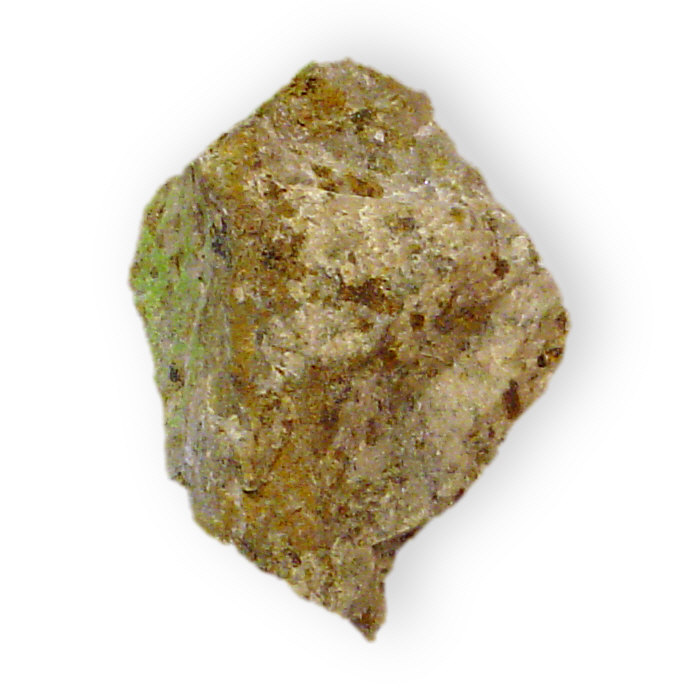
Arthurite is a mineral composed of divalent copper and iron ions in combination with trivalent arsenate, phosphate and sulfate ions with hydrogen and oxygen. Initially discovered by Sir Arthur Russell in 1954 at Hingston Down Consols mine in Calstock, Cornwall, England, arthurite is formed as a resultant mineral in the oxidation region of some copper deposits by the variation of enargite or arsenopyrite. The chemical formula of Arthurite is CuFe23+(AsO4,PO4,SO4)2(O,OH)2·4H2O.
Arthurite is named after Arthur W. G. Kingsbury (1906–1968), a British mineralogist, and Sir Arthur Russell (1878–1964), a collector of minerals.
Arthurite was determined to be a uniquely new mineral by R.J. Davis and M.H. Hey in 1964 after its initial discovery. A second specimen was confirmed by A.H Clark and R.H. Sillitoe (1969) from Potrerillos, Atacama Province, Chile in 1969. Subsequently, several other arthurite-like minerals have been discovered. There are variations in which the copper (Cu) ions are replaced with cobalt (Co), in the case of cobaltarthurite, manganese (Mn) replaces Cu in the case of earlshannonite, iron (Fe) in the case of bendadaite and whitmoreite and zinc (Zn) in the case of ojuelaite. Arthurite is the copper-dominant end-member of the arthurite group.
The theoretical chemical formula of Arthurite was originally determined to be Cu2Fe4(AsO4)3(O,OH)7•6H2O. The breakdown of the composition of arthurite in weight percent oxides is given in Table 1.
Table 1. Chemical composition of Arthurite in weight percent oxides
Arthurite crystallizes from an aqueous solution with whichever applicable anions are accessible in the solution. These available anions may be carbonate, arsenate, sulphate and phosphate. Some other minerals belonging to the arthurite group are cobaltarthurite, Co2+Fe3+2(AsO4)2(OH)2•4H2O, whitmoreite Fe2+Fe3+2(PO4)2(OH)2·4H2O, ojuelaite, ZnFe2(AsO4)2(OH)2·4H2O, earlshannonite, (Mn,Fe)Fe2(PO4)2(OH)2·4H2O and bendadaite, Fe2+Fe3+2(AsO4)2(OH)2·4H2O. The optimal compositions of the members of the arthurite group can be represented by A2+Fe3+2(XO4)2(OH)2·4H2O and are summarized in Table 2.
Table 2. Compositional breakdown of the arthurite group members
Arthurite is of the monoclinic space group: P21/c with a = 10.189(2)Å, b = 9.649(2)Å, c = 5.598(1)Å and β = 92.16(2). The coordination polyhedron of the Cu2+ ion is clearly tetragonally lengthened as compared to whitmoreite with the Phosphorus (P) and Arsenic (As). Figure 1 shows the crystal structure of arthurite.
Hub AI
Arthurite AI simulator
(@Arthurite_simulator)
Arthurite
Arthurite is a mineral composed of divalent copper and iron ions in combination with trivalent arsenate, phosphate and sulfate ions with hydrogen and oxygen. Initially discovered by Sir Arthur Russell in 1954 at Hingston Down Consols mine in Calstock, Cornwall, England, arthurite is formed as a resultant mineral in the oxidation region of some copper deposits by the variation of enargite or arsenopyrite. The chemical formula of Arthurite is CuFe23+(AsO4,PO4,SO4)2(O,OH)2·4H2O.
Arthurite is named after Arthur W. G. Kingsbury (1906–1968), a British mineralogist, and Sir Arthur Russell (1878–1964), a collector of minerals.
Arthurite was determined to be a uniquely new mineral by R.J. Davis and M.H. Hey in 1964 after its initial discovery. A second specimen was confirmed by A.H Clark and R.H. Sillitoe (1969) from Potrerillos, Atacama Province, Chile in 1969. Subsequently, several other arthurite-like minerals have been discovered. There are variations in which the copper (Cu) ions are replaced with cobalt (Co), in the case of cobaltarthurite, manganese (Mn) replaces Cu in the case of earlshannonite, iron (Fe) in the case of bendadaite and whitmoreite and zinc (Zn) in the case of ojuelaite. Arthurite is the copper-dominant end-member of the arthurite group.
The theoretical chemical formula of Arthurite was originally determined to be Cu2Fe4(AsO4)3(O,OH)7•6H2O. The breakdown of the composition of arthurite in weight percent oxides is given in Table 1.
Table 1. Chemical composition of Arthurite in weight percent oxides
Arthurite crystallizes from an aqueous solution with whichever applicable anions are accessible in the solution. These available anions may be carbonate, arsenate, sulphate and phosphate. Some other minerals belonging to the arthurite group are cobaltarthurite, Co2+Fe3+2(AsO4)2(OH)2•4H2O, whitmoreite Fe2+Fe3+2(PO4)2(OH)2·4H2O, ojuelaite, ZnFe2(AsO4)2(OH)2·4H2O, earlshannonite, (Mn,Fe)Fe2(PO4)2(OH)2·4H2O and bendadaite, Fe2+Fe3+2(AsO4)2(OH)2·4H2O. The optimal compositions of the members of the arthurite group can be represented by A2+Fe3+2(XO4)2(OH)2·4H2O and are summarized in Table 2.
Table 2. Compositional breakdown of the arthurite group members
Arthurite is of the monoclinic space group: P21/c with a = 10.189(2)Å, b = 9.649(2)Å, c = 5.598(1)Å and β = 92.16(2). The coordination polyhedron of the Cu2+ ion is clearly tetragonally lengthened as compared to whitmoreite with the Phosphorus (P) and Arsenic (As). Figure 1 shows the crystal structure of arthurite.