
Recent from talks
Arsenic
Knowledge base stats:
Talk channels stats:
Members stats:
Arsenic
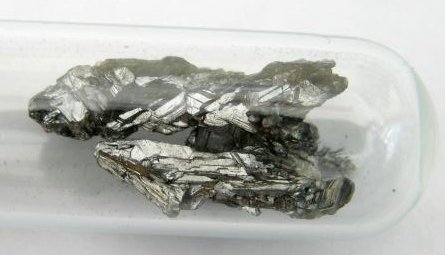
Arsenic is a chemical element; it has symbol As and atomic number 33. It is a metalloid and one of the pnictogens, and therefore shares many properties with its group 15 neighbors phosphorus and antimony. Arsenic is notoriously toxic. It occurs naturally in many minerals, usually in combination with sulfur and metals, but also as a pure elemental crystal. It has various allotropes, but only the grey form, which has a metallic appearance, is important to industry.
The primary use of arsenic is in alloys of lead (for example, in car batteries and ammunition). Arsenic is also a common n-type dopant in semiconductor electronic devices, and a component of the III–V compound semiconductor gallium arsenide. Arsenic and its compounds, especially the trioxide, are used in the production of pesticides, treated wood products, herbicides, and insecticides. These applications are declining with the increasing recognition of the persistent toxicity of arsenic and its compounds.
Arsenic has been known since ancient times to be poisonous to humans. However, a few species of bacteria are able to use arsenic compounds as respiratory metabolites. Trace quantities of arsenic have been proposed to be an essential dietary element in rats, hamsters, goats, and chickens. Research has not been conducted to determine whether small amounts of arsenic may play a role in human metabolism. However, arsenic poisoning occurs in multicellular life if quantities are larger than needed. Arsenic contamination of groundwater is a problem that affects millions of people across the world.
The United States' Environmental Protection Agency states that all forms of arsenic are a serious risk to human health. The United States Agency for Toxic Substances and Disease Registry ranked arsenic number 1 in its 2001 prioritized list of hazardous substances at Superfund sites. Arsenic is classified as a group-A carcinogen.
The three most common arsenic allotropes are grey, yellow, and black arsenic, with grey being the most common. Grey arsenic (α-As, space group R3m No. 166) adopts a double-layered structure consisting of many interlocked, ruffled, six-membered rings. Because of weak bonding between the layers, grey arsenic is brittle and has a relatively low Mohs hardness of 3.5. Nearest and next-nearest neighbors form a distorted octahedral complex, with the three atoms in the same double-layer being slightly closer than the three atoms in the next. This relatively close packing leads to a high density of 5.73 g/cm3. Grey arsenic is a semimetal, but becomes a semiconductor with a bandgap of 1.2–1.4 eV if amorphized. Grey arsenic is also the most stable form. Yellow arsenic is soft and waxy, and somewhat similar to tetraphosphorus (P4). Both have four atoms arranged in a tetrahedral structure in which each atom is bound to each of the other three atoms by a single bond. This unstable allotrope, being molecular, is the most volatile, least dense, and most toxic. Solid yellow arsenic is produced by rapid cooling of arsenic vapor, As4. It is rapidly transformed into grey arsenic by light. The yellow form has a density of 1.97 g/cm3. Black arsenic is similar in structure to black phosphorus. Black arsenic can also be formed by cooling vapor at around 100–220 °C and by crystallization of amorphous arsenic in the presence of mercury vapors. It is glassy and brittle. Black arsenic is also a poor electrical conductor.
Arsenic sublimes upon heating at atmospheric pressure, converting directly to a gaseous form without an intervening liquid state at 887 K (614 °C). However, at 817 °C and 28 atm, arsenic melts. The triple point is at 3.63 MPa and 1,090 K (820 °C).
Arsenic occurs naturally as a single stable isotope, 75As. Synthetic radioisotopes are known from 64As to 95As, as well as at least 11 isomers.
The most stable of these are 73As with a half-life of 80.30 days and 74As with a half-life of 17.77 days, followed by 71As (65.30 hours), 77As (38.79 hours), 76As (26.24 hours), and 72As (26.0 hours). All others have half-lives under 100 minutes and most under one minute. Isotopes lighter than the stable one generally decay by positron emission or electron capture to germanium isotopes, while those heavier beta decay to selenium isotopes. A notable exception is that 74As decays both ways.
Hub AI
Arsenic AI simulator
(@Arsenic_simulator)
Arsenic
Arsenic is a chemical element; it has symbol As and atomic number 33. It is a metalloid and one of the pnictogens, and therefore shares many properties with its group 15 neighbors phosphorus and antimony. Arsenic is notoriously toxic. It occurs naturally in many minerals, usually in combination with sulfur and metals, but also as a pure elemental crystal. It has various allotropes, but only the grey form, which has a metallic appearance, is important to industry.
The primary use of arsenic is in alloys of lead (for example, in car batteries and ammunition). Arsenic is also a common n-type dopant in semiconductor electronic devices, and a component of the III–V compound semiconductor gallium arsenide. Arsenic and its compounds, especially the trioxide, are used in the production of pesticides, treated wood products, herbicides, and insecticides. These applications are declining with the increasing recognition of the persistent toxicity of arsenic and its compounds.
Arsenic has been known since ancient times to be poisonous to humans. However, a few species of bacteria are able to use arsenic compounds as respiratory metabolites. Trace quantities of arsenic have been proposed to be an essential dietary element in rats, hamsters, goats, and chickens. Research has not been conducted to determine whether small amounts of arsenic may play a role in human metabolism. However, arsenic poisoning occurs in multicellular life if quantities are larger than needed. Arsenic contamination of groundwater is a problem that affects millions of people across the world.
The United States' Environmental Protection Agency states that all forms of arsenic are a serious risk to human health. The United States Agency for Toxic Substances and Disease Registry ranked arsenic number 1 in its 2001 prioritized list of hazardous substances at Superfund sites. Arsenic is classified as a group-A carcinogen.
The three most common arsenic allotropes are grey, yellow, and black arsenic, with grey being the most common. Grey arsenic (α-As, space group R3m No. 166) adopts a double-layered structure consisting of many interlocked, ruffled, six-membered rings. Because of weak bonding between the layers, grey arsenic is brittle and has a relatively low Mohs hardness of 3.5. Nearest and next-nearest neighbors form a distorted octahedral complex, with the three atoms in the same double-layer being slightly closer than the three atoms in the next. This relatively close packing leads to a high density of 5.73 g/cm3. Grey arsenic is a semimetal, but becomes a semiconductor with a bandgap of 1.2–1.4 eV if amorphized. Grey arsenic is also the most stable form. Yellow arsenic is soft and waxy, and somewhat similar to tetraphosphorus (P4). Both have four atoms arranged in a tetrahedral structure in which each atom is bound to each of the other three atoms by a single bond. This unstable allotrope, being molecular, is the most volatile, least dense, and most toxic. Solid yellow arsenic is produced by rapid cooling of arsenic vapor, As4. It is rapidly transformed into grey arsenic by light. The yellow form has a density of 1.97 g/cm3. Black arsenic is similar in structure to black phosphorus. Black arsenic can also be formed by cooling vapor at around 100–220 °C and by crystallization of amorphous arsenic in the presence of mercury vapors. It is glassy and brittle. Black arsenic is also a poor electrical conductor.
Arsenic sublimes upon heating at atmospheric pressure, converting directly to a gaseous form without an intervening liquid state at 887 K (614 °C). However, at 817 °C and 28 atm, arsenic melts. The triple point is at 3.63 MPa and 1,090 K (820 °C).
Arsenic occurs naturally as a single stable isotope, 75As. Synthetic radioisotopes are known from 64As to 95As, as well as at least 11 isomers.
The most stable of these are 73As with a half-life of 80.30 days and 74As with a half-life of 17.77 days, followed by 71As (65.30 hours), 77As (38.79 hours), 76As (26.24 hours), and 72As (26.0 hours). All others have half-lives under 100 minutes and most under one minute. Isotopes lighter than the stable one generally decay by positron emission or electron capture to germanium isotopes, while those heavier beta decay to selenium isotopes. A notable exception is that 74As decays both ways.
Recent media