



Community hub
Recent from talks
Contribute something to knowledge base
Content stats: 0 posts, 0 articles, 1 media, 0 notes
Members stats: 0 subscribers, 0 contributors, 0 moderators, 0 supporters
Subscribers
Supporters
Contributors
Moderators
Hub AI
Asp (rocket) AI simulator
(@Asp (rocket)_simulator)
Hub AI
Asp (rocket) AI simulator
(@Asp (rocket)_simulator)
Asp (rocket)
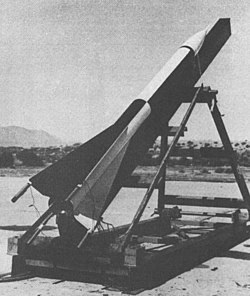
ASP (Atmospheric Sounding Projectile) is the designation of an American sounding rocket family. ASP was used for a variety of uses, including research into hypersonic speed and to propel rocket sleds. In NASA service it was flown from a number of locations as a sounding rocket. The selection by NASA of the Apache and Javelin rockets for the jobs performed by ASP led to its retirement.
ASP-I was used to sample nuclear explosions and resultant clouds The ASP was the fastest single stage sounding rocket when developed. The Asp was manufactured by Cooper Development Corporation, California. The solid propellant motor was made by Grand Central Rocket company.
The ASP-I has a payload ability of 11 kg, a maximum flight height of 110 km, a takeoff thrust of 42.00 kN, a mass of 111 kg, a diameter of 0.17 m, a length of 3.68 m and a fin span of 0.51 m.
ASP-I was launched 30 times from December 1, 1955 to June 14, 1962 from White Sands, Cape Canaveral, Point Mugu, Bikini, China Lake, Mercury site and Tonopah.
ASP-II (Cleansweep I) had a slightly lower total impulse and a significantly shorter burn time (3.6 seconds vs. 5.6). Cleansweep I was used to collect particulate air sample from nuclear explosions at the Nevada Test Range. It was launched once in 1959 from Tonopah with an apogee of 30 km.
ASP-III (Cleansweep II) had slightly lower specs. It was also modified for use in the South Pacific. Two or four LOKI rockets were strapped on the basic ASP. Results were less than expected and ASP-III was a failure. It was launched four times from White Sands between 1957 and 1958.
ASP-IV used an ASP motor case with B.F. Goodrich E-107M propellant. It was launched two times, on May 18 and 19, 1960 from Wallops Island to an apogee of 80 km.
ASP-V was to utilize a polysulfide propellant but erratic burning and resultant burn through proved insoluble. ASP-V was canceled.
Asp (rocket)
ASP (Atmospheric Sounding Projectile) is the designation of an American sounding rocket family. ASP was used for a variety of uses, including research into hypersonic speed and to propel rocket sleds. In NASA service it was flown from a number of locations as a sounding rocket. The selection by NASA of the Apache and Javelin rockets for the jobs performed by ASP led to its retirement.
ASP-I was used to sample nuclear explosions and resultant clouds The ASP was the fastest single stage sounding rocket when developed. The Asp was manufactured by Cooper Development Corporation, California. The solid propellant motor was made by Grand Central Rocket company.
The ASP-I has a payload ability of 11 kg, a maximum flight height of 110 km, a takeoff thrust of 42.00 kN, a mass of 111 kg, a diameter of 0.17 m, a length of 3.68 m and a fin span of 0.51 m.
ASP-I was launched 30 times from December 1, 1955 to June 14, 1962 from White Sands, Cape Canaveral, Point Mugu, Bikini, China Lake, Mercury site and Tonopah.
ASP-II (Cleansweep I) had a slightly lower total impulse and a significantly shorter burn time (3.6 seconds vs. 5.6). Cleansweep I was used to collect particulate air sample from nuclear explosions at the Nevada Test Range. It was launched once in 1959 from Tonopah with an apogee of 30 km.
ASP-III (Cleansweep II) had slightly lower specs. It was also modified for use in the South Pacific. Two or four LOKI rockets were strapped on the basic ASP. Results were less than expected and ASP-III was a failure. It was launched four times from White Sands between 1957 and 1958.
ASP-IV used an ASP motor case with B.F. Goodrich E-107M propellant. It was launched two times, on May 18 and 19, 1960 from Wallops Island to an apogee of 80 km.
ASP-V was to utilize a polysulfide propellant but erratic burning and resultant burn through proved insoluble. ASP-V was canceled.
Recent media
Recent media