Recent from talks
Contribute something
Nothing was collected or created yet.
Sounding rocket
View on Wikipedia

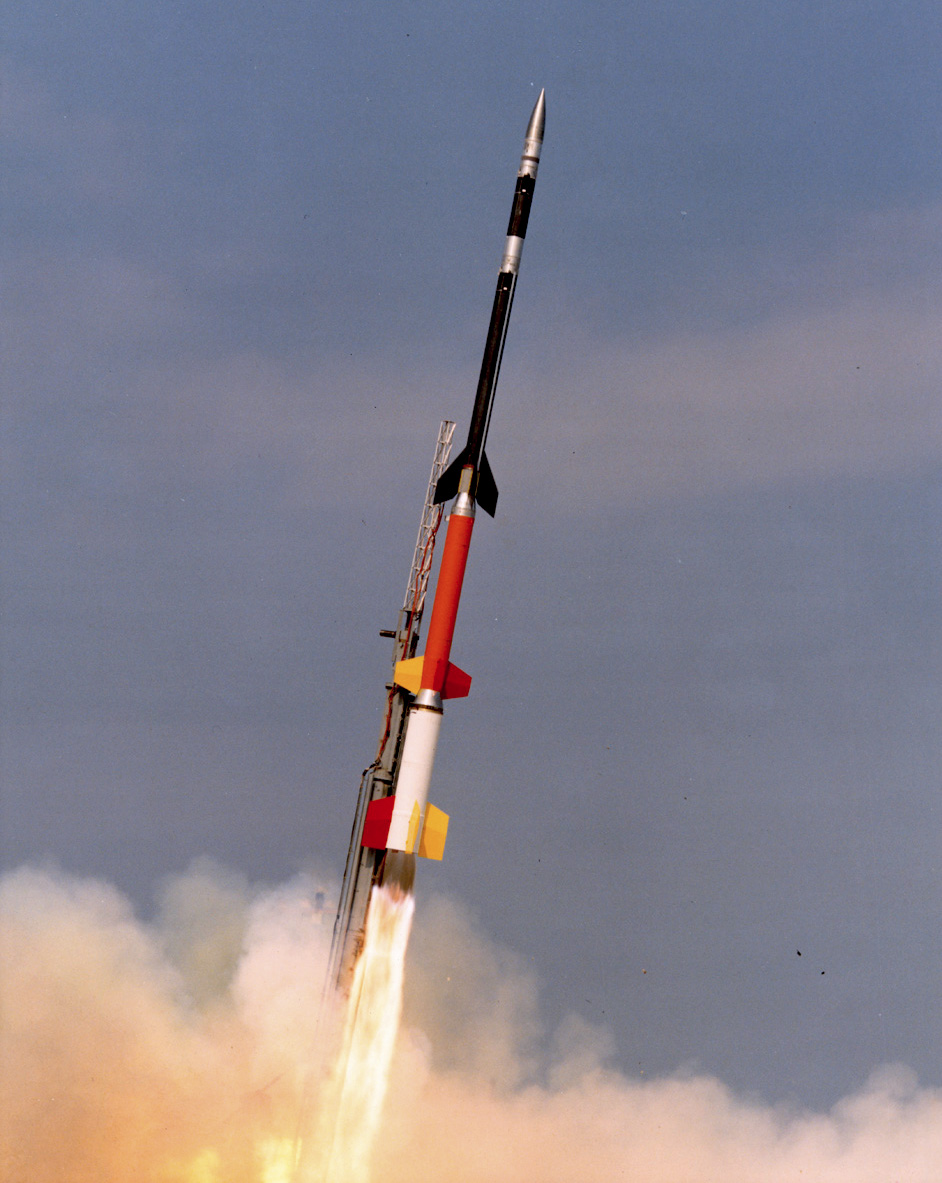
A sounding rocket or rocketsonde, sometimes called a research rocket or a suborbital rocket, is an instrument-carrying rocket designed to take measurements and perform scientific experiments during its sub-orbital flight. The rockets are often used to launch instruments from 48 to 145 km (30 to 90 mi)[1] above the surface of the Earth, the altitude generally between weather balloons and satellites; the maximum altitude for balloons is about 40 km (25 mi) and the minimum for satellites is approximately 121 km (75 mi).[2]
Due to their suborbital flight profile, sounding rockets are often much simpler than their counterparts built for orbital flight.[2] Certain sounding rockets have an apogee between 1,000 and 1,500 km (620 and 930 mi), such as the Black Brant X and XII, which is the maximum apogee of their class. For certain purposes, sounding rockets may be flown to altitudes as high as 3,000 kilometers (1,900 miles) to allow observing times of around 40 minutes to provide geophysical observations of the magnetosphere, ionosphere, thermosphere, and mesosphere.[3]
Etymology
[edit]The origin of the term comes from nautical vocabulary to sound, which is to throw a weighted line from a ship into the water to measure the water's depth. The term itself has its etymological roots in the Romance languages word for probe, of which there are nouns like sonda and sonde and verbs like sondar which means "to do a survey or a poll". Sounding in the rocket context is equivalent to "taking a measurement".[4]
Design
[edit]
The basic elements of a modern sounding rocket are a solid-fuel rocket motor and a science payload.[4] In certain sounding rockets the payload may even be nothing more than a smoke trail as in the Nike Smoke which is used to determine wind directions and strengths more accurately than may be determined by weather balloons. A sounding rocket such as the Nike-Apache may deposit sodium clouds to observe very high altitude winds. Larger, higher altitude rockets have multiple stages to increase altitude and payload capability.
A flight of a sounding rocket has several parts. During the boost phase, the rocket burns its fuel to accelerate upwards, nearly vertically. Once the motor burns all of its fuel, the rocket may fall away to allow the payload to coast along a freefall trajectory. The path of the rocket in nearly parabolic, being influenced only by gravity and small wind resistance at high altitudes. The speed decreases near the highest point of the flight, the apogee, allowing the payload to nearly hover around this point for a few minutes.[2] Lastly, the rocket descends, sometimes deploying a drag source such as a small balloon or a parachute.[4] The average flight time is less than 30 minutes; usually between 5 and 20 minutes.[2]
Sounding rockets have used balloons, airplanes, and artillery as first stages. Project Farside[5][6] used a rockoon[7] composed of a 106,188-cubic-metre (3,750,000 cu ft) balloon, lifting a four-stage rocket. Sparoair was launched in the air from Navy F4D and F-4 fighters. Sounding rockets can also be launched from artillery guns, such as Project HARP's 5, 7, and 15 in (130, 180, and 380 mm) guns, sometimes having additional rocket stages.[8]
Development history
[edit]This article may require copy editing for grammar, style, cohesion, tone, or spelling. (October 2024) |
The earliest sounding rockets were liquid propellant rockets such as the WAC Corporal, Aerobee, and Viking. The German V-2 served both the US and the USSR as sounding rockets during the immediate post-World War II period. During the 1950s and later, inexpensive surplus military boosters such as those used by the Nike, Talos, Terrier, and Sparrow came to be used. Since the 1960s, rockets specifically designed for the purpose, such as the Black Brant series have dominated sounding rockets, though often having additional stages, many from military surplus.
The earliest attempts at developing sounding rockets were in the Soviet Union. While all of the early rocket developers were concerned largely with developing the ability to launch rockets, some had the objective of investigating the stratosphere and beyond. The first All-Union Conference on the Study of Stratosphere was held in Leningrad (now St. Petersburg) in 1934.[9] While the conference primarily dealt with balloon Radiosondes, there was a small group of rocket developers who sought to develop "recording rockets" to explore the stratosphere and beyond.[10] Sergey Korolev, who later became the leading figure of the Soviet space program, gave a presentation in which he called for "the development of scientific instruments for high-altitude rockets to study the upper atmosphere."[11]
V. V. Razumov, of the Leningrad Group for the Study of Jet Propulsion, had a specific interest in sounding rocket design. As did A. I. Polyarny, who worked in a special group within the Society for Assistance to the Defense, Aviation and Chemical Construction of the USSR in Moscow, and designed the R-06, which eventually flew, but not in the meteorological role.[10]
The early Soviet efforts to develop a sounding rocket ultimately failed before WWII.[10] P. I. Ivanov built a three-stage rocket which flew in March 1946. At the end of summer 1946, development ended because it lacked sufficient thrust to lift a research payload.[10]
The first successful sounding rocket was created at the California Institute of Technology, where before World War II there was a group of rocket enthusiasts led by Frank Malina, under the aegis of Theodore von Kármán, known amidst the people of the CIT as the "Suicide Squad." Their immediate goal was to explore the upper atmosphere, which required developing the means of lofting instruments to high altitude and recovering the results. After the start of WWII, the CIT rocketry enthusiasts found themselves involved in a number of defence programs, one of which was intended to produce a bombardment-guided missile, the Corporal. Eventually known as the MGM-5 Corporal it became the first guided missile deployed by the US Army.
During WWII, the Signal Corps created a requirement for a sounding rocket to carry 25 pounds (11 kg) of instruments to 100,000 feet (30 km) or higher.[12] To meet that goal Malina proposed a small Liquid-propellant rocket to provide the GALCIT team necessary experience to aid in developing the Corporal missile.[13][14] Malina with Tsien Hsue-shen (Qian Xuesen in Pinyin transliteration), wrote "Flight analysis of a Sounding Rocket with Special Reference to Propulsion by Successive Impulses." As the Signal Corps rocket was being developed for the Corporal project, and lacked any guidance mechanism, it was Without Attitude Control. Thus it was named the WAC Corporal. The WAC Corporal served as the foundation of Sounding Rocketry in the US. WAC Corporal was developed in two versions, the second of which was much improved. After the war, the WAC Corporal was in competition for sounding mission funding with the much larger captured V-2 rocket being tested by the US Army. WAC Corporal was overshadowed at its job of cost-effectively lifting pounds of experiments to altitude, thus it effectively became obsolescent. WAC Corporals were later modified to become the upper stage of the first two-stage rocket the RTV-G-4 Bumper.
Captured V-2s dominated American sounding rockets and other rocketry developments during the late 1940s.[15] To meet the need for replacement a new sounding rocket was developed by the Aerojet Corporation to meet a requirement of the Applied Physics Laboratory and the Naval Research Laboratory. Over 1,000 Aerobees of various versions for varied customers were flow between 1947 and 1985.[16]: 57 [17] One engine produced for the Aerobee ultimately powered the second stage of the Vanguard (rocket), the first designed for the purpose Satellite Launch Vehicle, Vanguard. The AJ10 engine used by many Aerobees eventually evolved into the AJ10-190 which formed the Orbital Maneuvering System of the Space Shuttle.[18]
The Viking (rocket) was intended from the start by the Navy not only to be a sounding rocket capable of replacing, even exceeding the V-2, but also to advance guided missile technology.[19] The Viking was controlled by a multi-axis guidance system with gimbled Reaction Motors XLR10-RM-2 engine. The Viking was developed through two major versions. After the United States announced it intended to launch a satellite in the International Geophysical Year (1957–1958) the Viking was chosen as the first stage of the Vanguard Satellite Launch Vehicle. The last two Vikings were fired as Vanguard Test Vehicle 1 and 2.[20]
During the post-WWII era, the USSR also pursued V-2 base sounding rockets. The last two R-1As were flown in 1949 as sounding rockets. They were followed between July 1951 and June 1956 by 4 R-1B, 2 R-1V, 3 R-1D and 5 R-1Es, and 1 R-1E (A-1).[21] The improved V-2 descendant the R-2A could reach 120 miles and were flown between April 1957 and May 1962.[22] Fifteen R-5Vs were flown from June 1965 to October 1983. Two R-5 VAOs were flown in September 1964 and October 1965.[23] The first solid-fueled Soviet sounding rocket was the M-100.[24] Some 6640 M-100 sounding rockets were flown from 1957 to 1990.
Other early users of sounding rockets were Britain, France, and Japan.
Great Britain developed the Skylark (rocket) series and the later Skua for the International Geophysical Year.[16]
France had begun the design of a Super V-2 but that program had been abandoned in the late 1940s due to the inability of France to manufacture all components necessary. Though development of the Veronique (rocket) began in 1949, it was not until 1952 that the first full-scale Veronique was launched. Veronique variants were flown until 1974.[16][25] The Monica (rocket) family, an all solid-fueled which was pursued in a number of versions and later replaced by the ONERA. series of rockets.[16]
Japan was another early user with the Kappa (rocket). Japan also pursued Rockoons.[16]
The People's Republic of China was the last nation to launch a new liquid-fueled sounding rocket, the T-7.[26] It was first fired from a very primitive launch site, where the "command center" and borrowed power generator were in a grass hut separated from the launcher by a small river. There was no communications equipment- not even a telephone between the command post and the rocket launcher. The T-7 led to the T-7M, T-7A, T-7A-S, T-7A-S2 and T-7/GF-01A. The T-7/ GF-01A was used in 1969 to launch the FSW satellite technology development missions. Thus the I-7 led to the first Chinese satellite, the Dong Fang Hong 1 (The East is Red 1), launched by a DF-1. Vital to the development of Chinese rocketry and the Dong Feng-1 was Qian Xuesen (Tsien Hsue-shen in Wade Guiles transliteration) who with Theodore von Kármán and the California Institute of Technology "Suicide Squad" created the first successful sounding rocket the WAC Corporal.
By the early 1960s, the sounding rocket was considered established technology.
Advantages
[edit]Sounding rockets are advantageous for some research because of their low cost (often using military surplus rocket motors[4]),[2] relatively short lead time (sometimes less than six months)[4] and their ability to conduct research in areas inaccessible to either balloons or satellites. They are also used as test beds for equipment that will be used in more expensive and risky orbital spaceflight missions.[2] The smaller size of a sounding rocket also makes launching from temporary sites possible, allowing field studies at remote locations, and even in the middle of the ocean, if fired from a ship.[27]
Sounding rockets have been used for the examination of atmospheric nuclear tests by revealing the passage of the shock wave through the atmosphere.[28] [29][circular reference] In more recent times, sounding rockets have been used for other nuclear weapons research.[30]
Applications
[edit]Meteorology
[edit]
Weather observations, up to an altitude of 75 km, are done with rocketsondes, a kind of sounding rocket for atmospheric observations that consists of a rocket and radiosonde. The sonde records data on temperature, moisture, wind speed and direction, wind shear, atmospheric pressure, and air density during the flight. Position data (altitude and latitude/longitude) may also be recorded.
Common meteorological rockets are the Loki and Super Loki, typically 3.7 m tall and powered by a 10 cm diameter solid fuel rocket motor. The rocket motor separates at an altitude of 1500 m and the rest of the rocketsonde coasts to apogee (highest point). This can be set to an altitude of 20 km to 113 km.
Research
[edit]Sounding rockets are commonly used for:
- Research in aeronomy, the study of the upper atmosphere, which requires this tool for in situ measurements in the upper atmosphere.
- Ultraviolet and X-ray astronomy, which require being above the bulk of the Earth's atmosphere.
- Microgravity research which benefits from a few minutes of weightlessness on rockets launched to altitudes of a few hundred kilometers.
- Remote sensing of Earth resources uses sounding rockets to get an essentially instant synoptic view of the geographical area under observation.[31]
Dual use
[edit]Due to the high military relevance of ballistic missile technology, there has always been a close relationship between sounding rockets and military missiles. It is a typical dual-use technology, which can be used for both civil and military purposes.[32] During the Cold War, the Federal Republic of Germany cooperated on this topic with countries that had not signed the Non-Proliferation Treaty on Nuclear Weapons at that time, such as Brazil, Argentina and India. In the course of investigations by the German peace movement, this cooperation was revealed by a group of physicists in 1983.[33] The international discussion that was thus set in motion led to the development of the Missile Technology Control Regime (MTCR) at the level of G7 states. Since then, lists of technological equipment whose export is subject to strict controls have been drawn up within the MTCR framework.
Operators and programs
[edit]- Andøya Space Center in Norway operates two sounding rocket launch sites, one at Andøya and one at Svalbard. Has launched sounding rockets since 1962.
- Poker Flat Research Range is owned by the University of Alaska Fairbanks.
- The British Skylark sounding rocket programme began in 1955 and was used for 441 launches from 1957 to 2005. Skylark 12, from 1976, could lift 200 kilograms (440 lb) to 575 kilometres (357 mi) altitude.[34]
- The British also developed the Falstaff sounding rocket as a part of the Chevaline program. There were eight launches between 1969 and 1979 from the Woomera Test Range, Australia.
- Cedar, a program of the Haigazian College Rocket Society, Ceadar 8 crossed the Karman line[35]
- ISRO's VSSC developed the Rohini sounding rockets series starting in 1967 that reached altitudes of 500 km[36][37]
- Delft Aerospace Rocket Engineering from the Delft University of Technology operates the Stratos sounding rocket program, which reached 21.5 km in 2015.
- Exela Space Industries is developing the Aims-1 sounding rocket that will launch to 100 km in 2035.
- Evolution Space operates the Gold Chain Cowboy sounding rocket with launch to 124.5 km on April 22, 2023.[38]
- The Australian Space Research Institute (ASRI) operates a Small Sounding Rocket Program (SSRP) for launching payloads (mostly educational) to altitudes of about 7 km.
- Indian Institute of Space Science and Technology (IIST) launched a Sounding Rocket (Vyom) in May, 2012, which reached an altitude of 15 km. Vyom Mk-II is in its conceptual design stage with an objective to reach 70 km altitude with 20 kg payload capacity.[39]
- The University of Queensland operates Terrier-Orion sounding rockets (capable of reaching altitudes in excess of 300 km) as part of their HyShot hypersonics research.
- Iranian Space Agency operated its first sounding rocket in February 2007.
- UP Aerospace operates the SpaceLoft XL sounding rocket that can reach altitudes of 225 km.
- TEXUS and MiniTEXUS, German rocket programmes at Esrange for DLR and ESA microgravity research programmes.
- Astrium operates missions with sounding rockets on a commercial basis, as prime contractor to ESA or the German Aerospace Centre (DLR).
- MASER, Swedish rocket programme at Esrange for ESA microgravity research programmes.
- MAXUS, German-Swedish rocket programme at Esrange for ESA microgravity research programmes.
- Pakistan's SUPARCO launched Rehbar series of sounding rockets, based on American Nike-Cajun series of rockets, from 1962 to 1971.
- REXUS, German-Swedish rocket programme at Esrange for DLR and ESA student experiment programmes.
- The NASA Sounding Rocket Program.
- NASA routinely flies the Terrier Mk 70 boosted Improved Orion, lifting 270–450-kg (600–1,000-pound) payloads into the exoatmospheric region between 97 and 201 km (60 and 125 mi).[40]
- The JAXA operates the sounding rockets S-Series: S-310 / S-520 / SS-520.
- United States/New Zealand company Rocket Lab developed the highly adaptable Ātea series of sounding rockets to carry 5–70 kg payloads to altitudes of 250 km or greater, launched once on 30 November 2009.
- The Meteor rockets were built in Poland between 1963 and 1974.
- The Kartika I rocket was built and launched in Indonesia by LAPAN on 1964, becoming the fourth sounding rocket in Asia, after those from Japan, China and Pakistan.
- The Soviet Union developed an extensive program using rockets such as the M-100, the most used ever; its successor by its successor state, Russia, is the MR-20 and later the MR-30.
- Since 1965, Brazil has been developing and launching its Sonda series of sounding rockets, which has served as the foundation for its research and development efforts. Other rockets include the VSB-30, designed by the Institute of Aeronautics and Space (IAE), and the PESL rocket, created by the startup PION Labs.[41]
- The Paulet I rocket was built and launched in Peru by The National Commission for Aerospace Research and Development (CONIDA) on 2006, becoming the first sounding rocket of the country and the third rocket in South America, after those from Brazil and Argentina.
- The Experimental Sounding Rocket Association (ESRA) is a non-profit organization based in the United States which has operated the Intercollegiate Rocket Engineering Competition (IREC) since 2006.[42]
- The Latin American Space Challenge (LASC) is an international competition held in Brazil, focused on launching student-developed sounding rockets and experimental satellites. Since 2019, the event has attracted student-led teams from Latin American countries, as well as Turkey and Taiwan, to launch their projects.[43]
- ONERA in France launched a sounding rocket named Titus, developed for observation of the total solar eclipse in Argentina on November 12, 1966. Titus was a two-stage rocket with a length of 11.5 m, a launch weight of 3.4 tons, and a diameter of 56 cm. It reached a maximum height of 270 kilometers. It was launched twice in Las Palmas, Chaco during the eclipse, in collaboration with the Argentine space agency CNIE.[44]
- German Aerospace Center's Mobile Rocket Base (DLR MORABA) designs, builds and operates a variety of sounding rocket types and custom vehicles in support for national and international research programs.
- The Indian aerospace company Skyroot Aerospace launched Vikram S sounding rocket on 18 November 2022 and became the first private entity in India to achieve the mark.[45]
- The Agnibaan SOrTeD was launched by AgniKul Cosmos on 30 May 2024 from Sriharikota. The Indian company launched the world's first rocket with a single piece 3D printed rocket engine.[46]
- Interstellar Technologies is a Japanese company that is developing the experimental MOMO sounding rocket.
See also
[edit]- Aerobee
- Arcon (rocket)
- Astrobee
- Bellier (rocket)
- Black Brant (rocket)
- Boosted Dart
- Castor
- Castor-Lance
- Castor-Orbus
- Castor-Star
- Centaure (rocket)
- Delft Aerospace Rocket Engineering
- Dragon (rocket)
- Frank Malina
- High Power Rocketry
- Hopi Dart
- Iris (rocket)
- Kappa (rocket)
- Kookaburra (rocket)
- Loki (rocket)
- Mesquito
- M-100 (rocket)
- MMR06
- Model rocket
- Monica (rocket)
- MR-12
- MR-20
- Nike-Apache
- Petrel (rocket)
- Project HARP
- Nike Boster based sounding rockets
- R-1 (missile)
- R-2 (missile)
- R-5 Pobeda
- Raven (rocket)
- Rocket Lab
- Sonda
- Seliger Rocket
- Sigma (rocket)
- Skua Rocket
- Skylark (rocket)
- Sparoair
- Talos-Castor
- V-2 sounding rocket
- Veronique (rocket)
- Viking (rocket)
- VS-30 family
- WAC Corporal
References
[edit]- ^ nasa.gov NASA Sounding Rocket Program Handbook, June 2005, p. 1 (Archive link, December 2024)
- ^ a b c d e f "NASA Sounding Rocket Program Overview". NASA Sounding Rocket Program. NASA. 24 July 2006. Archived from the original on 27 November 2024. Retrieved 10 October 2006.
- ^ "High Altitude Sounding Rocket" (PDF). NASA Sounding Rocket Program. NASA. 29 September 2024. Archived from the original (PDF) on 27 November 2024. Retrieved 29 September 2024.
- ^ a b c d e Marconi, Elaine M. (12 April 2004). "What is a Sounding Rocket?". Research Aircraft. NASA. Archived from the original on 3 October 2019. Retrieved 10 October 2006.
- ^ "Farside". Astronautix. Mark Wade. Retrieved 21 September 2024.
- ^ Krebs, Gunter. "Farside". Gunter's Space Page. Gunter Krebs. Retrieved 22 September 2024.
- ^ "Rockoons: Rocket and Balloon Experiments". airandspace.si.edu. 2024-06-01. Retrieved 2025-05-21.
- ^ BRL Memorandum Report No. 1825
- ^ Duranty, Walter (1934-03-31). "RUSSIANS TO PLAN ALTITUDE FLIGHTS; First All-Union Conference on Stratosphere Opens Today in Leningrad. SCIENTISTS WILL ATTEND Practical Methods of Flying in Upper Reaches of the Air Will Be Discussed". The New York Times. ISSN 0362-4331. Retrieved 2025-05-26.
- ^ a b c d !NASA. "Essays on the History of Rocketry and Astronautics" (PDF). NASA. Retrieved 23 September 2024.
- ^ Siddiqi, Asif A. (2000). Challenge to Apollo: The Soviet Union and the Space Race, 1945-1974. NASA History Division, Office of Policy and Plans. ISBN 978-0-16-061305-0.
- ^ Bragg, James W. (1961). Development of the Corporal: The Embryo of the Army Missile Program (PDF). Vol. I. Alabama: Reports and Historical Office, Army Ballistic Missile Agency, Army Ordnance Missile Command, Redstone Arsenal. p. 42.
- ^ Malina, F. J. (1969). "The U.S. Army Air Corps Jet Propulsion Research Project GALCIT Project No. 1, 1939-1946: A Memoir". Essays on the History of Rocketry and Astronautics: Proceedings of the Third Symposia of the International Academy of Astronautics, Volume II (PDF). Washington D.C.: National Aeronautics and Space Administration Scientific and Technical Information Office. p. 153.
- ^ Frank. J Malina : Astronautical Pioneer Dedicated to International Cooperation and the Peaceful Uses of Outer Space. 57th International Astronautical Congress. 2006. doi:10.2514/6.IAC-06-H.L.4.01. p11
- ^ DeVorkin, David H. (1992). Science With A Vengeance. New York: Springer-Verlag. ISBN 0-387-94137-1.
- ^ a b c d e Newell, Homer E. Jr. (1959). Sounding Rockets. New York: McGraw-Hill.
- ^ Kennedy, Gregory P (2009). The Rockets and Missiles of White Sands Proving Ground 1945–1958. Atglen, PA: Schiffer Military History. p. 107. ISBN 978-0-7643-3251-7.
- ^ Sutton, George (2006). History of Liquid Propellant Rocket Engines. Reston Virginia: American Institute of Aeronautics and Astronautics. ISBN 1-56347-649-5.
- ^ Milton W. Rosen (1955). The Viking Rocket Story. New York: Harper & Brothers. OCLC 317524549.
- ^ Green, Constance; Lomask, Milton (1970). Vanguard - a History. Washington D.C.: NASA. NASA-SP-4202.
This article incorporates text from this source, which is in the public domain.
- ^ Wade, Mark. "R-1". Astronautix. Mark Wade. Retrieved 26 September 2024.
- ^ Wade, Mark. "R-2A". Astronautix. Mark Wade. Retrieved 26 September 2024.
- ^ Wade, Mark. "R-5V". Astronautix. Mark Wade. Retrieved 26 September 2024.
- ^ Wade, Mark. "M-100". Astronautix. Mark Wade. Retrieved 26 September 2024.
- ^ Wade, Mark. "Veronique". Astronautix. Mark Wade. Retrieved 26 September 2024.
- ^ Wade, Mark. "T-7". Astronautix. Mark Wade. Retrieved 28 September 2024.
- ^ "General Description of Sounding Rockets". Johns Hopkins University Sounding Rocket Program. Retrieved 10 October 2006.
- ^ "Rope Trick effect" (PDF). Wikipedia. 29 September 2024. Retrieved 29 September 2024.
- ^ "Rope Trick effect". Rapatronic Photography. Navada National Security Site. 29 September 2024. Retrieved 29 September 2024.
- ^ "Sandia delivers first DOE sounding rocket program since 1990s". Rapatronic Photography. Sandia National Labrtories. 29 September 2024. Retrieved 29 September 2024.
- ^ Payne, B.R.; Baird, J.L. (1976). "Remote Sensing of Earth Resources Sounding Rocket Capabilities". Canadian Journal of Remote Sensing. 2: 12–17. Bibcode:1976CaJRS...2...12P. doi:10.1080/07038992.1976.10854945.
- ^ DeVorkin, Science With A Vengeance, Springer-Verlag, New York, 1992, ISBN 0-387-94137-1
- ^ Campbell, D. (5 August 1983). "Germany helps Brazil to nuclear supremacy" (PDF). New Statesman.
- ^ Serra, Jean-Jacques. "Skylark sounding rockets". Rockets in Europe. Retrieved 2021-05-20.
- ^ Alhussayni, Ryme (23 October 2020). "From Cedars to the Stars". Lebanon Chronicles. Zenith Channels. Retrieved 22 September 2024.
- ^ The Hindu (2022-11-23). "ISRO's RH-200 sounding rocket records 200th consecutive successful flight". The Hindu. ISSN 0971-751X. Retrieved 2024-01-09.
- ^ "Sounding Rockets". www.isro.gov.in. Retrieved 2024-01-09.
- ^ Messier, Doug (2023-04-25). "Evolution Space Launches Rocket on Suborbital Flight From Mojave Desert". Parabolic Arc. Archived from the original on 2023-07-26. Retrieved 2023-07-26.
- ^ PTI. "IIST students' designed rocket launched". Deccan Herald. Retrieved 2024-01-09.
- ^ NASA Sounding Rocket Handbook
- ^ MundoGEO (2023-12-18). "PION Labs lança foguete a partir do Centro de Lançamento da Barreira do Inferno". MundoGEO (in Brazilian Portuguese). Retrieved 2025-04-07.
- ^ "ESRA". ESRA. Retrieved 2021-03-29.
- ^ Chiu, Adrian (2025-03-07). "Stepping Through the Door: Taiwan's Space Future in Motion (2)". Taiwan Insight. Retrieved 2025-04-07.
- ^ Wade, Mark. "Titus". Astronautix. Archived from the original on December 28, 2016. Retrieved 17 May 2020.
- ^ Madhok, Swati Gupta,Diksha (2022-11-18). "India's first private rocket Vikram-S is launched into space | CNN Business". CNN. Retrieved 2025-09-04.
{{cite web}}: CS1 maint: multiple names: authors list (link) - ^ "Agnikul launches World's First Rocket with Fully 3D Printed Engine". www.pib.gov.in. Archived from the original on 2024-06-05. Retrieved 2025-09-03.
External links
[edit]- 30 years of sounding rocket launches at Esrange in Kiruna, Sweden
- Amato, Ivan (2001). Pushing the Horizon. Seventy-Five Years of High Stakes Science and Technology at the Naval Research Laboratory. Fort Belvoir, Virginia: Defense Technical Information Center.
- Sounding rockets launched from Andøya Space Center in Norway
- Australian Space Research Institute Small Sounding Rocket Program Archived 2008-12-19 at the Wayback Machine
- Bollermann, Bruce (1970). A Study of 30Km to 200Km Meteorological Rocket Sounding Systems, Volume II. Literature and Data Review (PDF). George C. Marshall Space Flight Center, Alabama. Retrieved 2024-08-28.
- Hall, R. Cargiil (1969). Essays on the History of Rockerty and Astronautics: Proceedings of the Third Symposia of the International Academy of Astronautics, Volume II. Washington D.C.: National Aeronautics and Space Administration Scientific and Technical Information Office.
- Chertokt, Boris E. (2005-01-01). Rockets and People Volume I SP-2005-4110 (PDF). The NASA History Series. Washington D.C.l: National Aeronautics and Space Administration. Retrieved 2024-09-01.
- Chertokt, Boris E. (2006-06-01). Rockets and People Volume II Creating a Rocket Industry SP-2006-4110 (PDF). The NASA History Series. Washington D.C.: National Aeronautics and Space Administration. Retrieved 2024-09-01.
- Sounding rockets at EADS Astrium page
- Corliss, William R. (1971). NASA Sounding Rockets, 1958-1968. The NASA Historical Report Series. Washington D.C. Library of Congress Catalog Number = 70-169175: National Aeronautics and Space Administration. Retrieved 2024-08-24.
{{cite book}}: CS1 maint: location (link) - Cornell, Lloyd H. Jr, Editor, History of Rocketry and Astronautics AAS History Series, Number 15, American Astronautical Society, San Diego, California, 1993, INBN 0-87703-377-3
- DeLuca, Luigi T. (2017-05-21). GALCIT Projects: The Birth of US Rocketry. Retrieved 2024-08-24.
- DeVorkin, David H., Science With A Vengeance, Springer-Verlag, New York, 1992, ISBN 0-387-94137-1
- Dougherty, Kerrie (2006). Upper atmospheric research at Woomera: The Australian-built sounding rockets. Australia: Powerhouse Museum.
- Eckles, Jim (2013). Pocketful Of Rockets. Las Cruces, New Mexico: Fiddlebike Partnership. ISBN 9781492773504.
- Experimental Sounding Rocket Association (ESRA)*Fraser, L. W.; Siegler, E. H. (1948). To High Altitude Research Using The V-2 Rocket (PDF). Defense Technical Information Center. Retrieved 2024-08-28.
- Green, Constance; Lomask, Milton (1970). Vanguard - a History. Washington D.C.: NASA. NASA-SP-4202.
- German, Swedish and EADS-ST Programmes* ESA article on sounding rockets
- Kennedy, Gregory P. (2009). The Rockets and Missiles of White Sands Proving Grounds 1945-1958. Atglen, Pennsylvania: Schiffer Military History. ISBN 978-0-7643-3251-7.
- Morrow, Richard B.; Pines, Mitchell S. (2000). Small Sounding Rockets. Searingtown, New York: Small Rocket Press. ISBN 0-967-4106-0-6.
- Murphy, C. H.; Bull, G. V. (1967-02-01). BRL Memorandum Report No. 1825 (PDF). U.S. Army Material Command, Ballistic Research Laboratories, Aberdeen Proving Ground, Maryland. Defense Technical Information Center. Retrieved 2024-09-07.
- NASA Sounding Rocket Program
- NASA Sounding Rocket Operations Contract
- NASA Sounding Rockets, 1958–1968: A Historical Summary (NASA SP-4401, 1971)
- Newell, Homer E. Jr. Express to the Stars. New York: McGraw-Hill Book Company, Inc., 1961, Library of Congress Card Number 61-16734.
- Newell, Homer E. Jr. Sounding Rockets. New York: McGraw-Hill Book Company, Inc., 1959,Library of Congress Card Number 59-13884.
- Peraton, Inc (2023). NASA Sounding Rockets User Handbook (PDF). Greenbelt, Maryland: National Aeronautics and Space Administration Goddard Space Flight Center, NASA/TP-20230006855. Retrieved 2023-05-24.
- Rosen, Milton W., The Viking Rocket Story, Harper & Brothers, New York, Library of Congress Card Number 55–6592
- Seibertt, Günther (2006). The History of Sounding Rockets and Their Contribution to European Space Research. The Netherlands: ESA Publications Division. ISBN 92-9092-550-7.
- Smith Jr., Charles P., Pressly. Elanor C., 1958, Upper Atmosphere Research Report No. XXI Summary of Upper Atmosphere Research Firings, https://apps.dtic.mil/sti/tr/pdf/ADB957191.pdf, Naval Research Laboratory, Washington, D.C.*Sounding Rocket Division (1971). The United States Sounding Rocket Program. Greenbelt, Maryland: Godard Space Flight Center.
- White, L.D., 1952, Final Report, Project Hermes V-2 Missile Program, General Electric Company, Defense Products Group, Aeronauti and Ordnance Systems Division, Guided Missile Dept Schenectady, NY, Call Number 39088014776371, lccn96036508, oclc 1045303092l, https://archive.org/details/finalreportproje00whi
Sounding rocket
View on GrokipediaA sounding rocket is a suborbital launch vehicle that carries scientific instruments into the upper atmosphere or near-space environment along a parabolic trajectory, typically achieving apogees between 50 and 1,500 kilometers with mission durations of 5 to 20 minutes before re-entry.[1][2] These rockets differ from orbital vehicles by lacking the sustained velocity required for Earth orbit, instead enabling brief, cost-effective access for direct sampling of regions inaccessible to balloons or satellites.[1][3] Sounding rockets originated from early post-World War II developments in rocketry, with the U.S. WAC Corporal achieving the first successful American flight in 1945 by reaching 20 miles altitude with a 25-pound payload using liquid fuels.[4] They have since facilitated thousands of experiments in atmospheric physics, ionospheric studies, and microgravity research, providing empirical data that advanced understanding of space weather and matured technologies for subsequent orbital missions.[5][6] Multi-stage solid-fuel designs predominate today, supporting payloads from small darts to complex instruments launched by agencies like NASA and ESA.[7][8]
Definition and Terminology
Definition
A sounding rocket is an unmanned, suborbital launch vehicle designed to transport scientific instruments and experiments to altitudes between 50 and 1,500 kilometers above Earth's surface for durations of 5 to 20 minutes, enabling measurements of atmospheric, ionospheric, and space environmental phenomena before re-entry along a parabolic trajectory.[9][10][2] Unlike orbital rockets, sounding rockets do not achieve the velocity required for sustained Earth orbit, instead providing cost-effective, rapid-access platforms for short-term research missions that prioritize data collection over payload recovery in some cases.[9][10] These vehicles, often configured in single- to multi-stage designs, carry payloads weighing up to 450 kilograms, including sensors, cameras, and diagnostic tools to investigate topics such as solar radiation effects, plasma dynamics, and astrophysical events.[10][11] NASA operates 16 distinct sounding rocket types, ranging from the single-stage Orion to the four-stage Black Brant XII, supporting scientific, technical, and educational objectives with flight profiles that reach apogees tailored to specific experiment requirements.[9] The suborbital nature allows for frequent launches and lower costs compared to satellite missions, facilitating iterative testing and validation of technologies destined for orbital or deeper space applications.[9]Etymology
The term sounding rocket originates from the nautical verb "to sound," referring to the practice of measuring water depth by lowering a weighted line or plumb from a ship, a method dating back centuries for navigation and charting seabeds. This etymological root, from Middle English sounden via Old French sonder (itself from Old English sund meaning strait or swimming), evokes probing or exploring unknown depths to obtain empirical data. In rocketry, the analogy applies to vehicles that "sound" or vertically probe the upper atmosphere, collecting measurements of conditions like pressure, temperature, and composition before descending, without achieving orbital velocity.[12][13] The earliest known use of "sounding rocket" appears in 1947, in the American Journal of Physics, amid postwar development of suborbital research vehicles adapted from military missiles for scientific instrumentation.[14] This terminology distinguished atmospheric research probes from ballistic weapons or orbital launchers, emphasizing short-duration, data-gathering flights akin to oceanographic soundings. Alternative derivations, such as from Romance-language roots like sonda (probe) in Italian or Spanish, appear in some multilingual contexts but do not underpin the English term's primary nautical heritage.[15] The phrase underscores the rockets' role in empirical vertical profiling, predating satellite era capabilities for targeted, cost-effective upper-atmospheric sampling.[16]Historical Development
Origins in World War II and Immediate Postwar Period (1940s)
The German V-2 rocket program during World War II provided the technological foundation for postwar sounding rockets, as the Aggregat-4 (A-4), developed under Wernher von Braun's leadership from 1936 onward, became the first operational long-range liquid-propellant ballistic missile. Its inaugural successful vertical test flight occurred on October 3, 1942, from Peenemünde, reaching an altitude of approximately 84.5 kilometers, with production scaling to over 5,000 units by war's end for combat deployment starting September 8, 1944.[17][18] The V-2's design, featuring a 25-meter length, 12.5-tonne launch mass, and ethanol-liquid oxygen propulsion delivering 264 kN thrust, enabled suborbital trajectories that exceeded prior balloon capabilities, though initially optimized for weaponry rather than instrumentation.[18] Following Germany's surrender in May 1945, Allied forces captured approximately 300 V-2 missiles and key documentation, redirecting them toward upper-atmosphere research amid emerging Cold War priorities. In the United States, Operation Paperclip relocated over 100 German engineers, including von Braun, to Fort Bliss, Texas, where they supported assembly and testing; this effort saved an estimated $750 million in independent rocketry development costs.[19][20] The inaugural U.S. V-2 launch occurred on April 16, 1946, from White Sands Proving Ground, New Mexico, attaining only 5.5 kilometers due to guidance malfunction, but the subsequent flight on May 10, 1946, reached 113 kilometers, marking the first American rocket penetration of space and enabling payload experiments on cosmic rays and atmospheric density.[21] These V-2 adaptations initiated systematic sounding rocket operations, with 67 U.S. firings through 1952 carrying geophysical instruments to apogees of 160 kilometers or more, yielding data on ionospheric electron density and solar ultraviolet flux unattainable by ground-based or balloon methods.[22] The Soviet Union paralleled this by assembling V-2 replicas (R-1) from captured components at State Factory No. 88, conducting initial suborbital tests from Kapustin Yar in October 1947 to probe high-altitude aerodynamics and radiation, though exact sounding-specific payloads in the 1940s remain less documented due to program secrecy.[23] Such repurposing transformed wartime munitions into tools for empirical atmospheric science, bridging military rocketry to civilian research amid limited prewar alternatives like small solid-fuel probes.[16]Expansion During the Space Race (1950s-1970s)
The expansion of sounding rocket programs accelerated during the Space Race, driven by the need for rapid data collection on the upper atmosphere and near-space environment amid U.S.-Soviet competition following Sputnik's launch in 1957. In the United States, the Aerobee rocket, initially developed by the Navy in the late 1940s, became a primary vehicle for high-altitude research in the 1950s, with variants like the Aerobee Hi achieving altitudes of approximately 168 miles (270 km) by 1955.[16] The Nike series, repurposed from anti-aircraft missiles, powered hybrid sounding rockets such as Nike-Cajun and Nike-Apache, which were extensively used starting in the mid-1950s for payloads up to several hundred kilograms, reaching altitudes exceeding 200 km.[16] These vehicles enabled experiments on cosmic rays, solar radiation, and atmospheric density, providing critical data that informed early satellite and manned spaceflight preparations.[5] NASA's formal sounding rocket program, established in 1958 under the Wallops Flight Facility, inherited and expanded military-led efforts, conducting over 95 Aerobee launches alone between 1959 and 1963.[24] Launch rates grew significantly, with facilities like White Sands Missile Range and Fort Churchill (operational from the 1950s to 1970s) supporting dozens of annual flights by the 1960s, contributing to the International Geophysical Year (1957-1958) and subsequent geophysical research.[25] Worldwide, sounding rocket launches peaked at up to 500 per year around 1970, reflecting intensified international efforts paralleling orbital achievements.[5] In the Soviet Union, V-2 derivatives evolved into sounding rockets for similar atmospheric probing, though detailed launch statistics remain less documented compared to U.S. programs.[26] Technological advancements included multi-stage configurations and improved solid-fuel propellants, as seen in the Loki dart, a small unguided rocket deployed from the 1950s for meteorological and ionospheric measurements up to 100 km.[16] These developments supported over 2,800 NASA science missions cumulatively by later decades, with the 1950s-1970s era laying groundwork for understanding space weather and reentry dynamics essential to Apollo and beyond.[12] Despite constraints like short flight durations (typically 5-20 minutes), sounding rockets offered cost-effective, quick-turnaround access to microgravity and vacuum conditions, outpacing early satellite capabilities in resolution for transient phenomena.[16]Maturation and Internationalization (1980s-2000s)
In the United States, the NASA Sounding Rocket Program underwent consolidation in the mid-1980s at Wallops Flight Facility, centralizing operations under Goddard Space Flight Center to streamline management and launches from sites including White Sands Missile Range.[27] Technological maturation featured enhanced payload capacities, such as 1,000 pounds to 280 km apogee or 250 pounds to 1,500 km, supported by multi-stage vehicles like Black Brant IX, X, XI-A, and XII-A incorporating Terrier, Orion, Malemute, and Nihka motors.[27] Advancements in guidance included the S-19 Boost Guidance System (upgraded to DS-19 in 1999), telemetry systems achieving 14 Mbps data rates via PCM/FM and Axon/KAM-500, and attitude control via Celestial Attitude Control System with ST-5000 star trackers offering 0.8 arcsecond precision.[27] Europe saw parallel maturation through the European Space Agency's integration of sounding rockets into its 1980s Microgravity Research Programme, emphasizing prolonged microgravity for scientific payloads.[5] Key programs included Germany's Texus (using Skylark 7 for 6-minute microgravity, 43 flights by 2006), Sweden's Maser (initiated 1987 with Black Brant transitioning to Skylark 7, 10 flights by 2005), and ESA's Maxus (from 1992 using Castor 4B for 12-13 minutes microgravity, 7 flights by 2006) alongside Mini-Texus (1992-1998, 6 flights for 3-4 minutes).[5] Launches from Esrange peaked in the 1980s-1990s, accommodating up to 800 kg payloads to 250-800 km apogees, with refinements in guidance systems, parachute recovery, and thermal coatings like zirconium oxide.[5] Internationalization intensified via cross-agency collaborations, with NASA partnering with ESA for launches at Andøya, Norway, and Esrange, Sweden, facilitating shared access to polar and high-latitude sites.[27] The Canadian Black Brant rocket family, evolved by Bristol Aerospace (later Magellan), gained widespread adoption in ESA's Maser program and NASA missions, enabling joint microgravity and atmospheric research.[5] By 2000, NASA averaged 15-20 annual missions toward a cumulative 3,000-plus flights since 1959, while ESA efforts distributed experiment slots across member states (e.g., 49% on Texus), incorporating technologies from Brazil's VSB-30 and surplus military components for cost-effective global science.[27][5]Recent Advances (2010s-2025)
The NASA Sounding Rocket Program sustained high launch cadences throughout the 2010s, executing over 20 missions annually in some years to advance heliophysics and atmospheric research. In 2010, the Solar Ultraviolet Magnetograph Investigation (SUMI) launched via Black Brant rocket from White Sands Missile Range to map solar magnetic fields in the chromosphere and transition region, providing data that informed subsequent orbital missions.[28] The decade saw maturation of multi-stage vehicles like Terrier-Black Brant configurations, enabling payloads to reach altitudes exceeding 1,000 km for extended microgravity exposure.[29] Into the 2020s, coordinated multi-rocket campaigns demonstrated enhanced operational capabilities. The 2021 CLASP2.1 mission, launched on a Terrier-Black Brant from White Sands, employed ultraviolet spectropolarimetry to resolve solar transition region heating mechanisms, achieving spectral resolutions unattainable from ground observatories.[30] In April 2024, the Atmospheric Perturbations around Eclipse Path (APEP) deployed three Terrier-Improved Orion rockets from Wallops Island to measure ionospheric electron density variations during a total solar eclipse, revealing causal links between solar radiation and plasma dynamics.[31] The 2025 Hi-C Flare campaign, the fourth iteration of the High-resolution Coronal Imager, targeted X-ray observations of solar flares from Poker Flat, advancing understanding of coronal mass ejections.[32] Private sector contributions emerged prominently, with the 2010 Oriole launch representing the first U.S. privately developed sounding rocket in 25 years, utilizing solid propellant for suborbital testing and paving the way for commercial suborbital services.[33] By 2025, the Oriole IV variant supported NASA's RENU 3 mission from Andøya Space Center, investigating polar cusp electrodynamics with in-situ plasma measurements.[34] Defense applications advanced via Sandia's 2022 high-operational-tempo campaign, which tested hypersonic glide vehicle aerodynamics on sounding rockets, yielding empirical data for Navy and Army weapon systems.[35] Technological innovations included in-flight validation of plasma contactors in the 2024 B-SPICE mission on Black Brant IX, which mitigated spacecraft surface charging through electron emission, elevating technology readiness levels for deep-space operations.[34] UV lidar systems debuted in the 2025 TOMEX+ campaign, using three rockets to trace neutral winds and turbulence with unprecedented vertical resolution.[34] These developments underscore sounding rockets' role as cost-effective platforms for rapid prototyping, with empirical results directly informing flagship missions like NASA's heliophysics fleet.[36]Technical Design
Propulsion Systems
Sounding rockets primarily utilize solid-propellant rocket motors for propulsion, owing to their simplicity, storability, reliability, and suitability for short-duration suborbital flights requiring rapid deployment.[37] These motors consist of a pre-mixed solid fuel-oxidizer composite cast into a casing, ignited to produce thrust via controlled combustion exhaust through a nozzle.[27] Unlike liquid-propellant systems, solid motors cannot be throttled or shut down once ignited, but this fixed-burn profile aligns with the mission needs of sounding rockets, which prioritize quick ascent to altitudes typically between 100 and 1,500 kilometers.[29] Common first-stage boosters include the Terrier motor, derived from military surplus solid rockets originally developed for anti-aircraft applications, providing initial thrust for vehicles like the Terrier-Orion configuration.[37] The Terrier delivers approximately 25,000 pounds of thrust for about 4.5 seconds, enabling payloads of 200 to 800 pounds to reach apogees up to 200 kilometers when paired with sustainer stages.[27] Sustainer motors such as the Orion or Nihka extend the burn time and velocity, with the Orion producing around 6,000 pounds of thrust over 25 seconds using a double-base propellant formulation.[29] The Black Brant family, manufactured by Magellan Aerospace, represents advanced solid-motor designs used in multi-stage configurations like Black Brant IX (two-stage) or Black Brant XII (four-stage).[38] These employ high-performance ammonium perchlorate composite propellants, achieving specific impulses of 250-280 seconds and supporting payloads up to 500 kilograms to altitudes exceeding 1,000 kilometers in upper-stage variants.[27] Staging involves sequential ignition, often with small spin or attitude-control motors for separation and stabilization, minimizing complexity while maximizing altitude.[37] While solid propulsion dominates due to logistical advantages for remote launch sites, historical examples like the Aerobee series incorporated liquid propellants (aniline-fuel and nitric acid oxidizer) for early post-World War II flights, offering higher specific impulse but requiring cryogenic handling that complicated operations.[39] Modern hybrids, combining solid fuel with liquid oxidizer, have been explored for student or experimental sounding rockets to enable throttleability, though they remain non-standard owing to increased complexity and safety risks compared to proven solids.[40]
Vehicle Configurations and Staging
Sounding rockets utilize solid-propellant motors arranged in single- to multi-stage configurations, typically up to four stages, to propel scientific payloads to altitudes ranging from 100 km to over 1,000 km. These vehicles often incorporate surplus military rocket motors, such as the Terrier or Nike boosters, for cost efficiency and proven reliability, with configurations selected based on required apogee and payload mass.[37][27] Single-stage variants, like the Orion or Loki-Dart, achieve modest altitudes of 50-100 km using a single motor for short-duration experiments, while multi-stage designs enable greater performance through sequential propulsion.[29] Staging in sounding rockets employs serial (tandem) architecture, where each lower stage exhausts its propellant before separation, allowing the upper stage to ignite and continue ascent without the mass penalty of expended hardware. Separation mechanisms commonly include pyrotechnic devices, such as explosive bolts or linear shaped charges, triggered by timers, accelerometers detecting burnout, or ground commands to ensure precise timing and minimize structural stress.[27] For instance, the Black Brant series, developed by Magellan Aerospace, supports configurations from single-stage Black Brant V to four-stage Black Brant XII, with the latter combining a Terrier first stage, Black Brant IX second and third stages, and Nihka or Super Loki fourth stage for payloads up to 150 kg reaching apogees exceeding 1,500 km.[38][41] Two-stage configurations, such as Terrier-Orion or Nike-Black Brant, predominate for mid-altitude missions (300-800 km), balancing complexity and performance; the Terrier booster provides initial thrust, followed by Orion or Black Brant upper stage ignition post-separation.[29] Three-stage vehicles, like Black Brant IX or S-520 with additional motors, extend capabilities for deeper space access, with staging optimized to achieve near-vertical trajectories for extended microgravity exposure. Guidance is minimal, relying on fins, spin stabilization, or thrust vector control in advanced models, as precision orbital insertion is unnecessary.[42] Multi-staging enhances velocity increment via the rocket equation, discarding dead weight to maximize efficiency, though it introduces risks like interstage collisions or ignition failures, mitigated by redundant systems and pre-flight simulations.[27]Payload Integration and Instrumentation
Payload integration for sounding rockets involves securing scientific instruments and support subsystems to the vehicle's upper stage or dedicated payload section, ensuring compatibility with the rocket's structural, thermal, and dynamic environment. The process typically occurs at specialized facilities, such as NASA's Payload Integration Laboratory at Wallops Flight Facility, where mechanical fastening, electrical interfacing for power and telemetry, and pre-flight testing address launch loads exceeding 20g axial acceleration and high-frequency vibrations.[27] Standardized interfaces, including separation mechanisms like squib-actuated pyrotechnics, facilitate payload detachment post-apogee for recovery.[43] Instrumentation within payloads encompasses sensors tailored to suborbital flight durations of 5-20 minutes, focusing on in-situ measurements unattainable from ground-based or orbital platforms. Common categories include plasma diagnostics via Langmuir probes and retarding potential analyzers for ionospheric electron density and temperature; optical and UV spectrometers for auroral and airglow studies; and particle detectors for neutral and charged species fluxes.[44] Magnetometers and accelerometers provide vector magnetic field data and attitude control, while miniaturized systems enable multiple experiments per flight, as in NASA's multi-payload configurations.[45] Environmental hardening, such as shock isolation mounts, protects electronics from acoustic loads up to 140 dB and thermal swings from -50°C to +100°C during ascent and reentry.[46] Data acquisition relies on onboard recorders or real-time telemetry via UHF/VHF antennas, with post-flight recovery yielding high-resolution datasets; for instance, vibration recorders have been developed specifically for sounding rocket payloads to monitor structural integrity.[47] Integration testing verifies electromagnetic compatibility and functional operation under simulated flight conditions, minimizing mission risks in programs like NASA's Sounding Rocket Program Office, which oversees payload-vehicle mating for launches from sites including Wallops and Poker Flat.[37] Advances in miniaturization allow denser instrumentation suites, supporting experiments from microgravity materials processing to astrophysical EUV spectroscopy.[48]
Operational Advantages and Constraints
Primary Advantages
Sounding rockets provide a cost-effective platform for scientific research, with mission expenses significantly lower than those of orbital launches due to the absence of requirements for powerful boosters, prolonged orbital insertion, or extensive ground tracking infrastructure.[1] [7] This affordability enables frequent flights and access for university-level investigators who might otherwise be excluded from space-based experiments.[49] Their design supports rapid turnaround times, allowing responses to ephemeral atmospheric or ionospheric events—such as solar flares or noctilucent clouds—within days or weeks, in contrast to the multi-year preparation cycles of satellite missions.[50] [51] Mobile launch capabilities further enhance flexibility, permitting deployments from temporary sites tailored to specific observational needs, such as polar regions for auroral studies.[52] Suborbital profiles deliver payloads to altitudes of 100–1,000 km for 5–20 minutes of microgravity along parabolic trajectories, suiting short-duration experiments in fields like plasma dynamics, combustion, and biological responses to weightlessness without the complexities of orbital decay or reentry shielding.[1] [53] This configuration also facilitates in-situ measurements of the upper atmosphere and magnetosphere, yielding high-fidelity data on regions inaccessible to balloons or ground-based sensors.[54]Key Limitations and Criticisms
Sounding rockets provide only brief periods of microgravity and data collection, typically lasting 2 to 10 minutes near apogee, which constrains the scope and duration of experiments compared to orbital platforms like satellites or the International Space Station.[39][55] This short flight time limits the feasibility of time-intensive processes, such as certain biological or fluid dynamics studies requiring prolonged weightlessness, often necessitating simplified instrumentation or rapid data acquisition techniques.[39] Payload capacities remain modest, with most vehicles supporting 10 to 500 kg depending on configuration, restricting the integration of complex or heavy instruments and capping achievable apogees at 100 to 1,500 km without heavy-lift enhancements or advanced recovery systems.[6] Dynamic stability challenges arise during ascent due to rapid decreases in atmospheric density, potentially leading to trajectory deviations or mission failures even in nominally stable designs.[56] Reliability issues have persisted, with propulsion system failures—such as motor malfunctions in reputedly robust vehicles—resulting in lost flights, wasted resources, and delays, as documented in NASA reassessments from the 1960s onward.[57] Telemetry constraints, including bandwidth limits and range-specific radio frequency restrictions, further compromise real-time data transmission and post-flight analysis in upper atmospheric experiments.[58] Critics highlight funding vulnerabilities, with programs facing cuts that threaten launch rates and infrastructure, prompting recommendations for site bundling and prioritization of domestic operations to mitigate risks.[59] While cost-effective for rapid prototyping, the high per-flight expense relative to data yield—exacerbated by weather dependencies and recovery losses—has drawn scrutiny for underdelivering sustained scientific returns in an era of reusable orbital alternatives.[60][16]Applications
Atmospheric and Ionospheric Research
Sounding rockets facilitate direct, in-situ sampling of the mesosphere, thermosphere, and ionosphere, enabling measurements unattainable by balloons due to altitude limits or satellites due to orbital constraints.[61] These suborbital flights, lasting 5-20 minutes, allow for high-resolution data collection on parameters such as neutral and ion densities, temperatures, winds, electric and magnetic fields, and particle distributions during brief traversals up to several hundred kilometers altitude.[7] This capability supports investigations into dynamic processes like auroral electrodynamics, solar eclipse effects on ionospheric perturbations, and plasma instabilities.[62][63] Instruments deployed on sounding rockets for atmospheric and ionospheric research include Langmuir probes for electron density and temperature, mass spectrometers for neutral and ion composition, magnetometers for field variations, and particle detectors for charged species.[64] Pressure gauges, such as Pirani types, measure neutral densities, while accelerometers and vacuum gauges assess environmental conditions during ascent and descent.[65] Specialized payloads, like those in the Polar Mesosphere Winter Echoes (PMWE) project launched in April 2018, incorporate radar receivers, photometers, and Langmuir probes to probe echo formation mechanisms in the polar mesosphere.[66] Notable missions exemplify these applications. The Twin Rockets to Investigate Cusp Electrodynamics 2 (TRICE-2), part of NASA's Grand Challenge Initiative, targeted cusp region electrodynamics with dual rockets measuring fields and particles.[67] The Ion Cyclotron Instability-2 (ICI-2) mission, launched on December 5, 2008, from Ny-Ålesund, Norway, examined turbulence and intermittency in the winter cusp ionosphere using in-situ probes.[68] More recently, in June 2025, NASA launched rockets from a Pacific island to study high-altitude, radio-disrupting plasma clouds, assessing their impact on communication systems.[69] The Dynamo-2 missions focus on daytime lower ionosphere dynamos, winds, and electric fields with identical payloads.[70] These efforts contribute to upper atmosphere modeling and space weather prediction by providing empirical data that refines simulations of ionospheric variability and coupling with lower atmospheric layers.[61] Sounding rocket observations during events like the October 2023 annular solar eclipse, reaching apogees of 350 kilometers, revealed ionospheric density depletions and recovery dynamics.[63] Such targeted, frequent launches—often more cost-effective than orbital missions—enable rapid response to transient phenomena, enhancing understanding of ionospheric current closure and electrodynamic processes.[71]Microgravity and Materials Science Experiments
Sounding rockets facilitate microgravity experiments by achieving altitudes exceeding 100 km, where payloads experience free-fall conditions for 3 to 6 minutes at residual accelerations typically below 10^{-4} g, enabling observations of gravity-influenced processes unfeasible under 1 g terrestrial conditions.[1][72] This brief window allows precise study of phenomena dominated by buoyancy, convection, or sedimentation on Earth, such as diffusion-limited material behaviors, without the prolonged durations or costs of orbital platforms.[73] Unlike drop towers, which yield only seconds of microgravity, sounding rockets provide higher altitudes for reduced atmospheric drag and better vacuum environments, enhancing experiment fidelity.[74] In materials science, these flights have enabled investigations into solidification dynamics, where microgravity suppresses melt convection, permitting real-time imaging of dendrite formation and phase separation in alloys. The XRMON-GF payload on the 2007 MASER-12 mission, launched from Esrange, Sweden, employed X-ray radiography to monitor metallic alloy solidification over six minutes, revealing microstructural details unattainable in ground-based analogs due to gravitational flows.[75] Similarly, experiments on Japan's S-520 rockets have examined containerless processing of high-temperature materials, measuring thermophysical properties like viscosity and surface tension via electromagnetic levitation, with flights providing up to 7 minutes of data collection.[76] Combustion and fluid physics experiments leverage the environment to isolate diffusive mechanisms; for example, NASA flights of Black Brant vehicles have studied flame spread over thick fuels, demonstrating that microgravity flames exhibit spherically symmetric propagation rates up to 50% slower than buoyantly driven terrestrial counterparts, informing fire safety models for spacecraft.[73] Early U.S. efforts, dating to the 1960s on Aerobee and Black Brant rockets, established foundational data on metallic melt behaviors, cataloged in the Microgravity Research Experiments (MICREX) database, which tracks over 100 such processings yielding insights into purity and defect reduction in crystals.[77] These applications underscore sounding rockets' role in validating models for longer-duration space manufacturing, though limitations like payload vibration and reentry heating necessitate robust instrumentation.[78]Astrophysical Observations
Sounding rockets enable astrophysical observations by briefly placing instruments above the atmosphere, which absorbs high-energy radiation such as X-rays and ultraviolet light, allowing detection of cosmic sources inaccessible from ground-based telescopes.[79] These suborbital flights provide 5 to 15 minutes of data collection, ideal for testing prototype detectors and observing transient phenomena before satellite deployment.[79] NASA's sounding rocket program has historically pioneered such efforts, including the 1962 discovery of the first extra-solar X-ray source using a rocket-borne detector.[80] In X-ray astronomy, sounding rockets have mapped diffuse emissions and studied stellar remnants. The 2016 Diffuse X-ray emission from the Local galaxy (DXL) mission, launched from White Sands Missile Range, measured soft X-rays from the local interstellar medium to distinguish heliospheric and galactic contributions.[81] In 2018, a Black Brant XI rocket carried an X-ray telescope to observe Cassiopeia A, the remnant of a supernova exploded around 1680, capturing high-resolution images of its expanding debris.[82] The 2022 X-ray Quantum Calorimeter (XQC) payload on an Aerobee rocket targeted X-rays from the inner Milky Way, yielding data on unresolved sources during its suborbital arc.[83] Ultraviolet spectroscopy missions leverage sounding rockets for high-resolution studies of distant stars and galaxies. The 2024 OAxFORTIS mission reached 272 km apogee to observe hot ultraviolet stars in the globular cluster M10, providing over 360 seconds of exoatmospheric exposure.[84] The Focusing Optics X-ray Imager (FOXSI) flights have focused on hard X-ray emissions from solar and stellar coronae, with instruments achieving grazing-incidence optics for non-flaring active regions.[85] These platforms support instrument validation, as seen in the Rocket Experiment Demonstration of a Soft X-ray Polarimeter (REDSoX), which measured X-ray polarization from astrophysical sources.[86] Ongoing developments include ultraviolet imagers like FLUID, designed for arcsecond-level resolution across 92–193 nm bands to probe early universe galaxies.[87] Such missions demonstrate sounding rockets' role in rapid, cost-effective astrophysics, with typical budgets around $1.5 million per flight yielding minutes of unique data.[88]Military and Dual-Use Roles
Sounding rockets originated from military programs during and after World War II, with early U.S. developments leveraging captured German V-2 technology. The WAC Corporal, launched on October 25, 1945, from White Sands Proving Ground, New Mexico, became the first U.S. operational sounding rocket, achieving altitudes up to 100 km for suborbital scientific research that informed ballistic missile design.[26] The U.S. Navy's Viking rocket series, tested from 1949 to 1957, studied upper atmospheric effects on radio communications while testing innovations in control and propulsion applicable to large missiles.[26] Similarly, the Aerobee, developed from 1947 and launched over 1,000 times until 1985, supported both military and civilian upper atmosphere research.[26] Technologies in sounding rockets exhibit inherent dual-use characteristics, as suborbital trajectories and propulsion systems share fundamental engineering principles with ballistic missiles, enabling bidirectional knowledge transfer. Rocket motors, nozzles, and combustion chambers designed for sounding rockets are classified under international dual-use export controls due to their adaptability for missiles or space launch vehicles.[89] Historical programs, such as those at Sandia National Laboratories tracing back to 1950s atmospheric nuclear weapons tests, demonstrate how sounding rocket platforms validated shock wave propagation data relevant to missile reentry and defense systems.[35] In contemporary military applications, sounding rockets serve as cost-effective testbeds for hypersonic weapon development and missile defense, bridging ground simulations and full-scale flights. A 2022 Sandia National Laboratories campaign, launched October 26-27 from NASA's Wallops Flight Facility, utilized TeMale III rockets to test boost-glide trajectories exceeding Mach 9 for over one minute, supporting the Navy's Conventional Prompt Strike and Army's Long Range Hypersonic Weapon programs while collecting defensive data for the Missile Defense Agency.[35] At White Sands Missile Range, sounding rocket expertise informs construction of threat-representative ballistic targets for hypersonic test beds.[90] Configurations like the Terrier-Black Brant have been employed from military ranges for heating and reentry experiments pertinent to defense systems.[70] In 2023, NASA's Wallops supported Navy Strategic Systems Programs with suborbital launches advancing hypersonic capabilities.[91] These roles underscore sounding rockets' utility in rapid prototyping of sensors, materials, and trajectories under extreme conditions.[92]Operators and Programs
United States Programs
The NASA Sounding Rockets Program Office (SRPO), based at Wallops Flight Facility in Virginia, oversees the primary United States civilian sounding rocket efforts, providing suborbital flight opportunities for scientific investigations into the upper atmosphere, ionosphere, and microgravity environments.[9] Established formally in 1958 under NASA's Heliophysics Division, the program has executed over 2,800 science missions, leveraging cost-effective vehicles derived largely from surplus military solid-propellant motors such as the Terrier (developed by the U.S. Navy) and Nike (U.S. Army) boosters.[12] These rockets enable rapid deployment of payloads, offering 5 to 20 minutes of data collection at altitudes ranging from 100 to 1,400 kilometers.[9] Historically, U.S. sounding rocket development originated in military programs during and after World War II, with early efforts like the Navy's Loki-Dart in the 1940s and the Viking rocket in the late 1940s transitioning to scientific use.[26] The program expanded in the 1950s with vapor tracer experiments to map upper atmospheric winds, evolving into a key NASA asset for university-led research and technology validation.[9] Today, SRPO supports 20 to 30 launches annually from sites including Wallops Island, Virginia; White Sands Missile Range, New Mexico; and Poker Flat Research Range, Alaska, accommodating payloads up to 1,000 kilograms; these suborbital sounding rocket launches, while conducted frequently by NASA, are not typically counted as major space launches.[9] [7] Recent missions include the June 26, 2025, RockOn launch from Wallops carrying student-built experiments and the July 18, 2025, Atmospheric Perturbations from Eclipse Path (APEP) flight from White Sands to study solar corona effects.[70] [93] Vehicle configurations number 16, featuring combinations like the two-stage Terrier-Improved Orion for altitudes up to 200 kilometers and multi-stage Black Brant variants (licensed from Canadian designs) such as the Black Brant XII for higher apogees exceeding 1,000 kilometers.[29] These uncrewed, recoverable systems prioritize quick turnaround, with integration and testing at Wallops facilities.[70] Educational initiatives like RockOn! and RockSat-X enable undergraduate teams to design and fly experiments, fostering workforce development; for instance, RockSat-X launched on August 13, 2024, from Wallops.[70] U.S. military entities continue limited sounding rocket activities for defense applications, including hypersonic testing and nuclear security experiments.[35] Sandia National Laboratories operates the High Operational Tempo (HOT) program since 2018 under the National Nuclear Security Administration, launching from White Sands for propulsion and reentry research.[94] White Sands Missile Range supports both NASA and Department of Defense launches, maintaining expertise in ballistic targets and atmospheric probing inherited from 1950s nuclear tests.[95] These efforts complement NASA's focus, utilizing shared infrastructure for dual-use technologies without overlapping scientific payloads.[9]European and Russian Efforts
The European Space Research Organisation (ESRO), precursor to the European Space Agency (ESA), initiated coordinated sounding rocket activities in 1964 with its first launch from the Salto di Quirra range in Sardinia.[96] Between 1966 and 1972, ESRO oversaw 72 sounding rocket missions from Sweden's Esrange site, alongside 80 national launches there, supporting upper atmospheric and ionospheric research during campaigns typically held in spring or late autumn.[97] These efforts evolved into ESA's ongoing sounding rocket program, which deploys payloads of up to 100 kg to altitudes exceeding 750 km for short-duration experiments in microgravity, plasma physics, and aeronomy, often using vehicles like the Improved Orion or custom configurations.[98] National programs laid the groundwork for European sounding rocket development. France's Véronique, the first Western European liquid-fueled research rocket, achieved its inaugural successful flight on 20 May 1952 from the Centre d'Essais de Biscarrosse, with a total of 83 variants launched through the 1960s for altitude records up to 250 km and telemetry testing.[99][100] The United Kingdom's Skylark solid-fueled rocket, developed by the Royal Aircraft Establishment, reached space on 13 November 1957—prior to Sputnik's orbital flight—and conducted nearly 450 missions over five decades, advancing ultraviolet astronomy, auroral studies, and re-entry physics until its retirement in 2005.[101][102] Germany's Deutsche Aerospace Center (DLR) Mobile Rocket Base (MORABA), established post-war, has executed over 500 launches since the 1960s, including the TEXUS series—built by Airbus—for microgravity experiments, with the program marking its first flight in 1978 and continuing biennially to provide up to 6 minutes of weightlessness at 250-300 km apogee.[103] ESA's modern campaigns integrate student-led initiatives like REXUS (Rocket Experiments for University Students), which in March 2025 launched experiments from Esrange aboard two Improved Orion rockets, fostering hands-on training in propulsion, sensors, and data acquisition for over 70 participants.[104] These complement national capabilities, such as DLR's contributions to joint ESA-DLR missions targeting noctilucent clouds and middle atmosphere dynamics. Soviet sounding rocket efforts emphasized geophysical and meteorological probing, with the two-stage solid-propellant M-100—fin-stabilized and unguided—becoming the most prolifically deployed model, yielding over 6,000 launches from 1957 to 1990 for ionospheric profiling and wind shear measurements up to 100 km.[105] Earlier derivatives like the R-1, adapted from captured V-2 technology, served dual military-scientific roles until retirement in 1964, while the MR series (e.g., MR-12 as successor to MR-1) focused on routine atmospheric sampling.[106][107] These programs, centered at sites like Kapustin Yar, supported International Geophysical Year objectives and Cold War-era reconnaissance but prioritized orbital priorities post-1960s.[108] In the Russian Federation, sounding rocket activities have diminished since the Soviet dissolution, with resources redirected toward orbital systems like Soyuz; suborbital testing persists sporadically at Kapustin Yar for missile-derived vehicles, but no dedicated large-scale program rivals historical volumes or ESA equivalents.[5]Emerging Programs in Other Nations
Brazil's sounding rocket program, managed by the Instituto de Aeronáutica e Espaço (IAE) under the Departamento de Ciência e Tecnologia Aeroespacial (DCTA), emphasizes indigenous solid-propellant vehicles for suborbital research and technology validation. The VS-30, a single-stage rocket capable of carrying payloads up to 330 kilograms to altitudes exceeding 100 kilometers, supports atmospheric and microgravity experiments. On December 3, 2024, the Brazilian Air Force successfully launched a VS-30 from the Barreira do Inferno Launch Center, demonstrating reliable performance of domestically produced components in unguided, rail-launched configurations.[109] [110] The two-stage VSB-30 variant, combining S-31 and S-30 boosters, has conducted over 30 flights since its debut in 2004, often in collaboration with European partners for payload integration, reaching apogees around 250 kilometers.[111] Recent upgrades, including the VSB-30M, incorporate enhanced guidance and payload capacities to align with Brazil's broader ambitions in micro-launch vehicles.[112] India's Indian Space Research Organisation (ISRO) operates the Rohini series of sounding rockets, developed indigenously since the 1970s for ionospheric and meteorological investigations. Key variants include the RH-200 (diameter 200 mm, payload up to 20 kg to 80 km), RH-300 (300 mm, up to 100 kg to 120 km), and RH-560 (560 mm, up to 120 kg to over 300 km), with solid-propellant motors enabling rapid deployment for time-sensitive atmospheric sampling. By 2022, the RH-200 had achieved 198 consecutive successful flights, underscoring reliability in equatorial launch conditions from sites like the Thumba Equatorial Rocket Launching Station.[113] [114] ISRO continues periodic launches to calibrate instruments and study phenomena such as electron density profiles, supporting data validation for orbital missions without relying on foreign hardware.[115] South Korea's early sounding rocket efforts, led by the Korea Aerospace Research Institute (KARI), established foundational capabilities through the KSR series starting in 1990. The KSR-I and KSR-II solid-propellant rockets reached altitudes of about 70 km for ozone and atmospheric profiling, while the liquid-fueled KSR-III in 2002 tested engines for future orbital vehicles, attaining 42 km and velocities over 900 m/s.[116] Though recent activity has shifted toward larger launchers like the Nuri, these suborbital tests validated propulsion technologies critical to Korea's independent access to space, with potential for revival in specialized research.[117]References
- https://handwiki.org/wiki/Engineering:Sounding_rocket
