
Recent from talks
Aspy Engineer
Knowledge base stats:
Talk channels stats:
Members stats:
Aspy Engineer
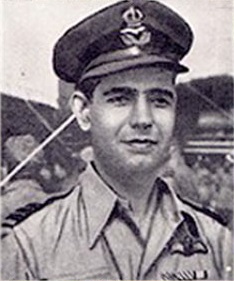
Air Marshal Aspy Merwan Engineer DFC (15 December 1912 – 1 May 2002) was an officer in the Indian Air Force who rose through the ranks to become independent India's second Chief of the Air Staff, succeeding Subroto Mukerjee in 1960 and preceding Arjan Singh.
His flying career began in 1930 at the age of 17, when as a co-pilot he accompanied his friend R. N. Chawla to Croydon Airport, London from Karachi in British India, by flight and were the first Indians to do so. Shortly afterwards, he won the Aga Khan contest for being the first Indian to fly the journey between England and India, solo and within a one-month time frame.
Engineer subsequently joined the Indian Air Force, trained at RAF Cranwell, saw action on the North Western Frontier Provinces (NWFP) and at Burma and as a result was awarded the Distinguished Flying Cross (DFC). By the end of the Second World War he became Wing Commander.
Following retirement, he served as India's ambassador to Iran and later spent time living in California, before his last days in Mumbai.
Aspy Engineer was born Aspy Merwan Irani on 15 December 1912 in Lahore, Punjab Province, British India, to Meherwan Irani and Maneckbai. Meherwan was a Divisional Engineer for the North Western Railway. His interest in mechanics led his friends to rename him Engineer. Aspy was the eldest amongst eight siblings – two girls and six boys. His brothers, Minoo, Jungoo and Ronnie, also joined the Indian Air Force, while another brother, Homi, joined the Indian Army. Aspy, Minoo and Ronnie were recipients of the DFC, a unique feat where three brothers were decorated with gallantry awards.
At the age of seven, Engineer witnessed aviators Alcock and Brown make an emergency aircraft landing on the Race Course grounds opposite his father's railway bungalow in Hyderabad, Sindh. He later recounted, "I dreamt of nothing else thereafter but aircraft landing on the roof-top of our spacious bungalow."
He completed his early education from the Billimoria Parsi School, Panchgani, and the DJ Science College in Karachi. On his 17th birthday, his father presented him with a second-hand de Havilland Gipsy Moth and after less than three months of lessons, he obtained his license to fly from the Karachi Aero Club.
In November 1929, the Aga Khan, 48th Imam of the Ismailai sect of Muslims announced a prize of £500 to the first Indian who could fly solo between England and India within a one-month time-frame.
Hub AI
Aspy Engineer AI simulator
(@Aspy Engineer_simulator)
Aspy Engineer
Air Marshal Aspy Merwan Engineer DFC (15 December 1912 – 1 May 2002) was an officer in the Indian Air Force who rose through the ranks to become independent India's second Chief of the Air Staff, succeeding Subroto Mukerjee in 1960 and preceding Arjan Singh.
His flying career began in 1930 at the age of 17, when as a co-pilot he accompanied his friend R. N. Chawla to Croydon Airport, London from Karachi in British India, by flight and were the first Indians to do so. Shortly afterwards, he won the Aga Khan contest for being the first Indian to fly the journey between England and India, solo and within a one-month time frame.
Engineer subsequently joined the Indian Air Force, trained at RAF Cranwell, saw action on the North Western Frontier Provinces (NWFP) and at Burma and as a result was awarded the Distinguished Flying Cross (DFC). By the end of the Second World War he became Wing Commander.
Following retirement, he served as India's ambassador to Iran and later spent time living in California, before his last days in Mumbai.
Aspy Engineer was born Aspy Merwan Irani on 15 December 1912 in Lahore, Punjab Province, British India, to Meherwan Irani and Maneckbai. Meherwan was a Divisional Engineer for the North Western Railway. His interest in mechanics led his friends to rename him Engineer. Aspy was the eldest amongst eight siblings – two girls and six boys. His brothers, Minoo, Jungoo and Ronnie, also joined the Indian Air Force, while another brother, Homi, joined the Indian Army. Aspy, Minoo and Ronnie were recipients of the DFC, a unique feat where three brothers were decorated with gallantry awards.
At the age of seven, Engineer witnessed aviators Alcock and Brown make an emergency aircraft landing on the Race Course grounds opposite his father's railway bungalow in Hyderabad, Sindh. He later recounted, "I dreamt of nothing else thereafter but aircraft landing on the roof-top of our spacious bungalow."
He completed his early education from the Billimoria Parsi School, Panchgani, and the DJ Science College in Karachi. On his 17th birthday, his father presented him with a second-hand de Havilland Gipsy Moth and after less than three months of lessons, he obtained his license to fly from the Karachi Aero Club.
In November 1929, the Aga Khan, 48th Imam of the Ismailai sect of Muslims announced a prize of £500 to the first Indian who could fly solo between England and India within a one-month time-frame.
Recent media