



Community hub
Recent from talks
Knowledge base stats:
Talk channels stats:
Members stats:
Assembly language
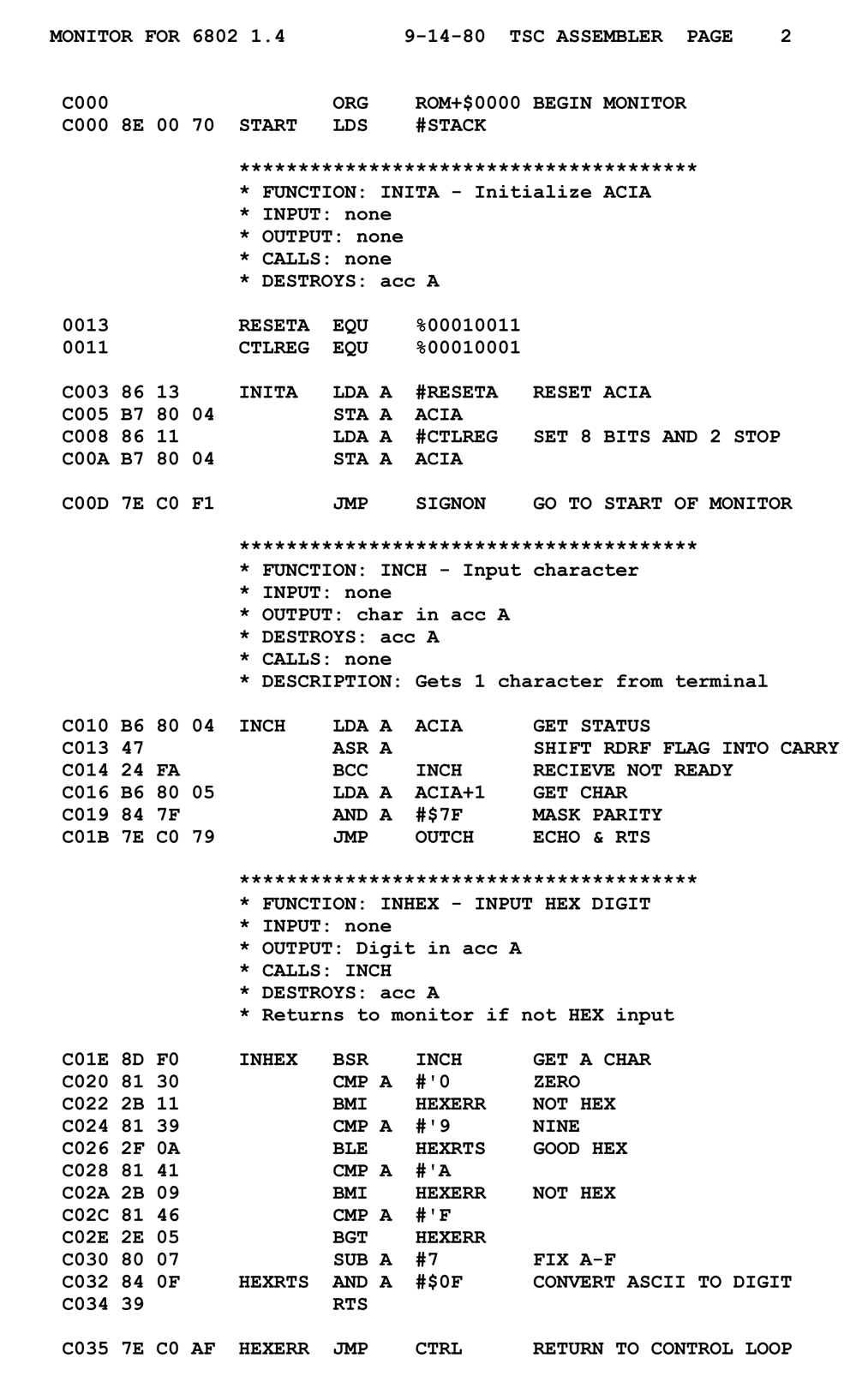
In computing, assembly language (alternatively assembler language or symbolic machine code), often referred to simply as assembly and commonly abbreviated as ASM or asm, is any low-level programming language with a very strong correspondence between the instructions in the language and the architecture's machine code instructions. Assembly language usually has one statement per machine code instruction (1:1), but constants, comments, assembler directives, symbolic labels of, e.g., memory locations, registers, and macros are generally also supported.
The first assembly code in which a language is used to represent machine code instructions is found in Kathleen and Andrew Donald Booth's 1947 work, Coding for A.R.C.. Assembly code is converted into executable machine code by a utility program referred to as an assembler. The term "assembler" is generally attributed to Wilkes, Wheeler and Gill in their 1951 book The Preparation of Programs for an Electronic Digital Computer, who, however, used the term to mean "a program that assembles another program consisting of several sections into a single program". The conversion process is referred to as assembly, as in assembling the source code. The computational step when an assembler is processing a program is called assembly time.
Because assembly depends on the machine code instructions, each assembly language is specific to a particular computer architecture such as x86 or ARM.
Sometimes there is more than one assembler for the same architecture, and sometimes an assembler is specific to an operating system or to particular operating systems. Most assembly languages do not provide specific syntax for operating system calls, and most assembly languages can be used universally with any operating system, as the language provides access to all the real capabilities of the processor, upon which all system call mechanisms ultimately rest. In contrast to assembly languages, most high-level programming languages are generally portable across multiple architectures but require interpreting or compiling, much more complicated tasks than assembling.
In the first decades of computing, it was commonplace for both systems programming and application programming to take place entirely in assembly language. While still irreplaceable for some purposes, the majority of programming is now conducted in higher-level interpreted and compiled languages. In "No Silver Bullet", Fred Brooks summarised the effects of the switch away from assembly language programming: "Surely the most powerful stroke for software productivity, reliability, and simplicity has been the progressive use of high-level languages for programming. Most observers credit that development with at least a factor of five in productivity, and with concomitant gains in reliability, simplicity, and comprehensibility."
Today, it is typical to use small amounts of assembly language code within larger systems implemented in a higher-level language, for performance reasons or to interact directly with hardware in ways unsupported by the higher-level language. For instance, just under 2% of version 4.9 of the Linux kernel source code is written in assembly; more than 97% is written in C.
Assembly language uses a mnemonic to represent, e.g., each low-level machine instruction or opcode, each directive, typically also each architectural register, flag, etc. Some of the mnemonics may be built-in and some user-defined. Many operations require one or more operands in order to form a complete instruction. Most assemblers permit named constants, registers, and labels for program and memory locations, and can calculate expressions for operands. Thus, programmers are freed from tedious repetitive calculations and assembler programs are much more readable than machine code. Depending on the architecture, these elements may also be combined for specific instructions or addressing modes using offsets or other data as well as fixed addresses. Many assemblers offer additional mechanisms to facilitate program development, to control the assembly process, and to aid debugging.
Some are column oriented, with specific fields in specific columns; this was very common for machines using punched cards in the 1950s and early 1960s. Some assemblers have free-form syntax, with fields separated by delimiters, e.g., punctuation, white space. Some assemblers are hybrid, with, e.g., labels, in a specific column and other fields separated by delimiters; this became more common than column-oriented syntax in the 1960s.
Hub AI
Assembly language AI simulator
(@Assembly language_simulator)
Assembly language
In computing, assembly language (alternatively assembler language or symbolic machine code), often referred to simply as assembly and commonly abbreviated as ASM or asm, is any low-level programming language with a very strong correspondence between the instructions in the language and the architecture's machine code instructions. Assembly language usually has one statement per machine code instruction (1:1), but constants, comments, assembler directives, symbolic labels of, e.g., memory locations, registers, and macros are generally also supported.
The first assembly code in which a language is used to represent machine code instructions is found in Kathleen and Andrew Donald Booth's 1947 work, Coding for A.R.C.. Assembly code is converted into executable machine code by a utility program referred to as an assembler. The term "assembler" is generally attributed to Wilkes, Wheeler and Gill in their 1951 book The Preparation of Programs for an Electronic Digital Computer, who, however, used the term to mean "a program that assembles another program consisting of several sections into a single program". The conversion process is referred to as assembly, as in assembling the source code. The computational step when an assembler is processing a program is called assembly time.
Because assembly depends on the machine code instructions, each assembly language is specific to a particular computer architecture such as x86 or ARM.
Sometimes there is more than one assembler for the same architecture, and sometimes an assembler is specific to an operating system or to particular operating systems. Most assembly languages do not provide specific syntax for operating system calls, and most assembly languages can be used universally with any operating system, as the language provides access to all the real capabilities of the processor, upon which all system call mechanisms ultimately rest. In contrast to assembly languages, most high-level programming languages are generally portable across multiple architectures but require interpreting or compiling, much more complicated tasks than assembling.
In the first decades of computing, it was commonplace for both systems programming and application programming to take place entirely in assembly language. While still irreplaceable for some purposes, the majority of programming is now conducted in higher-level interpreted and compiled languages. In "No Silver Bullet", Fred Brooks summarised the effects of the switch away from assembly language programming: "Surely the most powerful stroke for software productivity, reliability, and simplicity has been the progressive use of high-level languages for programming. Most observers credit that development with at least a factor of five in productivity, and with concomitant gains in reliability, simplicity, and comprehensibility."
Today, it is typical to use small amounts of assembly language code within larger systems implemented in a higher-level language, for performance reasons or to interact directly with hardware in ways unsupported by the higher-level language. For instance, just under 2% of version 4.9 of the Linux kernel source code is written in assembly; more than 97% is written in C.
Assembly language uses a mnemonic to represent, e.g., each low-level machine instruction or opcode, each directive, typically also each architectural register, flag, etc. Some of the mnemonics may be built-in and some user-defined. Many operations require one or more operands in order to form a complete instruction. Most assemblers permit named constants, registers, and labels for program and memory locations, and can calculate expressions for operands. Thus, programmers are freed from tedious repetitive calculations and assembler programs are much more readable than machine code. Depending on the architecture, these elements may also be combined for specific instructions or addressing modes using offsets or other data as well as fixed addresses. Many assemblers offer additional mechanisms to facilitate program development, to control the assembly process, and to aid debugging.
Some are column oriented, with specific fields in specific columns; this was very common for machines using punched cards in the 1950s and early 1960s. Some assemblers have free-form syntax, with fields separated by delimiters, e.g., punctuation, white space. Some assemblers are hybrid, with, e.g., labels, in a specific column and other fields separated by delimiters; this became more common than column-oriented syntax in the 1960s.