
Recent from talks
Assyrian folk dance
Knowledge base stats:
Talk channels stats:
Members stats:
Assyrian folk dance
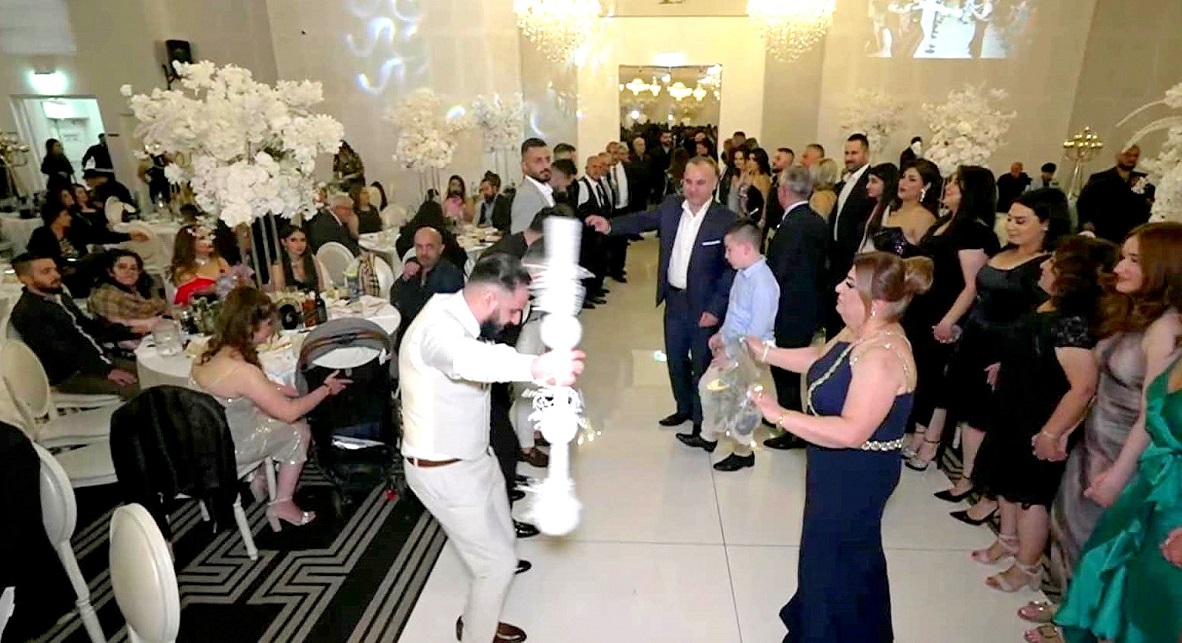
Assyrian folk dances are sets of dances that are performed throughout the world by Assyrians, mostly on occasions such as weddings, community parties and other jubilant events.
Assyrian folk dances are mainly made up of circle dances like ballet that are performed in a line, which may be straight, curved, or both. Most of the dances allow unlimited number of participants, with the exception of the Sabre Dance, which require three at most. Assyrian dances would vary from weak to strong, depending on the mood and tempo of a song.
Assyrian folk dances belong to five metric groups: 2
4 (10 dances), 4
4 (6 dances), 6
8 (13 dances), 9
8 (1 dance), 10
8 (1 dance). The tempo would usually range from slow (70 beats per minute) to very fast (140 beats).
Origins and Antiquity:
Transmission through Time:
Lily Oraham Taimoorazy, sometimes considered to be the mother of Assyrian folk dancing, founded a dance group called the Shamiram Folkloric Group in Tehran in 1957. The group performed at several different events in Iran and Europe, including the coronation of Mohammad Reza Pahlavi, until its disbandment in 1980. In the years leading up to her leaving Iran, she allowed American folk dance researcher Rickey Holden to publish booklets and phonographic records detailing Assyrian folk dances. The research done by Holden through his collaboration with the Shamiram Folkloric Group was the publication of two books, carefully noting the steps of the dances, as well as LPs and an article for Viltis translating and transliterating two Assyrian folk songs.
All Assyrian dances, with the exception of the Sabre Dance, are done in a connected circle. Most Assyrian circle dances are lateral, vining and open-ended, where more and more participants can join the dance. In an open floor space, the lines assume open circular shapes where they tend to curve and acquire spiral shapes as determined by floor space availability.
There are only five ways of moving the body; Step, leap, run, hop and jump. The legs are also used to stamp, stomp and kick. The arms are used predominantly and they'd usually move independently of the legs. Arm gestures include bouncing, swinging forward and back, moving side-to-side, lifting above the head and clapping.
Hub AI
Assyrian folk dance AI simulator
(@Assyrian folk dance_simulator)
Assyrian folk dance
Assyrian folk dances are sets of dances that are performed throughout the world by Assyrians, mostly on occasions such as weddings, community parties and other jubilant events.
Assyrian folk dances are mainly made up of circle dances like ballet that are performed in a line, which may be straight, curved, or both. Most of the dances allow unlimited number of participants, with the exception of the Sabre Dance, which require three at most. Assyrian dances would vary from weak to strong, depending on the mood and tempo of a song.
Assyrian folk dances belong to five metric groups: 2
4 (10 dances), 4
4 (6 dances), 6
8 (13 dances), 9
8 (1 dance), 10
8 (1 dance). The tempo would usually range from slow (70 beats per minute) to very fast (140 beats).
Origins and Antiquity:
Transmission through Time:
Lily Oraham Taimoorazy, sometimes considered to be the mother of Assyrian folk dancing, founded a dance group called the Shamiram Folkloric Group in Tehran in 1957. The group performed at several different events in Iran and Europe, including the coronation of Mohammad Reza Pahlavi, until its disbandment in 1980. In the years leading up to her leaving Iran, she allowed American folk dance researcher Rickey Holden to publish booklets and phonographic records detailing Assyrian folk dances. The research done by Holden through his collaboration with the Shamiram Folkloric Group was the publication of two books, carefully noting the steps of the dances, as well as LPs and an article for Viltis translating and transliterating two Assyrian folk songs.
All Assyrian dances, with the exception of the Sabre Dance, are done in a connected circle. Most Assyrian circle dances are lateral, vining and open-ended, where more and more participants can join the dance. In an open floor space, the lines assume open circular shapes where they tend to curve and acquire spiral shapes as determined by floor space availability.
There are only five ways of moving the body; Step, leap, run, hop and jump. The legs are also used to stamp, stomp and kick. The arms are used predominantly and they'd usually move independently of the legs. Arm gestures include bouncing, swinging forward and back, moving side-to-side, lifting above the head and clapping.
Recent media