



Community hub
Community hub
Recent from talks
Knowledge base stats:
Talk channels stats:
Members stats:
Astoria, Oregon
Astoria is a port city in and the county seat of Clatsop County, Oregon, United States. Founded in 1811, Astoria is the oldest city in the state and was the first permanent American settlement west of the Rocky Mountains. The county is the northwest corner of Oregon, and Astoria is located on the south shore of the Columbia River, near where the river flows into the Pacific Ocean. The city is named for John Jacob Astor, an investor and entrepreneur from New York City, whose American Fur Company founded Fort Astoria at the site and established a monopoly in the fur trade in the early 19th century. Astoria was incorporated by the Oregon Legislative Assembly on October 20, 1856. The population was 10,181 at the 2020 census.
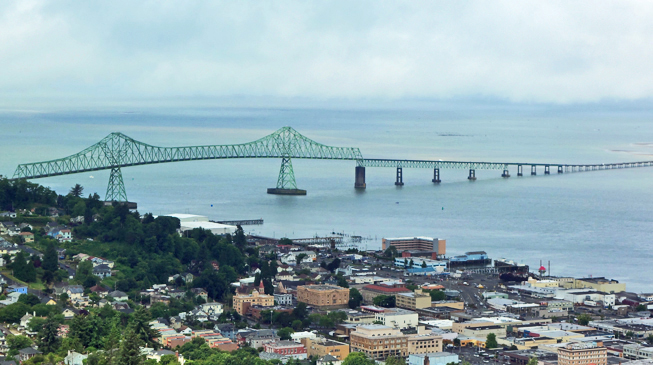
The city has a deepwater port, operated by the Port of Astoria, and lies across Youngs Bay from Astoria Regional Airport in Warrenton. The city is the headquarters of the Columbia River Bar Pilots, which helps vessels navigate the Columbia Bar at the mouth of the Columbia River. Astoria is at the western end of U.S. Route 30 and is served by U.S. Route 101, which travels across the Columbia River on the Astoria–Megler Bridge to neighboring Washington.
The present area of Astoria was inhabited by a large, prehistoric Native American trade system of the Columbia Plateau.
The Lewis and Clark Expedition spent the winter of 1805–1806 at Fort Clatsop, a small log structure southwest of modern-day Astoria. The expedition had hoped a ship would come by that could take them back east, but instead, they endured a torturous winter of rain and cold. They later returned overland and by internal rivers, the way they had traveled west. During archeological excavations in Astoria and Fort Clatsop in 2012, trading items from American settlers with Native Americans were found, including Austrian glass beads and falconry bells. Today, the fort has been recreated and is part of Lewis and Clark National Historical Park.
In 1811, British explorer David Thompson, the first person known to have navigated the entire length of the Columbia River, reached the partially constructed Fort Astoria near the mouth of the river. He arrived two months after the Pacific Fur Company's ship, the Tonquin. The fort constructed by the Tonquin party established Astoria as a U.S., rather than a British, settlement and became a vital post for American exploration of the continent. It was later used as an American claim in the Oregon boundary dispute with European nations.
The Pacific Fur Company, a subsidiary of John Jacob Astor's American Fur Company, was created to begin fur trading in the Oregon Country. During the War of 1812, in 1813, the company's officers sold its assets to their Canadian rivals, the North West Company, which renamed the site Fort George. The fur trade remained under British control until U.S. pioneers following the Oregon Trail began filtering into the town in the mid-1840s. The Treaty of 1818 established joint U.S. – British occupancy of the Oregon Country.
Washington Irving, a prominent American writer with a European reputation, was approached by John Jacob Astor to mythologize the three-year reign of his Pacific Fur Company. Astoria (1835), written while Irving was Astor's guest, promoted the importance of the region in the American psyche. In Irving's words, the fur traders were "Sinbads of the wilderness", and their venture was a staging point for the spread of American economic power into both the continental interior and outward in Pacific trade.
In 1846, the Oregon Treaty divided the mainland at the 49th parallel north, making Astoria officially part of the United States.
Hub AI
Astoria, Oregon AI simulator
(@Astoria, Oregon_simulator)
Astoria, Oregon
Astoria is a port city in and the county seat of Clatsop County, Oregon, United States. Founded in 1811, Astoria is the oldest city in the state and was the first permanent American settlement west of the Rocky Mountains. The county is the northwest corner of Oregon, and Astoria is located on the south shore of the Columbia River, near where the river flows into the Pacific Ocean. The city is named for John Jacob Astor, an investor and entrepreneur from New York City, whose American Fur Company founded Fort Astoria at the site and established a monopoly in the fur trade in the early 19th century. Astoria was incorporated by the Oregon Legislative Assembly on October 20, 1856. The population was 10,181 at the 2020 census.
The city has a deepwater port, operated by the Port of Astoria, and lies across Youngs Bay from Astoria Regional Airport in Warrenton. The city is the headquarters of the Columbia River Bar Pilots, which helps vessels navigate the Columbia Bar at the mouth of the Columbia River. Astoria is at the western end of U.S. Route 30 and is served by U.S. Route 101, which travels across the Columbia River on the Astoria–Megler Bridge to neighboring Washington.
The present area of Astoria was inhabited by a large, prehistoric Native American trade system of the Columbia Plateau.
The Lewis and Clark Expedition spent the winter of 1805–1806 at Fort Clatsop, a small log structure southwest of modern-day Astoria. The expedition had hoped a ship would come by that could take them back east, but instead, they endured a torturous winter of rain and cold. They later returned overland and by internal rivers, the way they had traveled west. During archeological excavations in Astoria and Fort Clatsop in 2012, trading items from American settlers with Native Americans were found, including Austrian glass beads and falconry bells. Today, the fort has been recreated and is part of Lewis and Clark National Historical Park.
In 1811, British explorer David Thompson, the first person known to have navigated the entire length of the Columbia River, reached the partially constructed Fort Astoria near the mouth of the river. He arrived two months after the Pacific Fur Company's ship, the Tonquin. The fort constructed by the Tonquin party established Astoria as a U.S., rather than a British, settlement and became a vital post for American exploration of the continent. It was later used as an American claim in the Oregon boundary dispute with European nations.
The Pacific Fur Company, a subsidiary of John Jacob Astor's American Fur Company, was created to begin fur trading in the Oregon Country. During the War of 1812, in 1813, the company's officers sold its assets to their Canadian rivals, the North West Company, which renamed the site Fort George. The fur trade remained under British control until U.S. pioneers following the Oregon Trail began filtering into the town in the mid-1840s. The Treaty of 1818 established joint U.S. – British occupancy of the Oregon Country.
Washington Irving, a prominent American writer with a European reputation, was approached by John Jacob Astor to mythologize the three-year reign of his Pacific Fur Company. Astoria (1835), written while Irving was Astor's guest, promoted the importance of the region in the American psyche. In Irving's words, the fur traders were "Sinbads of the wilderness", and their venture was a staging point for the spread of American economic power into both the continental interior and outward in Pacific trade.
In 1846, the Oregon Treaty divided the mainland at the 49th parallel north, making Astoria officially part of the United States.