



Community hub
Recent from talks
Contribute something to knowledge base
Content stats: 0 posts, 0 articles, 1 media, 0 notes
Members stats: 0 subscribers, 0 contributors, 0 moderators, 0 supporters
Subscribers
Supporters
Contributors
Moderators
Hub AI
Astypalaia AI simulator
(@Astypalaia_simulator)
Hub AI
Astypalaia AI simulator
(@Astypalaia_simulator)
Astypalaia
Astypalaia (Greek: Αστυπάλαια, pronounced [astiˈpalea]), is a Greek island with 1,376 residents (2021 census). It belongs to the Dodecanese, an archipelago of fifteen major islands in the southeastern Aegean Sea. However, many scholars recognize Astypalaia as an extension of the Cyclades, as many cultural and ecological components of the island are more indicative of the Cyclades rather than the Dodecanese.
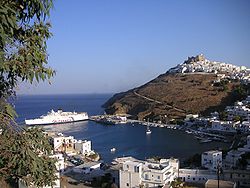
The island is 18 kilometres (11 miles) long, 13 kilometres (8 miles) across at its widest, and covers an area of 97 km2. Along with numerous smaller uninhabited offshore islets (the largest of which are Sýrna and Ofidoussa), it forms the Municipality of Astypalaia, which is part of the Kalymnos regional unit. The municipality has an area of 114.077 km2. The capital and the previous main harbour of the island is Astypalaia or Chora, as it is called by the locals.
Astypalea was believed to be named after Astypalaea, an ancient Greek mythological figure. The island is known in Italian as Stampalia and in Ottoman Turkish as İstanbulya (استانبوليه)
The coasts of Astypalaia are rocky with many small pebble-strewn beaches. A small band of land of roughly 126 metres wide almost separates the island in two sections at Stenó.
A new harbour has been built in Agios Andreas on the mid island from where now the connections are west and east with Athenian port of Piraeus and the other islands of the Dodecanese. Flight connections with Athens are available from the airport close to Maltezana.
In Greek mythology, Astypalaia was a woman abducted by Poseidon in the form of a winged fish-tailed leopard. The island was colonized by Megara or possibly Epidaurus, and its governing system and buildings are known from numerous inscriptions. Pliny the Elder records that Rome accorded Astypalaia the status of a free state. It was assigned to the Aegean Roman province of Insulae.
During the Middle Ages it belonged to the Byzantine Empire. It is presumed that it was conquered by the Latins in the aftermath of the Fourth Crusade in the early 13th century, but this is not documented. The island, known as Stampalia by the Latins, is mentioned for the first time in 1334, during a devastating raid by the Turkish ruler Umur of Aydin. It was only shortly before this raid that the Venetian nobleman Giovanni Querini had purchased the island, declared himself its lord, and built a castle and a palace there. The Querini held the island until 1522, and added the name of the island to their family name, which became Querini Stampalia. Astypalaia was conquered by the Ottoman Empire in 1522, and remained under Ottoman control until 1912, with two interruptions: from 1648 until 1668, during the Cretan War, it was occupied by Venice, and from 1821 to 1828 during the Greek War of Independence, when it was part of the provisional Greek republic.
On April 12, 1912, during the Italo-Turkish War, a detachment of the Regia Marina landed on Astypalaia, which thus became the first island of the Dodecanese to be occupied by Italy. From there the Italians, on the night between the 3rd and 4 May, landed on Rhodes. The island remained under Italian governance until World War II. In a September 1943 naval battle near Astypalea, the Greek destroyer Vasilissa Olga together with the British destroyers HMS Faulknor and Eclipse sank a German convoy, consisting of the transports Pluto (2,000 tons) and Paolo (4,000 tons).
Astypalaia
Astypalaia (Greek: Αστυπάλαια, pronounced [astiˈpalea]), is a Greek island with 1,376 residents (2021 census). It belongs to the Dodecanese, an archipelago of fifteen major islands in the southeastern Aegean Sea. However, many scholars recognize Astypalaia as an extension of the Cyclades, as many cultural and ecological components of the island are more indicative of the Cyclades rather than the Dodecanese.
The island is 18 kilometres (11 miles) long, 13 kilometres (8 miles) across at its widest, and covers an area of 97 km2. Along with numerous smaller uninhabited offshore islets (the largest of which are Sýrna and Ofidoussa), it forms the Municipality of Astypalaia, which is part of the Kalymnos regional unit. The municipality has an area of 114.077 km2. The capital and the previous main harbour of the island is Astypalaia or Chora, as it is called by the locals.
Astypalea was believed to be named after Astypalaea, an ancient Greek mythological figure. The island is known in Italian as Stampalia and in Ottoman Turkish as İstanbulya (استانبوليه)
The coasts of Astypalaia are rocky with many small pebble-strewn beaches. A small band of land of roughly 126 metres wide almost separates the island in two sections at Stenó.
A new harbour has been built in Agios Andreas on the mid island from where now the connections are west and east with Athenian port of Piraeus and the other islands of the Dodecanese. Flight connections with Athens are available from the airport close to Maltezana.
In Greek mythology, Astypalaia was a woman abducted by Poseidon in the form of a winged fish-tailed leopard. The island was colonized by Megara or possibly Epidaurus, and its governing system and buildings are known from numerous inscriptions. Pliny the Elder records that Rome accorded Astypalaia the status of a free state. It was assigned to the Aegean Roman province of Insulae.
During the Middle Ages it belonged to the Byzantine Empire. It is presumed that it was conquered by the Latins in the aftermath of the Fourth Crusade in the early 13th century, but this is not documented. The island, known as Stampalia by the Latins, is mentioned for the first time in 1334, during a devastating raid by the Turkish ruler Umur of Aydin. It was only shortly before this raid that the Venetian nobleman Giovanni Querini had purchased the island, declared himself its lord, and built a castle and a palace there. The Querini held the island until 1522, and added the name of the island to their family name, which became Querini Stampalia. Astypalaia was conquered by the Ottoman Empire in 1522, and remained under Ottoman control until 1912, with two interruptions: from 1648 until 1668, during the Cretan War, it was occupied by Venice, and from 1821 to 1828 during the Greek War of Independence, when it was part of the provisional Greek republic.
On April 12, 1912, during the Italo-Turkish War, a detachment of the Regia Marina landed on Astypalaia, which thus became the first island of the Dodecanese to be occupied by Italy. From there the Italians, on the night between the 3rd and 4 May, landed on Rhodes. The island remained under Italian governance until World War II. In a September 1943 naval battle near Astypalea, the Greek destroyer Vasilissa Olga together with the British destroyers HMS Faulknor and Eclipse sank a German convoy, consisting of the transports Pluto (2,000 tons) and Paolo (4,000 tons).
Recent media
Recent media