
Recent from talks
Athens Polytechnic uprising
Knowledge base stats:
Talk channels stats:
Members stats:
Athens Polytechnic uprising
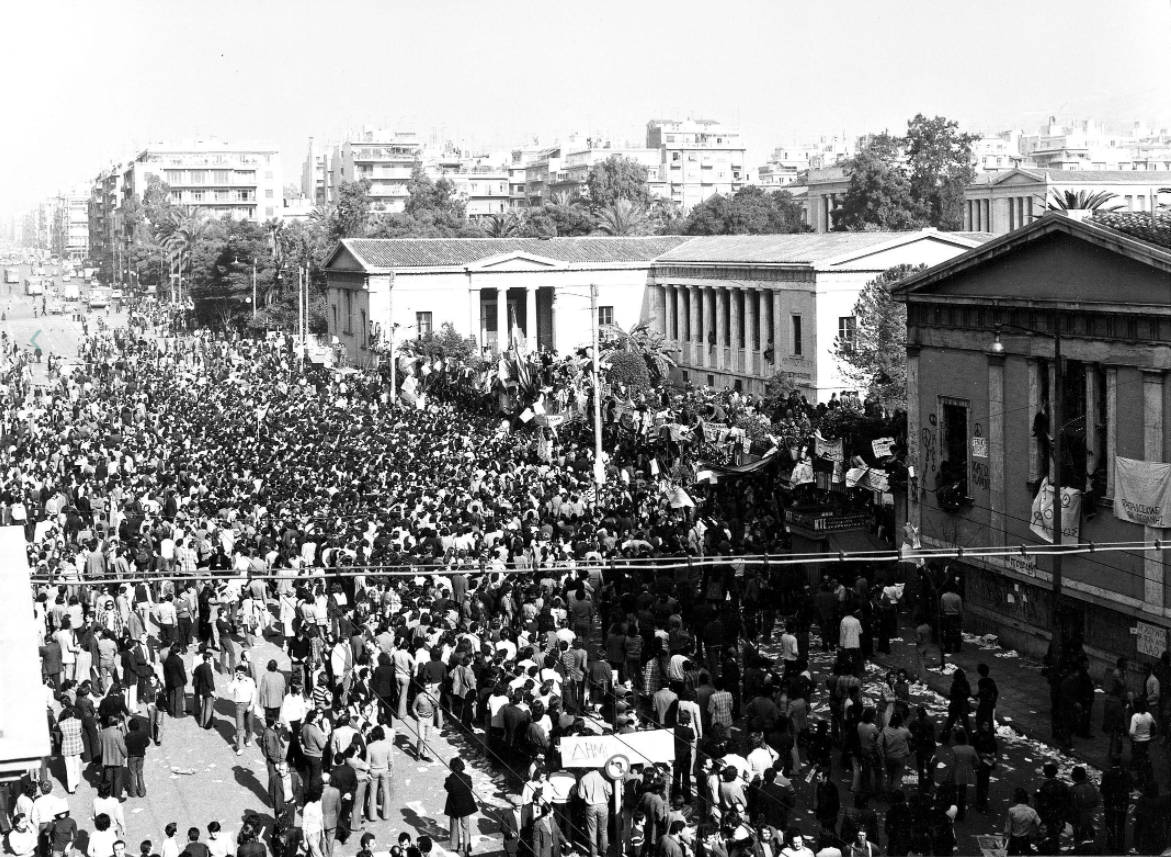
The Athens Polytechnic uprising occurred in November 1973 as a massive student demonstration of popular rejection of the Greek military junta of 1967–1974. It began on 14 November 1973, escalated to an open anti-junta revolt, and ended in bloodshed in the early morning of 17 November after a series of events starting with a tank crashing through the gates of the Athens Polytechnic. It is believed that approximately 40 people were killed by the Greek army on that day, and more than 2,000 were injured. This was the first event in a series of political crises that ultimately led to the fall of the junta in the summer of 1974, just a few months later.
The uprising had a lasting impact on Greek politics; it marked a break between the Greek youth and traditional leftist parties (KKE), and it also saw the beginning of the revival of Greek anarchism. The repression faced by students gave rise to the terrorist organization 17N.
The first massive public action against the Greek junta came from students on 21 February 1973, when law students and anarchists went on strike and barricaded themselves inside the buildings of the Law School of the University of Athens in the centre of Athens, demanding repeal of the law that imposed forcible conscription.
An anti-dictatorial student movement was growing among the youth, and the police utilised brutal methods and torture towards them, in order to confront the threat.
On 14 November 1973, students at the Athens Polytechnic (Polytechneion), radicalized by the nascent Greek anarchist circles went on strike and started protesting against the military junta (Regime of the Colonels). As the authorities stood by, the students were calling themselves the "Free Besieged" (Greek: Ελεύθεροι Πολιορκημένοι, a reference to the poem by Greek poet Dionysios Solomos inspired by the Ottoman siege of Mesolonghi). Their main rallying cry was:
Bread-Education-Liberty!
(Psomí-Paideía-Elefthería)
An assembly formed spontaneously and decided to occupy the Polytechnic. The anarchist group that had just formed at the university, notably thanks to the actions of Christos Konstantinidis and Nikos Balis, occupied a central place in this movement, Konstantinidis, in particular, succeeded in having the occupation extended into the night of the first day, which set the movement in motion for the long term. They adopted the following motion in the 14 November General Assembly:
The autonomous assembly of workers located in the premises of the Polytechnic School calls on workers to occupy places of production and to create factory and strike committees with the ultimate goal of establishing workers' councils. The minimum program of the workers' councils is the destruction of wage labor, the state, capitalism, and politics.
Hub AI
Athens Polytechnic uprising AI simulator
(@Athens Polytechnic uprising_simulator)
Athens Polytechnic uprising
The Athens Polytechnic uprising occurred in November 1973 as a massive student demonstration of popular rejection of the Greek military junta of 1967–1974. It began on 14 November 1973, escalated to an open anti-junta revolt, and ended in bloodshed in the early morning of 17 November after a series of events starting with a tank crashing through the gates of the Athens Polytechnic. It is believed that approximately 40 people were killed by the Greek army on that day, and more than 2,000 were injured. This was the first event in a series of political crises that ultimately led to the fall of the junta in the summer of 1974, just a few months later.
The uprising had a lasting impact on Greek politics; it marked a break between the Greek youth and traditional leftist parties (KKE), and it also saw the beginning of the revival of Greek anarchism. The repression faced by students gave rise to the terrorist organization 17N.
The first massive public action against the Greek junta came from students on 21 February 1973, when law students and anarchists went on strike and barricaded themselves inside the buildings of the Law School of the University of Athens in the centre of Athens, demanding repeal of the law that imposed forcible conscription.
An anti-dictatorial student movement was growing among the youth, and the police utilised brutal methods and torture towards them, in order to confront the threat.
On 14 November 1973, students at the Athens Polytechnic (Polytechneion), radicalized by the nascent Greek anarchist circles went on strike and started protesting against the military junta (Regime of the Colonels). As the authorities stood by, the students were calling themselves the "Free Besieged" (Greek: Ελεύθεροι Πολιορκημένοι, a reference to the poem by Greek poet Dionysios Solomos inspired by the Ottoman siege of Mesolonghi). Their main rallying cry was:
Bread-Education-Liberty!
(Psomí-Paideía-Elefthería)
An assembly formed spontaneously and decided to occupy the Polytechnic. The anarchist group that had just formed at the university, notably thanks to the actions of Christos Konstantinidis and Nikos Balis, occupied a central place in this movement, Konstantinidis, in particular, succeeded in having the occupation extended into the night of the first day, which set the movement in motion for the long term. They adopted the following motion in the 14 November General Assembly:
The autonomous assembly of workers located in the premises of the Polytechnic School calls on workers to occupy places of production and to create factory and strike committees with the ultimate goal of establishing workers' councils. The minimum program of the workers' councils is the destruction of wage labor, the state, capitalism, and politics.
Recent media