
Recent from talks
Atlantic Wall
Knowledge base stats:
Talk channels stats:
Members stats:
Atlantic Wall
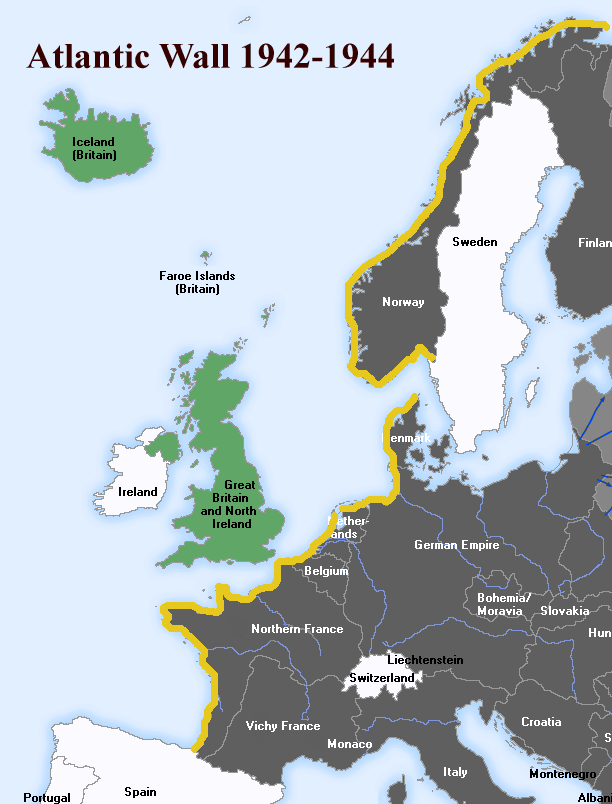
The Atlantic Wall (German: Atlantikwall) was an extensive system of coastal defences and fortifications built by Nazi Germany between 1942 and 1944 along the coast of continental Europe and Scandinavia as a defence against an anticipated Allied invasion of Nazi-occupied Europe from the United Kingdom, during World War II. The manning and operation of the Atlantic Wall was administratively overseen by the German Army, with some support from Luftwaffe ground forces. The Kriegsmarine (German Navy) maintained a separate coastal defence network, organised into a number of sea defence zones.
Hitler ordered the construction of the fortifications in 1942 through his Führer Directive No. 40. More than half a million French workers were drafted to build it. The wall was frequently mentioned in Nazi propaganda, where its size and strength were usually exaggerated. The fortifications included colossal coastal guns, batteries, mortars, and artillery, and thousands of artillery pieces were stationed in its defences. Today, ruins of the wall exist in all of the nations where it was built, although many structures have fallen into the ocean or have been demolished over the years.
World War II in Europe began on 1 September 1939, with Nazi Germany's invasion of Poland. Two days later, the UK and France declared war on Germany. Poland's geographical location, however, prevented the Allies from intervening directly.[citation needed] Four weeks into the attack, the Germans had successfully occupied Poland. Less than a month after this victory, Adolf Hitler issued a directive stating that Germany must be ready for an offensive through France and the Low Countries. However, the Oberkommando der Wehrmacht (German high command; OKW) was convinced that preparations would take at least until the following year. After furious arguments, Hitler reluctantly agreed to wait. In May 1940, three massive German army groups overran France and the Low Countries in little more than six weeks.
Prior to the Atlantic Wall decision, following a number of commando raids, on 2 June 1941 that Adolf Hitler asked for maps of the Channel Islands. These were provided the next day and by 13 June 1941 Hitler had made a decision. Ordering additional men to the islands and having decided the defences were inadequate, lacking tanks and coastal artillery, the Organisation Todt (OT) was instructed to undertake the building of 200–250 strong points in each of the larger islands. The plan was finalised by the OT and submitted to Hitler. The original defence order was reinforced with a second dated 20 October 1941, following a Fuhrer conference on 18 October to discuss the engineers' assessment of requirements. The permanent fortification of the Channel Islands was to make them into an impregnable fortress to be completed within 14 months. Festungspionierkommandeur XIV was created to command the project of fortifying the Channel Islands.
It was six months later on 23 March 1942 that Hitler issued Führer Directive No. 40, which called for the creation of an "Atlantic Wall". He ordered naval and submarine bases to be heavily defended. Fortifications remained concentrated around ports until late in 1943, when defences were increased in other areas. This decision required the army engineers and the OT to organise quickly. Massive supplies of cement, steel reinforcing and armour plate would be required and everything would need to be transported.
Nazi propaganda claimed that the wall stretched from the cape of Norway down to the Spanish border.
The Regelbau (standard build) system used books of plans for each of over 600 approved types of bunker and casemate, each having a specific purpose, having been updated as enemy constructions were overrun and examined, even testing some to destruction for effectiveness. They incorporated standard features, such as an entrance door at right angles, armoured air intake, 30-millimetre (1.2 in) steel doors, ventilation and telephones, internal walls lined with wood, and an emergency exit system. There were over 200 standardised armour parts.
The standardisation greatly simplified the manufacture of equipment, the supply of materials and the budgetary and financial control of the construction as well as the speed of planning for construction projects.
Hub AI
Atlantic Wall AI simulator
(@Atlantic Wall_simulator)
Atlantic Wall
The Atlantic Wall (German: Atlantikwall) was an extensive system of coastal defences and fortifications built by Nazi Germany between 1942 and 1944 along the coast of continental Europe and Scandinavia as a defence against an anticipated Allied invasion of Nazi-occupied Europe from the United Kingdom, during World War II. The manning and operation of the Atlantic Wall was administratively overseen by the German Army, with some support from Luftwaffe ground forces. The Kriegsmarine (German Navy) maintained a separate coastal defence network, organised into a number of sea defence zones.
Hitler ordered the construction of the fortifications in 1942 through his Führer Directive No. 40. More than half a million French workers were drafted to build it. The wall was frequently mentioned in Nazi propaganda, where its size and strength were usually exaggerated. The fortifications included colossal coastal guns, batteries, mortars, and artillery, and thousands of artillery pieces were stationed in its defences. Today, ruins of the wall exist in all of the nations where it was built, although many structures have fallen into the ocean or have been demolished over the years.
World War II in Europe began on 1 September 1939, with Nazi Germany's invasion of Poland. Two days later, the UK and France declared war on Germany. Poland's geographical location, however, prevented the Allies from intervening directly.[citation needed] Four weeks into the attack, the Germans had successfully occupied Poland. Less than a month after this victory, Adolf Hitler issued a directive stating that Germany must be ready for an offensive through France and the Low Countries. However, the Oberkommando der Wehrmacht (German high command; OKW) was convinced that preparations would take at least until the following year. After furious arguments, Hitler reluctantly agreed to wait. In May 1940, three massive German army groups overran France and the Low Countries in little more than six weeks.
Prior to the Atlantic Wall decision, following a number of commando raids, on 2 June 1941 that Adolf Hitler asked for maps of the Channel Islands. These were provided the next day and by 13 June 1941 Hitler had made a decision. Ordering additional men to the islands and having decided the defences were inadequate, lacking tanks and coastal artillery, the Organisation Todt (OT) was instructed to undertake the building of 200–250 strong points in each of the larger islands. The plan was finalised by the OT and submitted to Hitler. The original defence order was reinforced with a second dated 20 October 1941, following a Fuhrer conference on 18 October to discuss the engineers' assessment of requirements. The permanent fortification of the Channel Islands was to make them into an impregnable fortress to be completed within 14 months. Festungspionierkommandeur XIV was created to command the project of fortifying the Channel Islands.
It was six months later on 23 March 1942 that Hitler issued Führer Directive No. 40, which called for the creation of an "Atlantic Wall". He ordered naval and submarine bases to be heavily defended. Fortifications remained concentrated around ports until late in 1943, when defences were increased in other areas. This decision required the army engineers and the OT to organise quickly. Massive supplies of cement, steel reinforcing and armour plate would be required and everything would need to be transported.
Nazi propaganda claimed that the wall stretched from the cape of Norway down to the Spanish border.
The Regelbau (standard build) system used books of plans for each of over 600 approved types of bunker and casemate, each having a specific purpose, having been updated as enemy constructions were overrun and examined, even testing some to destruction for effectiveness. They incorporated standard features, such as an entrance door at right angles, armoured air intake, 30-millimetre (1.2 in) steel doors, ventilation and telephones, internal walls lined with wood, and an emergency exit system. There were over 200 standardised armour parts.
The standardisation greatly simplified the manufacture of equipment, the supply of materials and the budgetary and financial control of the construction as well as the speed of planning for construction projects.
Recent media