
Recent from talks
Audion
Knowledge base stats:
Talk channels stats:
Members stats:
Audion
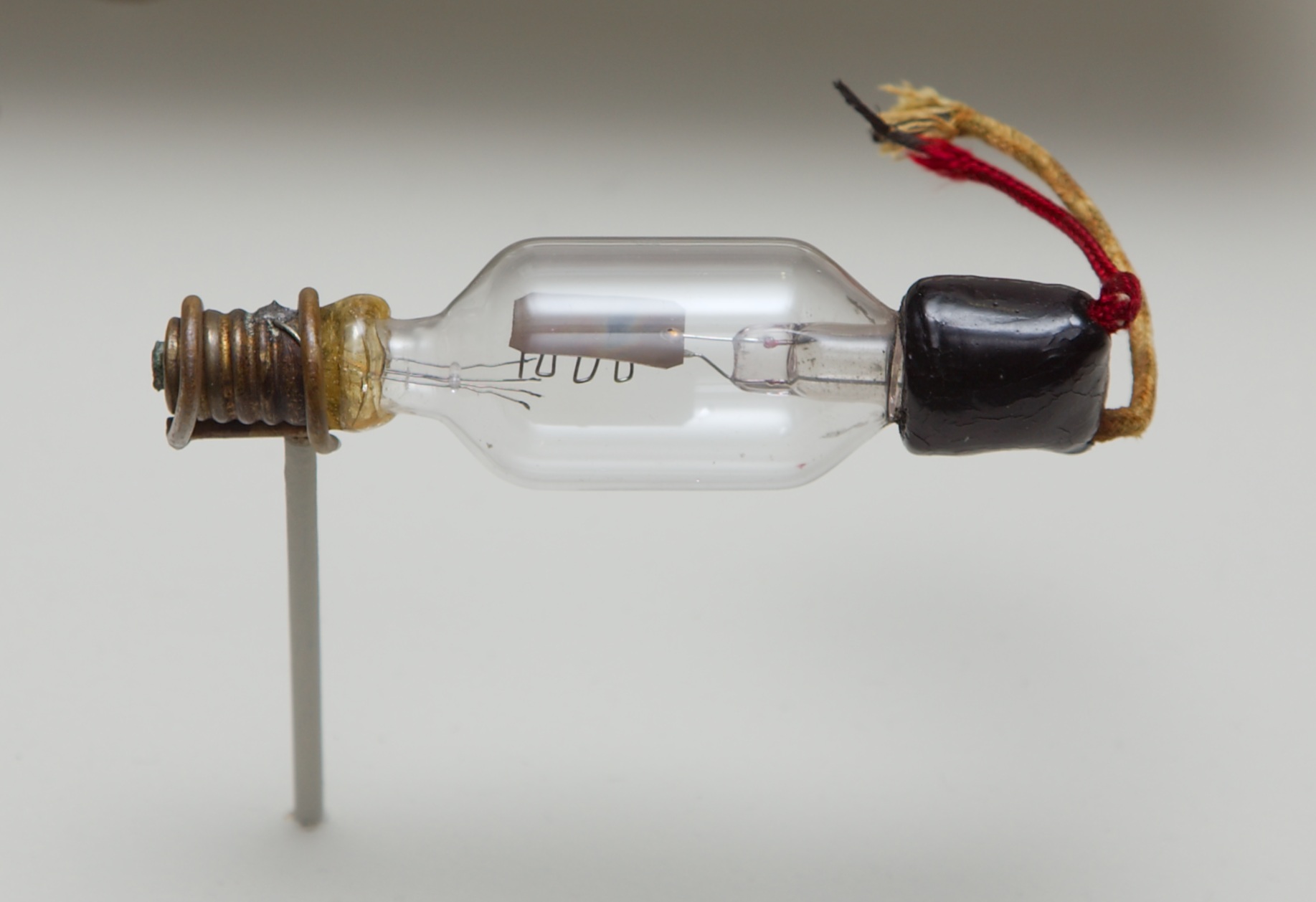
The Audion is an electronic detecting or amplifying vacuum tube invented by American electrical engineer Lee de Forest as a diode in 1906. Improved, it was patented as the first triode in 1908, consisting of an evacuated glass tube containing three electrodes: a heated filament (the cathode, made out of tantalum), a grid, and a plate (the anode). It is important in the history of technology because it was the first widely used electronic device that could amplify. A low power signal at the grid could control much more power in the plate circuit.
Audions had more residual gas than later vacuum tubes; the residual gas limited the dynamic range and gave the Audion non-linear characteristics and erratic performance. Originally developed as a radio receiver detector by adding a grid electrode to the Fleming valve, it found little use until its amplifying ability was recognized around 1912 by several researchers, who used it to build the first amplifying radio receivers and electronic oscillators. The many practical applications for amplification motivated its rapid development, and the original Audion was superseded within a few years by improved versions with a higher vacuum.
It had been known since the middle of the 19th century that gas flames were electrically conductive, and early wireless experimenters had noticed that this conductivity was affected by the presence of radio waves. De Forest found that gas in a partial vacuum heated by a conventional lamp filament behaved much the same way, and that if a wire were wrapped around the glass housing, the device could serve as a detector of radio signals. In his original design, a small metal plate was sealed into the lamp housing, and this was connected to the positive terminal of a 22–volt battery via a pair of headphones, the negative terminal being connected to one side of the lamp filament. When wireless signals were applied to the wire wrapped around the outside of the glass, they caused disturbances in the current which produced sounds in the headphones.
This was a significant development as existing commercial wireless systems were heavily protected by patents; a new type of detector would allow de Forest to market his own system. He eventually discovered that connecting the antenna circuit to a third electrode placed directly in the space current path greatly improved the sensitivity; in his earliest versions, this was simply a piece of wire bent into the shape of a gridiron (hence grid).
The Audion provided power gain; with other detectors, all of the power to operate the headphones had to come from the antenna circuit itself. Consequently, weak transmitters could be heard at greater distances.
De Forest and everybody else at the time greatly underestimated the potential of his grid Audion, imagining it to be limited to mostly military applications. It is significant that de Forest apparently did not see its potential as a telephone repeater amplifier at the time he filed the patent claiming it, even though he had previously patented amplification devices and crude electromechanical note magnifiers had been the bane of the telephone industry for at least two decades. (Ironically, in the years of patent disputes leading up to World War I, it was only this "loophole" that allowed vacuum triodes to be manufactured at all since de Forest's grid Audion patent did not mention this application).
De Forest was granted a patent for his early two-electrode diode version of the Audion on November 13, 1906 (U.S. patent 841,386), and the "triode" (three-electrode) version was patented in 1908 (U.S. patent 879,532). De Forest continued to claim that he developed the Audion independently from John Ambrose Fleming's earlier research on the thermionic valve (for which Fleming received Great Britain patent 24850 and the American Fleming valve patent U.S. patent 803,684), and de Forest became embroiled in many radio-related patent disputes. De Forest was famous for saying that he "didn't know why it worked, it just did".[citation needed]
He always referred to the vacuum triodes developed by other researchers as "Oscillaudions", although there is no evidence that he had any significant input to their development. It is true that after the invention of the true vacuum triode in 1913 (see below), de Forest continued to manufacture various types of radio transmitting and receiving apparatus, (examples of which are illustrated on this page). However, although he routinely described these devices as using "Audions", they actually used high-vacuum triodes, using circuitry very similar to that developed by other experimenters.
Hub AI
Audion AI simulator
(@Audion_simulator)
Audion
The Audion is an electronic detecting or amplifying vacuum tube invented by American electrical engineer Lee de Forest as a diode in 1906. Improved, it was patented as the first triode in 1908, consisting of an evacuated glass tube containing three electrodes: a heated filament (the cathode, made out of tantalum), a grid, and a plate (the anode). It is important in the history of technology because it was the first widely used electronic device that could amplify. A low power signal at the grid could control much more power in the plate circuit.
Audions had more residual gas than later vacuum tubes; the residual gas limited the dynamic range and gave the Audion non-linear characteristics and erratic performance. Originally developed as a radio receiver detector by adding a grid electrode to the Fleming valve, it found little use until its amplifying ability was recognized around 1912 by several researchers, who used it to build the first amplifying radio receivers and electronic oscillators. The many practical applications for amplification motivated its rapid development, and the original Audion was superseded within a few years by improved versions with a higher vacuum.
It had been known since the middle of the 19th century that gas flames were electrically conductive, and early wireless experimenters had noticed that this conductivity was affected by the presence of radio waves. De Forest found that gas in a partial vacuum heated by a conventional lamp filament behaved much the same way, and that if a wire were wrapped around the glass housing, the device could serve as a detector of radio signals. In his original design, a small metal plate was sealed into the lamp housing, and this was connected to the positive terminal of a 22–volt battery via a pair of headphones, the negative terminal being connected to one side of the lamp filament. When wireless signals were applied to the wire wrapped around the outside of the glass, they caused disturbances in the current which produced sounds in the headphones.
This was a significant development as existing commercial wireless systems were heavily protected by patents; a new type of detector would allow de Forest to market his own system. He eventually discovered that connecting the antenna circuit to a third electrode placed directly in the space current path greatly improved the sensitivity; in his earliest versions, this was simply a piece of wire bent into the shape of a gridiron (hence grid).
The Audion provided power gain; with other detectors, all of the power to operate the headphones had to come from the antenna circuit itself. Consequently, weak transmitters could be heard at greater distances.
De Forest and everybody else at the time greatly underestimated the potential of his grid Audion, imagining it to be limited to mostly military applications. It is significant that de Forest apparently did not see its potential as a telephone repeater amplifier at the time he filed the patent claiming it, even though he had previously patented amplification devices and crude electromechanical note magnifiers had been the bane of the telephone industry for at least two decades. (Ironically, in the years of patent disputes leading up to World War I, it was only this "loophole" that allowed vacuum triodes to be manufactured at all since de Forest's grid Audion patent did not mention this application).
De Forest was granted a patent for his early two-electrode diode version of the Audion on November 13, 1906 (U.S. patent 841,386), and the "triode" (three-electrode) version was patented in 1908 (U.S. patent 879,532). De Forest continued to claim that he developed the Audion independently from John Ambrose Fleming's earlier research on the thermionic valve (for which Fleming received Great Britain patent 24850 and the American Fleming valve patent U.S. patent 803,684), and de Forest became embroiled in many radio-related patent disputes. De Forest was famous for saying that he "didn't know why it worked, it just did".[citation needed]
He always referred to the vacuum triodes developed by other researchers as "Oscillaudions", although there is no evidence that he had any significant input to their development. It is true that after the invention of the true vacuum triode in 1913 (see below), de Forest continued to manufacture various types of radio transmitting and receiving apparatus, (examples of which are illustrated on this page). However, although he routinely described these devices as using "Audions", they actually used high-vacuum triodes, using circuitry very similar to that developed by other experimenters.
Recent media