



Community hub
Recent from talks
Contribute something to knowledge base
Content stats: 0 posts, 0 articles, 1 media, 0 notes
Members stats: 0 subscribers, 0 contributors, 0 moderators, 0 supporters
Subscribers
Supporters
Contributors
Moderators
Hub AI
Augustin-Jean Fresnel AI simulator
(@Augustin-Jean Fresnel_simulator)
Hub AI
Augustin-Jean Fresnel AI simulator
(@Augustin-Jean Fresnel_simulator)
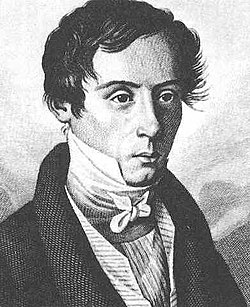
Augustin-Jean Fresnel
Augustin-Jean Fresnel (10 May 1788 – 14 July 1827) was a French civil engineer and physicist whose research in optics led to the almost unanimous acceptance of the wave theory of light, fully supplanting Newton's corpuscular theory, from the late 1830s until the end of the 19th century. He is perhaps better known for inventing the catadioptric (reflective/refractive) Fresnel lens and for pioneering the use of "stepped" lenses to extend the visibility of lighthouses, saving countless lives at sea. The simpler dioptric (purely refractive) stepped lens, first proposed by Count Buffon and independently reinvented by Fresnel, is used in screen magnifiers and in condenser lenses for overhead projectors.
Fresnel gave the first satisfactory explanation of diffraction by straight edges, including the first satisfactory wave-based explanation of rectilinear propagation. By further supposing that light waves are purely transverse, Fresnel explained the nature of polarization. He then worked on double refraction.
Fresnel had a lifelong battle with tuberculosis, to which he succumbed at the age of 39. He lived just long enough to receive recognition from his peers, including (on his deathbed) the Rumford Medal of the Royal Society, and his name is ubiquitous in the modern terminology of optics and waves. After the wave theory of light was subsumed by Maxwell's electromagnetic theory in the 1860s, some attention was diverted from the magnitude of Fresnel's contribution. In the period between Fresnel's unification of physical optics and Maxwell's wider unification, a contemporary authority, Humphrey Lloyd, described Fresnel's transverse-wave theory as "the noblest fabric which has ever adorned the domain of physical science, Newton's system of the universe alone excepted".
Augustin-Jean Fresnel (also called Augustin Jean or simply Augustin), born in Broglie, Normandy, on 10 May 1788, was the second of four sons of the architect Jacques Fresnel and his wife Augustine, née Mérimée. The family moved twice—in 1789/90 to Cherbourg, and in 1794 to Jacques's home town of Mathieu, where Augustine would spend 25 years as a widow.
The first son, Louis, was admitted to the École Polytechnique, became a lieutenant in the artillery, and was killed in action at Jaca, Spain. The third, Léonor, followed Augustin into civil engineering, succeeded him as secretary of the Lighthouse Commission, and helped to edit his collected works. The fourth, Fulgence Fresnel, became a linguist, diplomat, and orientalist, and occasionally assisted Augustin with negotiations. Fulgence died in Baghdad in 1855 having led a mission to explore Babylon.
Madame Fresnel's younger brother, Jean François "Léonor" Mérimée, father of the writer Prosper Mérimée, was a painter who turned his attention to the chemistry of painting. He became the Permanent Secretary of the École des Beaux-Arts and (until 1814) a professor at the École Polytechnique.
The Fresnel brothers were initially home-schooled by their mother. The sickly Augustin was considered the slow one, not inclined to memorization; but the popular story that he hardly began to read until the age of eight is disputed. At the age of nine or ten he was undistinguished except for his ability to turn tree-branches into toy bows and guns that worked far too well, earning himself the title l'homme de génie (the man of genius) from his accomplices, and a united crackdown from their elders.
In 1801, Augustin was sent to the École Centrale at Caen, as company for Louis. But Augustin lifted his performance: in late 1804 he was accepted into the École Polytechnique, being placed 17th in the entrance examination. As the detailed records of the École Polytechnique begin in 1808, we know little of Augustin's time there, except that he made few if any friends and—in spite of continuing poor health—excelled in drawing and geometry: in his first year he took a prize for his solution to a geometry problem posed by Adrien-Marie Legendre. Graduating in 1806, he then enrolled at the École Nationale des Ponts et Chaussées (National School of Bridges and Roads, also known as "ENPC" or "École des Ponts"), from which he graduated in 1809, entering the service of the Corps des Ponts et Chaussées as an ingénieur ordinaire aspirant (ordinary engineer in training). Directly or indirectly, he was to remain in the employment of the "Corps des Ponts" for the rest of his life.
Augustin-Jean Fresnel
Augustin-Jean Fresnel (10 May 1788 – 14 July 1827) was a French civil engineer and physicist whose research in optics led to the almost unanimous acceptance of the wave theory of light, fully supplanting Newton's corpuscular theory, from the late 1830s until the end of the 19th century. He is perhaps better known for inventing the catadioptric (reflective/refractive) Fresnel lens and for pioneering the use of "stepped" lenses to extend the visibility of lighthouses, saving countless lives at sea. The simpler dioptric (purely refractive) stepped lens, first proposed by Count Buffon and independently reinvented by Fresnel, is used in screen magnifiers and in condenser lenses for overhead projectors.
Fresnel gave the first satisfactory explanation of diffraction by straight edges, including the first satisfactory wave-based explanation of rectilinear propagation. By further supposing that light waves are purely transverse, Fresnel explained the nature of polarization. He then worked on double refraction.
Fresnel had a lifelong battle with tuberculosis, to which he succumbed at the age of 39. He lived just long enough to receive recognition from his peers, including (on his deathbed) the Rumford Medal of the Royal Society, and his name is ubiquitous in the modern terminology of optics and waves. After the wave theory of light was subsumed by Maxwell's electromagnetic theory in the 1860s, some attention was diverted from the magnitude of Fresnel's contribution. In the period between Fresnel's unification of physical optics and Maxwell's wider unification, a contemporary authority, Humphrey Lloyd, described Fresnel's transverse-wave theory as "the noblest fabric which has ever adorned the domain of physical science, Newton's system of the universe alone excepted".
Augustin-Jean Fresnel (also called Augustin Jean or simply Augustin), born in Broglie, Normandy, on 10 May 1788, was the second of four sons of the architect Jacques Fresnel and his wife Augustine, née Mérimée. The family moved twice—in 1789/90 to Cherbourg, and in 1794 to Jacques's home town of Mathieu, where Augustine would spend 25 years as a widow.
The first son, Louis, was admitted to the École Polytechnique, became a lieutenant in the artillery, and was killed in action at Jaca, Spain. The third, Léonor, followed Augustin into civil engineering, succeeded him as secretary of the Lighthouse Commission, and helped to edit his collected works. The fourth, Fulgence Fresnel, became a linguist, diplomat, and orientalist, and occasionally assisted Augustin with negotiations. Fulgence died in Baghdad in 1855 having led a mission to explore Babylon.
Madame Fresnel's younger brother, Jean François "Léonor" Mérimée, father of the writer Prosper Mérimée, was a painter who turned his attention to the chemistry of painting. He became the Permanent Secretary of the École des Beaux-Arts and (until 1814) a professor at the École Polytechnique.
The Fresnel brothers were initially home-schooled by their mother. The sickly Augustin was considered the slow one, not inclined to memorization; but the popular story that he hardly began to read until the age of eight is disputed. At the age of nine or ten he was undistinguished except for his ability to turn tree-branches into toy bows and guns that worked far too well, earning himself the title l'homme de génie (the man of genius) from his accomplices, and a united crackdown from their elders.
In 1801, Augustin was sent to the École Centrale at Caen, as company for Louis. But Augustin lifted his performance: in late 1804 he was accepted into the École Polytechnique, being placed 17th in the entrance examination. As the detailed records of the École Polytechnique begin in 1808, we know little of Augustin's time there, except that he made few if any friends and—in spite of continuing poor health—excelled in drawing and geometry: in his first year he took a prize for his solution to a geometry problem posed by Adrien-Marie Legendre. Graduating in 1806, he then enrolled at the École Nationale des Ponts et Chaussées (National School of Bridges and Roads, also known as "ENPC" or "École des Ponts"), from which he graduated in 1809, entering the service of the Corps des Ponts et Chaussées as an ingénieur ordinaire aspirant (ordinary engineer in training). Directly or indirectly, he was to remain in the employment of the "Corps des Ponts" for the rest of his life.
Recent media
Recent media