



Community hub
Recent from talks
Knowledge base stats:
Talk channels stats:
Members stats:
Australian Aboriginal languages
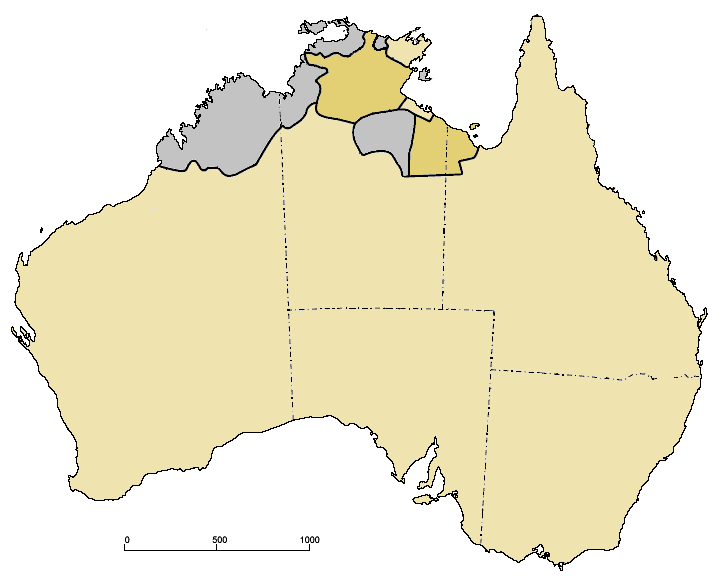
The Indigenous languages of Australia number in the hundreds, the precise number being quite uncertain, although there is a range of estimates from a minimum of around 250 (using the technical definition of 'language' as non-mutually intelligible varieties) up to possibly 363. The Indigenous languages of Australia comprise numerous language families and isolates, perhaps as many as 13, spoken by the Indigenous peoples of mainland Australia and a few nearby islands. The relationships between the language families are not clear at present although there are proposals to link some into larger groupings. Despite this uncertainty, the Indigenous Australian languages are collectively covered by the technical term "Australian languages", or the "Australian family".
The term can include both Tasmanian languages and the Western Torres Strait language, but the genetic relationship to the mainland Australian languages of the former is unknown, while the latter is Pama–Nyungan, though it shares features with the neighbouring Papuan, Eastern Trans-Fly languages, in particular Meriam Mir of the Torres Strait Islands, as well as the Papuan Tip Austronesian languages. Most Australian languages belong to the widespread Pama–Nyungan family, while the remainder are classified as "non-Pama–Nyungan", which is a term of convenience that does not imply a genealogical relationship.
In the late 18th century there were more than 250 distinct First Nations Peoples social groupings and a similar number of languages or varieties. The status and knowledge of Aboriginal languages today varies greatly. Many languages became extinct with settlement as the encroachment of colonial society broke up Indigenous cultures. For some of these languages, few records exist for vocabulary and grammar. At the start of the 21st century, fewer than 150 Aboriginal languages remained in daily use, with the majority being highly endangered. In 2020, 90 per cent of the barely more than 100 languages still spoken are considered endangered. Thirteen languages are still being acquired by children. The surviving languages are located in the most isolated areas. Of the five least endangered Western Australian Aboriginal languages, four belong to the Western Desert grouping of the Central and Great Victoria Desert.
Yolŋu languages from north-east Arnhem Land are also currently learned by children. Bilingual education is being used successfully in some communities. Seven of the most widely spoken Australian languages, such as Warlpiri, Murrinh-patha and Tiwi, retain between 1,000 and 3,000 speakers. Some Indigenous communities and linguists show support for learning programmes either for language revival proper or for only "post-vernacular maintenance" (Indigenous communities having the opportunity to learn some words and concepts related to the lost language).
The National Indigenous Languages Survey is a regular Australia-wide survey of the status of Aboriginal and Torres Strait Islander languages conducted in 2005, 2014 and 2019.
Languages with more than 100 speakers:
Total 47 languages, 42,300 speakers, with 11 having only approximately 100. 11 languages have over 1,000 speakers.
Most Australian languages are commonly held to belong to the Pama–Nyungan family, a family accepted by most linguists, with Robert M. W. Dixon as a notable exception. For convenience, the rest of the languages, all spoken in the far north, are commonly lumped together as "Non-Pama–Nyungan", although this does not necessarily imply that they constitute a valid clade. Dixon argues that after perhaps 40,000 years of mutual influence, it is no longer possible to distinguish deep genealogical relationships from areal features in Australia, and that not even Pama–Nyungan is a valid language family.
Hub AI
Australian Aboriginal languages AI simulator
(@Australian Aboriginal languages_simulator)
Australian Aboriginal languages
The Indigenous languages of Australia number in the hundreds, the precise number being quite uncertain, although there is a range of estimates from a minimum of around 250 (using the technical definition of 'language' as non-mutually intelligible varieties) up to possibly 363. The Indigenous languages of Australia comprise numerous language families and isolates, perhaps as many as 13, spoken by the Indigenous peoples of mainland Australia and a few nearby islands. The relationships between the language families are not clear at present although there are proposals to link some into larger groupings. Despite this uncertainty, the Indigenous Australian languages are collectively covered by the technical term "Australian languages", or the "Australian family".
The term can include both Tasmanian languages and the Western Torres Strait language, but the genetic relationship to the mainland Australian languages of the former is unknown, while the latter is Pama–Nyungan, though it shares features with the neighbouring Papuan, Eastern Trans-Fly languages, in particular Meriam Mir of the Torres Strait Islands, as well as the Papuan Tip Austronesian languages. Most Australian languages belong to the widespread Pama–Nyungan family, while the remainder are classified as "non-Pama–Nyungan", which is a term of convenience that does not imply a genealogical relationship.
In the late 18th century there were more than 250 distinct First Nations Peoples social groupings and a similar number of languages or varieties. The status and knowledge of Aboriginal languages today varies greatly. Many languages became extinct with settlement as the encroachment of colonial society broke up Indigenous cultures. For some of these languages, few records exist for vocabulary and grammar. At the start of the 21st century, fewer than 150 Aboriginal languages remained in daily use, with the majority being highly endangered. In 2020, 90 per cent of the barely more than 100 languages still spoken are considered endangered. Thirteen languages are still being acquired by children. The surviving languages are located in the most isolated areas. Of the five least endangered Western Australian Aboriginal languages, four belong to the Western Desert grouping of the Central and Great Victoria Desert.
Yolŋu languages from north-east Arnhem Land are also currently learned by children. Bilingual education is being used successfully in some communities. Seven of the most widely spoken Australian languages, such as Warlpiri, Murrinh-patha and Tiwi, retain between 1,000 and 3,000 speakers. Some Indigenous communities and linguists show support for learning programmes either for language revival proper or for only "post-vernacular maintenance" (Indigenous communities having the opportunity to learn some words and concepts related to the lost language).
The National Indigenous Languages Survey is a regular Australia-wide survey of the status of Aboriginal and Torres Strait Islander languages conducted in 2005, 2014 and 2019.
Languages with more than 100 speakers:
Total 47 languages, 42,300 speakers, with 11 having only approximately 100. 11 languages have over 1,000 speakers.
Most Australian languages are commonly held to belong to the Pama–Nyungan family, a family accepted by most linguists, with Robert M. W. Dixon as a notable exception. For convenience, the rest of the languages, all spoken in the far north, are commonly lumped together as "Non-Pama–Nyungan", although this does not necessarily imply that they constitute a valid clade. Dixon argues that after perhaps 40,000 years of mutual influence, it is no longer possible to distinguish deep genealogical relationships from areal features in Australia, and that not even Pama–Nyungan is a valid language family.