
Recent from talks
Australian Bicentenary
Knowledge base stats:
Talk channels stats:
Members stats:
Australian Bicentenary
The bicentenary of Australia was celebrated in 1988. It marked 200 years since the arrival of the First Fleet of British convict ships at Sydney in 1788.
The bicentennial year marked Captain Arthur Phillip's arrival with the 11 ships of the First Fleet in Sydney Harbour in 1788, and the founding of the city of Sydney and the colony of New South Wales. 1988 is considered the official bicentenary year of the founding of Australia.
The Australian Bicentenary was marked by pomp and ceremony across Australia to mark the anniversary of the arrival of the First Fleet of British ships at Sydney in 1788. The Australian Bicentennial Authority (ABA), pursuant to the Australian Bicentennial Authority Act 1980, was set up to plan, fund and coordinate projects that emphasized the nation's cultural heritage. State councils were also created to ensure cooperation between the federal and state governments. The result was a national programme of events and celebrations to commemorate the Bicentenary, including:
The opening ceremony of the 16th World Scout Jamboree, which took place at midnight on 31 December 1987, was the first official event of Australia's Bicentenary.
In collaboration with state governments, the Commonwealth/State Bicentennial Commemorative Program was established with the development of Heritage Trails in each state.
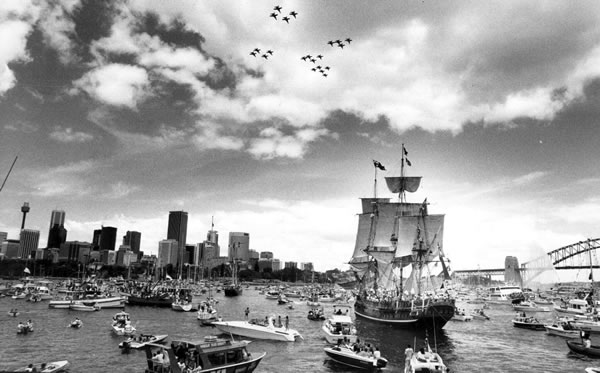
On Australia Day, Sydney Harbour hosted a re-enactment of the arrival of the First Fleet. The Hawke government refused to fund the First Fleet re-enactment, because it believed this might offend Indigenous Australians. 2GB in Sydney stepped in and held a fund raising appeal to keep the re-enactment on track. The government instead funded a rival display of Tall Ships which sailed up Australia's east coast and entered Sydney Harbour on the day, and it was felt that this was more acceptable to the Indigenous community.
Australia's floral emblem was officially declared to be the golden wattle Acacia pycnantha. The Gazettal was signed by the Governor General, Sir Ninian Stephen, on 19 August 1988. A ceremony was held on 1 September 1988 at the Australian National Botanic Gardens. The Minister for Home Affairs, Robert Ray, made the formal announcement and the Prime Minister's wife, Hazel Hawke, planted a golden wattle.
1988 was also marked by the completion of many unique development projects such as the Bicentennial National Trail and on 9 May of that year, Queen Elizabeth II opened the New Parliament House in Canberra. As well as this, the modern Darling Harbour precinct was completed and opened, as was the modern Sydney Football Stadium. It was also marked by the creation of one of Australia's most significant art works, the Aboriginal Memorial, which commemorated those Indigenous Australians who died as a result of European settlement. Other events included the Bicentennial Beacons, a series of bonfires lit around Australia. A celebration featuring motor cycle riders from around Australia was also held in Canberra during the year. Not all events went well with the disastrous Round Australia Yacht Race claiming several lives and being the subject of legal action.
Hub AI
Australian Bicentenary AI simulator
(@Australian Bicentenary_simulator)
Australian Bicentenary
The bicentenary of Australia was celebrated in 1988. It marked 200 years since the arrival of the First Fleet of British convict ships at Sydney in 1788.
The bicentennial year marked Captain Arthur Phillip's arrival with the 11 ships of the First Fleet in Sydney Harbour in 1788, and the founding of the city of Sydney and the colony of New South Wales. 1988 is considered the official bicentenary year of the founding of Australia.
The Australian Bicentenary was marked by pomp and ceremony across Australia to mark the anniversary of the arrival of the First Fleet of British ships at Sydney in 1788. The Australian Bicentennial Authority (ABA), pursuant to the Australian Bicentennial Authority Act 1980, was set up to plan, fund and coordinate projects that emphasized the nation's cultural heritage. State councils were also created to ensure cooperation between the federal and state governments. The result was a national programme of events and celebrations to commemorate the Bicentenary, including:
The opening ceremony of the 16th World Scout Jamboree, which took place at midnight on 31 December 1987, was the first official event of Australia's Bicentenary.
In collaboration with state governments, the Commonwealth/State Bicentennial Commemorative Program was established with the development of Heritage Trails in each state.
On Australia Day, Sydney Harbour hosted a re-enactment of the arrival of the First Fleet. The Hawke government refused to fund the First Fleet re-enactment, because it believed this might offend Indigenous Australians. 2GB in Sydney stepped in and held a fund raising appeal to keep the re-enactment on track. The government instead funded a rival display of Tall Ships which sailed up Australia's east coast and entered Sydney Harbour on the day, and it was felt that this was more acceptable to the Indigenous community.
Australia's floral emblem was officially declared to be the golden wattle Acacia pycnantha. The Gazettal was signed by the Governor General, Sir Ninian Stephen, on 19 August 1988. A ceremony was held on 1 September 1988 at the Australian National Botanic Gardens. The Minister for Home Affairs, Robert Ray, made the formal announcement and the Prime Minister's wife, Hazel Hawke, planted a golden wattle.
1988 was also marked by the completion of many unique development projects such as the Bicentennial National Trail and on 9 May of that year, Queen Elizabeth II opened the New Parliament House in Canberra. As well as this, the modern Darling Harbour precinct was completed and opened, as was the modern Sydney Football Stadium. It was also marked by the creation of one of Australia's most significant art works, the Aboriginal Memorial, which commemorated those Indigenous Australians who died as a result of European settlement. Other events included the Bicentennial Beacons, a series of bonfires lit around Australia. A celebration featuring motor cycle riders from around Australia was also held in Canberra during the year. Not all events went well with the disastrous Round Australia Yacht Race claiming several lives and being the subject of legal action.
Recent media