
Recent from talks
Acacia pycnantha
Knowledge base stats:
Talk channels stats:
Members stats:
Acacia pycnantha
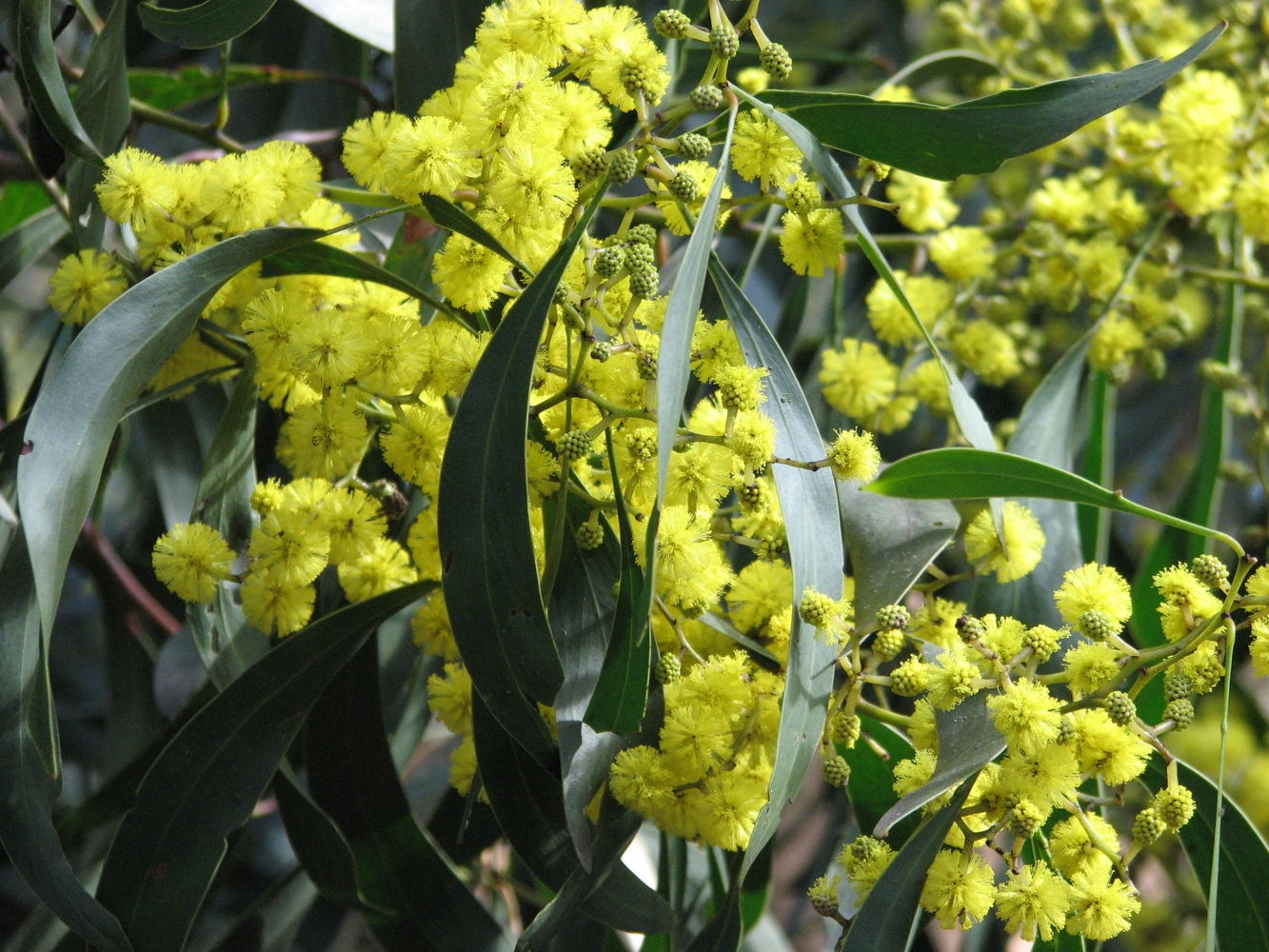
Acacia pycnantha, most commonly known as the golden wattle, is a tree of the family Fabaceae. It grows to a height of 8 metres (26 feet) and has phyllodes (flattened leaf stalks) instead of true leaves. The profuse fragrant, golden flowers appear in late winter and spring, followed by long seed pods. Explorer Thomas Mitchell collected the type specimen, from which George Bentham wrote the species description in 1842. The species is native to southeastern Australia as an understorey plant in eucalyptus forest. Plants are cross-pollinated by several species of honeyeater and thornbill, which visit nectaries on the phyllodes and brush against flowers, transferring pollen between them.
A. pycnantha has become a weed in areas of Australia, as well as in Africa and Eurasia. Its bark produces more tannin than any other wattle species, resulting in its commercial cultivation for production of this compound. It has been widely grown as an ornamental garden plant and for cut flower production. A. pycnantha was made the official floral emblem of Australia in 1988, and has been featured on the country's postal stamps.
Acacia pycnantha generally grows as a small tree to between 3 and 8 metres (10 and 30 feet) in height, though trees of up to 12 m (40 ft) high have been reported in Morocco. The bark is generally dark brown to grey—smooth in younger plants though it can be furrowed and rough in older plants. Branchlets may be bare and smooth or covered with a white bloom. The mature trees do not have true leaves but have phyllodes—flat and widened leaf stems—that hang down from the branches. Shiny and dark green, these are between 9 and 15 cm (3.5 and 5.9 in) long, 1–3.5 cm (0.4–1 in) wide and falcate (sickle-shaped) to oblanceolate in shape. New growth has a bronze colouration. Field observations at Hale Conservation Park show the bulk of new growth occurs over spring and summer from October to January.
Floral buds are produced year-round on the tips of new growth, but only those initiated between November and May go on to flower several months later. Flowering usually takes place from July to November (late winter to early summer) in the golden wattle's native range, and because the later buds develop faster, flowering peaks over July and August. The bright yellow inflorescences occur in groups of 40 to 80 on 2.5–9 cm (1–4 in)-long racemes that arise from axillary buds. Each inflorescence is a ball-like structure covered by 40 to 100 small flowers that have five tiny petals (pentamerous) and long erect stamens, which give the flower head a fluffy appearance.
Developing after flowering has finished, the seed pods are flattish, straight or slightly curved, 5–14 cm (2–6 in) long and 5–8 mm wide. They are initially bright green, maturing to dark brown and have slight constrictions between the seeds, which are arranged in a line in the pod. The oblong seeds themselves are 5.5 to 6 mm long, black and shiny, with a clavate (club-shaped) aril. They are released in December and January, when the pods are fully ripe.
Species similar in appearance include mountain hickory wattle (A. obliquinervia), coast golden wattle (A. leiophylla) and golden wreath wattle (A. saligna). Acacia obliquinervia has grey-green phyllodes, fewer flowers in its flower heads, and broader (1.25–2.5 cm (0.5–1 in)-wide) seed pods. A. leiophylla has paler phyllodes. A. saligna has longer, narrower phyllodes.
Acacia pycnantha was first formally described by botanist George Bentham in the London Journal of Botany in 1842. The type specimen was collected by the explorer Thomas Mitchell in present-day northern Victoria between Pyramid Hill and the Loddon River. Bentham thought it was related to A. leiophylla, which he described in the same paper. The specific epithet pycnantha is derived from the Greek words pyknos (dense) and anthos (flower), a reference to the dense cluster of flowers that make up the globular inflorescences. Queensland botanist Les Pedley reclassified the species as Racosperma pycnanthum in 2003, when he proposed placing almost all Australian members of the genus into the new genus Racosperma. However, this name is treated as a synonym of its original name.
Johann Georg Christian Lehmann described Acacia petiolaris in 1851 from a plant grown at Hamburg Botanic Gardens from seed said to be from the Swan River Colony (Perth). Carl Meissner described A. falcinella from material from Port Lincoln in 1855. Bentham classified both as A. pycnantha in his 1864 Flora Australiensis, though he did categorise a possible subspecies angustifolia based on material from Spencer Gulf with narrower phyllodes and fewer inflorescences. However, no subspecies are currently recognised, though an informal classification distinguishes wetland and dryland forms, the latter with narrower phyllodes.
Hub AI
Acacia pycnantha AI simulator
(@Acacia pycnantha_simulator)
Acacia pycnantha
Acacia pycnantha, most commonly known as the golden wattle, is a tree of the family Fabaceae. It grows to a height of 8 metres (26 feet) and has phyllodes (flattened leaf stalks) instead of true leaves. The profuse fragrant, golden flowers appear in late winter and spring, followed by long seed pods. Explorer Thomas Mitchell collected the type specimen, from which George Bentham wrote the species description in 1842. The species is native to southeastern Australia as an understorey plant in eucalyptus forest. Plants are cross-pollinated by several species of honeyeater and thornbill, which visit nectaries on the phyllodes and brush against flowers, transferring pollen between them.
A. pycnantha has become a weed in areas of Australia, as well as in Africa and Eurasia. Its bark produces more tannin than any other wattle species, resulting in its commercial cultivation for production of this compound. It has been widely grown as an ornamental garden plant and for cut flower production. A. pycnantha was made the official floral emblem of Australia in 1988, and has been featured on the country's postal stamps.
Acacia pycnantha generally grows as a small tree to between 3 and 8 metres (10 and 30 feet) in height, though trees of up to 12 m (40 ft) high have been reported in Morocco. The bark is generally dark brown to grey—smooth in younger plants though it can be furrowed and rough in older plants. Branchlets may be bare and smooth or covered with a white bloom. The mature trees do not have true leaves but have phyllodes—flat and widened leaf stems—that hang down from the branches. Shiny and dark green, these are between 9 and 15 cm (3.5 and 5.9 in) long, 1–3.5 cm (0.4–1 in) wide and falcate (sickle-shaped) to oblanceolate in shape. New growth has a bronze colouration. Field observations at Hale Conservation Park show the bulk of new growth occurs over spring and summer from October to January.
Floral buds are produced year-round on the tips of new growth, but only those initiated between November and May go on to flower several months later. Flowering usually takes place from July to November (late winter to early summer) in the golden wattle's native range, and because the later buds develop faster, flowering peaks over July and August. The bright yellow inflorescences occur in groups of 40 to 80 on 2.5–9 cm (1–4 in)-long racemes that arise from axillary buds. Each inflorescence is a ball-like structure covered by 40 to 100 small flowers that have five tiny petals (pentamerous) and long erect stamens, which give the flower head a fluffy appearance.
Developing after flowering has finished, the seed pods are flattish, straight or slightly curved, 5–14 cm (2–6 in) long and 5–8 mm wide. They are initially bright green, maturing to dark brown and have slight constrictions between the seeds, which are arranged in a line in the pod. The oblong seeds themselves are 5.5 to 6 mm long, black and shiny, with a clavate (club-shaped) aril. They are released in December and January, when the pods are fully ripe.
Species similar in appearance include mountain hickory wattle (A. obliquinervia), coast golden wattle (A. leiophylla) and golden wreath wattle (A. saligna). Acacia obliquinervia has grey-green phyllodes, fewer flowers in its flower heads, and broader (1.25–2.5 cm (0.5–1 in)-wide) seed pods. A. leiophylla has paler phyllodes. A. saligna has longer, narrower phyllodes.
Acacia pycnantha was first formally described by botanist George Bentham in the London Journal of Botany in 1842. The type specimen was collected by the explorer Thomas Mitchell in present-day northern Victoria between Pyramid Hill and the Loddon River. Bentham thought it was related to A. leiophylla, which he described in the same paper. The specific epithet pycnantha is derived from the Greek words pyknos (dense) and anthos (flower), a reference to the dense cluster of flowers that make up the globular inflorescences. Queensland botanist Les Pedley reclassified the species as Racosperma pycnanthum in 2003, when he proposed placing almost all Australian members of the genus into the new genus Racosperma. However, this name is treated as a synonym of its original name.
Johann Georg Christian Lehmann described Acacia petiolaris in 1851 from a plant grown at Hamburg Botanic Gardens from seed said to be from the Swan River Colony (Perth). Carl Meissner described A. falcinella from material from Port Lincoln in 1855. Bentham classified both as A. pycnantha in his 1864 Flora Australiensis, though he did categorise a possible subspecies angustifolia based on material from Spencer Gulf with narrower phyllodes and fewer inflorescences. However, no subspecies are currently recognised, though an informal classification distinguishes wetland and dryland forms, the latter with narrower phyllodes.
Recent media