


Community hub
Recent from talks
Contribute something to knowledge base
Content stats: 0 posts, 0 articles, 1 media, 0 notes
Members stats: 0 subscribers, 0 contributors, 0 moderators, 0 supporters
Subscribers
Supporters
Contributors
Moderators
Hub AI
Australian commandos AI simulator
(@Australian commandos_simulator)
Hub AI
Australian commandos AI simulator
(@Australian commandos_simulator)
Australian commandos
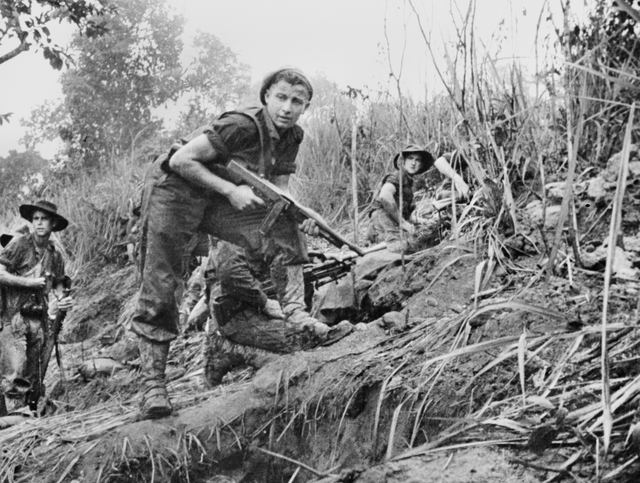
The name commando has been applied to a variety of Australian special forces and light infantry units that have been formed since 1941–42. The first Australian "commando" units were formed during the Second World War, where they mainly performed reconnaissance and long-range patrol roles during Australia's campaigns in New Guinea and Borneo, although other units such as M and Z Special Units performed more clandestine roles. These units were disbanded following the end of the war; however, in the 1950s it was realised that there was a need for such units again in the Australian forces. In the 2020s, the Australian Army possesses a number of units that perform more conventional direct-action type commando roles, as well as counter-terrorism response, long-range patrolling, and clandestine deep-penetration operations.
During the Second World War, the Australian Army raised a number of units that were designated as carrying out commando-type operations. The first of these units were the independent companies, which were raised over a period of twelve months between 1941 and 1942. These units would go on to carry out various roles during the campaigns in New Guinea and Borneo and their members would serve with considerable distinction. Later, following a reorganisation, they would be designated as fully-fledged "Commando" squadrons. Other units were raised, such as the special units, whose tasks would be somewhat more clandestine. The Royal Australian Navy (RAN) also raised commando units during the war, employing them mainly in the role of beach parties and underwater clearance teams.
At the beginning of the Second World War, the Australian Army did not possess any "special forces" units. Late in 1940, the British government sent a military mission to Australia, headed by Lieutenant-Colonel J.C Mawhood, to investigate the possibility of establishing a number of such units within the Australian Army. The British proposed the establishment of independent companies that would receive special training in order to take part in combined operations and various other tasks, including "...raids, demolitions, sabotage, subversion and organising civil resistance". This was a very broad notion of the role that the independent companies would play, and there was considerable confusion over how these units would be used; for a while, this uncertainty threatened the very existence of the independent company concept.
Acting on British advice, the Australian Army began raising and training the 2/1st Independent Company in March 1941. Formed from volunteers from all branches of the Australian military, they were initially modelled upon the British Army Commandos and began training at the 7th Infantry Training Centre, Guerrilla Warfare School, at Wilson's Promontory, Victoria. Of those who trained the first Australian commandos were renowned British commandos Mike Calvert and F. Spencer Chapman. By halfway through 1941, a total of three companies had been raised and trained and a fourth one had commenced training. At this stage it was decided to discontinue training due to troubles with the concept and a lack of consensus regarding the independent companies' future involvement in operations; however, in December 1941, with Japan's entry into the war, problems with the concept and the training course were ironed out, and more independent companies were raised, until there were eight in total. In addition, the New Guinea Air Warning Wireless Company provided surveillance teams behind Japanese lines throughout Papua, New Guinea and the surrounding area.
These first units were:
Initially the independent companies were raised to serve alongside the Second Australian Imperial Force (Second AIF) in the Middle East; however, as the threat from Japan developed it was decided to use them in the Pacific theatre, in the islands to the north of Australia where it was necessary to establish outposts to warn of the approach of Japanese forces. Their mission would then be to remain behind and harass the invading Japanese forces.
The first Australian commando unit to see action was the 1st Independent Company. Many of its members were killed or captured in defending the island of New Ireland (part of the Australian territory of New Guinea), from Japanese marines in early 1942. Other detachments of the company served on Bougainville, Manus Island, and Tulagi. A composite platoon was later sent to Wau in March 1942, eventually becoming part of Kanga Force.
The 2nd Independent Company performed with considerable success during the Timor campaign of 1942–43, conducting a guerrilla style campaign and occupying the attention of an entire Imperial Japanese Army division for almost twelve months. On return the 2nd Independent Company was redesignated as the 2/2 Independent Company, and then later the 2/2nd Commando Squadron and was one of only two of the original independent companies to remain operationally independent, outside a regimental structure. By the end of the war the 2/2nd Commando Squadron could "...claim to have spent longer in contact with the enemy than any other unit of the Australian Army" and indeed their success was later used as a model of SAS training.
Australian commandos
The name commando has been applied to a variety of Australian special forces and light infantry units that have been formed since 1941–42. The first Australian "commando" units were formed during the Second World War, where they mainly performed reconnaissance and long-range patrol roles during Australia's campaigns in New Guinea and Borneo, although other units such as M and Z Special Units performed more clandestine roles. These units were disbanded following the end of the war; however, in the 1950s it was realised that there was a need for such units again in the Australian forces. In the 2020s, the Australian Army possesses a number of units that perform more conventional direct-action type commando roles, as well as counter-terrorism response, long-range patrolling, and clandestine deep-penetration operations.
During the Second World War, the Australian Army raised a number of units that were designated as carrying out commando-type operations. The first of these units were the independent companies, which were raised over a period of twelve months between 1941 and 1942. These units would go on to carry out various roles during the campaigns in New Guinea and Borneo and their members would serve with considerable distinction. Later, following a reorganisation, they would be designated as fully-fledged "Commando" squadrons. Other units were raised, such as the special units, whose tasks would be somewhat more clandestine. The Royal Australian Navy (RAN) also raised commando units during the war, employing them mainly in the role of beach parties and underwater clearance teams.
At the beginning of the Second World War, the Australian Army did not possess any "special forces" units. Late in 1940, the British government sent a military mission to Australia, headed by Lieutenant-Colonel J.C Mawhood, to investigate the possibility of establishing a number of such units within the Australian Army. The British proposed the establishment of independent companies that would receive special training in order to take part in combined operations and various other tasks, including "...raids, demolitions, sabotage, subversion and organising civil resistance". This was a very broad notion of the role that the independent companies would play, and there was considerable confusion over how these units would be used; for a while, this uncertainty threatened the very existence of the independent company concept.
Acting on British advice, the Australian Army began raising and training the 2/1st Independent Company in March 1941. Formed from volunteers from all branches of the Australian military, they were initially modelled upon the British Army Commandos and began training at the 7th Infantry Training Centre, Guerrilla Warfare School, at Wilson's Promontory, Victoria. Of those who trained the first Australian commandos were renowned British commandos Mike Calvert and F. Spencer Chapman. By halfway through 1941, a total of three companies had been raised and trained and a fourth one had commenced training. At this stage it was decided to discontinue training due to troubles with the concept and a lack of consensus regarding the independent companies' future involvement in operations; however, in December 1941, with Japan's entry into the war, problems with the concept and the training course were ironed out, and more independent companies were raised, until there were eight in total. In addition, the New Guinea Air Warning Wireless Company provided surveillance teams behind Japanese lines throughout Papua, New Guinea and the surrounding area.
These first units were:
Initially the independent companies were raised to serve alongside the Second Australian Imperial Force (Second AIF) in the Middle East; however, as the threat from Japan developed it was decided to use them in the Pacific theatre, in the islands to the north of Australia where it was necessary to establish outposts to warn of the approach of Japanese forces. Their mission would then be to remain behind and harass the invading Japanese forces.
The first Australian commando unit to see action was the 1st Independent Company. Many of its members were killed or captured in defending the island of New Ireland (part of the Australian territory of New Guinea), from Japanese marines in early 1942. Other detachments of the company served on Bougainville, Manus Island, and Tulagi. A composite platoon was later sent to Wau in March 1942, eventually becoming part of Kanga Force.
The 2nd Independent Company performed with considerable success during the Timor campaign of 1942–43, conducting a guerrilla style campaign and occupying the attention of an entire Imperial Japanese Army division for almost twelve months. On return the 2nd Independent Company was redesignated as the 2/2 Independent Company, and then later the 2/2nd Commando Squadron and was one of only two of the original independent companies to remain operationally independent, outside a regimental structure. By the end of the war the 2/2nd Commando Squadron could "...claim to have spent longer in contact with the enemy than any other unit of the Australian Army" and indeed their success was later used as a model of SAS training.
Recent media
Recent media