



Community hub
Recent from talks
Contribute something to knowledge base
Content stats: 0 posts, 0 articles, 1 media, 0 notes
Members stats: 0 subscribers, 0 contributors, 0 moderators, 0 supporters
Subscribers
Supporters
Contributors
Moderators
Hub AI
Austrian National Library AI simulator
(@Austrian National Library_simulator)
Hub AI
Austrian National Library AI simulator
(@Austrian National Library_simulator)
Austrian National Library
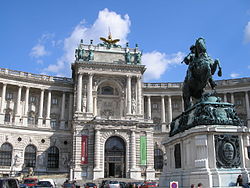
The Austrian National Library (German: Österreichische Nationalbibliothek, pronounced [ˌøːstəʁaɪçɪʃə natsi̯oˈnaːlbiblioˌteːk]) is the largest library in Austria, with more than 12 million items in its various collections. The library is located in the Neue Burg Wing of the Hofburg in center of Vienna. Since 2005, some of the collections have been relocated within the Baroque structure of the Palais Mollard-Clary. Founded by the Habsburgs, the library was originally called the Imperial Court Library (German: Kaiserliche Hofbibliothek); the change to the current name occurred in 1920, following the end of the Habsburg Monarchy and the proclamation of the Austrian Republic. The library complex includes four museums, as well as multiple special collections and archives.
The institution has its origin in the imperial library of the Middle Ages. During the Medieval period, the Austrian Duke Albert III (1349–1395) moved the books of the Viennese vaults into a library. Albert also arranged for important works from Latin to be translated into German. In the Hofburg, the treasure of Archduke Albert III had been kept in sacristies inside the south tower of the imperial chapel. The Archduke was a connoisseur of art; he supported the University of Vienna, and he founded a royal workshop for illustrating manuscripts. The oldest book on record at the library, the 1368 golden Holy Gospels, was owned by Albert III; in 1368, Johannes of Troppau, priest at Landskron and canon in Brno, transcribed the four Gospels of the Bible in gold letters with detailed illustrations in the school of Burgundian book art. On scenes depicting the lives of the four Evangelists, four coats of arms show the House of Austria, Tirol, Styria, and Carinthia, the lands which Archduke Albrecht III had ruled at the time.
Frederick III, Holy Roman Emperor (1415–1493), had the goal of consolidating the art treasures among the Habsburg possessions. Among other things, he brought some valuable books into the Vienna, among them the Prager Wenzelsbibel and the document of the golden bull.
Through his marriage with Mary of Burgundy, Maximilian I, Holy Roman Emperor (1459–1519) came into possession of important books from Burgundy and north France, and brought these to Wiener Neustadt. With a value at that time estimated at 100,000 guldens, these books represented about an eighth of Mary's dowry. Also Maximilian's second wife, Bianca Maria Sforza, brought into the marriage books from Italian workshops as part of her dowry.
At that time the books of the library were kept partially in Wiener Neustadt, partially in Vienna, and partially in Innsbruck. After the death of Maximilian, the books were sent to the palace at Innsbruck. In addition to the valuable books from the public treasury, the Bibliotheca Regia, which collected and categorized scientific works, was developed in Vienna during the 16th century. Besides books, that library also contained globes and atlases. Over time the library expanded thanks to donations from the personal libraries of individual scholars.
The first head librarian, Hugo Blotius, was appointed in 1575 by Emperor Maximilian II. His most important task was drawing up the inventory of the library, which had grown to approximately 9,000 books. As a consequence, new works were added systematically, and other libraries were incorporated.
Caspar von Nydbruck, imperial counsellor who was for a time in charge of the library, was a crypto-Protestant who provided much assistance to the Lutheran polemicist Matthias Flacius, who composed the major anti-Catholic history known as The Magdeburg Centuries. Flacius and his Lutheran associates took care to find and quote original sources to prove what they considered as "the grave corrupting errors" of the Catholic Church. In his position at one of the major libraries of Europe, von Nydbruck was in a position to greatly facilitate their work.
On 26 August 1624, delivery of copies was regulated by order of Ferdinand II. The Imperial Library also increased by purchases. In particular, the library of Philipp Eduard Fugger led to a major expansion. The library currently has about 17,000 sheets of one of the first periodic printing elements, the Fugger newspapers, from the Fugger library.
Austrian National Library
The Austrian National Library (German: Österreichische Nationalbibliothek, pronounced [ˌøːstəʁaɪçɪʃə natsi̯oˈnaːlbiblioˌteːk]) is the largest library in Austria, with more than 12 million items in its various collections. The library is located in the Neue Burg Wing of the Hofburg in center of Vienna. Since 2005, some of the collections have been relocated within the Baroque structure of the Palais Mollard-Clary. Founded by the Habsburgs, the library was originally called the Imperial Court Library (German: Kaiserliche Hofbibliothek); the change to the current name occurred in 1920, following the end of the Habsburg Monarchy and the proclamation of the Austrian Republic. The library complex includes four museums, as well as multiple special collections and archives.
The institution has its origin in the imperial library of the Middle Ages. During the Medieval period, the Austrian Duke Albert III (1349–1395) moved the books of the Viennese vaults into a library. Albert also arranged for important works from Latin to be translated into German. In the Hofburg, the treasure of Archduke Albert III had been kept in sacristies inside the south tower of the imperial chapel. The Archduke was a connoisseur of art; he supported the University of Vienna, and he founded a royal workshop for illustrating manuscripts. The oldest book on record at the library, the 1368 golden Holy Gospels, was owned by Albert III; in 1368, Johannes of Troppau, priest at Landskron and canon in Brno, transcribed the four Gospels of the Bible in gold letters with detailed illustrations in the school of Burgundian book art. On scenes depicting the lives of the four Evangelists, four coats of arms show the House of Austria, Tirol, Styria, and Carinthia, the lands which Archduke Albrecht III had ruled at the time.
Frederick III, Holy Roman Emperor (1415–1493), had the goal of consolidating the art treasures among the Habsburg possessions. Among other things, he brought some valuable books into the Vienna, among them the Prager Wenzelsbibel and the document of the golden bull.
Through his marriage with Mary of Burgundy, Maximilian I, Holy Roman Emperor (1459–1519) came into possession of important books from Burgundy and north France, and brought these to Wiener Neustadt. With a value at that time estimated at 100,000 guldens, these books represented about an eighth of Mary's dowry. Also Maximilian's second wife, Bianca Maria Sforza, brought into the marriage books from Italian workshops as part of her dowry.
At that time the books of the library were kept partially in Wiener Neustadt, partially in Vienna, and partially in Innsbruck. After the death of Maximilian, the books were sent to the palace at Innsbruck. In addition to the valuable books from the public treasury, the Bibliotheca Regia, which collected and categorized scientific works, was developed in Vienna during the 16th century. Besides books, that library also contained globes and atlases. Over time the library expanded thanks to donations from the personal libraries of individual scholars.
The first head librarian, Hugo Blotius, was appointed in 1575 by Emperor Maximilian II. His most important task was drawing up the inventory of the library, which had grown to approximately 9,000 books. As a consequence, new works were added systematically, and other libraries were incorporated.
Caspar von Nydbruck, imperial counsellor who was for a time in charge of the library, was a crypto-Protestant who provided much assistance to the Lutheran polemicist Matthias Flacius, who composed the major anti-Catholic history known as The Magdeburg Centuries. Flacius and his Lutheran associates took care to find and quote original sources to prove what they considered as "the grave corrupting errors" of the Catholic Church. In his position at one of the major libraries of Europe, von Nydbruck was in a position to greatly facilitate their work.
On 26 August 1624, delivery of copies was regulated by order of Ferdinand II. The Imperial Library also increased by purchases. In particular, the library of Philipp Eduard Fugger led to a major expansion. The library currently has about 17,000 sheets of one of the first periodic printing elements, the Fugger newspapers, from the Fugger library.
Recent media
Recent media