Hubbry Logo
ArchdukeArchdukeMain
Open search
Archduke
Community hub
Archduke
logo
8 pages, 0 posts
0 subscribers
Be the first to start a discussion here.
Archduke
Archduke
from Wikipedia
Archducal hat, the coronet of the Archduchy of Austria kept in the treasury of Klosterneuburg Abbey

Archduke (feminine: archduchess; German: Erzherzog, feminine form: Erzherzogin) was the title borne from 1358 by the Habsburg rulers of the Archduchy of Austria, and later by all senior members of that dynasty. It denotes a rank within the former Holy Roman Empire (962–1806), which was below that of emperor, and roughly equal to that of king, prince-(arch)bishop, and grand duke, but above that of sovereign prince and duke.[1]

The territory ruled by an archduke or archduchess was called an archduchy. All remaining archduchies ceased to exist in 1918. The current head of the House of Habsburg is Karl Habsburg.

Terminology

[edit]

The English word is first recorded in 1530, derived from Middle French archeduc, a 15th-century derivation from Medieval Latin archidux, from Latin archi- (Greek ἀρχι-) meaning "authority" or "primary" (see arch-) and dux "duke" (literally "leader").[2]

"Archduke" (German: Erzherzog; Dutch: aartshertog) is a title distinct from "grand duke" (French: grand-duc; Luxembourgish: Groussherzog; German: Großherzog; Dutch: groothertog), a later monarchic title borne by the rulers of other European countries (for instance, Luxembourg).

History

[edit]

The Latin title archidux is first attested in reference to Bruno the Great, who ruled simultaneously as Archbishop of Cologne and Duke of Lotharingia in the 10th century, in the work of his biographer Ruotger of Cologne. In Ruotger, the title served as an honorific denoting Bruno's unusual position rather than a formal office.[3]

The title was not used systematically until the 14th century, when the title "Archduke of Austria" was invented in the forged Privilegium Maius (1358–1359) by Duke Rudolf IV of Austria, called Rudolf the Founder (German: Rudolf der Stifter). Rudolf originally claimed the title in the form palatinus archidux ("palatine archduke").[4] The title was intended to emphasize the claimed precedence (thus "Arch-") of the Duchy of Austria, in an effort to put the Habsburgs on an even level with the Prince-Electors of the Holy Roman Empire, as Austria had been passed over when the Golden Bull of 1356 assigned that dignity to the four highest-ranking secular Imperial princes and three Archbishops. Holy Roman Emperor Charles IV refused to recognise the title, as did all the other ruling dynasties of the member countries of the Empire. But Duke Ernest the Iron and his descendants unilaterally assumed the title of Archduke.

The archducal title was only officially recognized in 1453 by Emperor Frederick III, when the Habsburgs had solidified their grip on the throne of the de jure elected Holy Roman Emperor, making it de facto hereditary.[5][6] Despite that imperial authorization of the title, which showed a Holy Roman Emperor from the Habsburg dynasty deciding over a title claim of the Habsburg dynasty, many ruling dynasties of the countries which formed the Empire refused to recognize the title "Archduke". Ladislaus the Posthumous, Duke of Austria, who died in 1457, never got in his lifetime the imperial authorization to use it, and accordingly, neither he nor anyone in his branch of the dynasty ever used the title. Emperor Frederick III himself simply used the title "Duke of Austria", never Archduke, until his death in 1493. The title was first granted to Frederick's younger brother, Albert VI of Austria (d. 1463), who used it at least from 1458.

In 1477, Frederick III also granted the title of Archduke to his first cousin, Sigismund of Austria, ruler of Further Austria (German: Vorderösterreich). Frederick's son and heir, the future Emperor Maximilian I, started to use the title, but apparently only after the death of his wife Mary of Burgundy (d. 1482), as Archduke never appears in documents issued jointly by Maximilian and Mary as rulers in the Low Countries (where Maximilian is still titled "Duke of Austria"). The title appears first in documents issued under the joint rule of Maximilian and his son Philip in the Low Countries.

Archduke was initially borne by those dynasts who ruled a Habsburg territory—i.e., only by males and their consorts, appanages being commonly distributed to cadets. But these "junior" archdukes did not thereby become sovereign hereditary rulers, since all territories remained vested in the Austrian crown. Occasionally a territory might be combined with a separate gubernatorial mandate ruled by an archducal cadet.

Usage

[edit]

From the 16th century onward, "Archduke" and its female form, "Archduchess", came to be used by all the members of the House of Habsburg (e.g. Queen Marie Antoinette of France was born Archduchess Maria Antonia of Austria). Upon extinction of the male line of the Habsburgs and the marriage of their heiress, the Holy Roman Empress-consort Maria Theresa, Queen of Hungary and Archduchess of Austria, to Francis Stephen, Duke of Lorraine, who was elected Holy Roman Emperor, their descendants formed the House of Habsburg-Lorraine. After the dissolution of the Holy Roman Empire this usage was retained in the Austrian Empire (1804–1867) and the Austro-Hungarian Empire (1867–1918).[5]

The official use of titles of nobility and of all other hereditary titles, including Archduke, has been illegal in the Republic of Austria for Austrian citizens since the Law on the Abolition of Nobility (Gesetz vom 3. April 1919 über die Aufhebung des Adels, der weltlichen Ritter- und Damenorden und gewisser Titel und Würden). Thus those members of the Habsburg family who are residents of the Republic of Austria are simply known by their first name(s) and their surname Habsburg-Lothringen. However, members of the family who reside in other countries may or may not use the title, in accordance with laws and customs in those nations.

For example, Otto Habsburg-Lothringen (1912–2011), the eldest son of the last Habsburg Emperor, was an Austrian, Hungarian and German citizen. As he lived in Germany, where it is permitted to use hereditary titles as part of the civil surname (including indications of origin, such as von or zu), his official civil name was Otto von Habsburg (literally: Otto of Habsburg), whereas in Austria he was registered as Otto Habsburg.[5]

The Monarchs of Spain also bear the nominal title of Archduke/Archduchess of Austria as part of their full list of titles, as the Bourbon dynasty adopted all the titles previously held by the Spanish Habsburgs when they took over the Spanish throne. However, "Archduke" was never considered by the Spanish Bourbons as a substantial dignity of their own dynasty, but rather as a traditional supplementary title of the Spanish Crown since the days of the Habsburg dynasty on the royal throne (1516–1700). Hence, no member of the royal family other than the Monarch bears the (additional) title of "Archduke".

Insignia

[edit]

The insignia of the Archduke of Lower and Upper Austria was the archducal hat, a coronet which is kept in Klosterneuburg Monastery.

See also

[edit]

References and notes

[edit]
[edit]
Revisions and contributorsEdit on WikipediaRead on Wikipedia
from Grokipedia
An archduke (German: Erzherzog; feminine: archduchess, Erzherzogin) is a hereditary title of nobility created exclusively for the House of Habsburg, initially denoting the ruler of the Archduchy of Austria and subsequently extended to all senior male members of the dynasty. The title, which ranked above duke but below king, symbolized the pre-eminent status of the Habsburgs within the Holy Roman Empire and later the Austro-Hungarian Empire. The title originated in 1359 when Duke Rudolf IV of forged the Privilegium Maius documents to assert his elevation to "Archduke Palatine," compensating for the Habsburgs' exclusion from the under the of 1356. Though the forgery was initially exposed by Emperor Charles IV, Frederick III formally recognized the archducal title in 1453, rendering it hereditary and integral to Habsburg sovereignty. This innovation elevated to an archduchy, distinguishing it from ordinary duchies and bolstering the dynasty's claims to imperial precedence. By the , the title encompassed sons and other male descendants of the Habsburg emperors, reinforcing familial unity and dynastic influence across . Archdukes often governed territories, commanded armies, and played pivotal roles in Habsburg and warfare, with the title persisting until the dissolution of the Austro-Hungarian in 1918. Notable controversies include the title's fabricated origins, which underscore the Habsburgs' strategic use of to amass power without imperial consent. The archducal coronet, a symbolic headdress distinct from crowns, visually represented this elevated yet non-regal status.

Terminology and Origins

Etymology and Definition

The English term archduke derives from Middle Latin archidux, a compound of the Greek-derived prefix archi- ("chief" or "principal") and Latin dux ("leader" or "duke"), first appearing in English records around the late 15th century to denote a sovereign or high-ranking noble above an ordinary duke. The German equivalent, Erzherzog, employs the prefix Erz- (from the same Greek root via Old High German, signifying primacy or excellence) affixed to Herzog ("duke"), reflecting the title's elevation within Germanic nobility. Historically, the title archduke designated the ruler of an archduchy—a elevated above a standard —or, from the onward, the male members of the Habsburg dynasty, including sons and male-line descendants of the or later the . Within the Holy Roman Empire's hierarchy (962–1806), it conferred precedence roughly equivalent to that of a or electoral prince, positioning its holder below the but above dukes, margraves, and other secular princes, while emphasizing authority over an imperial fief like . This usage remained confined almost exclusively to the Habsburgs after its formal adoption, distinguishing it from similar elevated titles like , which emerged independently in other European contexts.

Forged Creation by Rudolf IV

In 1358, Duke Rudolf IV of Austria (1339–1365), seeking to enhance the prestige and autonomy of his duchy within the Holy Roman Empire, commissioned his chancery to forge a series of documents collectively known as the Privilegium Maius. These five fabricated privileges purported to originate from medieval emperors, including Frederick I Barbarossa (dated to 1156) and others from the 11th and 12th centuries, granting Austria exceptional rights such as exemption from imperial oversight and elevation above other duchies. The forgeries were crafted during the winter of 1358/59, with Rudolf IV personally assuming the elevated title of Pfalz-Erzherzog (Archduke Palatine) on November 11, 1358, positioning Austria akin to an ecclesiastical province with palatine privileges similar to those of the Elector Palatine of the Rhine. The Privilegium Maius invented the archducal title (Erzherzog) entirely, as no such rank existed in the Empire's hierarchy prior to Rudolf's initiative; it was modeled loosely on archbishops' authority but applied to secular Habsburg rulers to assert quasi-sovereign status, including rights to mint coins, impose tolls, and judge high treason without imperial interference. Rudolf's motivation stemmed from resentment over Austria's exclusion from the electoral college after the Golden Bull of 1356, which formalized seven electors and sidelined Habsburg influence; the forgeries aimed to retroactively legitimize Austria's precedence through fabricated imperial grants. Though the documents were presented as ancient originals, their anachronistic language and seals betrayed their recent fabrication, a deception facilitated by Rudolf's control over ducal administration amid the Empire's fragmented authority under Emperor Charles IV. The forgery's exposure came in the 1440s under Emperor Frederick III, whose scholars, including , debunked the Privilegium Maius as spurious, leading to its formal repudiation. Despite this, practical recognition followed: in 1453, Frederick III, himself a Habsburg, granted the archducal title legitimately to Austria's rulers via the Archducal Bull, retroactively validating Rudolf's innovation and embedding it in Habsburg nomenclature, though the underlying privileges remained contested until the Empire's dissolution. This act of Privilegium Maius exemplified 14th-century princely ambitions for territorial sovereignty, prioritizing dynastic elevation over strict fealty to imperial norms, and laid the groundwork for the Habsburgs' later claims to imperial primacy.

Historical Role and Evolution

Early Adoption in Habsburg Territories

The title of Archduke (Erzherzog), initially claimed through the forged Privilegium Maius by Rudolf IV in 1359, saw its first practical adoption among Habsburg rulers in the early 15th century within their fragmented territories. Duke Ernest the Iron (1377–1424), governing the Inner Austrian lands of Styria, Carinthia, and Carniola from 1406, became the earliest Habsburg to actively employ the title in official documents and self-stylings, asserting precedence over other imperial princes without imperial challenge at the time. This usage reflected the Habsburgs' efforts to consolidate authority in their southeastern territories amid ongoing feuds and the empire's decentralized structure, where local ducal power often outpaced formal titles. Formal legitimization occurred on April 4, 1453, when Holy Roman Emperor Frederick III—himself Duke of Austria and a Habsburg—ratified the Privilegium Maius and elevated the Duchy of Austria to the status of an Archduchy, thereby confirming the archducal dignity as hereditary for the House of Habsburg and applicable across their holdings. Frederick extended the title to his brothers Albert VI and Sigismund, as well as to his son Maximilian, marking a pivotal shift from contested innovation to institutionalized privilege within Habsburg domains, including Austria proper and adjacent principalities. This decree, issued amid Frederick's struggles to assert control over Austria following the death of his cousin Albert II in 1439, underscored the title's role in bolstering dynastic claims during a period of internal strife, such as the Austrian-Hungarian War (1454–1456), where archducal authority helped rally loyalty in territories like Upper and Lower Austria. By the reign of Frederick's son (1459–1519), who succeeded as of in 1490 and emperor in 1493, the archducal was routinely invoked in Habsburg governance across their territories, facilitating administrative unity and diplomatic leverage. For instance, Maximilian's use of the in treaties and coinage reinforced Habsburg in lands stretching from the valley to the Adriatic, predating its broader extension to all family members in the . This early territorial adoption laid the groundwork for the 's evolution, prioritizing Habsburg over electoral dependencies in the .

Expansion and Precedence in the Holy Roman Empire

The title of Erzherzog (Archduke), invented by Rudolf IV, Duke of Austria, through the forged Privilegium Maius in 1358–1359, aimed to position Habsburg rulers as palatinus archidux, a rank endowed with electoral-like privileges including legislative autonomy, judicial sovereignty, and exemption from imperial taxes, thereby claiming superiority over standard dukes within the Holy Roman Empire. Holy Roman Emperor Charles IV rejected this self-elevation in 1359, denying Austria electoral status and blocking the title's integration into the Empire's formal hierarchy. Habsburg dukes persisted in using the Archduke style without imperial approval, applying it hereditarily to Austria's rulers and gradually extending it to cadet branches governing , , and Tyrol by the early , which incrementally broadened the 's dynastic scope amid Habsburg territorial consolidation. This unilateral expansion leveraged the family's growing influence, particularly after their near-permanent hold on the imperial throne from 1438 onward (interrupted only 1742–1745 and 1792), allowing the title to function as a marker of preeminence among non-royal princes. Formal recognition arrived in 1453 under Emperor Frederick III, a Habsburg who ratified the title for Austria's , transforming the into an archduchy and embedding it in imperial protocol as a unique rank above and but below or elector, with associated rights to mint coinage, regulate mining, and convene independently. This endorsement solidified Habsburg precedence, as the title's exclusivity to their house—unlike the more common ducal rank—reinforced collective dynastic authority, enabling archdukes to outrank other imperial in ceremonies and while avoiding the imperial veto required for kingship. By the late , the Archduke's precedence manifested in Habsburg orchestration of imperial diets and alliances, where Austrian archdukes wielded influence disproportionate to their non-electoral status, culminating in I's 1486 elevation of sons to archducal dignity, further entrenching the title's role in sustaining familial until the Empire's dissolution in 1806.

Centrality in the Austrian Empire and Austria-Hungary

In the , established in 1804, the title of archduke denoted all male members of the , forming a hereditary cadre that staffed critical administrative and military positions to maintain dynastic control over a centralized, multi-ethnic state. Archdukes served as viceroys and governors in peripheral territories, such as Archduke Ferdinand Maximilian's appointment as governor-general of Lombardy-Venetia in 1857, which aimed to reinforce Habsburg authority amid Italian unrest until his dismissal in 1859 following defeats in the . Similarly, Archduke Joseph held the position of from 1795 to 1847, acting as the king's deputy in legislative and executive matters, a role that exemplified the deployment of family members to secure loyalty in crown lands with strong noble traditions. Militarily, archdukes provided experienced leadership, with figures like , who commanded forces against and achieved victory at Aspern-Essling on May 21–22, 1809, while implementing reforms to professionalize the army during the early . This pattern persisted, as male archdukes routinely entered military service, rising to high ranks to embody imperial command and deter internal factionalism. The proliferation of the title—extending to dozens of princes by the mid-—ensured a reservoir of loyal Habsburgs for such roles, countering bureaucratic or ethnic challenges in a realm spanning , , , and . Following the , which restructured the empire into a , archdukes retained centrality in the common institutions, particularly the joint army and foreign policy, where their appointments underscored dynastic unity amid Hungarian autonomy. Archduke Friedrich, for instance, assumed nominal supreme command of the on July 11, 1914, though real authority rested with Chief of Staff Conrad von Hötzendorf, highlighting the ceremonial yet symbolic role in wartime mobilization. Archduke Albrecht, influential in military circles, held de facto oversight during despite his advanced age, advising on strategy and personnel to preserve Habsburg prestige. In this era, the archducal network facilitated governance by placing relatives in inspectorates and commands, mitigating the dualism's tensions and providing a counterweight to parliamentary influences in and Transleithania. The emperor's retention of the archducal title as head of the reinforced the dynasty's foundational claim, positioning archdukes as pillars of continuity in an empire reliant on personal rule rather than constitutional diffusion.

Rights, Privileges, and Symbols

Inheritance and Succession Practices

The Archducal title of , forged by Duke Rudolf IV through the in 1358–1359, was explicitly designed as a hereditary dignity for the ruler of and his legitimate male descendants, granting privileges akin to those of electoral princes in the without imperial ratification. This elevation transformed the into an archduchy, with the title descending indivisibly to the senior line, preventing fragmentation of core Habsburg territories that had occurred in prior partitions. Junior branches received appanages or secondary roles but did not gain independent sovereignty over the archducal lands, which remained vested in the collective Habsburg patrimony under the ruling archduke. Following Emperor Maximilian I's recognition of the title in 1512 via the Privilegium Maius's partial validation by the imperial court, the style "Archduke of Austria" extended to all legitimate male members of the House of Habsburg, functioning as a collective familial prerogative rather than a strictly territorial rank limited to the sovereign. Succession to the title within the dynasty adhered to Habsburg house laws emphasizing agnatic (male-line) inheritance, where all sons of an archduke automatically bore the dignity upon birth, irrespective of birth order, while daughters were excluded unless no surviving males existed in the entire dynasty. This practice reinforced patrilineal continuity, with the headship of the house—embodying the ruling archduke—passing via semi-Salic primogeniture, prioritizing the eldest male heir and his direct descendants before collateral male lines. Dynastic crises, such as the extinction of male lines in the 18th century, prompted adaptations like the , issued by Emperor Charles VI, which permitted female succession to the hereditary lands (including the archduchy) in the absence of brothers or nephews, as exemplified by Maria Theresa's inheritance in 1740 despite opposition from Salic purists in allied territories. However, the core title's male-centric application persisted, with females assuming it only through marriage to an archduke or, rarely, as heiresses presumptive without altering the prohibition on female transmission absent total male extinction. Post-1804, under the , Emperor Francis II (as Francis I of Austria) formalized the indivisibility of the archducal domains via the April Patent, ensuring succession followed strict among males to maintain centralized authority amid Napoleonic threats. In practice, Habsburg succession emphasized familial consensus via family pacts and testaments to avert disputes, as seen in Rudolf IV's 1363 inheritance contract with Tyrol, which secured lateral acquisitions without diluting the Austrian core. Illegitimate or morganatic offspring were barred from the title, preserving dynastic purity, while adoptions or equalizations (e.g., elevating certain collaterals) required imperial or house approval to uphold the semi-Salic framework. This system prioritized biological descent and male to sustain Habsburg dominance, adapting only under existential pressures rather than egalitarian reforms.

Insignia, Heraldry, and Ceremonial Usage

The principal insignia of the Archduke of Austria was the archducal hat (Erzherzogshut), a ceremonial coronet embodying the dignity of the archduchy. Crafted as a heraldic crown with five arches, it was donated to Klosterneuburg Monastery by Archduke Maximilian III on November 15, 1616, to commemorate the monastery's consecration, and has been preserved in its treasury since. This coronet, distinct from full crowns, symbolized the unique Habsburg-forged title, ranking above ducal but below royal headgear in imperial hierarchies. In ceremonial contexts, the archducal hat served as the focal attribute during the Erbhuldigung, the hereditary homage ritual wherein estates of pledged to a newly acceded Archduke. Performed without actual , this investiture-like ceremony underscored the archduke's sovereignty over Austrian lands, with the hat presented as the archduchy's "crown." The ritual, rooted in medieval traditions, reinforced dynastic continuity and was enacted for successive Habsburg rulers until the monarchy's abolition in 1918. Heraldically, the archduke's hat crowned the central escutcheon in many Habsburg arms, particularly the Austrian (gules, a fess argent), to denote archducal precedence. In Maria Theresa's initial (1740–1745), it surmounted this amid quartered territorial bearings; similarly, it appeared naturalistically atop Joseph II's heart alongside royal crowns of and . This usage persisted in seals, such as the 1752 central authority emblem, and in mid-tier arms from 1815 to 1918, hierarchically subordinating it to imperial crowns while affirming the house's archducal core. The hat's depiction thus visually codified the title's elevated yet non-regal status within the sprawling Habsburg armorial. Archdukes further displayed the title through quartered coats of arms incorporating ancestral Habsburg elements—such as the silver fess on red—with augmentations for inherited realms, often framed by to distinguish personal or archducal variants from imperial ones. Ceremonial attire included military uniforms adorned with orders like the , but the hat remained the title's singular, non-wearable emblem, evoking precedence in diplomatic seals and official depictions rather than daily regalia.

Notable Archdukes and Dynastic Impact

Franz Ferdinand and Catalysts for

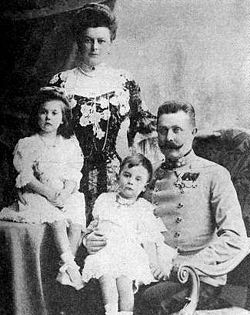
Archduke Franz Ferdinand von Österreich-Este (1863–1914) became to the Austro-Hungarian throne following the suicide of Rudolf on January 30, 1889, and the death of Archduke Karl Ludwig on May 19, 1896. Born on December 18, 1863, in , he was the eldest son of Archduke Karl Ludwig and held the title Archduke of Austria-Este, positioning him next in line after Emperor Franz Joseph I. His marriage to Countess Chotek on July 1, 1900, was morganatic, requiring a papal dispensation and excluding their children— (born 1901), (born 1902), and (born 1904)—from inheriting the throne due to Sophie's lack of requisite noble status under Habsburg house laws. This arrangement restricted Sophie's public appearances and fueled internal dynastic tensions, as Franz Ferdinand sought dispensations for her to participate in official events, including the Sarajevo visit. Franz Ferdinand advocated structural reforms to address within the , favoring trialism—a reorganization into German, Hungarian, and Slavic parliamentary entities—to counterbalance Magyar dominance and integrate , potentially undermining pan-Slavic backed by . He supported in to dilute ethnic elites' power and envisioned federalization to stabilize the empire amid rising Slavic discontent, views that positioned him as a perceived threat to Serbian nationalists seeking Yugoslav unification. On June 28, 1914—St. Vitus's Day, commemorating the 1389 —Franz Ferdinand and visited to inspect Bosnian troops, prompting an assassination plot by the Black Hand, a Serbian nationalist group aiding operatives. threw a at their around 10:15 a.m., wounding occupants of following vehicles but missing the archduke's; the couple proceeded after reassurance but took a wrong turn, halting near , a 19-year-old Bosnian Serb, who fired two shots from a Browning FN Model 1910 pistol, mortally wounding both—Franz Ferdinand in the jugular and in the abdomen. Princip and accomplices were arrested, later tried and imprisoned, with evidence linking the plot to Serbian . The murders ignited the , as , emboldened by Germany's "" assurance on July 5–6, issued a ten-point to on demanding suppression of anti-Austrian activities and participation in investigations. accepted most terms but rejected those infringing , prompting Austria's war declaration on July 28; mobilized in 's defense, triggering German ultimatums to and , and invasion of on August 4, escalating via alliance obligations into general European war. While underlying factors—militarism, alliance systems, , and Balkan —primed Europe for conflict, Franz Ferdinand's death provided the proximate trigger, eliminating a heir inclined toward concessions that might have defused Slavic without dissolution, though his succession uncertainties and the empire's rigid dualism constrained implementation. Austria's punitive response, prioritizing Serbian subjugation over restraint, amplified despite opportunities for mediation, as diplomatic cables reveal rigid commitments over compromise.

Other Key Figures and Contributions

Archduke Leopold Wilhelm (1614–1662), younger son of Emperor Ferdinand II, commanded Habsburg forces during the , including participation in the Battle of the White Mountain on November 8, 1620, though his later military efforts yielded mixed results against French and Swedish opponents. As governor of the from 1647 to 1656, he oversaw administrative and defensive duties amid ongoing conflicts, while amassing a renowned art collection of approximately 1,400 paintings, which later formed the core of Vienna's imperial collections. He accumulated titles, holding six bishoprics without priestly , reflecting Habsburg influence in church affairs. Archduke Charles, Duke of Teschen (1771–1847), brother of Emperor Francis II, spearheaded Austrian military reforms following defeats at and Austerlitz in 1805, introducing a corps-based organization, units, modernized , and improved over three years from 1806 onward. Appointed president of the Aulic War Council in 1809, he commanded Allied forces to victory at Aspern-Essling on May 21–22, 1809, temporarily halting Napoleon's advance, though subsequent losses at Wagram ensued. His reforms enhanced the army's resilience, contributing to Austria's performance in the despite persistent organizational challenges. Archduke Ferdinand Maximilian (1832–1867), younger brother of Emperor Franz Joseph I, served as commander-in-chief of the Austrian Navy from 1854 to 1864, overseeing modernization efforts including ship construction and Trieste's development as a naval base. Accepting the Mexican imperial throne in 1864 at the invitation of conservative monarchists backed by Napoleon III, he arrived in Mexico City on June 12, 1864, and attempted liberal reforms such as land redistribution and religious tolerance to consolidate power amid republican opposition led by Benito Juárez. Captured after French withdrawal and the siege of Querétaro, he faced execution by firing squad on June 19, 1867, marking the collapse of the Second Mexican Empire.

Decline, Abolition, and Modern Context

End of the Monarchy Post-1918

The in late 1918 marked the effective end of the and the privileged status associated with the Archduke title, which had been reserved for male members of the ruling . On November 11, 1918, following the , Emperor Charles I issued a proclamation from renouncing any participation in state affairs, while acknowledging the formation of a separate by its provisional assembly the previous day; this stopped short of explicit abdication, as Charles retained hopes of restoration. Similar pressures in led to parallel renunciations by November 13, severing the dual monarchy's structure. Facing mounting republican sentiment and Allied demands, Charles departed Vienna for exile in Switzerland on March 24, 1919, accompanied by his family, including several archdukes; this exodus extended to other Habsburg branches, with properties and assets across former imperial territories subject to seizure or nationalization. The Austrian National Council formalized the monarchy's abolition through the Habsburg Law of April 3, 1919, which banished all members of the House of Habsburg-Lorraine from Austrian soil unless they individually renounced dynastic claims, Habsburg identity, and thrones; it also authorized the expropriation of family estates without compensation, targeting the economic foundations that had sustained archducal privileges. Complementary legislation on the same date abolished nobility, titles, and heraldic privileges outright in the new republic, rendering the Archduke designation legally null and stripping it of state-sanctioned precedence, insignia rights, and ceremonial roles. Successor states followed suit: Hungary's provisional government dethroned Charles on November 16, 1918, and later monarchist efforts, including his failed 1921 bids for restoration backed by Admiral Miklós Horthy, collapsed amid international opposition, leading to Charles's relocation to Madeira and death on April 1, 1922. Czechoslovakia, Yugoslavia, and Poland enacted analogous bans on Habsburg return or claims, confiscating lands that had formed archducal appanages. While the family persisted in private use of the Archduke title as a courtesy among descendants in exile—primarily in Spain, Belgium, and later the Americas—these measures ensured its disconnection from sovereignty, inheritance practices tied to imperial succession, and symbols like the archducal hat or heraldry, which lost official validation. By mid-1919, the title's practical extinction as a marker of dynastic power was complete, reflecting the causal fallout of military defeat, ethnic nationalisms unleashed by Wilsonian principles, and revolutionary upheavals that prioritized republican legitimacy over monarchical continuity.

Contemporary Descendants and Pretenders

The persists through its living descendants, who hold no official titles or privileges following the 1919 abolishing noble ranks in , though they retain private claims to defunct imperial successions. (born January 11, 1961) has served as head of the house since succeeding his father, , upon Otto's death on July 4, 2011. In this capacity, Karl maintains titular precedence as to the thrones of , , , and , a role inherited through semi-Salic favoring male lines as per historical Habsburg practice. He resides in , where the family regained citizenship after Otto's formal renunciation of throne claims in 1961 to comply with republican laws, and engages in public activities including advocacy for via the and cultural preservation through , which he founded in 1996. Karl's heir apparent is his eldest son, Zvonimir von Habsburg-Lothringen (born June 21, 1997), who follows agnatic succession and pursues a professional career in motorsport, competing in events such as the since 2023. , named after historical figures including Archduke Franz , represents the continuation of the direct male line without active political pretensions to restoration. The family comprises additional descendants, including Karl's daughters Eleonore (born May 28, 1994) and Gloria (born 2001), who lead private lives aligned with contemporary an society rather than dynastic revival efforts. No competing pretenders challenge the main line's headship, which remains undisputed among genealogists tracking Habsburg-Lorraine descent from Emperor Charles I (reigned 1916–1918). Scattered collateral branches exist across and the , numbering fewer than 100 living members eligible for archducal courtesy styles, but the senior line centered on Karl holds symbolic precedence.

References

Add your contribution
Related Hubs
User Avatar
No comments yet.