
Recent from talks
Auto rickshaw
Knowledge base stats:
Talk channels stats:
Members stats:
Auto rickshaw
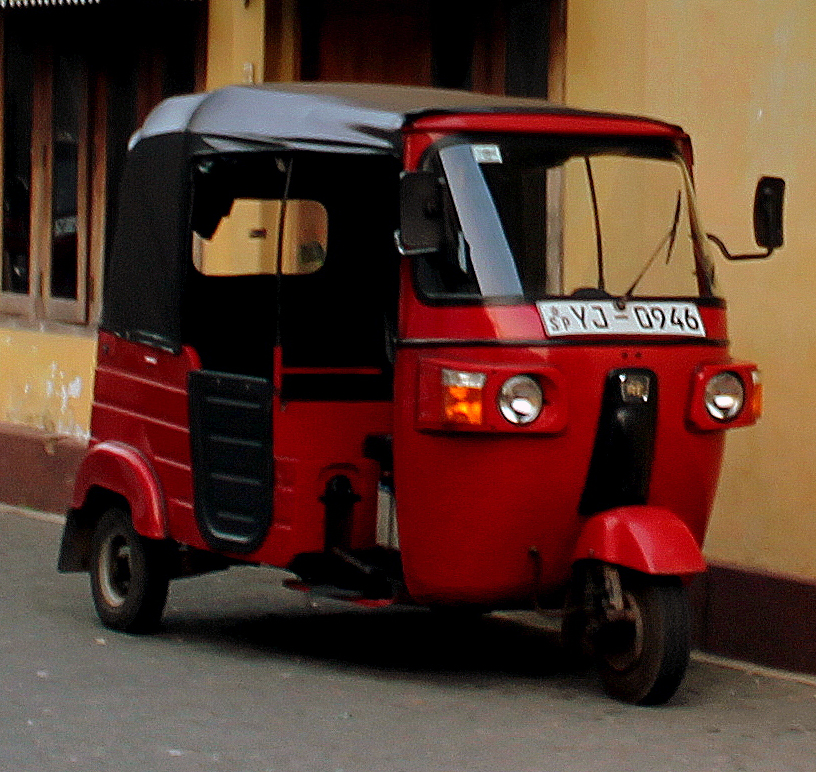
An auto rickshaw is a motorized version of the pulled rickshaw or cycle rickshaw. It is usually a three-wheeled vehicle, powered by an engine. They use a variety of fuels, with the most common being petrol, Compressed Natural Gas, Liquefied Petroleum Gas, and electricity. They are known by various other names across countries.
The auto rickshaw is a common form of transport around the world, both as a vehicle for hire and for private use. They are especially common in countries with tropical or subtropical climate since they are usually not fully enclosed, and in many developing countries because they are relatively inexpensive to own and operate.
There are different auto rickshaw designs. The most common type used for passenger transport is characterized by a sheet-metal body resting on three wheels with a canvas roof and drop-down side curtains. The driver is seated in a small cabin at the front and operates handlebar controls with a space for carrying up to three passengers in the back. The cargo versions might have an open space at the rear. A simpler version might have an expanded sidecar mounted on a three wheeled motorcycle.
As of 2023[update], India is the largest market for electric auto rickshaws, bypassing China. As of 2024[update], Bajaj Auto of India is the world's largest auto rickshaw manufacturer.
In the 1930s Japan, which was the most industrialized country in Asia at the time, encouraged the development of motorized vehicles including less expensive three-wheeled vehicles based on motorcycles. The Mazda-Go, a 3-wheel open "truck" released in 1931, is often considered the first of what became auto rickshaws. Later that decade the Japanese Ministry of Posts and Telecommunications of Japan distributed about 20,000 used three-wheelers to Southeast Asia as part of efforts to expand its influence in the region. They became popular in some areas, especially Thailand, which developed local manufacturing and design after the Japanese government abolished the three-wheeler license in Japan in 1965.
Production in Southeast Asia started from the knockdown production of the Daihatsu Midget, which was introduced in 1959. An exception is the indigenously modified Philippine tricycle, which originates from the Rikuo Type 97 motorcycle with a sidecar, introduced to the islands in 1941 by the Imperial Japanese Army during World War II.
In Europe, Corradino D'Ascanio, aircraft designer at Piaggio and inventor of the Vespa, came up with the idea of building a light three-wheeled commercial vehicle to power Italy's post-war economic reconstruction. The Piaggio Ape followed suit in 1947. Also Innocenti another leading Scooter manufacturer came up with their Lambretta line of three wheelers in cargo version, later adopted as passenger version by its Indian colloborator Automobile Products of India.
Locally named the "tuktuk", the rickshaw is used as a means of transportation in most parts of Egypt. It is generally rare to find in some affluent and newer parts of cities such as New Cairo and Heliopolis; and on highways due to police control and enforcement.
Hub AI
Auto rickshaw AI simulator
(@Auto rickshaw_simulator)
Auto rickshaw
An auto rickshaw is a motorized version of the pulled rickshaw or cycle rickshaw. It is usually a three-wheeled vehicle, powered by an engine. They use a variety of fuels, with the most common being petrol, Compressed Natural Gas, Liquefied Petroleum Gas, and electricity. They are known by various other names across countries.
The auto rickshaw is a common form of transport around the world, both as a vehicle for hire and for private use. They are especially common in countries with tropical or subtropical climate since they are usually not fully enclosed, and in many developing countries because they are relatively inexpensive to own and operate.
There are different auto rickshaw designs. The most common type used for passenger transport is characterized by a sheet-metal body resting on three wheels with a canvas roof and drop-down side curtains. The driver is seated in a small cabin at the front and operates handlebar controls with a space for carrying up to three passengers in the back. The cargo versions might have an open space at the rear. A simpler version might have an expanded sidecar mounted on a three wheeled motorcycle.
As of 2023[update], India is the largest market for electric auto rickshaws, bypassing China. As of 2024[update], Bajaj Auto of India is the world's largest auto rickshaw manufacturer.
In the 1930s Japan, which was the most industrialized country in Asia at the time, encouraged the development of motorized vehicles including less expensive three-wheeled vehicles based on motorcycles. The Mazda-Go, a 3-wheel open "truck" released in 1931, is often considered the first of what became auto rickshaws. Later that decade the Japanese Ministry of Posts and Telecommunications of Japan distributed about 20,000 used three-wheelers to Southeast Asia as part of efforts to expand its influence in the region. They became popular in some areas, especially Thailand, which developed local manufacturing and design after the Japanese government abolished the three-wheeler license in Japan in 1965.
Production in Southeast Asia started from the knockdown production of the Daihatsu Midget, which was introduced in 1959. An exception is the indigenously modified Philippine tricycle, which originates from the Rikuo Type 97 motorcycle with a sidecar, introduced to the islands in 1941 by the Imperial Japanese Army during World War II.
In Europe, Corradino D'Ascanio, aircraft designer at Piaggio and inventor of the Vespa, came up with the idea of building a light three-wheeled commercial vehicle to power Italy's post-war economic reconstruction. The Piaggio Ape followed suit in 1947. Also Innocenti another leading Scooter manufacturer came up with their Lambretta line of three wheelers in cargo version, later adopted as passenger version by its Indian colloborator Automobile Products of India.
Locally named the "tuktuk", the rickshaw is used as a means of transportation in most parts of Egypt. It is generally rare to find in some affluent and newer parts of cities such as New Cairo and Heliopolis; and on highways due to police control and enforcement.
Recent media