


Community hub
Recent from talks
Contribute something
Nothing was collected or created yet.
Rikuo Motorcycle
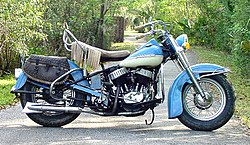
View on Wikipedia 1957 Rikuo RQ750 | |
| Manufacturer | Rikuo Nainenki |
|---|---|
| Assembly | Hiroshima, Japan |
| Predecessor | 750RS |
| Class | Standard |
| Engine | 747 cc (45.6 cu in) Air Cooled, Side Valve V-Twin |
| Top speed | 97 km/h (60 mph) |
| Power | 22 hp (16 kW) @ 4250 rpm |
| Torque | 4 kg⋅m (39 N⋅m; 29 lbf⋅ft) @ 3000 rpm |
| Transmission | 3 Forward, 1 Reverse |
| Weight | 230 kg (510 lb) (dry) |
Rikuo Internal Combustion Company (陸王内燃機関株式会社, Rikuō Nainenkikan Kabushiki kaisha) was one of the first motorcycle manufacturing companies in Japan. In the early 1930s Rikuo operated under the license and name of Harley-Davidson, using their tooling, and later under the name Rikuo until 1958.[2] Harley-Davidson themselves did not publicize this Japanese connection because the Japanese were helped in developing mass-production techniques by the introduction of this factory into Japan just prior to the Second World War.[3] The Society of Automotive Engineers of Japan (in Japanese) rates the 1935 Rikuoh Large Motorcycle as one of their 240 Landmarks of Japanese Automotive Technology.[4]
History
[edit]The production of the Harley-Davidson in Japan resulted in large part from the United Kingdom's McKenna Tariffs modification of 1921. In 1921 the Safeguarding of Industries act placed duties of 33.3 percent on 6500 items.[5] The tariffs were put into place to protect UK industry and levied a steep import duty against the American brands which were seen as damaging the UK motorcycle industry. This had the effect of denying Harley-Davidson one of their largest markets (Australia). At this time there were dozens of Japanese Motorcycle companies which were small shops spread all throughout Japan.
The Japanese government was also alarmed by the damage being done to their economy by Harley-Davidson. In 1924 the Military Subsidy law allowed the government to subsidize certain industries in order to encourage domestic production. Motorcycle production that had been conducted in small shops was now immediately being performed in large factories. Major Japanese industries were now manufacturing motorcycles. Both Murata Iron works and Toyo Kogyo, later called Mazda, tried to copy the Harley-Davidson motorcycle and failed.
During the Great Depression of 1929 Harley-Davidson was on the verge of bankruptcy. Having lost much of their overseas sales to the British Commonwealth nations, Harley-Davidson looked to Japan to make up for their losses.
Rikuo, a licensed copy of the Harley-Davidson, started production in 1929. In 1931 Dabittoson Harley Motorcycle Co., Ltd. was established in Japan. Dabittoson started domestic production of the Harley-Davidson Road King Motorcycle. The 4-cycle, 1200 cc, side-valve V-twin engine produces 28 horsepower for a top speed of 97 km per hour.

The Road King motorcycle was improved and produced by Lin Ritsukawa, and Tsui Meguro under the Tokyu Kogyo Kurogane Company during World War II. This included the Type 97 military motorcycle which was often produced with a sidecar, called they Type 93.
Harley-Davidson, through the efforts of Alfred Rich Child,[6] shipped tooling and personnel to Japan in the mid-1930s to build HD VL flathead (sidevalve) motorcycles.
In 1933 Sankyo Company changed its name to Sankyo Nainenki Co. and produced Harley-Davidson motorcycles under license as the Type 97 for the Japanese military. The Type 97 was made entirely from Japanese components. During their production the company was constantly modernizing the design. Approximately 1500 of these machines were produced for Japanese military use.
When Harley-Davidson was prepared to produce the new EL OHV Knucklehead design, they insisted that the Japanese factory buy the license to produce the EL as well. However Sankyo, Rikuo's parent company, was reluctant to produce the new vehicles and refused to make this commitment.
Japan's government was becoming increasingly militaristic leading up to World War II and eventually suggested that Harley-Davidson employees, including Mr. Child, leave the country. The motorcycle continued to be produced under the name of Rikuo, meaning "Land King" or "Continent King." Rikuo built approximately 18,000 motorcycles between 1937 and 1942, most of which were sold to the Japanese military and Japanese police departments.[7]
Sidecar combinations called Type 97 were produced for military work in the Philippines and Manchuria during the Second World War. Solo machines were supplied to civilian police forces, for example for Osaka in the 1950s.[8]
After the war the remaining factory continued producing the 750 cc (46 cu in) RQ and 1200 cc (74 cubic inch) VLE models still using the old flathead, total-loss lubrication design. The 750 gained a telescopic front suspension and the 1200 model retained springer forks. All of the new motorcycles were made with hardtail rear ends. In 1950 and 1951, the plant produced about fifty 45 cubic inch motors per month and thirty 74s with sidecars. By August 1952 production was estimated at seventy 45s a month while the 74s stayed about the same. The 45 and 74 models are near exact copies of the 1934 Harley-Davidson. An OHV version was prototyped, but never produced.[better source needed][9]

The factory began to use the "Tele-Glide" type front suspension in or around 1950 on the 750 cc units, but while updating the sheet metal on the VL type, retained the "Springer" type front suspension on those units. Therefore, the 1950s 750s are basically the Harley-Davidson 45 cu.in. RL of the early 1930s, and the 1950s 1200s are the Harley-Davidson VL of the same era, but both with updated sheet metal (the updated front fork of the RQ/RT notwithstanding).
Sale and End of Rikuo
[edit]In 1950 Sankyo sold Rikuo to Showa (the same company that supplies parts to HD today) [10] Rikuo manufacturing stopped in 1959 with operations going into bankruptcy in 1960 and the brand ceased to exist by 1962.[11]
Models
[edit]- Rikuo RQ 750 cc
- Rikuo VLE 1200 cc
- Rikuo QR750
- Kurogane - three wheel bike
- Rikuo VL- BluePaint
- Rikuo Land King
Specifications
[edit]The RQ has a 747 cc engine that develops 22 bhp at 4250 rpm and 4 Kgm of torque at 3000 rpm. The complete motorcycle weighs 230 Kg.[12]
References
[edit]- ^ Rikuo RQ750, Motor Cycle Classics Rikuo RQ750.
- ^ Hugo Vanneck (March 1998). "Japan's King of the Road". Classic Bike. pp. 93–97.
- ^ Harry V. Sucher (August 1981). "Harley-Davidson". Haynes Publishing Group Ltd. pp. 79–88.
- ^ "Rikuoh Large Motorcycle". 240 Landmarks of Japanese Automotive Technology. Society of Automotive Engineers of Japan, Inc. Retrieved 11 August 2013.
This is the first large motorcycle manufactured in Japan in response to a request from the Imperial Japanese Army.
- ^ "Tariffs and American Relations". 14 June 1929. The Churchill Centre and Museum. Archived from the original on 12 July 2011. Retrieved May 26, 2011.
- ^ AMA Hall of Fame, Alfred Rich Child sold Harley-Davidson to Japan.
- ^ Margie Siegal (January–February 2007). "Rikuo V-twin". Motorcycle Classics. Retrieved 2009-08-13.
- ^ "Rikuo News". Archived from the original on 2005-05-25. Retrieved 2008-04-02.
- ^ "陸王". Archived from the original on 2007-05-09. Retrieved 2007-12-07.
- ^ Rikuo RQ 750, One of Harley-Davidson's lesser-known ventures into overseas markets.
- ^ "1957 Rikuo QR750 - One of Harley-Davidson's lesser-known ventures into overseas markets | Hemmings Motor News". Archived from the original on 2016-10-20. Retrieved 2025-02-23.
- ^ "Honda Global | Honda Motor Co., LTD".
External links
[edit]- 1955 Rikuo RQ Honda Collection Hall article
- 1958 Rikuo RT2 American Motorcyclists Association article
- Rikuo Type 97 Vladivostok Oldtimers Museum photos
- Hemmings 1957 Rikuo QR750

Rikuo Motorcycle
View on GrokipediaRikuo Motorcycle was a Japanese brand of heavyweight V-twin motorcycles produced from the 1930s through the early 1960s, initially manufactured under license from Harley-Davidson by the Sankyo Trading Company, which branded its output as Rikuo—translating to "Land King."[1][2][3] The company began full production of complete Harley-derived models in 1935, including the VL-series big twins with 45-cubic-inch side-valve engines, adapting them for local roads and military applications.[1][3] During World War II, Rikuo motorcycles, such as the Type 97 with sidecar, served extensively in the Imperial Japanese Army, capable of transporting three fully equipped soldiers across theaters of operation.[4] Postwar, civilian production resumed in 1946, positioning Rikuo as Japan's largest motorcycle maker by 1947 amid the industry's recovery.[5] Notable postwar models like the RQ750 featured a 747cc V-twin engine delivering 22 horsepower at 4,250 rpm, achieving top speeds around 70 mph, though production waned by 1962 as Harley-Davidson reentered the Japanese market directly.[1][3]
Origins and Early Development
Founding and Harley-Davidson Licensing
In the aftermath of the 1929 stock market crash and ensuing Great Depression, Harley-Davidson sought to sustain its market presence in Japan by granting exclusive manufacturing rights there, providing detailed blueprints, tooling techniques, and engineering support to local partners.[5] This agreement, formalized in 1929, prohibited the export of any produced motorcycles or parts bearing Harley-Davidson designs, aiming to protect the American manufacturer's global sales while enabling domestic Japanese production to meet rising demand, particularly from military buyers.[5] Sankyo Company, which had earlier collaborated with Harley-Davidson representative Alfred Childs on imports starting in the mid-1920s, capitalized on the licensing deal by investing capital to establish Japan's first complete motorcycle manufacturing facility in Shinagawa, Tokyo.[6] [5] Initial production commenced in 1929, focusing on assembling and eventually fully fabricating V-twin models derived from Harley-Davidson's side-valve engines, such as the 45-cubic-inch and 74-cubic-inch flathead designs, with royalties paid back to the licensor.[5] This setup marked a shift from prior knock-down imports handled by entities like Nihon Jidosha, which had secured Harley distribution rights as early as 1916.[5] By 1932, Sankyo expanded the license to include full-scale engine production, collaborating with Japanese military interests to replicate Harley's flathead technology; this involved dismantling and relocating elements of a Harley engine plant to a site near Tokyo.[4] The Rikuo Nainenki K.K. (Rikuo Internal Combustion Engine Company) was formally incorporated in 1935 as the dedicated entity for these operations, completing its inaugural fully indigenous motorcycle that year under the Rikuo brand—translating to "King of the Road"—primarily based on the Harley-Davidson J-model with 750cc side-valve V-twin powerplants.[5] [6] This structure allowed Rikuo to produce reliable, heavy-duty machines suited to Japan's terrain and infrastructure needs, laying the groundwork for significant pre-war output.[4]Initial Production and Pre-War Expansion
Sankyo Company established Japan's first complete motorcycle manufacturing facility at Shinagawa, Tokyo, following a 1932 licensing agreement with Harley-Davidson to produce big twin engines and assemble complete machines.[4][5] Initial production emphasized imported components and CKD kits, transitioning to fully domestic assembly by 1935 under the Rikuo brand, derived from "Rikuō" meaning "King of the Road."[7][6] Early models replicated Harley-Davidson designs, including the VL series with a 1,200 cc side-valve V-twin engine producing around 20-25 horsepower, targeted at both civilian riders and emerging military needs.[3] Pre-war expansion accelerated after the licensing agreement expired in 1936, with Sankyo renaming to Sankyo Nainenki Company and prioritizing military contracts.[2] The introduction of the Type 97 in 1937, a militarized variant of the VL with added features like a sidecar capability and reinforced frame, drove output growth to support Imperial Japanese Army deployments in China and Manchuria.[8] By 1941, factory capacity had scaled to produce thousands annually, incorporating local adaptations such as metric fasteners while retaining core Harley-derived architecture, amid nationalization pressures in 1937 that aligned production with wartime priorities.[9][3]Military Applications
Type 97 Motorcycle and Imperial Japanese Forces
The Type 97 motorcycle, designated as the standard military model for the Imperial Japanese Army (IJA), entered production in 1937 by the Rikuo Nainen Company and other licensed manufacturers, drawing directly from Harley-Davidson VL-series designs under a pre-war licensing agreement.[10] [5] This heavy sidecar-equipped machine featured a 1,200 cc side-valve V-twin engine delivering 28 horsepower at around 4,000 rpm, with a three-speed transmission and a top speed of approximately 70 km/h when fully loaded.[10] [8] Weighing about 500 kg including the sidecar, it accommodated a crew of two and was optimized for rugged terrain, with a length of roughly 2.7 meters and basic suspension via girder forks.[10] Production continued across multiple facilities until Japan's surrender in 1945, with estimates placing total output at over 18,000 units to meet escalating demands for mechanized mobility.[4] [8] In IJA service, the Type 97 functioned primarily as a versatile transport platform for dispatch riders, reconnaissance patrols, and light logistics, often towing trailers or sidecars armed with Type 11 or Type 92 machine guns for mobile fire support.[11] [8] Its deployment began in frontline operations during the 1937 invasion of China, particularly in Manchuria, where it supported rapid advances by motorized infantry units amid limited truck availability due to resource constraints.[12] [10] By World War II, thousands were fielded across Pacific theaters, including the Philippines, for scouting enemy positions, evacuating wounded, and facilitating command communications in jungle and island-hopping campaigns, though maintenance challenges arose from wartime shortages of parts and fuel.[11] [4] The motorcycle's reliability in diverse environments made it a staple of IJA mechanized elements, contrasting with lighter scouts like the Type 95, but its weight limited off-road agility compared to Allied counterparts such as the Harley-Davidson WLA.[8]Wartime Production and Adaptations
The Rikuo Type 97, a sidecar-equipped motorcycle adapted for military use, formed the core of wartime production, with approximately 18,000 units manufactured between 1935 and 1942 by the Rikuo Nainen Company in collaboration with Sankyo near Tokyo.[3][4] In 1942, production halted as facilities redirected efforts toward torpedoes amid escalating resource shortages and strategic priorities of the Pacific War.[3] Key adaptations emphasized operational reliability in diverse terrains, including an integral driveshaft transmitting power to the sidecar wheel for enhanced traction and stability, particularly off-road, and elevated ground clearance suited to the muddy conditions of Manchuria and Southeast Asia.[4][3] Configurations extended to mounting machine guns on sidecars, enabling reconnaissance, escort duties, and light combat support, while the design accommodated three fully equipped soldiers for rapid troop mobility.[3][4] Powered by a 1,213 cc (74 cubic inch) side-valve V-twin engine delivering about 24 horsepower at 4,000 rpm, the Type 97 incorporated a three-speed forward transmission with reverse gear, facilitating maneuverability in confined or reverse scenarios common to military logistics.[11] These features, derived from pre-war Harley-Davidson licensing but fully localized with Japanese components, positioned the Rikuo as the primary motorized transport for the Imperial Japanese Army and Navy across theaters including China from 1937, Manchuria, the Philippines, and broader Pacific operations.[3][11][4]Post-War Revival
Resumption of Manufacturing
Following Japan's defeat in World War II and the subsequent Allied occupation, Rikuo halted motorcycle production during the immediate postwar period due to wartime destruction and regulatory restrictions imposed by the Supreme Commander for the Allied Powers (SCAP).[3] Manufacturing resumed in 1947, with the company restarting assembly of its established 750 cc sidevalve V-twin models derived from pre-war designs akin to the Harley-Davidson WL.[1][3] Initial postwar output remained constrained, averaging 1,500 to 2,000 units annually through the late 1940s, primarily directed toward government and police agencies amid Japan's economic recovery and limited civilian demand.[6] These machines retained core mechanical features from earlier Rikuo types, including the 745 cc flathead engine producing approximately 15 horsepower, emphasizing durability for official use over innovation.[13] By 1949, the original Rikuo Internal Combustion Company faced bankruptcy amid declining production and postwar market shifts, leading to its reorganization as Rikuo Motorcycle Co., Ltd.[9] The resumption marked a tentative revival, sustaining Rikuo's technical lineage while adapting to scarce resources and import barriers that protected nascent domestic industry, though competition from emerging lighter Japanese motorcycles loomed.[1] Production persisted into the 1950s with incremental updates, such as the RQ750 model introduced around 1957, featuring minor refinements to the sidevalve engine and chassis for postwar standards.[6]Civilian Models and Market Challenges
Following the resumption of manufacturing in 1947, Rikuo focused on civilian models derived from pre-war designs, primarily 750 cc sidevalve V-twin engines adapted for solo use without sidecars.[13][14] The RQ750 and QR750 variants, produced from 1953 to 1957, featured a 747 cc displacement, weighed over 500 pounds, and achieved top speeds of 65-70 mph with left-side braking.[6] Annual production hovered around 1,500 to 2,000 units in the late 1940s, positioning Rikuo as Japan's largest motorcycle producer by 1947 through sales to police forces and niche enthusiasts.[15][13] These heavy, large-displacement machines initially benefited from a lack of domestic competition in big-bore motorcycles, sustaining viability via institutional contracts.[13] However, post-war economic constraints favored lightweight, fuel-efficient scooters and small motorcycles from emerging rivals like Honda, which prioritized affordable urban transport amid Japan's recovery.[16] Rikuo's outdated Harley-derived designs proved ill-suited to shifting consumer demands for economical vehicles, eroding market share as production of civilian models dwindled and ceased by the late 1950s.[14][13]Decline and Cessation
Corporate Changes and Competition
Following World War II, Rikuo resumed civilian motorcycle production in 1946, registering as a manufacturer with Tokyo's Automobile Division in 1945, and achieving prominence as Japan's largest producer in 1947 with 252 sidecar-equipped units and 74 solo models.[5] However, the company encountered severe competitive pressures from new entrants prioritizing smaller, fuel-efficient engines suited to Japan's recovering economy and infrastructure limitations. Manufacturers such as Honda and Tohatsu captured the burgeoning 50-250cc market segment, which offered affordability and practicality over Rikuo's heavyweight, big-bore designs derived from pre-war Harley-Davidson licensing.[5] Rikuo's adherence to outdated side-valve V-twin engines and rigid suspension configurations proved disadvantageous against rivals introducing advanced overhead-valve (OHV) technology, exemplified by Meguro's 650cc OHV twin launched in 1957.[5] This technological lag, combined with a shrinking demand for large-displacement motorcycles, eroded Rikuo's market position; annual output peaked at 1,983 units in 1953 before plummeting to 520 machines in 1958.[5] No significant mergers or restructurings marked Rikuo's decline, distinguishing it from contemporaries that adapted through innovation or consolidation. Instead, manufacturing halted entirely in 1958, with limited assembly from stockpiled spares extending sales until 1960, after which the factory closed amid unviable economics.[5][1] The company's dissolution followed in 1962, reflecting the broader postwar consolidation in Japan's motorcycle sector where prewar firms like Rikuo failed to pivot effectively.[9]Final Years and Shutdown
In 1950, Sankyo sold Rikuo to Showa Aircraft, which utilized the company's skilled workforce to sustain motorcycle production amid postwar industrial shifts.[1] Under Showa's ownership, output focused on large-displacement V-twin models like the 747cc RT2 and 1,200cc QR series, primarily supplied to police forces, with annual volumes under 2,000 units.[6] By the mid-1950s, Rikuo encountered mounting challenges from competitors offering lighter, more economical two-stroke and four-stroke machines better suited to Japan's recovering economy and consumer preferences for affordability over power.[1] Customers previously loyal to Rikuo's heavyweight designs increasingly shifted to emerging brands, eroding demand for the outdated Harley-inspired platforms.[1] New motorcycle manufacturing ceased in 1958, though final assemblies from stockpiled components persisted into 1960.[1] Rikuo Nainenki permanently shuttered its factory in 1960, marking the end of the brand's operations.[5]Design and Technical Features
Engine Configurations and Harley Influences
Rikuo motorcycles initially featured engines directly derived from Harley-Davidson designs through a licensing agreement established in 1932 between Harley-Davidson and Japan's Sankyo Company, which built a factory in Shinagawa, Tokyo, using American blueprints and tooling.[3] The core configuration was a side-valve, air-cooled V-twin engine with a 45-degree cylinder angle, mirroring Harley's VL series introduced in 1930.[17] This 1200 cc (74 cubic inch) unit, with a bore of approximately 3.42 inches and stroke of 4.25 inches, produced around 24-28 horsepower at 4000 rpm, enabling a top speed of 97 km/h in military variants.[8][4] The licensing facilitated technology transfer, including Harley engineers training Japanese workers on precision manufacturing for the flathead V-twin, which emphasized low-revving torque suitable for sidecar-equipped military use.[1] For the Type 97 military motorcycle, introduced in 1937 and based on the Harley VLH, the engine retained the side-valve design paired with a three-speed transmission including reverse gear, prioritizing reliability over performance in rugged conditions.[17] Although Harley-Davidson offered overhead-valve Knucklehead technology later, Rikuo persisted with the outdated side-valve configuration post-1936 license expiration, producing approximately 18,000 Type 97 units by 1942 without further royalties or updates.[3][17] Post-war revival in 1947 introduced smaller engine variants to address civilian market needs and material shortages, including a 750 cc side-valve V-twin modeled on Harley's WL "45" series, with a bore and stroke of about 2.75 x 3.81 inches.[13] This configuration, seen in models like the RT/W series, delivered sufficient low-end power for urban use while maintaining the Harley-inspired architecture, such as cast-iron cylinders and wet sump lubrication.[2] By 1950, larger 1200 cc side-valve engines reappeared in premium models, but Rikuo's adherence to these pre-war Harley designs—eschewing overhead valves or unit construction—highlighted a lack of innovation, contributing to competitive disadvantages against emerging Japanese four-stroke singles and two-strokes.[3] Production of these V-twin configurations continued until 1958, with the final RT2 model in 1957 exemplifying the enduring, albeit obsolete, Harley influence.[2]Chassis, Suspension, and Unique Variants
The chassis of Rikuo motorcycles, exemplified by the Type 97, employed a rigid tubular frame derived from Harley-Davidson designs licensed in the 1930s, offering durability for military transport.[8] This frame construction prioritized strength over flexibility, with stamped steel elements contributing to a lightweight yet robust structure suitable for sidecar-equipped operations.[12] Suspension on the Type 97 featured pendulum-style front forks equipped with friction dampers, providing precise handling and stability on varied terrains during wartime use from 1937 onward.[12] Rear suspension remained rigid, aligning with contemporary heavy motorcycle standards and emphasizing load-bearing capacity over comfort.[12] Post-war civilian models, such as the 1957 RT2, upgraded to telescopic front forks for improved road performance, while retaining hardtail rear designs with sprung seats.[2] Unique variants included the military Type 97 sidecar configuration, which incorporated shaft drive to the sidecar wheel for enhanced traction in off-road conditions, distinguishing it from solo civilian versions.[1] Larger 1200cc models, produced alongside 750cc counterparts through the 1950s, featured similar chassis adaptations but with scaled frames to accommodate increased engine displacement and power outputs up to 22 horsepower.[1] These variants reflected Sankyo Rikuo's efforts to diversify beyond strict Harley replicas, incorporating local modifications for Japanese market and military needs.[3]Models and Specifications
Major Model Lines
Rikuo's major model lines centered on air-cooled, side-valve V-twin engines licensed from Harley-Davidson designs, with displacements of 750 cc and 1,200 cc forming the core of production both pre- and post-war. The 750 cc line, revived in 1947 as a copy of the Harley-Davidson "Baby Twin," included models such as the RO (reintroduced in 1952), RQ, R, and RT series, producing 22 hp at 4,250 rpm with bore and stroke dimensions of 69 mm x 100 mm, enabling top speeds of 65–70 mph.[13][1][14] These 750 cc models, like the 1953–1957 RQ750 and 1957 RT2 "Land King," weighed over 500 pounds, featured kick-starting, hand-shift/foot-clutch transmissions until 1956, and were aimed at civilian transport amid post-war shortages.[1][2][18] The larger 1,200 cc line, originating with the pre-war Type 97 military sidecar model (a direct copy of the 1930s Harley-Davidson VL with 30 hp output), continued post-war in variants like the VLE through 1959, retaining total-loss lubrication and springer front suspension for heavy-duty applications.[11][1][19] To address civilian demand for lighter machines, Rikuo introduced 350 cc single-cylinder models in the 1950s, styled after BSA and BMW designs, though these represented a smaller portion of output compared to the V-twins.[20] Production of all lines ceased by 1958, with assembly from stockpiled parts extending to 1960, as competition from more modern imported and domestic motorcycles eroded market share.[1]Detailed Specifications by Model
The RQ750, manufactured from 1953 to 1957, utilized a 747 cc air-cooled side-valve V-twin engine producing 22 horsepower at 4,250 rpm, enabling a top speed of 70 mph.[1] The model weighed approximately 510 pounds dry, featured drum brakes, laced wheels, and a wide low-rise handlebar, with a three-speed transmission operated via hand shift and foot clutch standard until 1956.[2][21] This configuration closely mirrored Harley-Davidson's 1929 flathead design, adapted for postwar civilian use.[1] Prewar Rikuo models, such as the Type 97 military variant introduced in 1937, employed a 1,200 cc side-valve V-twin engine derived from the Harley-Davidson VL series, generating around 28 horsepower at 4,000 rpm in high-compression form.[12][8] Equipped typically with a sidecar, it achieved a top speed of 70 km/h and weighed 500 kg overall, with a length of 2.7 meters; the design included a rigid frame and prioritized durability for military transport.[22] The VLE 1200 cc model, a civilian-oriented prewar offering, retained the side-valve V-twin configuration with hand gearchange and foot clutch, emphasizing reliability in Japan's early motorcycle market. Postwar variants like the RT2 continued the 747 cc flathead lineage into the late 1950s, maintaining similar chassis elements including drum braking and laced spoked wheels, though production emphasized basic transportation over performance.[21]| Model | Engine Displacement | Configuration | Power Output | Top Speed | Weight (approx.) | Transmission |
|---|---|---|---|---|---|---|
| RQ750 (1953-1957) | 747 cc | Side-valve V-twin, air-cooled | 22 hp @ 4,250 rpm | 70 mph | 510 lbs dry | 3-speed, hand shift/foot clutch |
| Type 97 (1937+) | 1,200 cc | Side-valve V-twin | 28 hp @ 4,000 rpm | 70 km/h (with sidecar) | 500 kg (with sidecar) | 3-speed (details vary by variant) |
| VLE 1200 cc | 1,200 cc | Side-valve V-twin | Not specified | Not specified | Not specified | Hand gearchange/foot clutch |