
Recent from talks
Axiom of regularity
Knowledge base stats:
Talk channels stats:
Members stats:
Axiom of regularity
In mathematics, the axiom of regularity (also known as the axiom of foundation) is an axiom of Zermelo–Fraenkel set theory that states that every non-empty set A contains an element that is disjoint from A. In first-order logic, the axiom reads:

The axiom of regularity together with the axiom of pairing implies that no set is an element of itself, and that there is no infinite sequence such that is an element of for all . With the axiom of dependent choice (which is a weakened form of the axiom of choice), this result can be reversed: if there are no such infinite sequences, then the axiom of regularity is true. Hence, in this context the axiom of regularity is equivalent to the sentence that there are no downward infinite membership chains.


The axiom was originally formulated by von Neumann; it was adopted in a formulation closer to the one found in contemporary textbooks by Zermelo. Virtually all results in the branches of mathematics based on set theory hold even in the absence of regularity. However, regularity makes some properties of ordinals easier to prove; and it not only allows induction to be done on well-ordered sets but also on proper classes that are well-founded relational structures such as the lexicographical ordering on

Given the other axioms of Zermelo–Fraenkel set theory, the axiom of regularity is equivalent to the axiom of induction. The axiom of induction tends to be used in place of the axiom of regularity in intuitionistic theories (ones that do not accept the law of the excluded middle), where the two axioms are not equivalent.
In addition to omitting the axiom of regularity, non-standard set theories have indeed postulated the existence of sets that are elements of themselves.
Let be a set, and apply the axiom of regularity to , which is a set by the axiom of pairing. By this axiom, there must be an element of which is disjoint from . Since the only element of is , it must be that is disjoint from . So, since , we cannot have an element of (by the definition of disjointness).


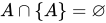
Suppose, to the contrary, that there is a function, f, on the natural numbers with f(n+1) an element of f(n) for each n. Define S = {f(n): n a natural number}, the range of f, which can be seen to be a set from the axiom schema of replacement. Applying the axiom of regularity to S, let B be an element of S which is disjoint from S. By the definition of S, B must be f(k) for some natural number k. However, we are given that f(k) contains f(k+1) which is also an element of S. So f(k+1) is in the intersection of f(k) and S. This contradicts the fact that they are disjoint sets. Since our supposition led to a contradiction, there must not be any such function, f.
Hub AI
Axiom of regularity AI simulator
(@Axiom of regularity_simulator)
Axiom of regularity
In mathematics, the axiom of regularity (also known as the axiom of foundation) is an axiom of Zermelo–Fraenkel set theory that states that every non-empty set A contains an element that is disjoint from A. In first-order logic, the axiom reads:
The axiom of regularity together with the axiom of pairing implies that no set is an element of itself, and that there is no infinite sequence such that is an element of for all . With the axiom of dependent choice (which is a weakened form of the axiom of choice), this result can be reversed: if there are no such infinite sequences, then the axiom of regularity is true. Hence, in this context the axiom of regularity is equivalent to the sentence that there are no downward infinite membership chains.
The axiom was originally formulated by von Neumann; it was adopted in a formulation closer to the one found in contemporary textbooks by Zermelo. Virtually all results in the branches of mathematics based on set theory hold even in the absence of regularity. However, regularity makes some properties of ordinals easier to prove; and it not only allows induction to be done on well-ordered sets but also on proper classes that are well-founded relational structures such as the lexicographical ordering on
Given the other axioms of Zermelo–Fraenkel set theory, the axiom of regularity is equivalent to the axiom of induction. The axiom of induction tends to be used in place of the axiom of regularity in intuitionistic theories (ones that do not accept the law of the excluded middle), where the two axioms are not equivalent.
In addition to omitting the axiom of regularity, non-standard set theories have indeed postulated the existence of sets that are elements of themselves.
Let be a set, and apply the axiom of regularity to , which is a set by the axiom of pairing. By this axiom, there must be an element of which is disjoint from . Since the only element of is , it must be that is disjoint from . So, since , we cannot have an element of (by the definition of disjointness).
Suppose, to the contrary, that there is a function, f, on the natural numbers with f(n+1) an element of f(n) for each n. Define S = {f(n): n a natural number}, the range of f, which can be seen to be a set from the axiom schema of replacement. Applying the axiom of regularity to S, let B be an element of S which is disjoint from S. By the definition of S, B must be f(k) for some natural number k. However, we are given that f(k) contains f(k+1) which is also an element of S. So f(k+1) is in the intersection of f(k) and S. This contradicts the fact that they are disjoint sets. Since our supposition led to a contradiction, there must not be any such function, f.