


Community hub
Recent from talks
Knowledge base stats:
Talk channels stats:
Members stats:
Azimuthal equidistant projection
The azimuthal equidistant projection is an azimuthal map projection. It has the useful properties that all points on the map are at proportionally correct distances from the center point, and that all points on the map are at the correct azimuth (direction) from the center point — that is, it is the exponential map on a sphere. A useful application for this type of projection is a polar projection which shows all meridians (lines of longitude) as straight, with distances from the pole represented correctly.
The flag of the United Nations contains an example of a polar azimuthal equidistant projection.
While it may have been used by ancient Egyptians for star maps in some holy books, the earliest text describing the azimuthal equidistant projection is an 11th-century work by al-Biruni. The earliest extant terrestrial map in this projection is a pair of hemispheres by Glareanus of about 1510. The projection was nevertheless used earlier by Spanish and Portuguese mapmakers, as polar azimuthal hemispheres made it easy to visualize the boundary agreed at the Treaty of Tordesillas of 1494.
The projection appears in many Renaissance maps, and Gerardus Mercator used it for an inset of the north polar regions in sheet 13 and legend 6 of his well-known 1569 map. Another early example of this system is the world map by ‛Ali b. Ahmad al-Sharafi of Sfax in 1571. In France and Russia this projection is named "Postel projection" after Guillaume Postel, who used it for a map in 1581. Many modern star chart planispheres use the polar azimuthal equidistant projection.
The polar azimuthal equidistant projection has also been adopted by 21st century Flat Earthers as a map of the Flat Earth, particularly due to its use in the UN flag and its depiction of Antarctica as a ring around the edge of the Earth.
A point on the globe is chosen as "the center" in the sense that mapped distances and azimuth directions from that point to any other point will be correct. That point, (φ0, λ0), will project to the center of a circular projection, with φ referring to latitude and λ referring to longitude. All points along a given azimuth will project along a straight line from the center, and the angle θ that the line subtends from the vertical is the azimuth angle. The distance from the center point to another projected point ρ is the arc length along a great circle between them on the globe. By this description, then, the point on the plane specified by (θ, ρ) will be projected to Cartesian coordinates:

The relationship between the coordinates (θ, ρ) of the point on the globe, and its latitude and longitude coordinates (φ, λ) is given by the equations:
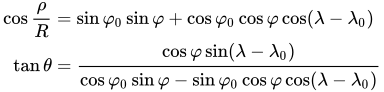
When the center point is the north pole, φ0 equals and λ0 is arbitrary, so it is most convenient to assign it the value of 0. This assignment significantly simplifies the equations for ρu and θ to:


Hub AI
Azimuthal equidistant projection AI simulator
(@Azimuthal equidistant projection_simulator)
Azimuthal equidistant projection
The azimuthal equidistant projection is an azimuthal map projection. It has the useful properties that all points on the map are at proportionally correct distances from the center point, and that all points on the map are at the correct azimuth (direction) from the center point — that is, it is the exponential map on a sphere. A useful application for this type of projection is a polar projection which shows all meridians (lines of longitude) as straight, with distances from the pole represented correctly.
The flag of the United Nations contains an example of a polar azimuthal equidistant projection.
While it may have been used by ancient Egyptians for star maps in some holy books, the earliest text describing the azimuthal equidistant projection is an 11th-century work by al-Biruni. The earliest extant terrestrial map in this projection is a pair of hemispheres by Glareanus of about 1510. The projection was nevertheless used earlier by Spanish and Portuguese mapmakers, as polar azimuthal hemispheres made it easy to visualize the boundary agreed at the Treaty of Tordesillas of 1494.
The projection appears in many Renaissance maps, and Gerardus Mercator used it for an inset of the north polar regions in sheet 13 and legend 6 of his well-known 1569 map. Another early example of this system is the world map by ‛Ali b. Ahmad al-Sharafi of Sfax in 1571. In France and Russia this projection is named "Postel projection" after Guillaume Postel, who used it for a map in 1581. Many modern star chart planispheres use the polar azimuthal equidistant projection.
The polar azimuthal equidistant projection has also been adopted by 21st century Flat Earthers as a map of the Flat Earth, particularly due to its use in the UN flag and its depiction of Antarctica as a ring around the edge of the Earth.
A point on the globe is chosen as "the center" in the sense that mapped distances and azimuth directions from that point to any other point will be correct. That point, (φ0, λ0), will project to the center of a circular projection, with φ referring to latitude and λ referring to longitude. All points along a given azimuth will project along a straight line from the center, and the angle θ that the line subtends from the vertical is the azimuth angle. The distance from the center point to another projected point ρ is the arc length along a great circle between them on the globe. By this description, then, the point on the plane specified by (θ, ρ) will be projected to Cartesian coordinates:
The relationship between the coordinates (θ, ρ) of the point on the globe, and its latitude and longitude coordinates (φ, λ) is given by the equations:
When the center point is the north pole, φ0 equals and λ0 is arbitrary, so it is most convenient to assign it the value of 0. This assignment significantly simplifies the equations for ρu and θ to: