
Recent from talks
Bacillus cereus
Knowledge base stats:
Talk channels stats:
Members stats:
Bacillus cereus
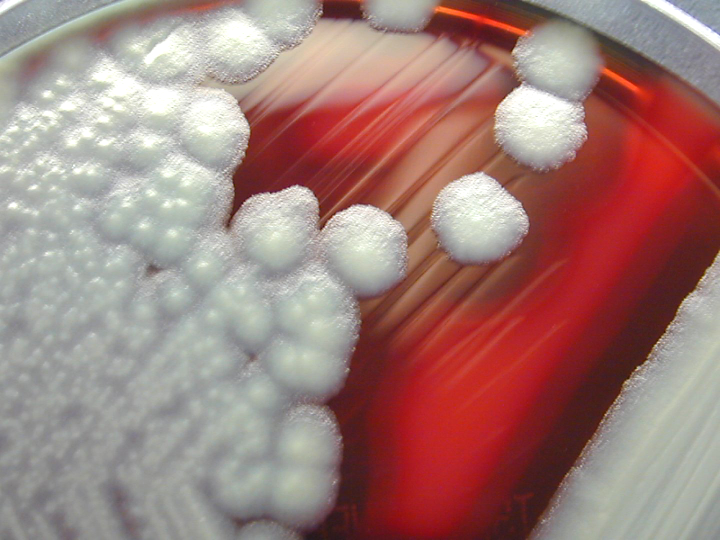
Bacillus cereus is a Gram-positive rod-shaped bacterium commonly found in soil, food, and marine sponges. The specific name, cereus, meaning "waxy" in Latin, refers to the appearance of colonies grown on blood agar. Some strains are harmful to humans and cause foodborne illness due to their spore-forming nature, while other strains can be beneficial as probiotics for animals, and even exhibit mutualism with certain plants. B. cereus bacteria may be aerobes or facultative anaerobes, and like other members of the genus Bacillus, can produce protective endospores. They have a wide range of virulence factors, including phospholipase C, cereulide, sphingomyelinase, metalloproteases, and cytotoxin K, many of which are regulated via quorum sensing. B. cereus strains exhibit flagellar motility.
The Bacillus cereus group comprises seven closely related species: B. cereus sensu stricto (referred to herein as B. cereus), B. anthracis, B. thuringiensis, B. mycoides, B. pseudomycoides, and B. cytotoxicus; or as six species in a Bacillus cereus sensu lato: B. weihenstephanensis, B. mycoides, B. pseudomycoides, B. cereus, B. thuringiensis, and B. anthracis. A phylogenomic analysis combined with average nucleotide identity (ANI) analysis revealed that the B. anthracis species also includes strains annotated as B. cereus and B. thuringiensis.
Colonies of B. cereus were originally isolated by Percy F. Frankland from a gelatine plate left exposed to the air in a cow shed in 1887. In the 2010s, examination of warning letters issued by the US Food and Drug Administration issued to pharmaceutical manufacturing facilities addressing facility microbial contamination revealed that the most common contaminant was B. cereus.
Several new enzymes have been discovered in B. cereus, such as AlkC and AlkD, both of which are involved in DNA repair.
B. cereus is a rod-shaped bacterium with a Gram-positive cell envelope. Depending on the strain, it may be aerobic or facultatively anaerobic. Most strains are mesophilic, having an optimal temperature between 25 °C and 37 °C, and neutralophilic, preferring neutral pH, but some have been found to grow in environments with much more extreme conditions.
These bacteria are both spore-forming and biofilm-forming, presenting a large challenge to the food industry due to their contamination capability. Biofilms of B. cereus most commonly form on air-liquid interfaces or on hard surfaces such as glass. B. cereus display flagellar motility, which has been shown to aid in biofilm formation via an increased ability to reach surfaces suitable for biofilm formation, to spread the biofilm over a larger surface area, and to recruit planktonic, or single, free-living bacteria. Biofilm formation may also occur while in spore form due to varying adhesion ability of spores.
Their flagella are peritrichous, meaning there are many flagella located all around the cell body that can bundle together at a single location on the cell to propel it. This flagellar property also allows the cell to change directions of movement depending on where on the cell the flagellum filaments come together to generate movement.
Some studies and observations have shown that silica particles the size of a few nanometers have been deposited in a spore coat layer in the extracytoplasmic region of the Bacillus cereus spore. The layer was first discovered by the use of scanning transmission electron microscopy (STEM), however the images taken did not have resolution high enough to determine the precise location of the silica. Some investigators hypothesize that the layer helps different spores from sticking together. It has also been shown to provide some resistance to acidic environments. The silica coat is related to the permeability of the spore's inner membrane. Strong mineral acids are able to break down spore permeability barriers and kill the spore. However, when the spore has a silica coating, it may reduce the permeability of the membrane and provide resistance to many acids.
Hub AI
Bacillus cereus AI simulator
(@Bacillus cereus_simulator)
Bacillus cereus
Bacillus cereus is a Gram-positive rod-shaped bacterium commonly found in soil, food, and marine sponges. The specific name, cereus, meaning "waxy" in Latin, refers to the appearance of colonies grown on blood agar. Some strains are harmful to humans and cause foodborne illness due to their spore-forming nature, while other strains can be beneficial as probiotics for animals, and even exhibit mutualism with certain plants. B. cereus bacteria may be aerobes or facultative anaerobes, and like other members of the genus Bacillus, can produce protective endospores. They have a wide range of virulence factors, including phospholipase C, cereulide, sphingomyelinase, metalloproteases, and cytotoxin K, many of which are regulated via quorum sensing. B. cereus strains exhibit flagellar motility.
The Bacillus cereus group comprises seven closely related species: B. cereus sensu stricto (referred to herein as B. cereus), B. anthracis, B. thuringiensis, B. mycoides, B. pseudomycoides, and B. cytotoxicus; or as six species in a Bacillus cereus sensu lato: B. weihenstephanensis, B. mycoides, B. pseudomycoides, B. cereus, B. thuringiensis, and B. anthracis. A phylogenomic analysis combined with average nucleotide identity (ANI) analysis revealed that the B. anthracis species also includes strains annotated as B. cereus and B. thuringiensis.
Colonies of B. cereus were originally isolated by Percy F. Frankland from a gelatine plate left exposed to the air in a cow shed in 1887. In the 2010s, examination of warning letters issued by the US Food and Drug Administration issued to pharmaceutical manufacturing facilities addressing facility microbial contamination revealed that the most common contaminant was B. cereus.
Several new enzymes have been discovered in B. cereus, such as AlkC and AlkD, both of which are involved in DNA repair.
B. cereus is a rod-shaped bacterium with a Gram-positive cell envelope. Depending on the strain, it may be aerobic or facultatively anaerobic. Most strains are mesophilic, having an optimal temperature between 25 °C and 37 °C, and neutralophilic, preferring neutral pH, but some have been found to grow in environments with much more extreme conditions.
These bacteria are both spore-forming and biofilm-forming, presenting a large challenge to the food industry due to their contamination capability. Biofilms of B. cereus most commonly form on air-liquid interfaces or on hard surfaces such as glass. B. cereus display flagellar motility, which has been shown to aid in biofilm formation via an increased ability to reach surfaces suitable for biofilm formation, to spread the biofilm over a larger surface area, and to recruit planktonic, or single, free-living bacteria. Biofilm formation may also occur while in spore form due to varying adhesion ability of spores.
Their flagella are peritrichous, meaning there are many flagella located all around the cell body that can bundle together at a single location on the cell to propel it. This flagellar property also allows the cell to change directions of movement depending on where on the cell the flagellum filaments come together to generate movement.
Some studies and observations have shown that silica particles the size of a few nanometers have been deposited in a spore coat layer in the extracytoplasmic region of the Bacillus cereus spore. The layer was first discovered by the use of scanning transmission electron microscopy (STEM), however the images taken did not have resolution high enough to determine the precise location of the silica. Some investigators hypothesize that the layer helps different spores from sticking together. It has also been shown to provide some resistance to acidic environments. The silica coat is related to the permeability of the spore's inner membrane. Strong mineral acids are able to break down spore permeability barriers and kill the spore. However, when the spore has a silica coating, it may reduce the permeability of the membrane and provide resistance to many acids.
Recent media