Hubbry Logo
SoilSoilMain
Open search
Soil
Community hub
Soil
logo
8 pages, 0 posts
0 subscribers
Be the first to start a discussion here.
Soil
Soil
from Wikipedia
Not found
Revisions and contributorsEdit on WikipediaRead on Wikipedia
from Grokipedia
Soil is the unconsolidated upper layer of the Earth's crust, composed primarily of mineral particles derived from weathered rock, organic matter from decomposed organisms, water, and air, forming a dynamic medium that interfaces the lithosphere, hydrosphere, atmosphere, and biosphere. A typical soil profile by volume comprises about 45% inorganic minerals, 5% organic material, 25% water, and 25% air, with variations depending on environmental conditions. Soil develops through pedogenic processes governed by five state factors—parent material, climate, organisms, relief (topography), and time—as quantitatively modeled by pedologist Hans Jenny in his foundational work on soil formation. Essential to terrestrial ecosystems, soil supports plant growth by supplying water, nutrients, and anchorage; regulates hydrological cycles and carbon sequestration; and sustains biodiversity through microbial and faunal communities. In agriculture, fertile soils underpin global food production, providing 98.8% of human caloric intake via crop cultivation, though intensive practices can lead to degradation if not managed sustainably.

Definition and Importance

Definition of Soil

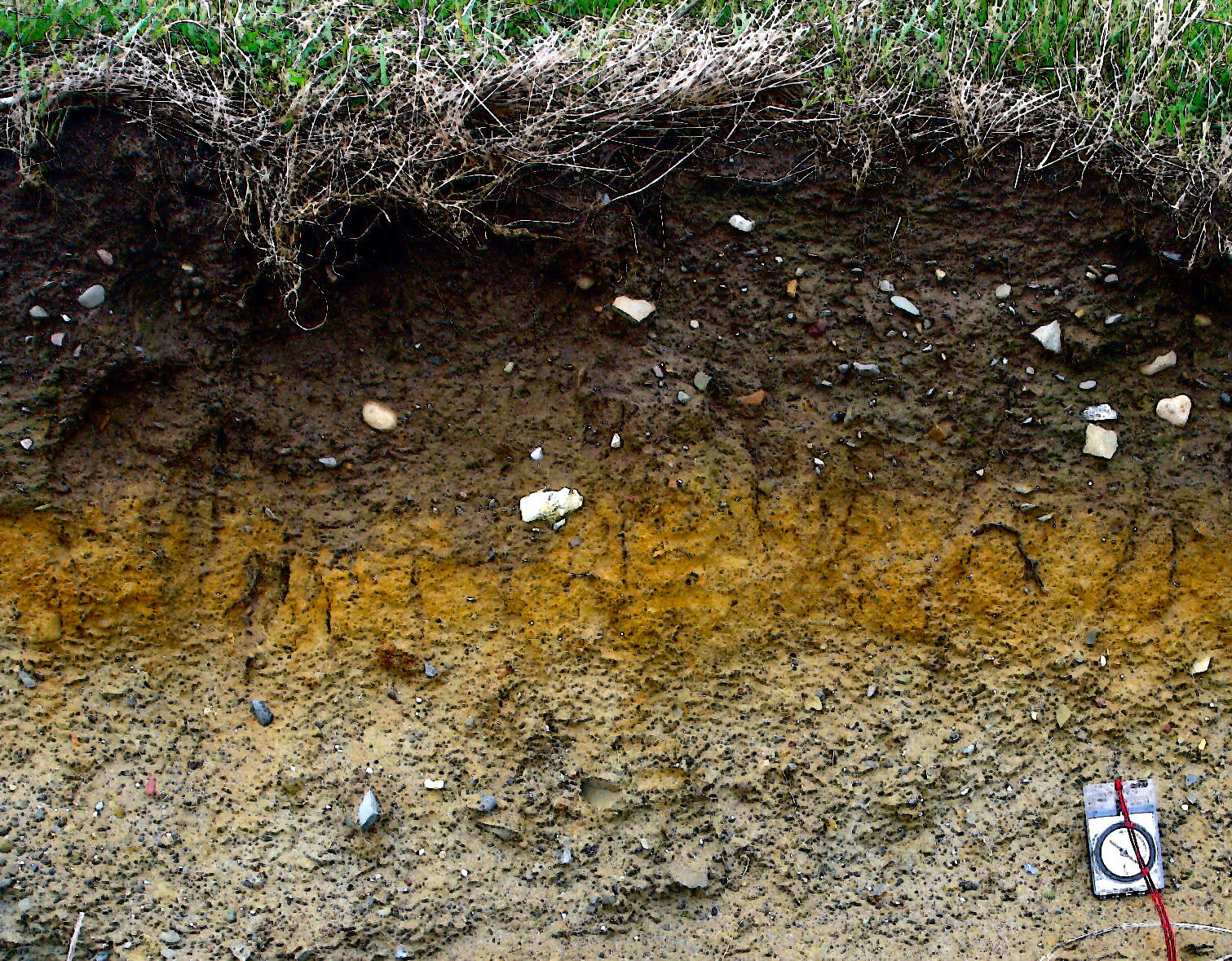
Soil, in the discipline of , is defined as the unconsolidated or organic material on the immediate surface of the that has been subjected to pedogenic processes, resulting in distinct horizons or layers distinguishable from underlying through additions, losses, transfers, and transformations of and . This definition, adopted by the U.S. Department of Agriculture's (NRCS), emphasizes soil as a natural body capable of supporting rooted in a , occupying space on the land surface, and comprising solids ( and ), liquids, and gases. The of America similarly describes soil as layers of loose and/or organic material affected by physical, chemical, and biological processes at or near the Earth's surface, typically to a depth of about 1 to 2 meters where roots and soil organisms are active. Fundamentally, soil forms a three-phase system: solid particles (approximately 45-50% by volume, including weathered minerals like sand, silt, and clay, and organic matter from decomposed biota), pore spaces filled with water and air (collectively 50-55%), and biotic components such as bacteria, fungi, protozoa, nematodes, and plant roots that drive nutrient cycling and decomposition. Unlike mere sediment or regolith, which lack significant biological alteration, soil exhibits pedogenic organization, with horizons reflecting differential accumulation of clays, humus, salts, or carbonates due to weathering, leaching, and biogenic activity over timescales ranging from centuries to millennia. The Food and Agriculture Organization (FAO) of the United Nations defines soil as a natural body composed of layers (horizons) of mineral and organic constituents, serving as the medium for plant growth while regulating water, solute, and gas exchange in the pedosphere. This pedogenic distinction underscores soil's role as a dynamic interface between , , atmosphere, and , where physical fragmentation of by freeze-thaw cycles or root wedging, chemical dissolution via acids from organic decay, and biological contributions from collectively engender its fertility and structure. Quantitatively, fertile horizons often contain 1-6% by weight, which enhances retention (up to 20 times its weight in ) and , critical for , though this varies by climate and —arid soils may hold less than 0.5% organics, while humid soils exceed 5%. Such properties emerge not from static composition but from ongoing processes, rendering soil a continuum rather than a uniform entity, with depth typically extending to the zone of genetic influence, often 1-2 meters, beyond which or predominates.

Ecological and Civilizational Role

Soil functions as the primary medium for growth, anchoring and facilitating uptake essential for and ecosystem productivity. It sustains a vast array of organisms, serving as for approximately 59% of global , ranging from microorganisms to larger and influencing aboveground through symbiotic interactions like mycorrhizal networks. Beyond supporting and , soil regulates hydrological cycles by infiltrating and filtering water, thereby mitigating floods, maintaining , and improving through pollutant adsorption and microbial degradation. Soils also play a critical role in biogeochemical cycles, particularly , where they store about 2,500 gigatons of organic carbon—roughly three times the amount in the atmosphere—primarily through microbial processing of residues and exudates into stable forms. This storage capacity buffers atmospheric CO2 levels, while and cycling in soil supports and prevents in downstream waters. As a dynamic interface, soil hosts decomposers that recycle , releasing nutrients for reuse and suppressing pathogens, thereby enhancing resilience against disturbances like or . In civilizational development, fertile soils underpinned the transition from societies to during the around 10,000 BCE, enabling crop domestication in regions like the and generating surpluses that supported , , and complex social structures. However, mismanagement leading to and fertility loss has precipitated declines in multiple historical societies; for instance, intensive Maya in the from 250–900 CE caused widespread soil degradation and accelerated , contributing to agricultural shortfalls amid climatic variability and eventual . Similarly, Roman imperial expansion depleted Mediterranean soils by the 1st century CE, forcing reliance on grain imports and weakening . Today, global soil degradation affects 33% of land, eroding at rates up to 100 times natural formation in agricultural areas, threatening food production for 8 billion people and underscoring the causal link between soil stewardship and civilizational sustainability.

Formation and Pedogenic Processes

Factors Influencing Soil Formation

The formation of soil, or pedogenesis, results from the interaction of five primary state factors—, , organisms (biota), (topography), and time—as formalized in Hans Jenny's quantitative model, which treats soil as a function of these variables: S=f(cl,o,r,p,t)S = f(cl, o, r, p, t), where interactions among them drive , organic accumulation, translocation, and horizon differentiation. These factors operate causally through physical, chemical, and biological processes, with providing the initial substrate and the others modulating rates of transformation; for instance, empirical studies confirm that variations in these factors explain up to 70-80% of soil property differences across landscapes in controlled chronosequences. Parent material, the unweathered geologic deposit (e.g., , , or ) from which soil derives, fundamentally determines initial , texture, and reserves; granitic materials yield coarse, quartz-rich sands with low fertility due to slow of resistant feldspars, whereas basaltic parent rocks produce finer-textured, clay-rich soils with higher base saturation from rapid release of magnesium and calcium. Calcium-rich lithologies, such as , enhance soil organic carbon by 33%, total by 58%, and by 55% compared to silica-dominated materials, as they buffer and support microbial activity, though this effect diminishes over time with leaching. Marine or lacustrine sediments often result in soils with elevated salinity and finer particles, influencing early pedogenic pathways like gleysols in waterlogged settings. Climate exerts control via temperature, which accelerates rates (doubling roughly every 10°C rise per van't Hoff rule) and , which drives and leaching; in tropical regions with >2000 mm annual rainfall, silicate depletes bases, forming highly acidic , while arid zones (<500 mm) favor physical disintegration and carbonate accumulation, yielding calcisols with shallow, saline profiles. Formation rates increase exponentially in warm, humid conditions—up to 0.1-1 mm/year depth gain—versus near-zero in polar deserts, with 's erosive force redistributing fines downslope and amplifying topographic effects. Observed shifts, such as 8-21% projected erosion increases under warming scenarios, underscore climate's dominant role in modulating long-term soil stability. Organisms, encompassing vegetation, microbes, and fauna, actively engineer soil through organic matter inputs (e.g., 1-5% annual litterfall in forests boosting humus), bioturbation (earthworms translocating 20-50 tons/ha/year), and biochemical alterations; mycorrhizal fungi and bacteria decompose recalcitrant organics, cycling 90% of nitrogen via fixation and mineralization, while conifer roots acidify profiles to pH 4-5 via organic acids, promoting podzolization. In grasslands, grazing mammals enhance aeration and nutrient turnover, fostering mollisols with granular structure, but microbial communities in early pedogenesis—dominated by phosphorus-solubilizing bacteria—can increase bioavailable P by 20-30% in nascent soils. These biotic influences interact with climate, as warmer conditions amplify decomposition rates by 2-3 fold, though overgrazing or deforestation can reverse gains by exposing mineral horizons. Relief, or topography, governs gravitational redistribution of water, sediments, and solutes; steep slopes (>15%) accelerate , limiting soil depth to <50 cm and favoring entisols with minimal horizonation, whereas footslopes and depressions trap colluvium, enabling argillic horizons via illuviation at rates of 0.01-0.1 mm/year. Aspect modulates insolation—south-facing slopes in the Northern Hemisphere experience 20-30% higher evapotranspiration, yielding drier, warmer microsites with accelerated organic decay—while elevation gradients alter precipitation by 10-20% per 100 m rise, influencing redox and clay migration. In zero-order watersheds, convergent topography concentrates biota and moisture, hastening pedogenesis compared to divergent crests. Time integrates these factors, permitting cumulative changes; immature soils form within decades post-disturbance (e.g., volcanic tephras developing andisols in 100-500 years), but mature profiles require 10,000-100,000 years for B-horizon clay accumulation exceeding 20%, with equilibrium states where addition balances loss. Chronosequences reveal logarithmic development—rapid initial gains in organic matter (peaking at 5-10 ka) slow as substrates deplete—though catastrophic events like glaciation reset clocks, as seen in Holocene soils averaging 3-5 ka age in glaciated midlatitudes. Human acceleration via tillage can mimic millennia of natural mixing but often depletes structure, highlighting time's role in stable horizonation.

Key Pedogenic Processes


Pedogenic processes encompass the fundamental mechanisms driving soil development from parent material, categorized into four primary types: additions, losses, translocations, and transformations. These processes operate concurrently under the influence of environmental factors, leading to horizon differentiation and soil profile maturation over timescales ranging from centuries to millennia. Additions involve the influx of new materials, primarily at the soil surface, such as atmospheric dust deposition, organic matter from plant litter and root exudates, and precipitation-borne ions. In arid regions, aeolian dust can contribute up to 20-50% of fine soil fractions in some profiles, enhancing fertility.
Losses refer to the removal of soil constituents, occurring via surface erosion, leaching of soluble salts and bases, or volatilization of gases like nitrogen oxides. Leaching predominates in humid climates, where percolating water extracts cations such as calcium and magnesium, potentially acidifying upper horizons over 1,000-10,000 years. Erosion rates vary widely, averaging 0.1-10 tons per hectare annually in undisturbed landscapes but accelerating to over 100 tons under cultivation. Translocations entail the downward or lateral movement of particles and solutes within the profile, exemplified by eluviation—washing out of clays, iron oxides, and organic colloids from upper horizons—and subsequent illuviation, their accumulation in lower B horizons. This process forms argillic horizons in many temperate soils, with translocation rates of clay estimated at 0.1-1 cm per 1,000 years in moderately weathered profiles. Biological activity, including earthworm burrowing, facilitates bioturbation, mixing materials at rates up to 10-20 tons per hectare yearly in fertile grasslands. Transformations involve in situ chemical and biological alterations, such as primary mineral weathering to secondary clays (e.g., feldspar to kaolinite) and decomposition of organic matter into stable humus. Weathering intensity increases with time and moisture, releasing nutrients like potassium at rates of 1-5% annually from micas in early stages, while humification stabilizes 10-20% of annual litter inputs as recalcitrant carbon. These changes enhance soil structure and fertility but can lead to thresholds where processes shift abruptly, such as from nutrient accumulation to depletion after 10,000-100,000 years on basaltic substrates.

Physical Properties

Texture, Structure, and Porosity

Soil texture is defined by the relative proportions of sand, silt, and clay particles, which are categorized by size as sand (0.05–2.0 mm diameter), silt (0.002–0.05 mm), and clay (<0.002 mm). The United States Department of Agriculture (USDA) employs a texture triangle to classify soils into 12 categories, such as sand, loam, and clay, based on percentage compositions determined via sieve analysis or the feel method. Texture profoundly influences soil behavior, with sandy soils exhibiting high permeability but low water and nutrient retention, whereas clayey soils retain more water and nutrients yet drain poorly due to smaller particle sizes. Soil structure describes the aggregation of primary particles into secondary units called peds, which form shapes including granular (crumb-like, common in surface horizons), blocky (angular or subangular, prevalent in subsoils), prismatic (vertical columns), and platy (horizontal plates). These aggregates arise from pedogenic processes involving organic matter binding via microbial exudates and fungal hyphae, root penetration, earthworm activity, and physicochemical forces like alternate wetting-drying or freezing-thawing cycles. Well-structured soils enhance root proliferation and microbial habitat compared to massive or compacted structures, which result from over-tillage or heavy traffic and impede drainage. Porosity quantifies the void spaces within soil, expressed as the fraction of total volume unoccupied by solids, typically ranging from 0.3 to 0.6 in undisturbed soils. It is calculated as n=1ρbρpn = 1 - \frac{\rho_b}{\rho_p}, where nn is porosity, ρb\rho_b is (1.0–1.8 g/cm³ for most soils), and ρp\rho_p is particle density (approximately 2.65 g/cm³ for mineral soils). Texture governs primary pore size distribution—coarse-textured soils feature larger macropores (>0.08 diameter) favoring rapid drainage and , while fine-textured soils have more micropores for greater but reduced permeability. modifies this by creating inter-aggregate macropores that improve connectivity, infiltration, and ; poor , such as in compacted soils, reduces effective porosity and increases bulk density, limiting oxygen diffusion and root growth.

Soil Water Dynamics

Soil water dynamics encompass the processes of infiltration, retention, movement, and depletion of within soil pores, which are critical for growth, nutrient transport, and hydrological cycling. enters the soil primarily through infiltration from or , with rates influenced by surface conditions and ; sandy soils permit rapid infiltration up to several centimeters per hour, while clay soils exhibit slower rates due to smaller pore sizes and higher forces. Once infiltrated, is retained in three forms: , which drains freely under ; , held by in smaller pores and available to ; and hygroscopic water, tightly bound to soil particles and unavailable for uptake. Retention capacity varies with soil texture and structure, as finer-textured soils like clays hold more water (up to 40% volumetric water content at saturation) due to greater microporosity, whereas coarser sands retain less (around 10-20%). The soil water retention curve describes this relationship, plotting volumetric water content against matric potential (measured in kPa), with key thresholds including field capacity—the water content after 1-3 days of drainage at approximately -10 to -33 kPa, representing the upper limit of plant-available water—and the permanent wilting point at -1500 kPa, below which plants cannot extract water sufficiently to sustain transpiration. Plant-available water capacity, the difference between field capacity and wilting point, ranges from 5-7% in sands to 15-20% in loams and silty clays, directly impacting crop productivity and irrigation needs. Water movement in soil follows under saturated conditions, expressed as discharge Q=KAΔhΔLQ = -K A \frac{\Delta h}{\Delta L}, where KK is (typically 10^{-2} to 10^{-5} m/s for sands to clays), AA is cross-sectional area, Δh\Delta h is head difference, and ΔL\Delta L is flow path length; in unsaturated zones, flow is slower and governed by moisture-dependent conductivity via Richards' equation. transports water downward beyond the root zone to aquifers, while upward fluxes occur via and (), which can deplete by 1-5 mm/day depending on and . The soil water balance equation, ΔSW=PAETQSQG\Delta SW = P - AET - QS - QG (where PP is , AET is actual , QS is , and QG is ), quantifies net changes, with imbalances leading to drought stress or saturation. enhances retention and infiltration by improving structure, increasing available water by 1-3% per percent added.

Soil Air and Temperature

Soil air consists of the gaseous phase occupying pore spaces within the soil matrix, typically comprising oxygen (O₂), (CO₂), (N₂), and , with compositions differing from atmospheric air due to biological respiration and root activity. In well-aerated soils, O₂ concentrations range from 10% to 20% by volume, lower than the atmospheric 21%, while CO₂ levels are elevated at 0.25% to 5%, often 10 to 100 times higher than the atmospheric 0.04%, reflecting microbial and root respiration that consumes O₂ and produces CO₂. These gases exchange with the atmosphere primarily through , driven by concentration gradients, with rates influenced by soil , moisture content, and structure; excessive water reduces pore connectivity, impeding O₂ influx and leading to anaerobic conditions below critical thresholds of 2-5% O₂, which inhibit aerobic processes. Soil aeration, the process of gas replenishment in pores, is essential for root respiration, microbial decomposition of organic matter, and nutrient mineralization, as many soil organisms require O₂ for energy-yielding oxidation reactions that release plant-available nutrients like nitrogen and phosphorus. Factors limiting aeration include soil compaction, which reduces macropores and air permeability; high water saturation, displacing air; and dense root mats or organic layers that increase CO₂ production without adequate diffusion. In agricultural contexts, poor aeration from flooding or tillage-induced compaction can reduce crop yields by 20-50% in sensitive species like corn, as roots suffer hypoxia, shifting metabolism to inefficient anaerobic fermentation. Soil temperature modulates air-related processes by affecting gas rates—higher temperatures increase molecular and thus diffusion coefficients—and biological demand for O₂, with respiration rates doubling roughly every 10°C rise up to an optimum of 25-30°C for most microbes. classifies temperature regimes based on mean annual soil temperature (MAST) at 50 cm depth: hyperthermic (>22°C), thermic (15-22°C), mesic (8-15°C), frigid (<8°C), and others like cryic for permafrost-influenced soils, with iso- variants indicating <6°C difference between mean summer and winter temperatures. Elevated temperatures accelerate organic matter decomposition and enzyme activities, enhancing CO₂ efflux and potentially depleting soil carbon stocks by 10-30% in warming scenarios, while extremes above 35°C impair root elongation and microbial diversity, favoring heat-tolerant anaerobes in poorly aerated zones. Conversely, low temperatures (<5°C) slow gas exchange and microbial activity, preserving O₂ but limiting nutrient cycling, as seen in northern latitudes where frigid regimes constrain decomposition rates to <10% of tropical equivalents.

Chemical Properties

Soil pH, Buffering, and Reactivity

Soil pH measures the acidity or alkalinity of the soil solution, defined as the negative base-10 logarithm of the hydrogen ion (H⁺) activity, with values typically ranging from 3.5 in highly acidic soils to 9.5 in alkaline ones, and 7 indicating neutrality. It is determined by mixing soil with distilled water or a calcium chloride solution (e.g., 1:2.5 soil-to-solution ratio) and measuring with a glass electrode pH meter after equilibration, though water extracts overestimate pH in saline soils while salt extracts provide a more accurate estimate of actual soil solution pH. Soil pH profoundly affects chemical processes and biological activity; nutrient availability peaks near pH 6 to 7 for most crops, where macronutrients like , , and are optimally soluble, but drops sharply below pH 6 due to P fixation by aluminum (Al³⁺) and oxides or above pH 7.5 from P sorption onto carbonates and reduced solubility of micronutrients like , , and . In acidic soils (pH < 5.5), toxic Al³⁺ and mobilize, inhibiting root growth, while alkaline conditions (pH > 8) promote accumulation, exacerbating sodicity in irrigated arid regions. Buffering capacity denotes the soil's resistance to pH shifts from acid or base inputs, quantified as the amount of or base required to change pH by one unit (e.g., in cmolₖ₊ kg⁻¹ pH⁻¹), and stems primarily from cation exchange reactions on clay minerals, , and oxides, with carbonates providing strong buffering above pH 8.5. High-clay soils (e.g., those dominated by 2:1 layer silicates like smectites) and those with elevated (>3%) exhibit superior buffering due to greater and variable charge sites that adsorb H⁺ or OH⁻, whereas sandy soils with low (CEC < 5 cmolₖ₊ kg⁻¹) change pH rapidly—e.g., a 1-ton/ha lime application might raise pH by 0.5 units in buffered clay loams but 2 units in sands. Factors like parent material weathering (releasing bases) and decomposition (producing organic acids) modulate long-term buffering, with tropical Oxisols showing high buffering from Fe/Al oxides despite low pH. Soil reactivity encompasses pH-driven processes such as ion exchange, precipitation-dissolution, and hydrolysis; variable-charge surfaces on humus and metal oxides generate pH-dependent charges—negative at high pH via deprotonation (e.g., >Al-OH → >Al-O⁻ + H⁺) and positive at low pH via —influencing anion (e.g., ) and cation adsorption, with exchangeable Al increasing exponentially below 5.5 on these sites. itself varies with , rising from 10-20 cmolₖ₊ kg⁻¹ at 4 to 30-40 cmolₖ₊ kg⁻¹ at 7 in variable-charge soils due to enhanced negative sites, facilitating retention but also base cation leaching under acidic conditions from ammonium-based fertilizers. reactions, such as Fe³⁺ reduction to Fe²⁺ in waterlogged acidic soils, further amplify reactivity by altering and profiles.

Nutrient Cycling and Availability

Nutrient cycling in soil refers to the continuous transformation and movement of essential elements, primarily through biological, chemical, and physical processes that regulate their supply to plants and microorganisms. Key macronutrients such as nitrogen (N), phosphorus (P), and potassium (K) cycle via mineralization of organic matter into plant-available inorganic forms, plant uptake, return through litterfall and root exudates, and microbial immobilization, with losses occurring through leaching, gaseous emissions, or fixation. These cycles maintain soil fertility but are influenced by environmental conditions; for instance, in forest ecosystems, nutrient retranslocation within plants can recycle up to 50-70% of foliar N and P before leaf abscission, reducing external inputs. Nitrogen cycling begins with atmospheric N2 fixation by in roots or free-living soil microbes, converting it to (NH4+), followed by to (NO3-) by autotrophic like and under aerobic conditions. then returns N to the atmosphere as N2 or N2O in waterlogged, anaerobic soils, leading to losses estimated at 10-30% of applied fertilizers in agricultural systems. Ammonification mineralizes organic N from plant residues or into NH4+, with rates accelerated by high soil temperatures (optimal at 25-35°C) and neutral (6-7). Phosphorus availability is limited by its low mobility and tendency to form insoluble compounds; organic P mineralization by phosphatases from microbes and roots releases orthophosphate, which comprises 50-75% of total soil P, but fixation with aluminum, iron, or calcium reduces bioavailability, especially in acidic (pH <5.5) or alkaline (pH >7.5) soils. Mycorrhizal fungi enhance P uptake by extending root reach and solubilizing bound forms via organic acids, increasing acquisition by up to 80% in P-deficient soils. Cycling is slower than N, with plant uptake recycling 10-20% annually in natural systems, and erosion represents a major loss pathway in tilled fields. Potassium cycles predominantly as the exchangeable K+ ion held on surfaces via cation exchange, with total soil K exceeding 20,000 mg/kg but only 1-2% plant-available; fixation into non-exchangeable forms occurs in 2:1 clays like , while leaching losses are higher than for P due to K+'s , reaching 50-100 kg/ha/year in sandy soils under high rainfall. absorb K+ via mass flow and , with uptake rates peaking at soil solution concentrations of 0.001-0.01 M, and through crop residues returns 90-95% in low-leach environments. Availability of these nutrients is modulated by soil properties: enhances cycling through microbial mediation, supplying 20-50% of plant N via , while low (<5.5) mobilizes toxic Al3+ and reduces P solubility by 50-70% via Al-P precipitation. Clay content correlates positively with cation retention (e.g., CEC >15 cmol/kg in loamy soils holds more K+), and influences micronutrients like Fe and Mn, with anaerobic conditions increasing their solubility by factors of 10-100. Microbial communities drive 80-90% of mineralization, but excessive inputs can disrupt balances, leading to acidification and reduced long-term availability.

Exchange Capacity and Redox Processes

Cation exchange capacity (CEC) refers to the total quantity of negative surface charges in soil that attract and retain positively charged ions, or cations, such as calcium (Ca²⁺), magnesium (Mg²⁺), potassium (K⁺), and hydrogen (H⁺). These charges primarily arise from clay minerals and , with CEC measured in centimoles of charge per of soil (cmol/kg) or milliequivalents per 100 grams (meq/100g). Soils with higher CEC, often exceeding 20 cmol/kg, exhibit greater nutrient-holding capacity, reducing leaching losses and supporting plant fertility, whereas low-CEC sands below 5 cmol/kg require frequent fertilization. Factors influencing CEC include the type and amount of clay minerals—such as expansive 2:1 clays like , which contribute up to 150 cmol/kg, compared to less expansive 1:1 clays like at 3–15 cmol/kg—and , which can add 200–400 cmol/kg due to carboxyl and phenolic groups. pH affects effective CEC, as aluminum (Al³⁺) saturation at low pH (<5.5) occupies exchange sites, displacing nutrient cations. Measurement typically involves saturating soil with an index cation like ammonium (NH₄⁺) at a standard pH (e.g., 7.0), displacing it with another cation, and quantifying the exchangeable amount via titration or spectroscopy. Anion exchange capacity (AEC), though generally lower than CEC in most soils, becomes significant in highly weathered, variable-charge soils like tropical oxisols and ultisols, where oxide minerals (e.g., Fe and Al oxides) develop positive charges at low pH. AEC retains anions such as (PO₄³⁻) and (SO₄²⁻), preventing their downward migration, and increases as pH decreases below 5.5, contrasting with CEC's pH dependency. In such soils, AEC values can reach 10–20 cmol/kg, enhancing retention of essential but mobile anions critical for crop nutrition. Redox processes in soil govern the oxidation states of elements through electron transfer reactions, quantified by redox potential (), typically ranging from +700 mV in aerobic conditions to below -200 mV in anaerobic flooded soils. Under oxic conditions (Eh >300 mV), oxygen serves as the primary , maintaining insoluble oxidized forms of iron (Fe³⁺) and (Mn⁴⁺); anaerobic shifts, driven by microbial respiration of , sequentially reduce (NO₃⁻) to N₂ gas, Mn⁴⁺ to soluble Mn²⁺, Fe³⁺ to Fe²⁺, and to (H₂S). These transitions alter availability: reduces nitrogen losses in waterlogged paddies, while Fe²⁺ and Mn²⁺ mobilization can induce in sensitive crops like at Eh <200 mV. Eh is influenced by soil moisture, temperature, organic carbon content, and microbial activity, with flooded soils exhibiting progressive Eh decline over days—from aerobic surface layers to reducing subsoils—evident in gleyed horizons with Fe mottles. Measurement uses platinum electrodes calibrated against a reference like Ag/AgCl, though in situ probes account for soil-specific equilibria, as disequilibria from multiple electron acceptors can yield variable readings. Redoximorphic features, such as gray reduced zones and orange oxidized mottles, signal fluctuating Eh, impacting phosphorus sorption via Fe oxide transformations and trace metal solubility.

Biological Components

Soil Microbiota and Fauna

Soil microbiota, comprising , archaea, fungi, and protozoa, dominate the microbial biomass in soil, with accounting for 70–90% of the total microbial biomass and fungi ranking second in abundance. These microorganisms exhibit high diversity, with bacterial and fungal communities influenced by factors such as soil texture, organic matter content, and land-use practices, often showing decreased richness in intensively managed agricultural soils compared to natural systems. Archaea, though less abundant, contribute to processes like methanogenesis in anaerobic microsites, while protozoa prey on , facilitating nutrient release through grazing. Bacteria and fungi play central roles in nutrient cycling, including the decomposition of organic matter into humus, mineralization of nitrogen, phosphorus, and other elements, and fixation of atmospheric nitrogen by groups such as rhizobia in symbiosis with legumes. Fungi, particularly mycorrhizal species, extend plant root systems via hyphal networks, enhancing uptake of water and immobile nutrients like phosphorus, while suppressing soil-borne pathogens through competition and antibiotic production. Microbial communities also regulate carbon sequestration by transforming plant residues into stable soil organic matter, with bacterial dominance in labile carbon turnover and fungal contributions to recalcitrant fractions. Soil fauna encompasses microfauna (e.g., nematodes and protozoa), mesofauna (e.g., mites and springtails), and macrofauna (e.g., earthworms and ants), which interact with microbiota to influence soil structure and function. Bacterivorous and fungivorous nematodes promote nitrogen mineralization by grazing on microbes, releasing excess nutrients for plant uptake and controlling microbial populations to prevent imbalances. Earthworms, as ecosystem engineers, bioturbate soil through burrowing, improving aeration, water infiltration, and root penetration while fragmenting organic residues to accelerate microbial decomposition. Arthropods like ants and termites contribute to soil mixing and organic matter incorporation, enhancing vertical transport of microbes and nutrients, though their activities can vary by soil type and climate. Interactions within the soil food web link microbiota and fauna, with predation and mutualism driving community dynamics; for instance, earthworm casts enrich microbial activity, while nematode populations respond to worm presence by shifting trophic structures. These biotic components collectively sustain soil fertility, with disruptions from tillage or monocropping reducing diversity and impairing functions like disease suppression and aggregate formation.

Organic Matter Decomposition

Organic matter decomposition in soil encompasses the microbial, enzymatic, and abiotic breakdown of plant residues, animal remains, and other organic inputs into simpler compounds, including mineral nutrients and stabilized humus. This process follows a continuum from fresh litter to partially decomposed detritus and ultimately recalcitrant humic substances, with rates varying by substrate quality and environmental conditions. Primary decomposition involves depolymerization of complex polymers like cellulose, lignin, and proteins into monomers such as sugars, amino acids, and phenols, followed by mineralization to CO₂, H₂O, NH₄⁺, PO₄³⁻, and other ions. The overall rate is governed by microbial activity, where extracellular enzymes hydrolyze bonds, and intracellular metabolism assimilates products, with approximately 50-60% of carbon respired as CO₂ under aerobic conditions. Soil microorganisms dominate the decomposition process, with bacteria, fungi, and actinomycetes comprising the core decomposer community. Bacteria, such as those in the phyla Proteobacteria and Actinobacteria, rapidly metabolize labile substrates like sugars and amino acids, achieving turnover times of days to weeks. Fungi, particularly white-rot species like those in Basidiomycota, specialize in recalcitrant lignocellulose via lignin peroxidases and laccases, enabling access to cellulose and hemicellulose; their hyphal networks enhance substrate penetration and nutrient translocation. Archaea contribute minimally but participate in methanogenesis under anaerobic conditions, while fauna like nematodes and earthworms fragment residues, stimulating microbial activity through grazing and burrowing. Protozoa and mesofauna regulate bacterial populations, indirectly influencing decomposition efficiency. Community composition shifts with substrate; fungal dominance prevails in high C/N ratio materials (>30:1), while bacteria favor low-ratio inputs. Decomposition rates are modulated by physicochemical factors, with exerting a strong positive effect via Q₁₀ values of 1.5-3.0, doubling rates per 10°C rise up to an optimum of 25-35°C before thermal inhibition. influences oxygen availability and ; optimal decomposition occurs at 50-60% water-filled pore space, with rates declining under waterlogging (favoring ) or (halting enzymatic activity). Clay-rich textures physically protect via adsorption and aggregation, reducing decomposability by 20-50% compared to sandy soils. Chemical quality, quantified by C/N , determines net mineralization; ratios below 20-25:1 yield excess release, whereas higher ratios immobilize N, slowing decomposition until microbial is met. affects stability and , with neutral to slightly acidic conditions ( 5-7) maximizing rates; extremes inhibit key taxa, as seen in priming effects where shifts alter legacy carbon turnover by up to 30%. This sustains by mineralizing 1-5% of organic N annually into plant-available forms, enhancing through accumulation (up to 200-300 cmol/kg in humic acids), and improving aggregate stability for and water retention. Stabilized fractions resist further breakdown, sequestering carbon for centuries, while labile pools drive short-term ; disruptions, such as tillage-induced priming, can accelerate losses by 20-50% via enhanced microbial access. In agricultural contexts, balanced under grass cover versus forests yields 2-4% higher levels due to finer root inputs and exudates favoring microbial efficiency.

Soil Profiles and Horizons

Horizon Development

Soil horizon development occurs through pedogenic processes that differentiate the soil profile into distinct layers, primarily via additions, losses, translocations, and transformations of materials. Additions involve inputs such as organic matter from plant residues and atmospheric dust, which contribute to the formation of surface horizons like the O and A layers. Losses occur through leaching of soluble salts, bases, and carbonates by percolating water, often leading to acidification and depletion in upper horizons. Translocations entail the downward movement of particles like clay, iron, and aluminum oxides via illuviation, enriching subsurface B horizons. Transformations include chemical weathering, oxidation-reduction reactions, and biological decomposition that alter mineral structures and organic compounds, fostering horizon-specific properties such as structure and color. These processes are governed by five interacting factors: , organisms, (), , and time, as outlined in the CLORPT framework. influences rates and moisture regimes; for instance, high accelerates leaching, promoting E horizon development in humid regions, while arid conditions favor calcic horizons through accumulation. Organisms, including and , drive incorporation and bioturbation, enhancing A horizon formation—roots and earthworms can mix materials up to depths of 1-2 meters over centuries. affects and deposition; slopes experience thinner, less developed profiles due to runoff, whereas depressions accumulate finer particles, accelerating horizon differentiation. provides the initial substrate, with unconsolidated sediments forming horizons faster than resistant , which may persist as a C or R horizon for millennia. Time scales range from decades for initial A horizon darkening to thousands of years for mature B horizon illuviation, with equilibrium often reached in 10,000-100,000 years under stable conditions. Horizon development progresses in stages, beginning with minimal differentiation in young soils (e.g., with A-C profiles) and advancing to complex profiles in older landscapes. Initially, within 50-500 years, organic additions darken the surface into an A horizon over the C horizon derived from . Over 500-5,000 years, eluviation may form a pale E horizon, followed by B horizon accumulation of translocated clays and sesquioxides, as seen in Alfisols or Ultisols. In forested ecosystems, O horizons accumulate slowly over hundreds of years from undecomposed litter, while agricultural disturbance can truncate development, maintaining simpler A-B-C sequences. Diagnostic features like argillic (clay-rich) B horizons require 1,000-10,000 years of translocation under temperate climates with 500-1,000 mm annual .

Diagnostic Horizons and Profiles

Diagnostic horizons are morphologically distinct layers within a soil profile that exhibit specific physical, chemical, and biological properties meeting defined criteria for soil classification, primarily as outlined in the USDA's Keys to Soil Taxonomy. These horizons reflect pedogenic processes such as organic matter accumulation, clay translocation, or redoximorphic features, enabling differentiation of soil taxa from order to series level. The presence, thickness, depth, and sequence of diagnostic horizons in a soil profile—the vertical cross-section from surface to underlying material—form the basis for taxonomic placement, with requirements for continuity across at least 50% of a pedon (a representative three-dimensional soil body). Epipedons represent the upper diagnostic horizons, typically 10–60 cm thick, influenced by , , and management, and include types such as mollic (dark, thick, high base saturation >50%, organic carbon >0.6%, in Mollisols), umbric (similar but base saturation <50%, in soils like Udults), ochric (pale, low organic carbon <0.6% or thin), and histic (organic, >20% , water-saturated). Subsurface diagnostic horizons indicate deeper alterations, including the argillic (clay accumulation, illuvial clay increase >1.2 times overlying horizon, in Alfisols and Ultisols), spodic (amorphous materials from podzolization, Fe/Al oxides, in Spodosols), oxic (highly weathered, low activity clays <16 cmol/kg, in Oxisols), cambic (altered but without illuviation, weak structure, in Inceptisols), and calcic (secondary carbonates >15% by weight, in Aridisols). Additional subsurface features like natric (argillic with columnar structure and high sodium), gypsic ( accumulation >5%), and sombric (dark, low base saturation) further refine . Soil profiles must include at least one diagnostic epipedon and often a subsurface horizon to qualify for higher-order categories, with exclusions for human-altered or thin layers not meeting quantitative thresholds (e.g., argillic requires observable clay films or 3% absolute clay increase). For instance, a profile with a mollic epipedon over an argillic horizon typifies many midwestern U.S. Alfisols, supporting due to fertility, whereas a spodic horizon in sandy profiles signals acidic, low-fertility conditions in northern forests. Verification involves field morphology, lab analyses for properties like (>25 cmol/kg for some cambics) or retention (>85% for andic properties), ensuring classifications align with genesis and function rather than arbitrary boundaries.
Diagnostic HorizonKey PropertiesAssociated Soil Orders
Mollic EpipedonThickness ≥18 cm (or ≥10 cm if overlain by ), color value ≤3 moist/≤5 dry, >0.6% OC, base saturation ≥50%Mollisols, some Alfisols
Argillic HorizonIlluvial clay increase (e.g., 8% absolute in loamy sand), clay films or skeletansAlfisols, Ultisols, some
Spodic HorizonIlluvial Fe/Al/organics, ≤5.9, <0.6% OC in lower partSpodosols
Oxic HorizonWeathered, clay activity <1.5 cmol/kg, P retention >85%, ≥30 cm thick
Cambic HorizonStructure/ color change, no illuviation, ≥15 cm thickInceptisols,
This table summarizes common horizons per Keys to Soil Taxonomy criteria, emphasizing measurable thresholds for reproducibility. Profiles lacking diagnostic horizons default to , reflecting minimal development, as seen in young alluvial or eolian deposits.

Classification and Mapping

Historical Classification Systems

Early attempts at soil classification date back to ancient civilizations, with the earliest documented system appearing in the Chinese text Yugong around 2500 years before present, which categorized based on agricultural productivity and regional characteristics across ancient . In , Roman agronomists like in the 1st century AD described soils qualitatively by color, texture, and suitability for crops, but these lacked systematic principles and treated soil primarily as a substrate modified by and . The foundations of modern pedology emerged in the mid-19th century, spurred by advances in and chemistry. German agriculturist Friedrich Albert Fallou is credited with coining the term "" in 1862 to denote the scientific study of soil as a distinct natural body, emphasizing field observation over chemical analysis alone. However, systematic classification awaited Vasily Dokuchaev's work in during the 1880s. Dokuchaev, through expeditions mapping soils starting in 1877, proposed the first genetic in publications from 1883 to 1886, viewing soil as an independent entity formed by interactions of , organisms, , , and time—termed "soil-forming factors." His system classified Russian soils into zones (e.g., podzols in northern forests, in steppes), highlighting latitudinal zonality driven by and , which marked a shift from lithologic to ecogenetic principles. Dokuchaev's framework influenced international pedology via disciples like Nikolay Glinka, whose 1914 translations spread Russian concepts to and America. In the United States, initial efforts under Milton Whitney, appointed Chief of the USDA Division of Soils in 1894, focused on practical agricultural mapping from 1899 onward, classifying soils primarily by texture, color, and geological origin into types and series by 1909—yielding over 2,000 series by the 1920s but criticized for lacking genetic depth and overemphasizing . Curtis Fletcher Marbut, exposed to Glinka's work during , reformed USDA classification in the 1920s–1930s by adopting Dokuchaevian . His 1935 atlas and text Soils: Their Genesis and divided soils into zonal (climate-dominated, e.g., pedalfers in humid regions), azonal (immature, e.g., alluvial), and intrazonal (locally influenced, e.g., bog soils) groups, enabling a 1:2,500,000-scale national map that integrated profile morphology and environmental factors. This zonal , while influential, faced critiques for oversimplifying soil variability and underweighting local . Parallel developments occurred elsewhere: in , Georges Ville's 19th-century fertility-based groupings evolved into Eugène-Melchior Péligot's texture-focused systems by the , while British surveys from the 1800s emphasized mapping over taxonomy. By the early , these historical systems laid groundwork for quantitative taxonomies, transitioning from descriptive to predictive frameworks grounded in observable soil properties and formation processes.

Modern Soil Taxonomies

The , developed by the Department of Agriculture's , establishes a system with six categories: order (12 total, based on major soil-forming processes), suborder, great group, , (incorporating physical and mineralogical properties), and series (the most specific mapping unit). First outlined in 1975, it relies on diagnostic horizons and surface features defined by quantitative criteria such as depth, color, texture, structure, and chemical properties to enable interpretation and predictions. The system's 13th edition of Keys to Soil Taxonomy, released in 2022, refines these keys for precise identification, emphasizing observable and lab-measurable attributes over genetic inferences. In contrast, the World Reference Base for Soil Resources (WRB), endorsed by the International Union of Soil Sciences as the global standard, employs a two-tier structure with 32 Reference Soil Groups (e.g., Andosols for volcanic ash-derived soils, Chernozems for humus-rich soils) defined by key diagnostic properties, supplemented by over 120 qualifiers for substratum, texture, or moisture regime variations. Its fourth edition, published in December 2022, prioritizes international comparability for soil mapping and correlation, using criteria like horizon thickness (e.g., minimum 10 cm for an argic horizon with clay increase) and redoximorphic features without assuming pedogenic history. While both systems anchor classification in diagnostic horizons—such as the mollic epipedon in fertile soils or spodic horizons in podzols—they diverge in granularity and application: USDA Taxonomy supports detailed U.S.-centric surveys with finer subdivisions, whereas WRB facilitates cross-national harmonization but requires national adaptations for local precision. Direct equivalences are limited due to differing thresholds (e.g., WRB's broader ferralsol group versus USDA's with stricter content), necessitating correlation tables for global datasets. Other regional systems, like the Australian Soil Classification (with 14 orders emphasizing surface textures), draw from these but adapt to endemic conditions, underscoring modern taxonomies' role in integrating with geospatial and environmental modeling.

Human Uses and Management

Agricultural Applications

Soil functions as the primary in , supplying mechanical support for , retaining and dissolved nutrients, facilitating for root respiration, and hosting microbial communities that cycle into bioavailable forms. These attributes enable anchorage against and , with empirical studies showing that soils with adequate structure—typically 40-50% pore space—support root penetration depths exceeding 1 meter, correlating with higher accumulation in cereals like . (SOM), comprising 1-6% of in arable lands, enhances , buffering nutrient leaching; meta-analyses indicate that each 1% increase in SOM can boost yields by 5-15% in temperate regions through improved water-holding capacity of up to 20,000 liters per per percent SOM. Soil texture, defined by the proportions of (0.05-2 mm), (0.002-0.05 mm), and clay (<0.002 mm) particles, dictates crop suitability by influencing drainage, compaction risk, and nutrient retention. Loamy soils, with roughly equal parts of each fraction, are optimal for diverse row crops such as wheat, soybeans, and vegetables, offering balanced permeability (infiltration rates of 1-5 cm/hour) and fertility; for instance, silt loam supports corn yields averaging 10-12 tons per hectare under irrigation. Sandy soils, prevalent in 20-30% of global arable lands, suit root vegetables like carrots and potatoes due to rapid drainage preventing rot, though they require frequent irrigation to mitigate low water-holding capacity (often <10% volumetric at field capacity). Conversely, clay-rich soils, with high shrink-swell potential, excel for water-intensive crops like rice paddies, where saturation tolerance sustains yields of 4-8 tons per hectare, but demand careful management to avoid crusting that impedes seedling emergence. Fertility management applications leverage soil testing to target amendments, with pH adjustment via lime (raising pH by 0.5-1 unit per 2 tons/ha) optimizing nutrient uptake; acidic soils (pH <5.5) limit phosphorus availability, reducing yields by 20-30% in brassicas unless corrected. Nitrogen, phosphorus, and potassium fertilizers, applied at rates of 100-200 kg N/ha for grains, have driven yield doublings since 1960, though site-specific application via precision tools minimizes excess; U.S. corn production data from 1990-2020 show integrated nutrient management sustaining 170 bushels/acre averages while curbing runoff. Cover cropping and reduced tillage, as in conservation systems, maintain SOM levels above 2%, stabilizing yields under variable climate—long-term trials report 21% soil health gains without yield penalties compared to conventional plowing.

Non-Agricultural Uses

Soil provides the foundational support for buildings, roads, bridges, and other infrastructure through its mechanical properties, including bearing capacity, shear strength, and permeability, which engineers evaluate to ensure structural stability and prevent settlement or failure. In geotechnical engineering, soil classification systems group materials by grain size distribution, plasticity, and compaction characteristics to predict performance under applied loads, such as those from foundations or embankments. For instance, cohesive soils like clays exhibit high plasticity but low permeability, influencing their suitability for retaining structures, while granular soils like sands offer better drainage but require compaction to achieve adequate strength. Soils contribute directly to construction materials, with clay-rich varieties fired into bricks and mixed with other components to produce cement, accounting for a significant portion of global building material production; for example, Portland cement derives from calcined limestone and clay, enabling durable concrete used in over 90% of modern infrastructure projects. Earthworks involve excavating, compacting, and stabilizing native soils for site preparation, road bases, and landfills, where mechanical stabilization techniques like dynamic compaction increase density and load-bearing capacity by up to 20-30% in loose deposits. In urban environments, soils underpin green infrastructure applications, such as bioswales, permeable pavements, and tree pits, where amended urban soils enhance stormwater infiltration, reducing runoff by 30-50% in managed systems compared to impervious surfaces. These soils support vegetation growth while providing ecosystem services like carbon storage—urban soils can sequester 0.5-2 tons of carbon per hectare annually—and water retention, mitigating flood risks in cities. Engineered soil mixes in green roofs and rain gardens filter pollutants, with studies showing removal rates of 60-90% for heavy metals and nutrients from stormwater. Recreational and landscaping uses leverage soil's ability to support turf and ornamental plants in parks and sports fields, where loamy soils with balanced texture ensure root anchorage and drainage, sustaining high-traffic areas; for example, golf course greens use sandy soils amended for optimal percolation rates exceeding 6 inches per hour. In waste management, compacted clay soils serve as liners in landfills to minimize leachate migration, with low hydraulic conductivity below 10^-7 cm/s preventing groundwater contamination. These applications highlight soil's versatility beyond agriculture, though urban compaction and contamination often necessitate remediation to restore functionality.

Soil Management Techniques

Conservation tillage practices, such as no-till or reduced-till systems that leave at least 30% of crop residue on the soil surface, minimize soil disturbance to preserve structure, reduce erosion rates by up to 90% compared to conventional tillage, and enhance organic matter accumulation, thereby improving water infiltration and microbial diversity. Long-term field studies demonstrate that these methods increase soil organic carbon by 0.2-0.5% annually in temperate regions, supporting greater crop resilience to drought, though they may elevate anaerobic conditions and nitrous oxide emissions in poorly drained soils, complicating greenhouse gas mitigation. Crop rotation, involving the sequential planting of diverse species like legumes with cereals, replenishes soil nutrients by leveraging differential root uptake and nitrogen fixation, reducing dependency on synthetic fertilizers by 20-50% in rotations including soybeans or alfalfa. This practice disrupts pest cycles and improves soil aggregation through varied root architectures, with meta-analyses confirming enhanced physical properties like reduced bulk density and increased water-holding capacity under conservation tillage integration. Empirical data from U.S. Midwest trials show yield stability increases of 10-15% over monocultures, attributed to balanced microbial communities that boost nutrient cycling efficiency. Cover cropping deploys non-cash crops like rye or clover during fallow periods to suppress weeds, scavenge residual nutrients, and build soil organic matter, with root exudates stimulating microbial activity that decomposes residues into humus, elevating soil carbon stocks by 0.3-1.0 Mg/ha/year. These systems cut nutrient runoff by 50% or more via improved infiltration and can suppress erosion by anchoring soil particles, as evidenced in Ohio field experiments where legume-grass mixes reduced sediment loss by 70-90%. However, termination timing is critical; delayed incorporation risks nitrogen immobilization, temporarily limiting availability for succeeding crops unless managed with balanced mixes. Organic amendments, including manure or compost applications at rates of 10-20 tons/ha, elevate cation exchange capacity and microbial biomass, with 37-year trials indicating 25-80% greater carbon inputs and partial retention fostering long-term fertility. Precision nutrient management, guided by soil testing, applies fertilizers at optimal rates (e.g., 4R principles: right source, rate, time, place), minimizing leaching; USDA data link this to 15-30% efficiency gains in corn-soy systems. Erosion control techniques on slopes, such as contour plowing and terracing, redirect runoff to reduce rill formation, with NRCS guidelines showing contour farming halves soil loss versus straight-row methods on 2-8% gradients. Riparian buffers of grasses and trees along waterways filter sediments, cutting phosphorus export by 50-90% in agricultural watersheds per Iowa monitoring. Vegetation mulching and check dams further stabilize surfaces, though efficacy depends on site-specific hydrology and maintenance to prevent undercutting.

Degradation Mechanisms

Physical Degradation

Physical degradation of soil encompasses structural alterations that diminish its capacity to support plant growth, retain water, and facilitate root development, primarily through mechanisms such as erosion, compaction, and crusting. These processes disrupt soil aggregation, increase bulk density, and reduce porosity, leading to decreased infiltration rates and heightened susceptibility to runoff. According to assessments by the (FAO), physical degradation affects approximately 25% of global land, exacerbating food insecurity and biodiversity loss by impairing soil functionality. Soil erosion, a dominant form of physical degradation, involves the detachment and transport of topsoil particles by water, wind, or tillage, often accelerated by unsustainable land management practices like excessive tillage and deforestation. Water erosion predominates in humid regions, where rainfall detaches particles and runoff transports them, while wind erosion prevails in arid areas with sparse vegetation cover. Globally, soil erosion rates average 12-15 tons per hectare per year on agricultural land, far exceeding natural soil formation rates of 1-2.5 tons per hectare annually, resulting in net topsoil loss that diminishes soil depth and nutrient-holding capacity over time. In the United States, the Natural Resources Conservation Service (NRCS) reports that cropland erosion averaged 5.9 tons per acre annually as of 2017, though conservation tillage has reduced rates from historical highs of over 12 tons per acre in the 1980s. Tillage erosion, induced by farm equipment, redistributes soil downslope, further homogenizing profiles and exposing subsoils with inferior physical properties. Compaction occurs when external pressures from heavy machinery, livestock trampling, or excessive traffic compress soil pores, elevating bulk density beyond optimal levels of 1.0-1.6 g/cm³ for most crops and restricting root elongation and water movement. This degradation is particularly acute in fine-textured soils under repeated wet-season trafficking, where penetration resistance can exceed 2 MPa, inhibiting microbial activity and aeration. Studies indicate that compacted layers persist for years without intervention, amplifying erosion risks by curtailing infiltration and promoting surface ponding. In European subsoils, up to 32% exhibit high compaction vulnerability, correlating with yield reductions of 10-50% in affected fields. Surface crusting and sealing arise from the slaking of aggregates under raindrop impact and microbial breakdown, forming a dense, impermeable layer 1-5 mm thick that impedes seedling emergence and infiltration by up to 90%. This phenomenon intensifies in soils low in organic matter or exposed after tillage, fostering anaerobic conditions and nutrient leaching during heavy rains. Crusting exacerbates erosion by channeling runoff into rills, with observed increases in sediment yields of 2-10 times on crusted versus aggregated surfaces. Remediation requires maintaining residue cover or incorporating organic amendments to stabilize structure, as mechanical disruption alone often induces further degradation.

Chemical Degradation

Chemical degradation of soil refers to the alteration of its chemical composition and properties, primarily through anthropogenic activities, leading to diminished fertility, increased toxicity, and impaired ecosystem functions. Key processes include acidification, salinization, heavy metal contamination, and nutrient imbalances, often exacerbated by excessive fertilizer use, irrigation practices, and industrial pollution. These changes disrupt soil pH, cation exchange capacity, and microbial activity, ultimately reducing agricultural productivity and posing risks to human health via the food chain. Soil acidification occurs when soil pH drops below optimal levels (typically <5.5), primarily due to nitrogen deposition from fertilizers and acid rain from sulfur and nitrogen oxides. This process accelerates the leaching of essential base cations like calcium and magnesium while mobilizing toxic aluminum, inhibiting root growth and nutrient uptake in plants. Globally, nitrogen addition has been shown to significantly lower soil pH, with biotic factors such as vegetation type modulating the rate; for instance, forests exhibit greater sensitivity than grasslands. In agricultural settings, acidification contributes to an average 13.7% reduction in crop yields, with vegetables experiencing higher losses (up to 20-30%) compared to cereals due to aluminum toxicity thresholds. A 2016 study highlighted that without liming, severe acidification in temperate regions can increase aluminum saturation to levels exceeding 20%, correlating with yield declines of 10-50% in sensitive crops like alfalfa. Salinization involves the accumulation of soluble salts (e.g., ) in the soil profile, often from poor irrigation management in arid regions where evaporation exceeds leaching. This raises soil electrical conductivity, osmotic stress on plants, and sodium-induced dispersion of soil aggregates, reducing permeability and aeration. Worldwide, salt-affected soils cover approximately 1,381 million hectares, or 10.7% of global land area, with over 3% of topsoils and 6% of subsoils impacted by or sodicity as of recent assessments. Primary salinization, driven by natural aridity and exacerbated by , affects vast dryland areas, while secondary salinization from irrigation impacts 20% of irrigated croplands globally, leading to yield losses of 10-50% in staples like wheat and rice. In regions like the Middle East and Central Asia, salinization has rendered millions of hectares unproductive, with projections indicating a 10-25% expansion by 2050 under current practices. Heavy metal contamination, from sources such as mining, industrial effluents, and agrochemicals (e.g., phosphate fertilizers containing ), introduces persistent toxins like lead, , and arsenic that exceed natural background levels. These metals bind to soil particles, reducing bioavailability but accumulating in crops via root uptake, with bioaccumulation factors varying by metal-soil pH interactions; for example, uptake increases at lower pH. Effects include inhibition of soil enzyme activity, microbial diversity loss (up to 50% reduction in bacterial populations at high concentrations), and phytotoxicity manifesting as chlorosis and stunted growth. Chronic exposure through contaminated produce links to human health issues, including renal dysfunction from and neurotoxicity from lead, with global hotspots in industrial belts showing soil concentrations 10-100 times above safe limits (e.g., >1 mg/kg for in arable soils). Remediation challenges persist due to metals' immobility and resistance to degradation. Nutrient imbalances and chemical pollution from pesticides and excess fertilizers further degrade soil chemistry by promoting runoff and residual toxicities. Over-application of and depletes and alters microbial communities, while persistent organics like analogs bioaccumulate, disrupting . These factors collectively contribute to a 20-40% loss in intensively farmed soils, underscoring the need for precise management to mitigate cascading effects on and .

Biological Degradation

Biological degradation of soil encompasses the diminution of soil biotic communities, including microorganisms (, fungi, actinomycetes), meso- and macrofauna (such as nematodes, earthworms, and arthropods), resulting in impaired functions like , cycling, and pathogen suppression. This process often stems from anthropogenic pressures intertwined with physical and chemical stressors, such as intensive that fragments habitats and disrupts fungal hyphal networks, leading to reduced microbial connectivity and diversity. applications further exacerbate losses by directly toxic effects on non-target organisms; for instance, common insecticides negatively impact 84% of tested physiological parameters, while overall exposure harms soil invertebrates like earthworms, , and ground-nesting bees in 71% of studied cases. Declines in (SOM), frequently linked to continuous cropping without amendments, trigger cascading biological effects by limiting carbon substrates essential for microbial proliferation; historical data from long-term experiments indicate that halving SOM from 5% to 2% over 60 years can slash by up to 90%. Such reductions favor opportunistic bacterial dominance over diverse fungal communities, altering fungal-to-bacterial ratios and diminishing extracellular activities critical for mineralization. Compaction from heavy machinery, while primarily physical, indirectly curtails biological activity by restricting pore space for macrofauna burrowing and reducing mineralization rates by up to 18%, thereby constraining microbial access to substrates. The consequences manifest in diminished and resilience; microbial diversity losses impair efficiency, slowing carbon and turnover, which in turn elevates plant disease vulnerability due to weakened suppressive microbiomes against pathogens. populations, key engineers enhancing aeration and aggregation, decline sharply under pesticide-laden conditions, with synthetic chemicals posing severe threats via and gut disruption. Quantitatively, events like heavy metal inputs from can suppress microbial respiration by up to 80%, while broader scenarios—encompassing and —shift community compositions, reducing functional guilds responsible for solubilization and organic pollutant breakdown. These alterations collectively undermine soil's capacity for self-regulation, amplifying susceptibility to further degradation cycles.

Controversies and Debates

Extent of Global Soil Degradation

Global assessments of soil degradation extent reveal significant variability due to differing methodologies, definitions, and data sources, ranging from to field surveys. A 2024 review indicates that approximately 33% of the world's soils are moderately to highly degraded, primarily from , organic matter loss, imbalances, acidification, salinization, and . The (FAO) estimates that 1.66 billion hectares of land—over 10% of the global land area—are degraded due to human activities, with more than 60% impacting agricultural lands. Annual degradation rates are estimated at 100 million hectares globally by the United Nations Convention to Combat Desertification (UNCCD), exacerbating pressures on food production and ecosystems. Specific degradation types show widespread occurrence: salinity affects nearly 1.4 billion hectares (about 10% of global land), while nearly half of croplands experience varying degrees of degradation linked to agricultural practices and climate extremes. Regional disparities are pronounced, with hosting around 40% of degraded soils, often in arable areas where up to 46% of land is affected. These figures derive largely from FAO and UNCCD frameworks like GLADIS and , which integrate biophysical indicators but face challenges in uniform global application, potentially under- or over-estimating trends in data-sparse regions. Despite restoration commitments covering one billion hectares by 2030, ongoing degradation outpaces efforts in many areas. Empirical underscore that while not all degraded soils are irretrievable, productivity losses from compaction and alone could diminish global agricultural output without intervention.

Causes: Anthropogenic vs. Natural Factors

Natural processes contributing to soil degradation operate over geological timescales and include physical by and , chemical , and influenced by variability. Under undisturbed, non-agricultural conditions, average rates are typically less than 2 Mg ha⁻¹ yr⁻¹, with long-term background rates often below 10 mm per thousand years. These rates are generally balanced by processes, such as mineral and accumulation, maintaining stability in the absence of external perturbations. Events like volcanic eruptions or extreme climatic shifts, such as prolonged droughts or floods, can episodically accelerate degradation, but such occurrences are infrequent and localized, with recovery possible through natural pedogenic processes. Anthropogenic factors, however, dramatically amplify degradation rates through land use changes that disrupt vegetative cover and . Agricultural practices, including , , and , expose soil to erosive forces, resulting in rates 10 to 100 times higher than natural baselines; for instance, activities cause approximately 10 times more continental surface than all natural processes combined. and further exacerbate this by removing protective plant and compacting soil, leading to accelerated and , depletion, and from pollutants like and excess fertilizers. Chemical degradation, such as salinization from improper or acidification from intensified by industrial emissions, is predominantly human-driven, with global models attributing over 80% of current to cropland expansion and management practices. Empirical comparisons reveal that while factors set baseline degradation, anthropogenic influences dominate contemporary global patterns, overriding rates by orders of magnitude—-induced changes occur over decades rather than millennia. Peer-reviewed assessments estimate that 33% of global land is moderately to highly degraded, with as the primary driver, far outpacing variability in both extent and severity. This disparity underscores causal realism: processes alone rarely lead to irreversible loss of soil productivity, whereas acceleration prevents replenishment, as evidenced by modeling studies projecting continued increases in under current trajectories.

Efficacy of Proposed Solutions

Conservation agriculture practices, such as no-till farming combined with cover crops and residue retention, have demonstrated efficacy in reducing soil erosion and improving soil organic carbon (SOC) content in meta-analyses of global field experiments. For instance, no-till practices in vulnerable areas can reduce soil loss and sediment yield by over 70% compared to conventional tillage. Similarly, strip relay cropping increased SOC by 23.7%, outperforming no-till with cover crops at 4.4%. Long-term adoption of no-till has also enhanced crop resilience to weather extremes and outyielded tilled systems after 15 years in comparative studies. However, efficacy varies by context, with debates centering on and broader degradation reversal. Some meta-analyses indicate no consistent reduction in or runoff from conservation practices at field scales, suggesting limited impact on chemical degradation without targeted amendments. No-till systems can improve and retention but may exacerbate compaction or pressure in heavy clay soils without cover crops, leading to contrasting outcomes versus conventional methods in short-term trials. Restoration techniques like passive revegetation show promise for recovery in low-stress sites but often fail in heavily degraded or high-productivity areas due to persistent abiotic limitations such as compaction and anoxia. Overall, while empirical data affirm benefits—evidenced by a 21% average increase under even amid warming—critics argue that solutions overestimate reversal of global degradation due to scale mismatches between plot-level gains and watershed-level persistence of factors like . barriers, including initial yield dips and costs, further temper efficacy claims, with success hinging on site-specific integration rather than universal application.

Restoration and Conservation

Reclamation Methods

Soil reclamation involves restoring degraded land to a state capable of supporting , , or other uses, addressing issues such as , , compaction, , or depletion through targeted interventions. Physical methods include replacement and deep to alleviate compaction and reconstruct ; for instance, scraper haul and cross-pit wheel techniques have been applied in mined lands to reposition materials, achieving reclamation success rates measured by soil productivity metrics like equivalents. Decompaction via air tilling disrupts compacted layers around root zones without further disturbance, redistributing soil to enhance infiltration and root penetration in disturbed sites. Chemical amendments neutralize specific degradations, such as applying to sodic soils to replace sodium ions via cation exchange, reducing exchangeable sodium percentage (ESP) and improving ; empirical studies in Ethiopian sodic soils demonstrated that gypsum combined with organic inputs lowered ESP by up to 40% and boosted yields by 25-50% within two years. Lime additions raise pH in acidic or metal-contaminated soils, immobilizing and decreasing their , as evidenced in post-mining reclamation where liming reduced uptake in crops by enhancing reactions. For saline soils, leaching with low-salinity water alongside drainage systems flushes excess salts, while organic fertilizers maintain soil organic carbon to prevent re-salinization, with field trials showing sustained productivity gains in irrigated arid zones. Biological approaches leverage organisms for remediation, including phytostabilization where metal-tolerant immobilize contaminants in and rhizospheres, effectively reducing leaching risks in mining-impacted soils without excavation; a review of real-world applications confirmed its efficacy for long-term stabilization of legacy pollutants like lead and . employs microbial consortia to degrade organics or transform inorganics, augmented by amendments like to stimulate native , yielding up to 80% contaminant reduction in hydrocarbon-polluted sites per case studies. Revegetation with nutrient-rich amendments such as or accelerates recovery on construction-disturbed or oil/gas well sites, with trials in reporting enhanced soil microbial activity and vegetation cover exceeding 70% within five years, outperforming unamended controls. Meta-analyses across indicate that integrated restoration combining these methods increases indicators—such as by 20-30% and reduced —more effectively than single interventions, though success depends on site-specific factors like and .

Conservation Strategies and Outcomes

Conservation strategies for soil encompass practices designed to minimize , enhance , and maintain fertility, including , cover cropping, contour farming, terracing, and . These methods aim to counteract degradation by preserving and promoting natural processes such as root reinforcement and residue cover. Empirical assessments indicate that integrated , combining reduced with cover crops and residue retention, yields an average 21% improvement in indicators like organic carbon and microbial activity after long-term adoption, while sustaining yields comparable to conventional systems. No-till farming, which avoids plowing to limit soil disturbance, substantially reduces rates by over 80% compared to conventional , thereby protecting soil aggregates and enhancing water infiltration. Long-term studies spanning 30 years demonstrate that no-till systems outperform tilled counterparts in crop resilience to weather extremes and yield stability, particularly after 15 years of continuous practice, with benefits accruing from preserved and reduced compaction. However, outcomes vary by and management; in some cases, surface compaction may intensify without complementary practices like cover cropping. Cover crops, planted between main crop seasons, bolster by increasing levels by 4% to 62% for non-legume species and improving nutrient cycling, with detectable enhancements in soil properties observable within the first few years of adoption across diverse U.S. farms. on 78 farms in nine states confirms gains in key indicators such as active carbon and aggregate stability, contributing to and moisture retention. When combined with no-till, cover crops further elevate soil organic carbon and nitrogen, fostering microbial diversity essential for long-term fertility. Contour farming and terracing, applied on sloping lands, redirect water flow to curb runoff and loss; contour practices alone can halve relative to up-and-down cultivation, while terracing reduces soil loss by up to 75% and runoff by 20% within two years in untreated versus treated areas. In mountainous regions, terraced coverage exceeding 40% of area has achieved 43% to 70% , preserving and enabling sustained productivity. These structural interventions prove most effective when integrated with vegetative covers, though initial costs and demands influence adoption rates. Agroforestry systems, incorporating trees into agricultural landscapes, enhance through root networks that stabilize soil and recycle nutrients, leading to improved fertility and reduced alongside . Systematic reviews document 's role in elevating services like nutrient retention and , with field evidence showing decreased degradation on degraded lands via addition and barriers. Outcomes include heightened stocks and water-holding capacity, though benefits accrue gradually and depend on species selection and . Riparian buffers, a subset of , exemplify targeted conservation by filtering sediments and nutrients before they reach waterways, as observed in Midwest U.S. implementations.

Research History and Advances

Early Soil Fertility Studies

In the early 17th century, conducted one of the first quantitative experiments on plant growth and soil contribution, planting a 5-pound willow sapling in a tub with 200 pounds of oven-dried soil and adding only rainwater over five years. The resulting tree weighed 169 pounds, while the soil mass decreased by only about 2 ounces after accounting for dust loss, prompting van Helmont to infer that vegetation arose primarily from transmuted into matter rather than soil solids. This conclusion, while empirically grounded in , overlooked trace leaching into the water, as later analyses confirmed soil's role in supplying essential elements despite minimal net weight change. Building on such observations, mid-18th-century inquiries shifted toward mechanical soil processing. Scottish chemist Francis Home performed controlled pot experiments in 1757, testing ash solutions from burned plants and concluding that saline minerals, not , primarily nourished crops, though he still emphasized organic amendments for soil vitality. Independently, English agriculturist Jethro Tull, in his 1731 treatise Horse-Hoeing Husbandry, rejected humus-based theories dominant since antiquity, arguing instead that plants derived sustenance from finely pulverized soil particles released through deep , analogous to mastication exposing nutrients. Tull advocated repeated hoeing to depths of 8-10 inches without , claiming it fermented soil internally to enhance , a view supported by his vineyard yields but later critiqued for ignoring organic matter's products. The late 18th and early 19th centuries marked a transition to chemical paradigms, with Humphry Davy’s 1813 lectures identifying potash and soda as key plant bases, though he retained a humoral view of soil exhaustion. Decisive progress came with Justus von Liebig's 1840 work Chemistry in Its Application to Agriculture and Physiology, which posited that soil fertility hinges on mineral salts—nitrogen, phosphorus, and potassium—absorbed in ionic form, with crop yields proportional to the scarcest nutrient per his "law of the minimum," illustrated by a barrel's capacity limited by its shortest stave. Liebig's analysis of ash residues from various plants empirically validated essentiality of these elements, advocating synthetic fertilizers over organics, though he initially underestimated atmospheric nitrogen fixation, a gap addressed by concurrent Rothamsted trials. At the Rothamsted Experimental Station, founded in 1843 by John Bennet Lawes and Joseph Henry Gilbert, long-term plots like the Broadbalk wheat experiment quantified impacts, showing inorganic salts alone insufficient without sources, thus refining Liebig's mineral theory through replicated field data spanning decades. These studies collectively displaced organic-centric views, establishing empirical foundations for modern by prioritizing verifiable nutrient balances over speculative fermentation.

Evolution of Soil Science

In the early , British agriculturist Jethro Tull advanced practical soil management through his 1731 book Horse-Hoeing Husbandry, promoting deep with a horse-drawn hoe to pulverize soil for better and root penetration, under the theory that plants derive directly from finely divided soil particles rather than or , a view that emphasized mechanical soil preparation but underestimated nutrient cycling. This approach influenced farming practices by prioritizing over , though Tull's rejection of organic amendments limited its long-term fertility insights. The 19th century shifted toward chemical explanations of , led by German chemist , who in 1840 formulated the Law of the Minimum, stating that crop yields are controlled by the scarcest essential nutrient rather than total resources, with , , and identified as primary plant requirements derived from soil minerals. Liebig's work, detailed in publications like Organic Chemistry in Its Applications to and (1840), promoted inorganic fertilizers to replenish depleted minerals, challenging prevailing theories and laying groundwork for synthetic nutrient application, though it initially undervalued by soil organisms. Modern pedology emerged in the late 19th century through Russian geologist Vasily Dokuchaev (1846–1903), who during expeditions from 1877 to 1890 established soil as an independent natural entity distinct from mere weathered rock, formed through interactions of six factors: parent material, climate, organisms, relief, time, and human activity. Dokuchaev's 1883 monograph Russian Chernozem introduced zonal soil classification, recognizing vertical soil profiles (horizons) as evidence of genetic processes, and demonstrated in 1898 that identical parent rocks yield divergent soils under varying climates, founding soil genesis as a core discipline. His holistic, factor-based model integrated geology, biology, and climatology, elevating soil science beyond empirical agriculture. Early 20th-century expansions included the "Golden Age of Soil Microbiology" (1890–1910), where researchers like Sergei Vinogradsky identified nitrogen-fixing bacteria and fungal roles in decomposition, refining Liebig's nutrient focus by highlighting microbial mediation. In the United States, Dokuchaev's ideas influenced Curtis Marbut's translation of Russian works, spurring federal soil surveys from 1898 and culminating in the USDA's Soil Taxonomy system, developed from the 1950s to 1975 under Guy D. Smith, which formalized hierarchical classification based on diagnostic horizons and properties for global mapping. These advancements transitioned soil science from descriptive fertility studies to predictive, ecosystem-integrated pedology, enabling quantitative assessments of soil formation rates and sustainability.

Contemporary Developments

Recent research in has increasingly focused on the soil microbiome's role in functions, with studies highlighting microbial communities' contributions to nutrient cycling, , and resilience to environmental stressors. Advances in and high-throughput sequencing have enabled detailed mapping of microbial diversity, revealing that soil bacteria and fungi mediate aggregation and carbon stabilization, potentially enhancing soil mechanical stability by up to 20-30% in managed systems. For instance, projects like the U.S. Department of Energy's "Microbes Persist" initiative, ongoing since the early , have demonstrated as a key regulator of microbial activity and mortality, influencing rates under changing patterns projected by climate models. Soil carbon sequestration has emerged as a critical area, with meta-analyses indicating that practices such as application can sequester an average of 13.0 Mg ha⁻¹ of soil organic carbon globally, though long-term efficacy varies by and climate. Recent experiments, including those published in 2025, show -amended soils not only store carbon but also actively sorb atmospheric CO₂, increasing sequestration by enhancing mineral-associated organic carbon formation, particularly in clay-rich profiles. However, global-scale assessments from 2025 caution that restoration's sequestration potential may offset only a fraction of emissions—estimated at less than 1 Gt CO₂-equivalent annually—due to biophysical limits like saturation in mineral stabilization and microbial priming effects that release stored carbon. These findings underscore the need for site-specific modeling, as overestimations in earlier projections ignored abiotic constraints such as interactions. Technological integrations, including AI-driven digital soil mapping and in-situ sensors, have transformed monitoring and prediction capabilities since 2020. algorithms now analyze data alongside field metrics to forecast indicators like content with accuracies exceeding 85% in regional pilots, enabling precision management in . In , targeted interventions for major soil types using these tools have boosted yields by 10-20% while improving metrics, demonstrating scalable applications for sustainable intensification. Concurrently, long-term field studies, such as a 30-year forest soil experiment recognized by the Soil Science Society of America in 2025, provide empirical baselines for validating models of carbon persistence and nutrient dynamics under natural succession. European initiatives like the Joint Programme for Soil (EJP SOIL, 2020-2025) have advanced integrated approaches, combining data with policy-relevant indicators to address climate-smart management, though challenges persist in scaling microbial inoculants due to context-dependent efficacy. Overall, these developments emphasize interdisciplinary synthesis, prioritizing mechanistic insights over empirical correlations to refine predictions of soil responses to anthropogenic pressures.

References

Add your contribution
Related Hubs
User Avatar
No comments yet.