
Recent from talks
BNC connector
Knowledge base stats:
Talk channels stats:
Members stats:
BNC connector
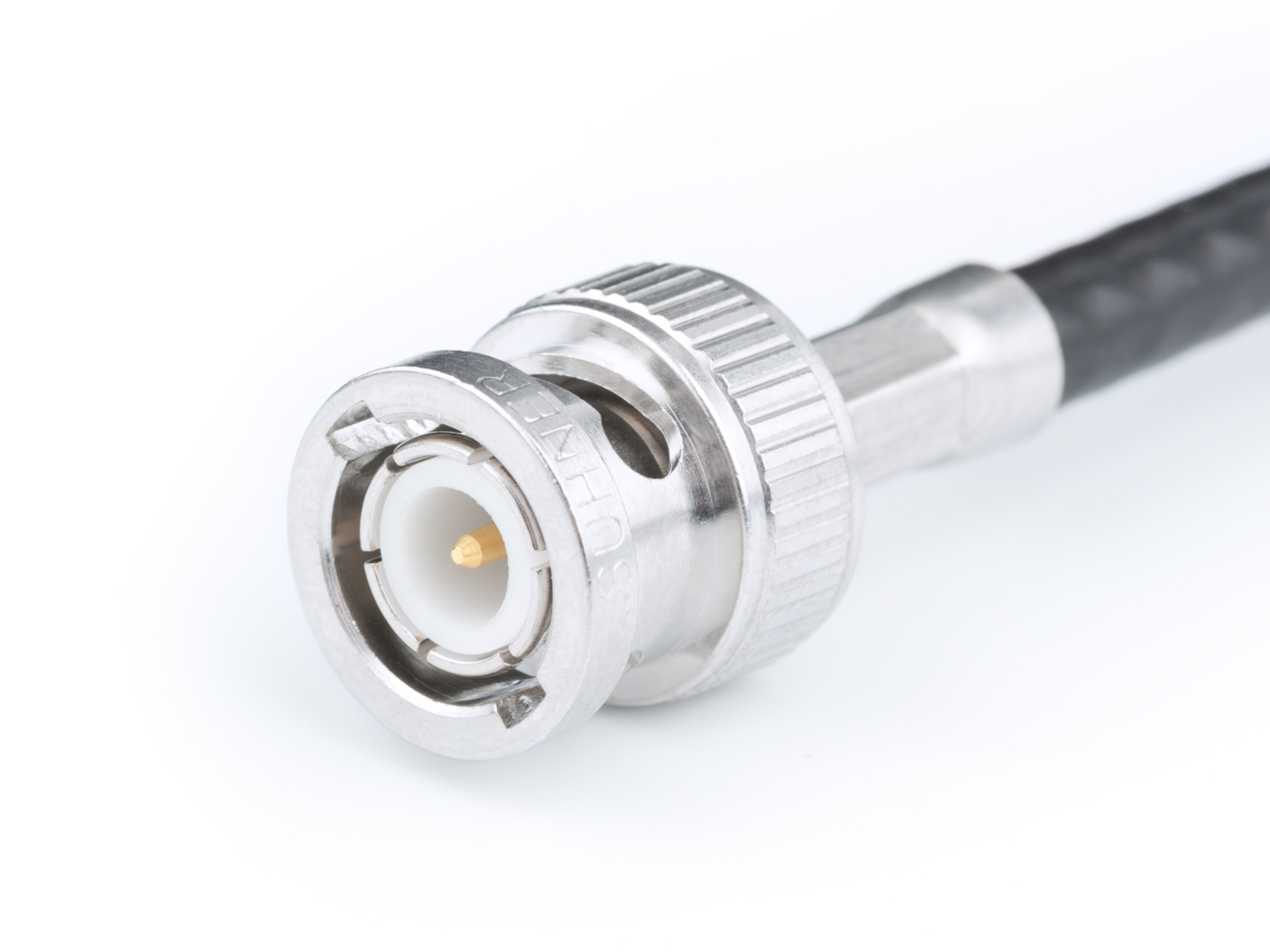
The BNC connector is a miniature quick-connect/disconnect radio-frequency connector for coaxial cable. It was introduced on military radio equipment in the 1940s, and has since become widely used in radio systems and as a common type of video connector. It has a twist-to-lock design, where two lugs on the female connector engage slots in the shell of the male one.
BNC is designed to maintain the characteristic impedance of the cable across the connection, and is made in 50-ohm and 75-ohm versions. It is normally used for radio-frequency signals up to about 2 gigahertz and 500 volts.
Similar radio-frequency connectors differ in dimensions and attachment features, and may allow for higher voltages, higher frequencies, or three-wire connections.
In 1941, the US Navy used a smaller version of the threaded N connector, the Type BN (Baby N), as the UG-85/U, UG-86/U, UG-114/U and UG-115/U.
In 1943, the British introduced a ¼ inch 50 ohm coaxial cable, and companies immediately developed many connectors for it. In 1944, the US Navy called the designers together to find a single, standard design acceptable to all. Paul Neill, the inventor of the original N connector, developed a prototype connector which had a constant 50 ohm impedance at frequencies beyond 1 GHz, used a bayonet fastening (faster to use than a threaded one), and was easier to manufacture and assemble. It was specified by the Bell Laboratory drawing ESL 662916, dated March 2, 1944.
In April 1944, the Navy took Neill’s design, added a C (for constant impedance) to BN to get Type BNC (Baby Neill Constant), and assigned part numbers UG 88/U to the male and UG 89/U to the female (Amphenol still makes them). The Navy issued a final drawing RE 49F 246, dated December 2, 1944.
In May 1945, Octavio M. Salati of Hazeltine Corporation applied for a patent for the BNC, which was granted in January 1951. In 1958, Hazeltine sued Dage Electric Company, a maker of BNC connectors, for infringement on this patent. The court found that Salati’s patent was invalid because he knew of the Navy’s BNC before his application date.
The US Navy used the term BNC to mean "Baby Neill Constant". The term BNC appeared in 1948 in ads for Amphenol connectors together with the MIL-spec name UG-88/U.
Hub AI
BNC connector AI simulator
(@BNC connector_simulator)
BNC connector
The BNC connector is a miniature quick-connect/disconnect radio-frequency connector for coaxial cable. It was introduced on military radio equipment in the 1940s, and has since become widely used in radio systems and as a common type of video connector. It has a twist-to-lock design, where two lugs on the female connector engage slots in the shell of the male one.
BNC is designed to maintain the characteristic impedance of the cable across the connection, and is made in 50-ohm and 75-ohm versions. It is normally used for radio-frequency signals up to about 2 gigahertz and 500 volts.
Similar radio-frequency connectors differ in dimensions and attachment features, and may allow for higher voltages, higher frequencies, or three-wire connections.
In 1941, the US Navy used a smaller version of the threaded N connector, the Type BN (Baby N), as the UG-85/U, UG-86/U, UG-114/U and UG-115/U.
In 1943, the British introduced a ¼ inch 50 ohm coaxial cable, and companies immediately developed many connectors for it. In 1944, the US Navy called the designers together to find a single, standard design acceptable to all. Paul Neill, the inventor of the original N connector, developed a prototype connector which had a constant 50 ohm impedance at frequencies beyond 1 GHz, used a bayonet fastening (faster to use than a threaded one), and was easier to manufacture and assemble. It was specified by the Bell Laboratory drawing ESL 662916, dated March 2, 1944.
In April 1944, the Navy took Neill’s design, added a C (for constant impedance) to BN to get Type BNC (Baby Neill Constant), and assigned part numbers UG 88/U to the male and UG 89/U to the female (Amphenol still makes them). The Navy issued a final drawing RE 49F 246, dated December 2, 1944.
In May 1945, Octavio M. Salati of Hazeltine Corporation applied for a patent for the BNC, which was granted in January 1951. In 1958, Hazeltine sued Dage Electric Company, a maker of BNC connectors, for infringement on this patent. The court found that Salati’s patent was invalid because he knew of the Navy’s BNC before his application date.
The US Navy used the term BNC to mean "Baby Neill Constant". The term BNC appeared in 1948 in ads for Amphenol connectors together with the MIL-spec name UG-88/U.
Recent media