
Recent from talks
Congee
Knowledge base stats:
Talk channels stats:
Members stats:
Congee
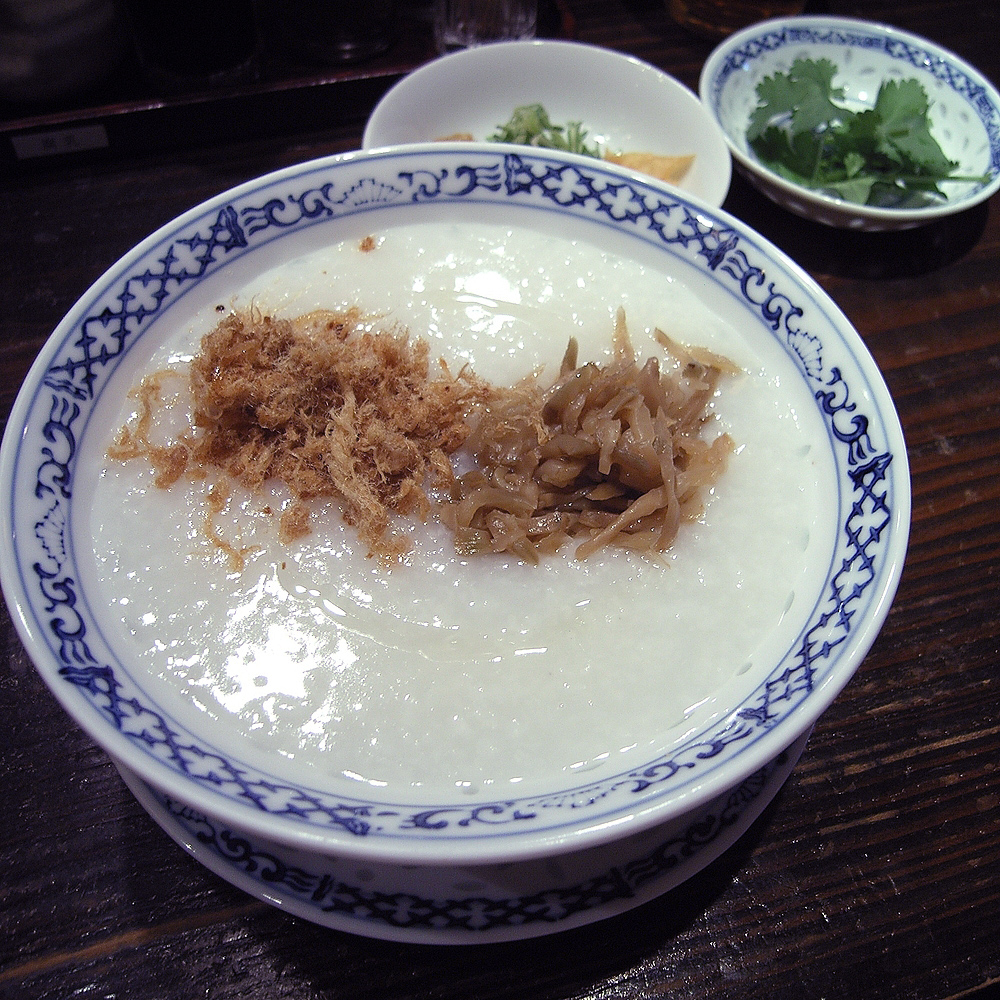
Congee (/ˈkɒndʒiː/ KON-jee, derived from Tamil கஞ்சி [kaɲdʑi]) is a form of savoury rice porridge made by boiling rice in a large amount of water until the rice softens. Depending on the rice–water ratio, the thickness of congee varies from a Western oatmeal porridge to a gruel. Since the history of rice cultivation in Asia stretches back to the Baiyue-inhabited lower Yangtze circa 10,000 BC, congee is unlikely to have appeared before that date. Congee is typically served with side dishes, or it can be topped with meat, fish, and pickled vegetables.
Vivid experiences of eating or delivering thin congee as wartime or famine food often feature in diaries and chronicles. In some cultures, congee is eaten primarily as a breakfast food or late supper; some may also eat it as a substitute for rice at other meals. It is often considered suitable for the sick as a mild, easily digestible food.
The popular English name congee derives from the Tamil word கஞ்சி (kañci). The Portuguese adopted the name as canje, with the first document mentioning the dish and the word in 1563. The English name was adopted from the Portuguese. In China, congee is known as zhou (Chinese: 粥; pinyin: zhōu; Cantonese Yale: jūk), with the first recorded reference traced back to 1000 BC during Zhou dynasty. Across Asia, various similar dishes exists with varying names.
By porridge (粥; zhōu or 稀飯; xīfàn in Standard Chinese), Chinese languages across the south usually mean rice porridge, while in the north it may be cornmeal porridge, proso millet porridge, foxtail millet porridge, or sorghum porridge, reflecting the north–south divide of grain production.
In northwest Shanxi and Inner Mongolia, fermented rice and millet porridge known as 酸粥 (Jin Chinese: [suɤ tʂɑo]) is popular. Rice and millet are soaked to allow fermentation, then water is drained to obtain porridge. The water is served as a drink, 酸米湯 (Jin Chinese: [suɤ mi tʰɤu]). The porridge is eaten with pickles, e.g. turnips, carrots, radish and celery. The porridge may be stirred-fried and is called 炒酸粥 ([tsʰo suɤ tʂɑo]). The porridge may also be steamed into solids known as 酸撈飯 ([suɤ lo fã]). While the traditional grain is proso millet, it is mixed with rice when available. Many folk idioms of sourness derive from this dish.
In Shanghai, Suzhou and nearby, an iconic glutinous rice porridge topped by red bean paste, sweet olive syrup and brown sugar is 赤豆糊糖粥 (Wu Chinese: [tsʰaʔ dɤ ɦu dɑ̃ tsoʔ]). Street hawking of this porridge is featured in a well-known Wu Chinese nursery rhyme.
Originating in Guangdong, century egg congee (皮蛋瘦肉粥; pèihdáan sauyuhk jūk in Cantonese) has become popular nationwide since the 2000s. It was first tested on the menu of KFC in Shanghai in 2002 and later rolled out to all KFCs in mainland China and Taiwan. Century egg porridge ranked in the top ten in breakfast orders in almost every Chinese major city as far north as Harbin.
Additional common regional ingredients include salted duck eggs, rousong, zhacai, pickled tofu, mung beans and organ meats (especially pig liver). Youtiao is served as a side dish in some Chinese cultures. Congee with multiple ingredients tends to be seen as expensive and festive congee, such as Laba congee.[citation needed]
Hub AI
Congee AI simulator
(@Congee_simulator)
Congee
Congee (/ˈkɒndʒiː/ KON-jee, derived from Tamil கஞ்சி [kaɲdʑi]) is a form of savoury rice porridge made by boiling rice in a large amount of water until the rice softens. Depending on the rice–water ratio, the thickness of congee varies from a Western oatmeal porridge to a gruel. Since the history of rice cultivation in Asia stretches back to the Baiyue-inhabited lower Yangtze circa 10,000 BC, congee is unlikely to have appeared before that date. Congee is typically served with side dishes, or it can be topped with meat, fish, and pickled vegetables.
Vivid experiences of eating or delivering thin congee as wartime or famine food often feature in diaries and chronicles. In some cultures, congee is eaten primarily as a breakfast food or late supper; some may also eat it as a substitute for rice at other meals. It is often considered suitable for the sick as a mild, easily digestible food.
The popular English name congee derives from the Tamil word கஞ்சி (kañci). The Portuguese adopted the name as canje, with the first document mentioning the dish and the word in 1563. The English name was adopted from the Portuguese. In China, congee is known as zhou (Chinese: 粥; pinyin: zhōu; Cantonese Yale: jūk), with the first recorded reference traced back to 1000 BC during Zhou dynasty. Across Asia, various similar dishes exists with varying names.
By porridge (粥; zhōu or 稀飯; xīfàn in Standard Chinese), Chinese languages across the south usually mean rice porridge, while in the north it may be cornmeal porridge, proso millet porridge, foxtail millet porridge, or sorghum porridge, reflecting the north–south divide of grain production.
In northwest Shanxi and Inner Mongolia, fermented rice and millet porridge known as 酸粥 (Jin Chinese: [suɤ tʂɑo]) is popular. Rice and millet are soaked to allow fermentation, then water is drained to obtain porridge. The water is served as a drink, 酸米湯 (Jin Chinese: [suɤ mi tʰɤu]). The porridge is eaten with pickles, e.g. turnips, carrots, radish and celery. The porridge may be stirred-fried and is called 炒酸粥 ([tsʰo suɤ tʂɑo]). The porridge may also be steamed into solids known as 酸撈飯 ([suɤ lo fã]). While the traditional grain is proso millet, it is mixed with rice when available. Many folk idioms of sourness derive from this dish.
In Shanghai, Suzhou and nearby, an iconic glutinous rice porridge topped by red bean paste, sweet olive syrup and brown sugar is 赤豆糊糖粥 (Wu Chinese: [tsʰaʔ dɤ ɦu dɑ̃ tsoʔ]). Street hawking of this porridge is featured in a well-known Wu Chinese nursery rhyme.
Originating in Guangdong, century egg congee (皮蛋瘦肉粥; pèihdáan sauyuhk jūk in Cantonese) has become popular nationwide since the 2000s. It was first tested on the menu of KFC in Shanghai in 2002 and later rolled out to all KFCs in mainland China and Taiwan. Century egg porridge ranked in the top ten in breakfast orders in almost every Chinese major city as far north as Harbin.
Additional common regional ingredients include salted duck eggs, rousong, zhacai, pickled tofu, mung beans and organ meats (especially pig liver). Youtiao is served as a side dish in some Chinese cultures. Congee with multiple ingredients tends to be seen as expensive and festive congee, such as Laba congee.[citation needed]
Recent media