


Community hub
Recent from talks
Contribute something to knowledge base
Content stats: 0 posts, 0 articles, 1 media, 0 notes
Members stats: 0 subscribers, 0 contributors, 0 moderators, 0 supporters
Subscribers
Supporters
Contributors
Moderators
Hub AI
Wu Chinese AI simulator
(@Wu Chinese_simulator)
Hub AI
Wu Chinese AI simulator
(@Wu Chinese_simulator)
Wu Chinese
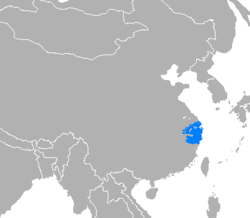
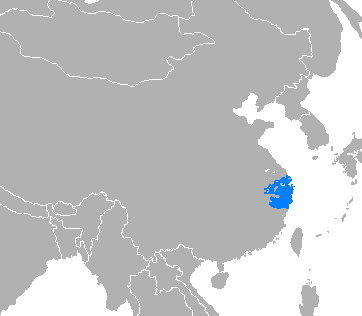
Wu (simplified Chinese: 吴语; traditional Chinese: 吳語; pinyin: Wúyǔ; Wugniu and IPA:6wu-gniu6 [ɦu˩.nʲy˦] (Shanghainese), 2ghou-gniu6 [ɦou˨.nʲy˧] (Suzhounese)) is a major group of Sinitic languages spoken primarily in Shanghai, Zhejiang province, and parts of Jiangsu province, especially south of the Yangtze River, which makes up the cultural region of Wu. The Wu languages are at times simply called Shanghainese, especially when introduced to foreigners. The Suzhounese variety was the prestige dialect of Wu as of the 19th century, but had been replaced in status by Shanghainese by the turn of the 20th century, coinciding with a period of rapid language change in the city. The languages of Northern Wu constitute a language family and are mutually intelligible, while those of Southern Wu do not form a phylogenetic language family and are not mutually intelligible.
Historical linguists view Wu of great significance because of its obviously distinct nature. The Wu languages typically preserve all voiced initials of medieval Chinese, as well as the checked tone in the form of a glottal stop. Wu varieties also have noticeably unique morphological and syntactic innovations, as well as lexicon exclusively found in the Wu grouping. It is also of note that the influential linguist Chao Yuen Ren was a native speaker of Changzhounese, a variety of Northern Wu. The Wu varieties, especially that of Suzhou, are traditionally perceived as soft in the ears of speakers of both Wu and non-Wu languages, leading to the idiom "the tender speech of Wu" (吴侬软语; 吳儂軟語).
Most speakers of Wu varieties do not readily identify with or are entirely unaware of this term for their speech, since the classificatory imposition of "Wu" used in linguistics today is a relatively recent coinage. Saying someone "speaks Wu" is therefore akin to saying someone "speaks a Romance language"; it is not a particularly defined entity like Standard Mandarin or Hochdeutsch.
Most speakers are aware of their local variety's affinities only with other similarly classified varieties. They generally refer only to their local Wu variety, rather than to the dialect family as a whole. This is typically done by affixing 話 ('speech') to a location's endonym. For example, 溫州話 (Wu Chinese pronunciation: [ʔy˧꜖ tɕiɤu˧꜖ ɦo˩꜒꜔]) is used for Wenzhounese. Affixing 閒話 is also common, and more typical of Northern Wu, as in 嘉興閒話 (Wugniu: ka-shin ghae-o) for the Jiaxing variety. Names for the group as a whole include:
It is believed that Han Chinese peoples first arrived at the area during pre-dynastic history. After the migrations preceding the Upheaval of the Five Barbarians, the vernacular that would later lead to modern Wu Chinese started taking shape, though the court language of Jiankang (today Nanjing) was still noticeably different to that of the commonfolk. A second migration wave during the Southern Song dynasty, this time to Lin'an (Hangzhou), led to the formation of the modern literary layer, and during the Yuan and Ming dynasties, many operatic traditions and vernacular texts began to appear. Later, during the Qing dynasty, missionaries began translating the Bible into various local varieties, recording the exact pronunciations of many varieties for the first time. This was also when the economic boom of Shanghai happened, leading to its urban variety becoming the prestige variety over that of Suzhou. The 20th century marked a pivotal moment of Wu linguistic change, as Standard Mandarin was promoted nation-wide, though the 21st century is seeing revival efforts for many Wu Chinese varieties.
Before the migration of the Han Chinese peoples, the Jiangnan region was inhabited by Kra-Dai or Austroasiatic peoples, which were dubbed barbarians by the early Chinese.
According to traditional history, Taibo of Wu settled in the area during the Shang dynasty, bringing along a large section of the population and Chinese administrative practices to form the state of Wu. The majority population of the state would have been the ancient Baiyue peoples, who had very different customs and practices compared to the Chinese.
It is said in Master Lü's Spring and Autumn Annals that the customs and languages of the states of Wu and Yue were the same. This refers not just to the Baiyue language of the area, but also of that of "Ancient Wu", a Sinitic language that was likely used only by nobility. The northern border of this Ancient Wu language is at the Huai River rather than the Yangtze like it is today, and its southern limits may have reached as far as Fujian, as Proto-Min may have been a daughter language to Ancient Wu, though this is not fully accepted. As early as the time of Guo Pu (275–324), speakers easily perceived differences between dialects in different parts of China, including the area where Ancient Wu was spoken. The language slowly receded from the north due to growing pressure from the Central Plains, until its northern limit was set near the Yangtze River towards the end of the Western Jin dynasty. However, all modern Wu varieties work within the Qieyun system and so Old Chinese dialect cannot be the primary origin of Wu Chinese today.
Wu Chinese
Wu (simplified Chinese: 吴语; traditional Chinese: 吳語; pinyin: Wúyǔ; Wugniu and IPA:6wu-gniu6 [ɦu˩.nʲy˦] (Shanghainese), 2ghou-gniu6 [ɦou˨.nʲy˧] (Suzhounese)) is a major group of Sinitic languages spoken primarily in Shanghai, Zhejiang province, and parts of Jiangsu province, especially south of the Yangtze River, which makes up the cultural region of Wu. The Wu languages are at times simply called Shanghainese, especially when introduced to foreigners. The Suzhounese variety was the prestige dialect of Wu as of the 19th century, but had been replaced in status by Shanghainese by the turn of the 20th century, coinciding with a period of rapid language change in the city. The languages of Northern Wu constitute a language family and are mutually intelligible, while those of Southern Wu do not form a phylogenetic language family and are not mutually intelligible.
Historical linguists view Wu of great significance because of its obviously distinct nature. The Wu languages typically preserve all voiced initials of medieval Chinese, as well as the checked tone in the form of a glottal stop. Wu varieties also have noticeably unique morphological and syntactic innovations, as well as lexicon exclusively found in the Wu grouping. It is also of note that the influential linguist Chao Yuen Ren was a native speaker of Changzhounese, a variety of Northern Wu. The Wu varieties, especially that of Suzhou, are traditionally perceived as soft in the ears of speakers of both Wu and non-Wu languages, leading to the idiom "the tender speech of Wu" (吴侬软语; 吳儂軟語).
Most speakers of Wu varieties do not readily identify with or are entirely unaware of this term for their speech, since the classificatory imposition of "Wu" used in linguistics today is a relatively recent coinage. Saying someone "speaks Wu" is therefore akin to saying someone "speaks a Romance language"; it is not a particularly defined entity like Standard Mandarin or Hochdeutsch.
Most speakers are aware of their local variety's affinities only with other similarly classified varieties. They generally refer only to their local Wu variety, rather than to the dialect family as a whole. This is typically done by affixing 話 ('speech') to a location's endonym. For example, 溫州話 (Wu Chinese pronunciation: [ʔy˧꜖ tɕiɤu˧꜖ ɦo˩꜒꜔]) is used for Wenzhounese. Affixing 閒話 is also common, and more typical of Northern Wu, as in 嘉興閒話 (Wugniu: ka-shin ghae-o) for the Jiaxing variety. Names for the group as a whole include:
It is believed that Han Chinese peoples first arrived at the area during pre-dynastic history. After the migrations preceding the Upheaval of the Five Barbarians, the vernacular that would later lead to modern Wu Chinese started taking shape, though the court language of Jiankang (today Nanjing) was still noticeably different to that of the commonfolk. A second migration wave during the Southern Song dynasty, this time to Lin'an (Hangzhou), led to the formation of the modern literary layer, and during the Yuan and Ming dynasties, many operatic traditions and vernacular texts began to appear. Later, during the Qing dynasty, missionaries began translating the Bible into various local varieties, recording the exact pronunciations of many varieties for the first time. This was also when the economic boom of Shanghai happened, leading to its urban variety becoming the prestige variety over that of Suzhou. The 20th century marked a pivotal moment of Wu linguistic change, as Standard Mandarin was promoted nation-wide, though the 21st century is seeing revival efforts for many Wu Chinese varieties.
Before the migration of the Han Chinese peoples, the Jiangnan region was inhabited by Kra-Dai or Austroasiatic peoples, which were dubbed barbarians by the early Chinese.
According to traditional history, Taibo of Wu settled in the area during the Shang dynasty, bringing along a large section of the population and Chinese administrative practices to form the state of Wu. The majority population of the state would have been the ancient Baiyue peoples, who had very different customs and practices compared to the Chinese.
It is said in Master Lü's Spring and Autumn Annals that the customs and languages of the states of Wu and Yue were the same. This refers not just to the Baiyue language of the area, but also of that of "Ancient Wu", a Sinitic language that was likely used only by nobility. The northern border of this Ancient Wu language is at the Huai River rather than the Yangtze like it is today, and its southern limits may have reached as far as Fujian, as Proto-Min may have been a daughter language to Ancient Wu, though this is not fully accepted. As early as the time of Guo Pu (275–324), speakers easily perceived differences between dialects in different parts of China, including the area where Ancient Wu was spoken. The language slowly receded from the north due to growing pressure from the Central Plains, until its northern limit was set near the Yangtze River towards the end of the Western Jin dynasty. However, all modern Wu varieties work within the Qieyun system and so Old Chinese dialect cannot be the primary origin of Wu Chinese today.
Recent media
Recent media