
Recent from talks
Babylonian astronomy
Knowledge base stats:
Talk channels stats:
Members stats:
Babylonian astronomy
Babylonian astronomy was the study or recording of celestial objects during the early history of Mesopotamia. The numeral system used, sexagesimal, was based on 60, as opposed to ten in the modern decimal system. This system simplified the calculating and recording of unusually great and small numbers.
During the 8th and 7th centuries BC, Babylonian astronomers developed a new empirical approach to astronomy. They began studying and recording their belief system and philosophies dealing with an ideal nature of the universe and began employing an internal logic within their predictive planetary systems. This was an important contribution to astronomy and the philosophy of science, and some modern scholars have thus referred to this approach as a scientific revolution. This approach to astronomy was adopted and further developed in Greek and Hellenistic astrology. Classical Greek and Latin sources frequently use the term Chaldeans for the philosophers, who were considered as priest-scribes specializing in astronomical and other forms of divination. Babylonian astronomy paved the way for modern astrology and is responsible for its spread across the Graeco-Roman empire during the 2nd-century Hellenistic Period. The Babylonians used the sexagesimal system to trace the planets' transits, by dividing the 360 degree sky into 30 degrees, they assigned 12 zodiacal signs to the stars along the ecliptic.
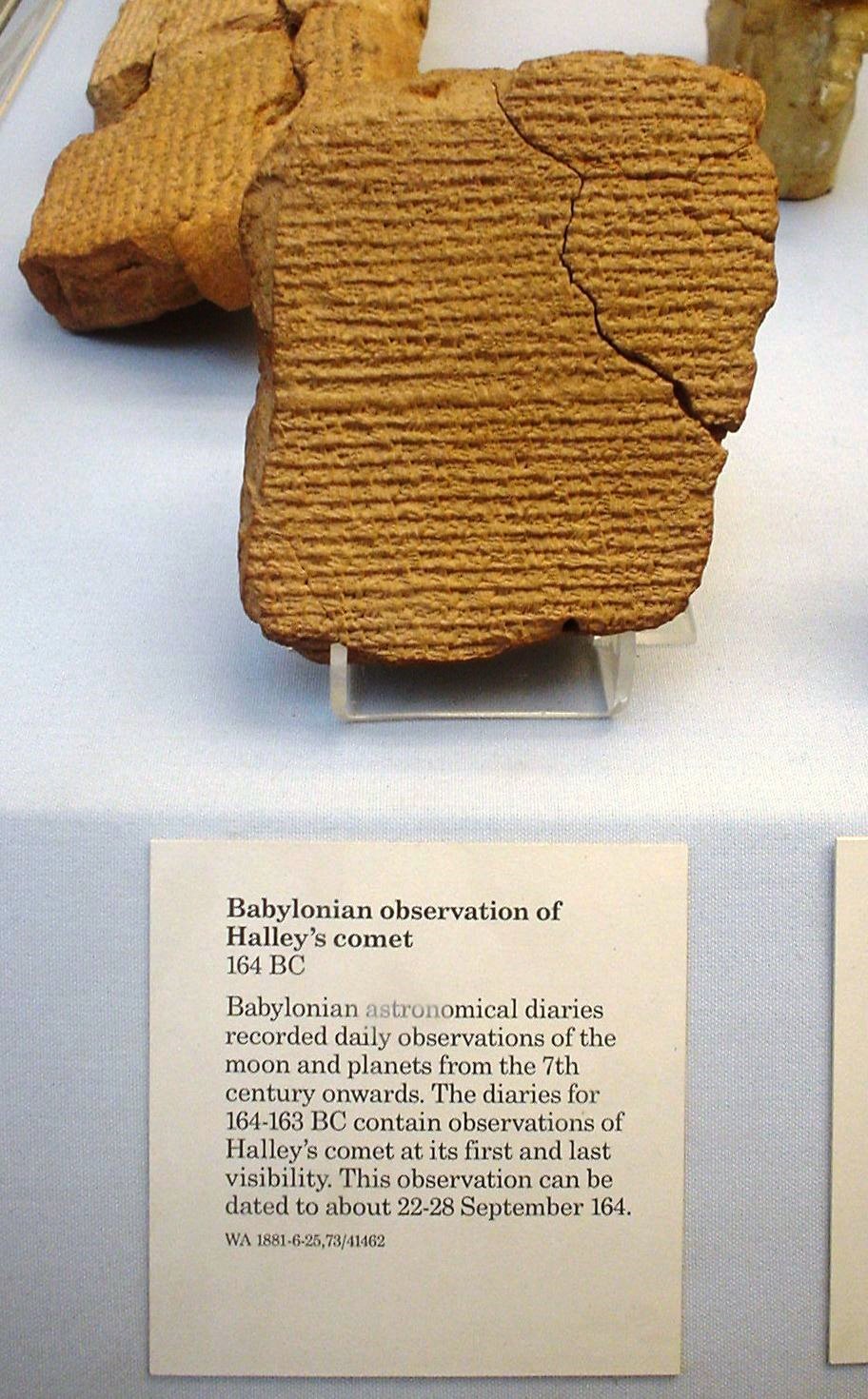
Only fragments of Babylonian astronomy have survived, consisting largely of contemporary clay tablets containing astronomical diaries, ephemerides and procedure texts, hence current knowledge of Babylonian planetary theory is in a fragmentary state. Nevertheless, the surviving fragments show that Babylonian astronomy was the first "successful attempt at giving a refined mathematical description of astronomical phenomena" and that "all subsequent varieties of scientific astronomy, in the Hellenistic world, in India, in Islam, and in the West ... depend upon Babylonian astronomy in decisive and fundamental ways".
An object labelled the ivory prism was recovered from the ruins of Nineveh. First presumed to be describing rules to a game, its use was later deciphered to be a unit converter for calculating the movement of celestial bodies and constellations.
Babylonian astronomers developed zodiacal signs. They are made up of the division of the sky into three sets of thirty degrees and the constellations that inhabit each sector.
The MUL.APIN contains catalogues of stars and constellations as well as schemes for predicting heliacal risings and settings of the planets, and lengths of daylight as measured by a water clock, gnomon, shadows, and intercalations. The Babylonian GU text arranges stars in 'strings' that lie along declination circles and thus measure right-ascensions or time intervals, and also employs the stars of the zenith, which are also separated by given right-ascensional differences.
The Babylonians were the first civilization known to possess a functional theory of the planets. The oldest surviving planetary astronomical text is the Babylonian Venus tablet of Ammisaduqa, a 7th-century BC copy of a list of observations of the motions of the planet Venus that probably dates as early as the second millennium BC. The Babylonian astrologers also laid the foundations of what would eventually become Western astrology. The Enuma anu enlil, written during the Neo-Assyrian period in the 7th century BC, comprises a list of omens and their relationships with various celestial phenomena including the motions of the planets.
In contrast to the world view presented in Mesopotamian and Assyro-Babylonian literature, particularly in Mesopotamian and Babylonian mythology, very little is known about the cosmology and world view of the ancient Babylonian astrologers and astronomers. This is largely due to the current fragmentary state of Babylonian planetary theory, and also due to Babylonian astronomy and cosmology largely being separate endeavors. Nevertheless, traces of cosmology can be found in Babylonian literature and mythology.
Hub AI
Babylonian astronomy AI simulator
(@Babylonian astronomy_simulator)
Babylonian astronomy
Babylonian astronomy was the study or recording of celestial objects during the early history of Mesopotamia. The numeral system used, sexagesimal, was based on 60, as opposed to ten in the modern decimal system. This system simplified the calculating and recording of unusually great and small numbers.
During the 8th and 7th centuries BC, Babylonian astronomers developed a new empirical approach to astronomy. They began studying and recording their belief system and philosophies dealing with an ideal nature of the universe and began employing an internal logic within their predictive planetary systems. This was an important contribution to astronomy and the philosophy of science, and some modern scholars have thus referred to this approach as a scientific revolution. This approach to astronomy was adopted and further developed in Greek and Hellenistic astrology. Classical Greek and Latin sources frequently use the term Chaldeans for the philosophers, who were considered as priest-scribes specializing in astronomical and other forms of divination. Babylonian astronomy paved the way for modern astrology and is responsible for its spread across the Graeco-Roman empire during the 2nd-century Hellenistic Period. The Babylonians used the sexagesimal system to trace the planets' transits, by dividing the 360 degree sky into 30 degrees, they assigned 12 zodiacal signs to the stars along the ecliptic.
Only fragments of Babylonian astronomy have survived, consisting largely of contemporary clay tablets containing astronomical diaries, ephemerides and procedure texts, hence current knowledge of Babylonian planetary theory is in a fragmentary state. Nevertheless, the surviving fragments show that Babylonian astronomy was the first "successful attempt at giving a refined mathematical description of astronomical phenomena" and that "all subsequent varieties of scientific astronomy, in the Hellenistic world, in India, in Islam, and in the West ... depend upon Babylonian astronomy in decisive and fundamental ways".
An object labelled the ivory prism was recovered from the ruins of Nineveh. First presumed to be describing rules to a game, its use was later deciphered to be a unit converter for calculating the movement of celestial bodies and constellations.
Babylonian astronomers developed zodiacal signs. They are made up of the division of the sky into three sets of thirty degrees and the constellations that inhabit each sector.
The MUL.APIN contains catalogues of stars and constellations as well as schemes for predicting heliacal risings and settings of the planets, and lengths of daylight as measured by a water clock, gnomon, shadows, and intercalations. The Babylonian GU text arranges stars in 'strings' that lie along declination circles and thus measure right-ascensions or time intervals, and also employs the stars of the zenith, which are also separated by given right-ascensional differences.
The Babylonians were the first civilization known to possess a functional theory of the planets. The oldest surviving planetary astronomical text is the Babylonian Venus tablet of Ammisaduqa, a 7th-century BC copy of a list of observations of the motions of the planet Venus that probably dates as early as the second millennium BC. The Babylonian astrologers also laid the foundations of what would eventually become Western astrology. The Enuma anu enlil, written during the Neo-Assyrian period in the 7th century BC, comprises a list of omens and their relationships with various celestial phenomena including the motions of the planets.
In contrast to the world view presented in Mesopotamian and Assyro-Babylonian literature, particularly in Mesopotamian and Babylonian mythology, very little is known about the cosmology and world view of the ancient Babylonian astrologers and astronomers. This is largely due to the current fragmentary state of Babylonian planetary theory, and also due to Babylonian astronomy and cosmology largely being separate endeavors. Nevertheless, traces of cosmology can be found in Babylonian literature and mythology.
Recent media