
Recent from talks
Water clock
Knowledge base stats:
Talk channels stats:
Members stats:
Water clock
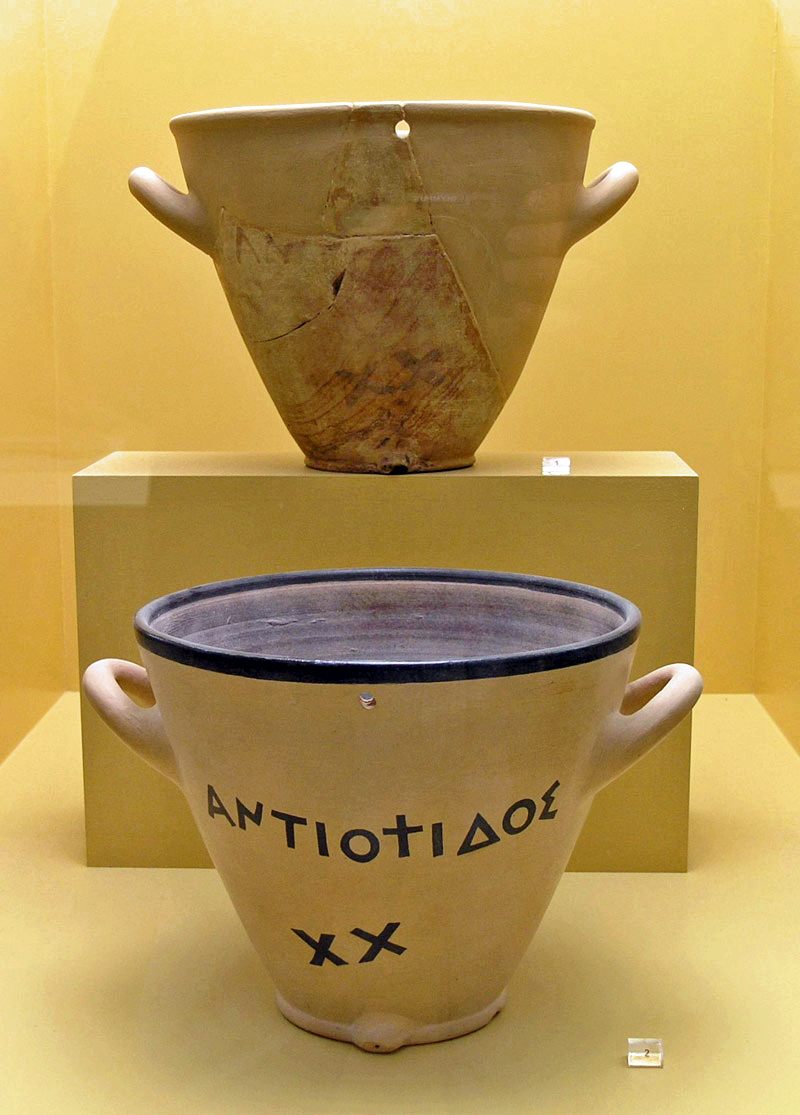
A water clock, or clepsydra (from Ancient Greek κλεψύδρα (klepsúdra) 'pipette, water clock'; from κλέπτω (kléptō) 'to steal' and ὕδωρ (hydor) 'water'; lit. ' water thief'), is a timepiece by which time is measured by the regulated flow of liquid into (inflow type) or out from (outflow type) a vessel, and where the amount of liquid can then be measured.
Water clocks are some of the oldest time-measuring instruments. The simplest form of water clock, with a bowl-shaped outflow, existed in Babylon, Egypt, and Persia around the 16th century BC. Other regions of the world, including India and China, also provide early evidence of water clocks, but the earliest dates are less certain. Water clocks were used in ancient Greece and in ancient Rome, as described by technical writers such as Ctesibius (died 222 BC) and Vitruvius (died after 15 BC).
A water clock uses the flow of water to measure time. If viscosity is neglected, the physical principle required to study such clocks is Torricelli's law. Two types of water clock exist: inflow and outflow. In an outflow water clock, a container is filled with water, and the water is drained slowly and evenly out of the container. This container has markings that are used to show the passage of time. As the water leaves the container, an observer can see where the water is level with the lines and tell how much time has passed. An inflow water clock works in basically the same way, except instead of flowing out of the container, the water is filling up the marked container. As the container fills, the observer can see where the water meets the lines and tell how much time has passed. Some modern timepieces are called "water clocks" but work differently from the ancient ones. Their timekeeping is governed by a pendulum, but they use water for other purposes, such as providing the power needed to drive the clock by using a water wheel or something similar, or by having water in their displays.
The Greeks and Romans advanced water clock design to include the inflow clepsydra with an early feedback system, gearing, and escapement mechanism, which were connected to fanciful automata and resulted in improved accuracy. Further advances were made in Byzantium, Syria, and Mesopotamia, where increasingly accurate water clocks incorporated complex segmental and epicyclic gearing, water wheels, and programmability, advances which eventually made their way to Europe. Independently, the Chinese developed their own advanced water clocks, incorporating gears, escapement mechanisms, and water wheels, passing their ideas on to Korea and Japan.[citation needed]
Some water clock designs were developed independently, and some knowledge was transferred through the spread of trade. These early water clocks were calibrated with a sundial. While never reaching a level of accuracy comparable to today's standards of timekeeping, the water clock was a commonly used timekeeping device for millennia, until it was replaced by more accurate verge escapement mechanical clocks in Europe around 1300.
The oldest water clock of which there is physical evidence dates to c. 1417–1379 BC in the New Kingdom of Egypt, during the reign of the pharaoh Amenhotep III, where it was used in the Precinct of Amun-Re at Karnak. The oldest documentation of the water clock is the tomb inscription of the 16th century BC Egyptian court official Amenemhet, which identifies him as its inventor. These simple water clocks, which were of the outflow type, were stone vessels with sloping sides that allowed water to drip at a nearly constant rate from a small hole near the bottom. There were twelve separate columns with consistently spaced markings on the inside to measure the passage of "hours" as the water level reached them. The columns were for each of the twelve months to allow for the variations of the seasonal hours. Priests used these clocks to determine the time at night so that the temple rites and sacrifices could be performed at the correct hour.
In Babylon, water clocks were of the outflow type and were cylindrical in shape. Use of the water clock as an aid to astronomical calculations dates back to the Old Babylonian Empire (c. 2000 – c. 1600 BC). While there are no surviving water clocks from the Mesopotamian region, most evidence of their existence comes from writings on clay tablets. Two collections of tablets, for example, are the Enuma Anu Enlil (1600–1200 BC) and the MUL.APIN (7th century BC). In these tablets, water clocks are used for payment of the night and day watches (guards).
These clocks were unique, as they did not have an indicator such as hands (as are typically used today) or grooved notches (as were used in Egypt). Instead, these clocks measured time "by the weight of water flowing from" it. The volume was measured in capacity units called qa. The weight, mana or mina (the Greek unit for about one pound), is the weight of water in a water clock.[citation needed]
Hub AI
Water clock AI simulator
(@Water clock_simulator)
Water clock
A water clock, or clepsydra (from Ancient Greek κλεψύδρα (klepsúdra) 'pipette, water clock'; from κλέπτω (kléptō) 'to steal' and ὕδωρ (hydor) 'water'; lit. ' water thief'), is a timepiece by which time is measured by the regulated flow of liquid into (inflow type) or out from (outflow type) a vessel, and where the amount of liquid can then be measured.
Water clocks are some of the oldest time-measuring instruments. The simplest form of water clock, with a bowl-shaped outflow, existed in Babylon, Egypt, and Persia around the 16th century BC. Other regions of the world, including India and China, also provide early evidence of water clocks, but the earliest dates are less certain. Water clocks were used in ancient Greece and in ancient Rome, as described by technical writers such as Ctesibius (died 222 BC) and Vitruvius (died after 15 BC).
A water clock uses the flow of water to measure time. If viscosity is neglected, the physical principle required to study such clocks is Torricelli's law. Two types of water clock exist: inflow and outflow. In an outflow water clock, a container is filled with water, and the water is drained slowly and evenly out of the container. This container has markings that are used to show the passage of time. As the water leaves the container, an observer can see where the water is level with the lines and tell how much time has passed. An inflow water clock works in basically the same way, except instead of flowing out of the container, the water is filling up the marked container. As the container fills, the observer can see where the water meets the lines and tell how much time has passed. Some modern timepieces are called "water clocks" but work differently from the ancient ones. Their timekeeping is governed by a pendulum, but they use water for other purposes, such as providing the power needed to drive the clock by using a water wheel or something similar, or by having water in their displays.
The Greeks and Romans advanced water clock design to include the inflow clepsydra with an early feedback system, gearing, and escapement mechanism, which were connected to fanciful automata and resulted in improved accuracy. Further advances were made in Byzantium, Syria, and Mesopotamia, where increasingly accurate water clocks incorporated complex segmental and epicyclic gearing, water wheels, and programmability, advances which eventually made their way to Europe. Independently, the Chinese developed their own advanced water clocks, incorporating gears, escapement mechanisms, and water wheels, passing their ideas on to Korea and Japan.[citation needed]
Some water clock designs were developed independently, and some knowledge was transferred through the spread of trade. These early water clocks were calibrated with a sundial. While never reaching a level of accuracy comparable to today's standards of timekeeping, the water clock was a commonly used timekeeping device for millennia, until it was replaced by more accurate verge escapement mechanical clocks in Europe around 1300.
The oldest water clock of which there is physical evidence dates to c. 1417–1379 BC in the New Kingdom of Egypt, during the reign of the pharaoh Amenhotep III, where it was used in the Precinct of Amun-Re at Karnak. The oldest documentation of the water clock is the tomb inscription of the 16th century BC Egyptian court official Amenemhet, which identifies him as its inventor. These simple water clocks, which were of the outflow type, were stone vessels with sloping sides that allowed water to drip at a nearly constant rate from a small hole near the bottom. There were twelve separate columns with consistently spaced markings on the inside to measure the passage of "hours" as the water level reached them. The columns were for each of the twelve months to allow for the variations of the seasonal hours. Priests used these clocks to determine the time at night so that the temple rites and sacrifices could be performed at the correct hour.
In Babylon, water clocks were of the outflow type and were cylindrical in shape. Use of the water clock as an aid to astronomical calculations dates back to the Old Babylonian Empire (c. 2000 – c. 1600 BC). While there are no surviving water clocks from the Mesopotamian region, most evidence of their existence comes from writings on clay tablets. Two collections of tablets, for example, are the Enuma Anu Enlil (1600–1200 BC) and the MUL.APIN (7th century BC). In these tablets, water clocks are used for payment of the night and day watches (guards).
These clocks were unique, as they did not have an indicator such as hands (as are typically used today) or grooved notches (as were used in Egypt). Instead, these clocks measured time "by the weight of water flowing from" it. The volume was measured in capacity units called qa. The weight, mana or mina (the Greek unit for about one pound), is the weight of water in a water clock.[citation needed]
Recent media