
Recent from talks
Bait ball
Knowledge base stats:
Talk channels stats:
Members stats:
Bait ball
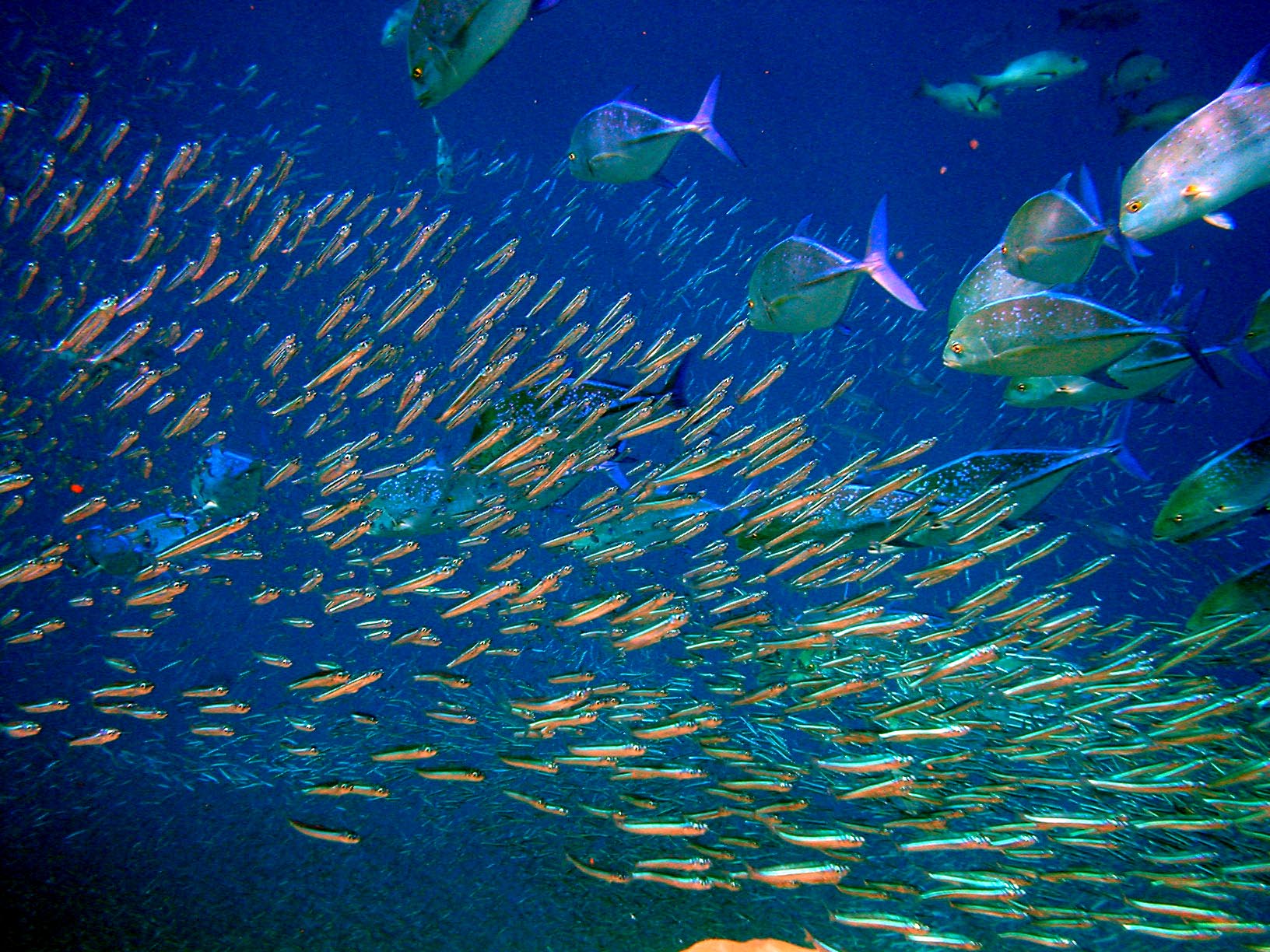
A bait ball, or baitball, occurs when small fish swarm in a tightly packed spherical formation about a common centre. It is a last-ditch defensive measure adopted by small schooling fish when they are threatened by predators. Small schooling fish are eaten by many types of predators, and for this reason they are called bait fish or forage fish.
For example, sardines group together when they are threatened. This instinctual behaviour is a defence mechanism, as lone individuals are more likely to be eaten than an individual in a large group. Sardine bait balls can be 10–20 metres (33–66 ft) in diameter and extend to a depth of 10 metres (33 ft). The bait balls are short-lived and seldom last longer than 10 minutes.
However, bait balls are also conspicuous, and when schooling fish form a bait ball, they can draw the attention of many other predators. As a response to the defensive capabilities of schooling fish, some predators have developed sophisticated countermeasures. These countermeasures can be spectacularly successful, and can seriously undermine the defensive value of forming bait balls.
Small pelagic fish live in the open water, so unlike demersal or reef fish, they cannot hide among kelp, or in crevices in coral, or under rocks on the bottom. This leaves them vulnerable to attack by large predatory fish, as well as other predators, such as marine mammals and seabirds. As a result, small pelagic fish usually aggregate in schools for protection. Schooling fish have evolved sophisticated evasion techniques. When they school, they have many eyes, making ambush difficult; and their silvery bodies dazzle, making it difficult for predators to pick out individual fish. They react to movements from a predator with lightning reflexes, rhythmically streaming up and down with rapid direction changes. When a predator approaches, they can split and reform behind the predator. During the final stages of an attack, they can explosively disband in all directions and then just as rapidly reform. Defensive manoeuvres like these appear to be choreographed, though they are not. Within the school itself, there is no centralized intelligence aware of how the school has configured itself. Rather, the schooling behaviour is the emergent consequence of relatively simple rules followed by each individual fish in the school, such as remaining close together, moving in the same direction, and avoiding collisions with each other.
Some species of forage fish, driven by nutrient availability and their life-cycle stage, form vast schools at predictable locations and times of the year. Normally, schooling works well as protection from occasional predators. Fish schooling in vast numbers may attract correspondingly huge numbers of predators, including seabirds, sharks, tuna, billfish, pods of dolphins, and killer and humpback whales. Aggregations of predators on such a scale means the schools can be attacked on all sides and panicked into forming bait balls.
A bait ball is a last-ditch defensive measure adopted by fish schools when they are overwhelmed and more effective defensive strategies have broken down. Schooling fish are easier to attack once they abandon their free streaming behaviour and form into a tight bait ball. Many predator species have learned that by interacting cooperatively they can panic schooling fish into forming a bait ball. This cooperative behaviour can occur both intraspecifically (among the individuals within a predator species) and interspecifically (across individuals belonging to more than one predator species).
The process that leads to the formation of a bait ball typically starts when predators locate a fish school deep below the surface. The predators make rushes and use various scare tactics to force the fish school to the surface, herding it at the same time into a compact volume. The alarmed fish, trapped against the surface above and surrounded all about, abandon their coordinated schooling movements and become chaotic. Their graceful and disciplined schooling strategies of uniform spacing and polarity degrade into frenetic attempts by each fish to save itself. In this way, a dense bait ball forms as each fish scrambles to get away from the surface of the ball and hide in the interior. The symmetry of this centripetal action forms a sphere, the shape with the minimum surface area for a given volume, thereby exposing the fewest fish on the surface to the predators. The movement, sound and smell can attract more predators, including different predator species, until there is a carousel of them, each species using its own characteristic predatory strategies. Fish that break loose are singled out and eaten. A frenzy can develop as predators compete. As the bait ball reduces in size and number, it becomes progressively easier for the predators to target the survivors.
Predators have devised various countermeasures to disrupt the defensive shoaling and schooling manoeuvres of forage fish. Often this involves charging the school or bait ball at high speed.
Hub AI
Bait ball AI simulator
(@Bait ball_simulator)
Bait ball
A bait ball, or baitball, occurs when small fish swarm in a tightly packed spherical formation about a common centre. It is a last-ditch defensive measure adopted by small schooling fish when they are threatened by predators. Small schooling fish are eaten by many types of predators, and for this reason they are called bait fish or forage fish.
For example, sardines group together when they are threatened. This instinctual behaviour is a defence mechanism, as lone individuals are more likely to be eaten than an individual in a large group. Sardine bait balls can be 10–20 metres (33–66 ft) in diameter and extend to a depth of 10 metres (33 ft). The bait balls are short-lived and seldom last longer than 10 minutes.
However, bait balls are also conspicuous, and when schooling fish form a bait ball, they can draw the attention of many other predators. As a response to the defensive capabilities of schooling fish, some predators have developed sophisticated countermeasures. These countermeasures can be spectacularly successful, and can seriously undermine the defensive value of forming bait balls.
Small pelagic fish live in the open water, so unlike demersal or reef fish, they cannot hide among kelp, or in crevices in coral, or under rocks on the bottom. This leaves them vulnerable to attack by large predatory fish, as well as other predators, such as marine mammals and seabirds. As a result, small pelagic fish usually aggregate in schools for protection. Schooling fish have evolved sophisticated evasion techniques. When they school, they have many eyes, making ambush difficult; and their silvery bodies dazzle, making it difficult for predators to pick out individual fish. They react to movements from a predator with lightning reflexes, rhythmically streaming up and down with rapid direction changes. When a predator approaches, they can split and reform behind the predator. During the final stages of an attack, they can explosively disband in all directions and then just as rapidly reform. Defensive manoeuvres like these appear to be choreographed, though they are not. Within the school itself, there is no centralized intelligence aware of how the school has configured itself. Rather, the schooling behaviour is the emergent consequence of relatively simple rules followed by each individual fish in the school, such as remaining close together, moving in the same direction, and avoiding collisions with each other.
Some species of forage fish, driven by nutrient availability and their life-cycle stage, form vast schools at predictable locations and times of the year. Normally, schooling works well as protection from occasional predators. Fish schooling in vast numbers may attract correspondingly huge numbers of predators, including seabirds, sharks, tuna, billfish, pods of dolphins, and killer and humpback whales. Aggregations of predators on such a scale means the schools can be attacked on all sides and panicked into forming bait balls.
A bait ball is a last-ditch defensive measure adopted by fish schools when they are overwhelmed and more effective defensive strategies have broken down. Schooling fish are easier to attack once they abandon their free streaming behaviour and form into a tight bait ball. Many predator species have learned that by interacting cooperatively they can panic schooling fish into forming a bait ball. This cooperative behaviour can occur both intraspecifically (among the individuals within a predator species) and interspecifically (across individuals belonging to more than one predator species).
The process that leads to the formation of a bait ball typically starts when predators locate a fish school deep below the surface. The predators make rushes and use various scare tactics to force the fish school to the surface, herding it at the same time into a compact volume. The alarmed fish, trapped against the surface above and surrounded all about, abandon their coordinated schooling movements and become chaotic. Their graceful and disciplined schooling strategies of uniform spacing and polarity degrade into frenetic attempts by each fish to save itself. In this way, a dense bait ball forms as each fish scrambles to get away from the surface of the ball and hide in the interior. The symmetry of this centripetal action forms a sphere, the shape with the minimum surface area for a given volume, thereby exposing the fewest fish on the surface to the predators. The movement, sound and smell can attract more predators, including different predator species, until there is a carousel of them, each species using its own characteristic predatory strategies. Fish that break loose are singled out and eaten. A frenzy can develop as predators compete. As the bait ball reduces in size and number, it becomes progressively easier for the predators to target the survivors.
Predators have devised various countermeasures to disrupt the defensive shoaling and schooling manoeuvres of forage fish. Often this involves charging the school or bait ball at high speed.
Recent media