



Community hub
Recent from talks
Knowledge base stats:
Talk channels stats:
Members stats:
Balao-class submarine
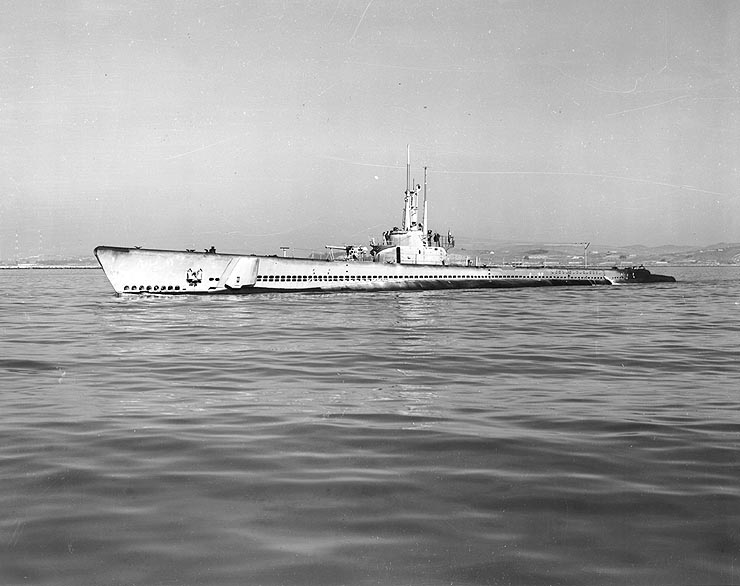
The Balao class is a design of United States Navy submarines that was used during World War II, and with 120 boats completed, the largest class of submarines in the United States Navy. An improvement on the earlier Gato class, the boats had slight internal differences. The most significant improvement was the use of thicker, higher yield-strength steel in the pressure hull skins and frames, which increased their test depth to 400 feet (120 m). A Balao-class submarine, the USS Tang, actually exceeded her depth gauge's maximum reading of 612 ft (187 m) in 1944, when taking on water in the forward torpedo room while evading a destroyer.
The Balaos were similar to the Gatos, except they were modified to increase test depth from 300 ft (90 m) to 400 ft (120 m). In late 1941, two of the Navy's leading submarine designers, Captain Andrew McKee and Commander Armand Morgan, met to explore increasing diving depth in a redesigned Gato. A switch to a new high-tensile steel alloy, combined with an increase in hull thickness from 9⁄16 inch (14.3 mm) to 7⁄8 inch (22.2 mm), would result in a test depth of 450 ft (140 m) and a collapse depth of 900 ft (270 m). However, the limited capacity of the trim pump at deep depths, and lack of time to design a new pump, caused Rear Admiral E. L. Cochrane, chief of the Bureau of Ships, to limit test depth to 400 ft (120 m). Fortunately in 1944, a redesigned Gould centrifugal pump replaced the noisy early-war pump, and effective diving depth was increased.
The Balao boats incorporated the fairwater, conning tower, and periscope shears reduction efforts that were being retrofitted to the Gatos and the preceding classes in the original design, refining the reductions and reducing the sail to the smallest practical size. By the time the boats began to be launched, lessons learned from patrol reports had been worked into the design and the bridge and sail proved to be efficiently laid out, well equipped, and well-liked by the crews.
For the masts and periscope shears, the original arrangement for both the Government and Electric Boat designs had (forward to aft) the two tapered cone-shaped periscope support shears, followed by a thin mast for the SJ surface search radar, and then by a thin mast for the SD air search radar. Minor differences existed in how the periscopes were braced against vibration, but both designs were nearly identical. About halfway through their production run, Electric Boat altered their design, moving the SJ radar mast forward of the periscopes, then altered it again a few boats later by enlarging the SD radar mast. Late in the war, many Balaos built with the original design had the SD air search radar moved slightly aft onto a thickened and taller mast. These mast arrangements, along with the tremendous variation in the gun layout as the war progressed, account for the numerous exterior detail differences among the boats, to the point that at any given time, no two Balaos looked exactly alike.
The propulsion of the Balao-class submarines was generally similar to that of the preceding Gato class. Like their predecessors, they were true diesel-electric submarines; their four diesel engines powered electrical generators, and electric motors drove the shafts. No direct connection was made between the main engines and the shafts.
Balao-class submarines received main engines from one of two manufacturers. General Motors Cleveland Model 16-278A V-type diesels or Fairbanks-Morse 38D 8-1/8 nine-cylinder opposed-piston engine. The General Motors Cleveland Model 16-248 V-type as original installations, while boats from Sand Lance onward received 10-cylinder engines. Earlier General Motors boats received Model 16-248 engines, but beginning with Perch Model 16-278A engines were used. In each case, the newer engines had greater displacement than the old, but were rated at the same power; they operated at lower mean effective pressure for greater reliability. Both the Fairbanks-Morse and General Motors engines were two-stroke cycle types.
Unicorn and Vendace were to receive Hooven-Owens-Rentschler diesels, which proved unreliable on previous classes, but both boats were cancelled.
Two manufacturers supplied electric motors for the Balao class. Elliott Company motors were fitted primarily to boats with Fairbanks-Morse engines. General Electric motors were fitted primarily to boats with General Motors engines, but some Fairbanks-Morse boats received General Electric motors. Allis-Chalmers motors were to be used in SS-530 through SS-536, but those seven boats were cancelled before even receiving names.
Hub AI
Balao-class submarine AI simulator
(@Balao-class submarine_simulator)
Balao-class submarine
The Balao class is a design of United States Navy submarines that was used during World War II, and with 120 boats completed, the largest class of submarines in the United States Navy. An improvement on the earlier Gato class, the boats had slight internal differences. The most significant improvement was the use of thicker, higher yield-strength steel in the pressure hull skins and frames, which increased their test depth to 400 feet (120 m). A Balao-class submarine, the USS Tang, actually exceeded her depth gauge's maximum reading of 612 ft (187 m) in 1944, when taking on water in the forward torpedo room while evading a destroyer.
The Balaos were similar to the Gatos, except they were modified to increase test depth from 300 ft (90 m) to 400 ft (120 m). In late 1941, two of the Navy's leading submarine designers, Captain Andrew McKee and Commander Armand Morgan, met to explore increasing diving depth in a redesigned Gato. A switch to a new high-tensile steel alloy, combined with an increase in hull thickness from 9⁄16 inch (14.3 mm) to 7⁄8 inch (22.2 mm), would result in a test depth of 450 ft (140 m) and a collapse depth of 900 ft (270 m). However, the limited capacity of the trim pump at deep depths, and lack of time to design a new pump, caused Rear Admiral E. L. Cochrane, chief of the Bureau of Ships, to limit test depth to 400 ft (120 m). Fortunately in 1944, a redesigned Gould centrifugal pump replaced the noisy early-war pump, and effective diving depth was increased.
The Balao boats incorporated the fairwater, conning tower, and periscope shears reduction efforts that were being retrofitted to the Gatos and the preceding classes in the original design, refining the reductions and reducing the sail to the smallest practical size. By the time the boats began to be launched, lessons learned from patrol reports had been worked into the design and the bridge and sail proved to be efficiently laid out, well equipped, and well-liked by the crews.
For the masts and periscope shears, the original arrangement for both the Government and Electric Boat designs had (forward to aft) the two tapered cone-shaped periscope support shears, followed by a thin mast for the SJ surface search radar, and then by a thin mast for the SD air search radar. Minor differences existed in how the periscopes were braced against vibration, but both designs were nearly identical. About halfway through their production run, Electric Boat altered their design, moving the SJ radar mast forward of the periscopes, then altered it again a few boats later by enlarging the SD radar mast. Late in the war, many Balaos built with the original design had the SD air search radar moved slightly aft onto a thickened and taller mast. These mast arrangements, along with the tremendous variation in the gun layout as the war progressed, account for the numerous exterior detail differences among the boats, to the point that at any given time, no two Balaos looked exactly alike.
The propulsion of the Balao-class submarines was generally similar to that of the preceding Gato class. Like their predecessors, they were true diesel-electric submarines; their four diesel engines powered electrical generators, and electric motors drove the shafts. No direct connection was made between the main engines and the shafts.
Balao-class submarines received main engines from one of two manufacturers. General Motors Cleveland Model 16-278A V-type diesels or Fairbanks-Morse 38D 8-1/8 nine-cylinder opposed-piston engine. The General Motors Cleveland Model 16-248 V-type as original installations, while boats from Sand Lance onward received 10-cylinder engines. Earlier General Motors boats received Model 16-248 engines, but beginning with Perch Model 16-278A engines were used. In each case, the newer engines had greater displacement than the old, but were rated at the same power; they operated at lower mean effective pressure for greater reliability. Both the Fairbanks-Morse and General Motors engines were two-stroke cycle types.
Unicorn and Vendace were to receive Hooven-Owens-Rentschler diesels, which proved unreliable on previous classes, but both boats were cancelled.
Two manufacturers supplied electric motors for the Balao class. Elliott Company motors were fitted primarily to boats with Fairbanks-Morse engines. General Electric motors were fitted primarily to boats with General Motors engines, but some Fairbanks-Morse boats received General Electric motors. Allis-Chalmers motors were to be used in SS-530 through SS-536, but those seven boats were cancelled before even receiving names.