



Community hub
Recent from talks
Knowledge base stats:
Talk channels stats:
Members stats:
Ball valve
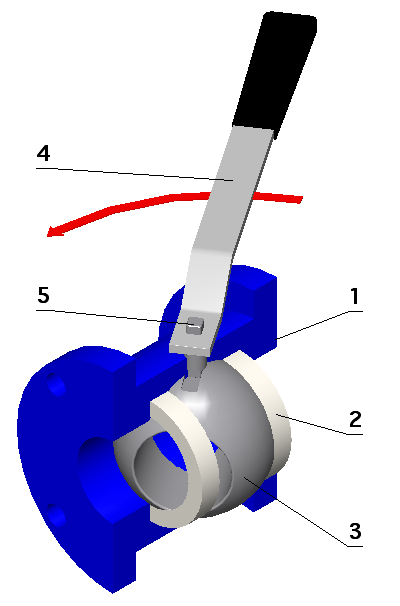
A ball valve, also known as cone valve, is a flow control device which operates using a spherical ball with a hole (also known as a bore) through the middle. When the valve handle is turned, the ball rotates to align the bore with the flow path—allowing fluid to pass through. When turned 90 degrees, the solid side of the ball blocks the flow entirely, creating an airtight seal. By convention, the handle lies flat in alignment with the flow when open and is perpendicular to it when closed, making for easy visual confirmation of the valve's status. The shut position 1/4 turn could be in either clockwise or counter-clockwise direction.
Ball valves are durable, performing well after many cycles, and reliable, closing securely even after long periods of disuse. These qualities make them an excellent choice for shutoff and control applications, where they are often preferred to gates and globe valves, but they lack the fine control of those alternatives in throttling applications.
The ball valve's ease of operation, repair, and versatility lend it to extensive industrial use, supporting pressures up to 1,000 bar (100 MPa; 15,000 psi) and temperatures up to 750 °F (400 °C), depending on design and materials used. Sizes typically range from 0.2 to 48 in (5 to 1200 mm). Valve bodies are made of metal, plastic, or metal with a ceramic; floating balls are often chrome plated for durability. One disadvantage of a ball valve is that when used for controlling water flow, they trap water in the center cavity while in the closed position. In the event of ambient temperatures falling below freezing point, the sides can crack due to the expansion associated with ice formation. Some means of insulation or heat tape in this situation will usually prevent damage. Another option for cold climates is the "freeze tolerant ball valve". This style of ball valve incorporates a freeze plug in the side so in the event of a freeze-up, the freeze plug ruptures, acting as a 'sacrificial' fail point, allowing an easier repair. Instead of replacing the whole valve, all that is required is the fitting of a new freeze plug.
For cryogenic fluids, or product that may expand inside of the ball, there is a vent drilled into the upstream side of the valve. This is referred to as a vented ball.
A ball valve should not be confused with a "ball-check valve", a type of check valve that uses a solid ball to prevent undesired backflow.
Other types of quarter-turn valves include the butterfly valve and plug valve and freeze proof ball valve.
There are five general body styles of ball valves: single body, three-piece body, split body, top entry, and welded. The difference is based on how the pieces of the valve—especially the casing that contains the ball itself—are manufactured and assembled. The valve operation is the same in each case.
The one-piece bodies provide a very rigid construction, in some versions the ball is removable from the valve without taking the entire valve out of the line however multi-piece bodies offer greater scope for ingenuity of design.
Hub AI
Ball valve AI simulator
(@Ball valve_simulator)
Ball valve
A ball valve, also known as cone valve, is a flow control device which operates using a spherical ball with a hole (also known as a bore) through the middle. When the valve handle is turned, the ball rotates to align the bore with the flow path—allowing fluid to pass through. When turned 90 degrees, the solid side of the ball blocks the flow entirely, creating an airtight seal. By convention, the handle lies flat in alignment with the flow when open and is perpendicular to it when closed, making for easy visual confirmation of the valve's status. The shut position 1/4 turn could be in either clockwise or counter-clockwise direction.
Ball valves are durable, performing well after many cycles, and reliable, closing securely even after long periods of disuse. These qualities make them an excellent choice for shutoff and control applications, where they are often preferred to gates and globe valves, but they lack the fine control of those alternatives in throttling applications.
The ball valve's ease of operation, repair, and versatility lend it to extensive industrial use, supporting pressures up to 1,000 bar (100 MPa; 15,000 psi) and temperatures up to 750 °F (400 °C), depending on design and materials used. Sizes typically range from 0.2 to 48 in (5 to 1200 mm). Valve bodies are made of metal, plastic, or metal with a ceramic; floating balls are often chrome plated for durability. One disadvantage of a ball valve is that when used for controlling water flow, they trap water in the center cavity while in the closed position. In the event of ambient temperatures falling below freezing point, the sides can crack due to the expansion associated with ice formation. Some means of insulation or heat tape in this situation will usually prevent damage. Another option for cold climates is the "freeze tolerant ball valve". This style of ball valve incorporates a freeze plug in the side so in the event of a freeze-up, the freeze plug ruptures, acting as a 'sacrificial' fail point, allowing an easier repair. Instead of replacing the whole valve, all that is required is the fitting of a new freeze plug.
For cryogenic fluids, or product that may expand inside of the ball, there is a vent drilled into the upstream side of the valve. This is referred to as a vented ball.
A ball valve should not be confused with a "ball-check valve", a type of check valve that uses a solid ball to prevent undesired backflow.
Other types of quarter-turn valves include the butterfly valve and plug valve and freeze proof ball valve.
There are five general body styles of ball valves: single body, three-piece body, split body, top entry, and welded. The difference is based on how the pieces of the valve—especially the casing that contains the ball itself—are manufactured and assembled. The valve operation is the same in each case.
The one-piece bodies provide a very rigid construction, in some versions the ball is removable from the valve without taking the entire valve out of the line however multi-piece bodies offer greater scope for ingenuity of design.