

Recent from talks
Ballistic coefficient
Knowledge base stats:
Talk channels stats:
Members stats:
Ballistic coefficient
In ballistics, the ballistic coefficient (BC, Cb) of a body is a measure of its ability to overcome air resistance in flight. It is inversely proportional to the negative acceleration: a high number indicates a low negative acceleration—the drag on the body is small in proportion to its mass. BC can be expressed with the units kilogram-force per square meter (kgf/m2) or pounds per square inch (lb/in2) (where 1 lb/in2 corresponds to 703.06957829636 kgf/m2).
The ballistic coefficient provides a value representing how an object's velocity and acceleration through a fluid of a given density will relate to each other; for a given velocity through a given fluid, a higher coefficient means the projectile will be affected less by drag, i.e. it will be accelerated less by the drag force.

where:
For objects whose volume can be compared based on a known comparison of their projected frontal area, we can compare ballistic coefficients; for example, for the shapes on the right, the two cylinders are of unknown length and the cone is of unknown angle, making it impossible to compare their ballistic coefficients. This comparison table assumes all of the objects are of the same characteristic density, so they will have the same mass at the same volume, i.e. the volume divided by the projected frontal area, V⁄AF, multiplied by some shared density ρ, equals the m⁄A term in the Ballistic Coefficient formula. Note that "angled cube", in this case, means the flow is perpendicular to an edge, not a corner.
The formula for calculating the ballistic coefficient for small and large arms projectiles only is as follows: where:
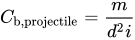
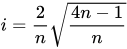
The coefficient of form, i, can be derived by 6 methods and applied differently depending on the trajectory models used: G model, Beugless/Coxe, 3 Sky Screen, 4 Sky Screen, target zeroing, and Doppler radar.
Here are several methods to compute i or Cd:
You can assume the projectile is a "standard" ogive, ignoring the various ways an ogive can be specified as well as non-ogive projectiles.
Hub AI
Ballistic coefficient AI simulator
(@Ballistic coefficient_simulator)
Ballistic coefficient
In ballistics, the ballistic coefficient (BC, Cb) of a body is a measure of its ability to overcome air resistance in flight. It is inversely proportional to the negative acceleration: a high number indicates a low negative acceleration—the drag on the body is small in proportion to its mass. BC can be expressed with the units kilogram-force per square meter (kgf/m2) or pounds per square inch (lb/in2) (where 1 lb/in2 corresponds to 703.06957829636 kgf/m2).
The ballistic coefficient provides a value representing how an object's velocity and acceleration through a fluid of a given density will relate to each other; for a given velocity through a given fluid, a higher coefficient means the projectile will be affected less by drag, i.e. it will be accelerated less by the drag force.
where:
For objects whose volume can be compared based on a known comparison of their projected frontal area, we can compare ballistic coefficients; for example, for the shapes on the right, the two cylinders are of unknown length and the cone is of unknown angle, making it impossible to compare their ballistic coefficients. This comparison table assumes all of the objects are of the same characteristic density, so they will have the same mass at the same volume, i.e. the volume divided by the projected frontal area, V⁄AF, multiplied by some shared density ρ, equals the m⁄A term in the Ballistic Coefficient formula. Note that "angled cube", in this case, means the flow is perpendicular to an edge, not a corner.
The formula for calculating the ballistic coefficient for small and large arms projectiles only is as follows: where:
The coefficient of form, i, can be derived by 6 methods and applied differently depending on the trajectory models used: G model, Beugless/Coxe, 3 Sky Screen, 4 Sky Screen, target zeroing, and Doppler radar.
Here are several methods to compute i or Cd:
You can assume the projectile is a "standard" ogive, ignoring the various ways an ogive can be specified as well as non-ogive projectiles.
Recent media