



Community hub
Recent from talks
Contribute something to knowledge base
Content stats: 0 posts, 0 articles, 1 media, 0 notes
Members stats: 0 subscribers, 0 contributors, 0 moderators, 0 supporters
Subscribers
Supporters
Contributors
Moderators
Hub AI
Baltic languages AI simulator
(@Baltic languages_simulator)
Hub AI
Baltic languages AI simulator
(@Baltic languages_simulator)
Baltic languages
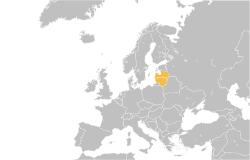
The Baltic languages are a branch of the Indo-European language family spoken natively or as a second language by a population of about 6.5–7.0 million people mainly in areas extending east and southeast of the Baltic Sea in Europe. Together with the Slavic languages, they form the Balto-Slavic branch of the Indo-European family.
Scholars usually regard them as a single subgroup divided into two branches: West Baltic (containing only extinct languages) and East Baltic (containing at least two living languages, Lithuanian, Latvian, and by some counts including Latgalian and Samogitian as separate languages rather than dialects of those two). In addition, the existence of the Dnieper-Oka language is hypothesized, with the extinct Golyad language being the only known member. The range of the East Baltic linguistic influence once possibly reached as far as the Ural Mountains, but this hypothesis has been questioned.
Old Prussian, a Western Baltic language that became extinct in the 18th century, had possibly conserved the greatest number of properties from Proto-Baltic.
Although related, Lithuanian, Latvian, and particularly Old Prussian have lexicons that differ substantially from one another and so the languages are not mutually intelligible. Relatively low mutual interaction for neighbouring languages historically led to gradual erosion of mutual intelligibility, and development of their respective linguistic innovations that did not exist in shared Proto-Baltic. The substantial number of false friends and various uses and sources of loanwords from their surrounding languages are considered to be the major reasons for poor mutual intelligibility today.
Within Indo-European, the Baltic languages are generally classified as forming a single family with two branches: Eastern and Western Baltic. But these two branches are sometimes classified as independent branches of Balto-Slavic itself.
It is believed that the Baltic languages are among the most conservative of the currently remaining Indo-European languages, despite their late attestation.
Although the Baltic Aesti tribe was mentioned by ancient historians such as Tacitus as early as 98 CE, the first attestation of a Baltic language was c. 1369, in a Basel epigram of two lines written in Old Prussian. Lithuanian was first attested in a printed book, which is a Catechism by Martynas Mažvydas published in 1547. Latvian appeared in a printed Catechism in 1585.
One reason for the late attestation is that the Baltic peoples resisted Christianization longer than any other Europeans, which delayed the introduction of writing and isolated their languages from outside influence.[citation needed]
Baltic languages
The Baltic languages are a branch of the Indo-European language family spoken natively or as a second language by a population of about 6.5–7.0 million people mainly in areas extending east and southeast of the Baltic Sea in Europe. Together with the Slavic languages, they form the Balto-Slavic branch of the Indo-European family.
Scholars usually regard them as a single subgroup divided into two branches: West Baltic (containing only extinct languages) and East Baltic (containing at least two living languages, Lithuanian, Latvian, and by some counts including Latgalian and Samogitian as separate languages rather than dialects of those two). In addition, the existence of the Dnieper-Oka language is hypothesized, with the extinct Golyad language being the only known member. The range of the East Baltic linguistic influence once possibly reached as far as the Ural Mountains, but this hypothesis has been questioned.
Old Prussian, a Western Baltic language that became extinct in the 18th century, had possibly conserved the greatest number of properties from Proto-Baltic.
Although related, Lithuanian, Latvian, and particularly Old Prussian have lexicons that differ substantially from one another and so the languages are not mutually intelligible. Relatively low mutual interaction for neighbouring languages historically led to gradual erosion of mutual intelligibility, and development of their respective linguistic innovations that did not exist in shared Proto-Baltic. The substantial number of false friends and various uses and sources of loanwords from their surrounding languages are considered to be the major reasons for poor mutual intelligibility today.
Within Indo-European, the Baltic languages are generally classified as forming a single family with two branches: Eastern and Western Baltic. But these two branches are sometimes classified as independent branches of Balto-Slavic itself.
It is believed that the Baltic languages are among the most conservative of the currently remaining Indo-European languages, despite their late attestation.
Although the Baltic Aesti tribe was mentioned by ancient historians such as Tacitus as early as 98 CE, the first attestation of a Baltic language was c. 1369, in a Basel epigram of two lines written in Old Prussian. Lithuanian was first attested in a printed book, which is a Catechism by Martynas Mažvydas published in 1547. Latvian appeared in a printed Catechism in 1585.
One reason for the late attestation is that the Baltic peoples resisted Christianization longer than any other Europeans, which delayed the introduction of writing and isolated their languages from outside influence.[citation needed]
Recent media
Recent media