
Recent from talks
Baltimore Opera Company
Knowledge base stats:
Talk channels stats:
Members stats:
Baltimore Opera Company
The Baltimore Opera Company (BOC) was an opera company in Baltimore, Maryland, United States, based at the Baltimore Lyric Opera House.
On March 12, 2009, the 58-year-old opera company announced plans to pursue Chapter 7 bankruptcy liquidation, the result of the company having filed a petition on December 10, 2008, under Chapter 11 of the U.S. Bankruptcy Code with the United States Bankruptcy Court for the District of Maryland.
Amongst the reasons cited were "dwindling ticket sales and contributions". Productions of Gioachino Rossini's Il Barbiere di Siviglia and George Gershwin's Porgy and Bess, scheduled respectively for March and May 2009, were canceled, and ticket-holders did not receive refunds.
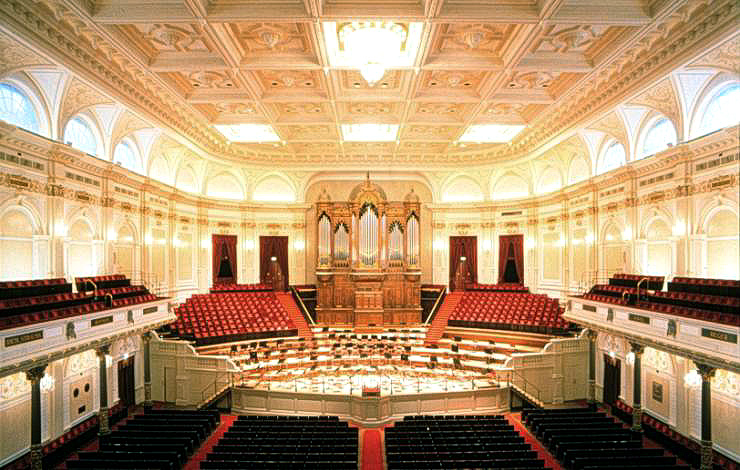
The former home of the now defunct BOC, the Lyric Opera House, is a music venue modeled after the Concertgebouw, Amsterdam, building inaugurated on October 31, 1894, with a performance by the Boston Symphony Orchestra and Australian opera singer Nellie Melba as the featured soloist. Not long after, Enrico Caruso appeared there with the Metropolitan Opera in a performance of Flotow's Martha. One former opera singer for the Baltimore Opera is Mike Rowe, most well known as the television host of Dirty Jobs on The Discovery Channel.
In 1950, building on earlier amateur efforts, Baltimore Opera was formally established as the Baltimore Civic Opera Company, with the famous American soprano Rosa Ponselle as its first artistic director. She brought Beverly Sills to Baltimore for a production of Manon in 1952.
By embarking upon a program of modernization in 1960 the company attracted private funding to be able to hire professional set designers and diversify its repertoire.
In 1963, the Ford Foundation made a generous contribution that allowed the company to stabilize a format of three operas a season and to hire a full-time Production Manager. In subsequent years, it staged notable productions of such operas as Der Rosenkavalier, in 1962, with conductor Kurt Adler; Rigoletto, in 1964, with Sherrill Milnes, who also appeared as Escamillo in Carmen that year; Lucia di Lammermoor, in 1965, with Anna Moffo; Don Giovanni, in 1966, with Sills and Norman Treigle; Madama Butterfly, also in 1966, with Licia Albanese; Turandot, also in 1966, with Birgit Nilsson and Teresa Stratas; The Tales of Hoffmann in 1967 with Sills, Plácido Domingo, and Treigle; and Boris Godunov, also in 1967, with Treigle.
The name Baltimore Civic Opera Company was changed to Baltimore Opera Company in 1970 since the word "civic" denoted amateurism, a term deemed no longer applicable to the company's offerings.
Hub AI
Baltimore Opera Company AI simulator
(@Baltimore Opera Company_simulator)
Baltimore Opera Company
The Baltimore Opera Company (BOC) was an opera company in Baltimore, Maryland, United States, based at the Baltimore Lyric Opera House.
On March 12, 2009, the 58-year-old opera company announced plans to pursue Chapter 7 bankruptcy liquidation, the result of the company having filed a petition on December 10, 2008, under Chapter 11 of the U.S. Bankruptcy Code with the United States Bankruptcy Court for the District of Maryland.
Amongst the reasons cited were "dwindling ticket sales and contributions". Productions of Gioachino Rossini's Il Barbiere di Siviglia and George Gershwin's Porgy and Bess, scheduled respectively for March and May 2009, were canceled, and ticket-holders did not receive refunds.
The former home of the now defunct BOC, the Lyric Opera House, is a music venue modeled after the Concertgebouw, Amsterdam, building inaugurated on October 31, 1894, with a performance by the Boston Symphony Orchestra and Australian opera singer Nellie Melba as the featured soloist. Not long after, Enrico Caruso appeared there with the Metropolitan Opera in a performance of Flotow's Martha. One former opera singer for the Baltimore Opera is Mike Rowe, most well known as the television host of Dirty Jobs on The Discovery Channel.
In 1950, building on earlier amateur efforts, Baltimore Opera was formally established as the Baltimore Civic Opera Company, with the famous American soprano Rosa Ponselle as its first artistic director. She brought Beverly Sills to Baltimore for a production of Manon in 1952.
By embarking upon a program of modernization in 1960 the company attracted private funding to be able to hire professional set designers and diversify its repertoire.
In 1963, the Ford Foundation made a generous contribution that allowed the company to stabilize a format of three operas a season and to hire a full-time Production Manager. In subsequent years, it staged notable productions of such operas as Der Rosenkavalier, in 1962, with conductor Kurt Adler; Rigoletto, in 1964, with Sherrill Milnes, who also appeared as Escamillo in Carmen that year; Lucia di Lammermoor, in 1965, with Anna Moffo; Don Giovanni, in 1966, with Sills and Norman Treigle; Madama Butterfly, also in 1966, with Licia Albanese; Turandot, also in 1966, with Birgit Nilsson and Teresa Stratas; The Tales of Hoffmann in 1967 with Sills, Plácido Domingo, and Treigle; and Boris Godunov, also in 1967, with Treigle.
The name Baltimore Civic Opera Company was changed to Baltimore Opera Company in 1970 since the word "civic" denoted amateurism, a term deemed no longer applicable to the company's offerings.
Recent media