



Community hub
Recent from talks
Knowledge base stats:
Talk channels stats:
Members stats:
Bananaquit
The bananaquit (Coereba flaveola) is a species of passerine bird in the tanager family Thraupidae. Before the development of molecular genetics in the 21st century, its relationship to other species was uncertain and it was either placed with the buntings and New World sparrows in the family Emberizidae, with New World warblers in the family Parulidae or its own monotypic family Coerebidae. This small, active nectarivore is found in warmer parts of the Americas and is generally common.
Its name is derived from its yellow color and the English word quit, which refers to small passerines of tropical America; cf. grassquit, orangequit.
The bananaquit was formally described by Carl Linnaeus in his landmark 1758 10th edition of Systema Naturae as Certhia flaveola. Linnaeus based his description on the "black and yellow bird" described by John Ray and Hans Sloane, and the "Black and Yellow Creeper" described and illustrated by George Edwards in 1751. The bananaquit was reclassified as the only member of the genus Coereba by Louis Pierre Vieillot in 1809. The genus name is of uncertain origin but may be from a Tupi name Güirá for a small black and yellow bird. The specific epithet flaveolus is a diminutive of the Latin flavus meaning "golden" or "yellow".
Before the development of techniques to sequence DNA, the relationship of the bananaquit to other species was uncertain. It was variously placed with the New World warblers in the family Parulidae, with the buntings and New World sparrows in the family Emberizidae, or in its own monotypic family Coerebidae. Based on the results of molecular phylogenetic studies, the bananaquit is now placed in the tanager family Thraupidae and belongs with Darwin's finches to the subfamily Coerebinae.
It is still unclear if any of the island subspecies should be elevated to species, but phylogenetic studies have revealed three clades: the nominate group from Jamaica, Hispaniola, and the Cayman Islands, the bahamensis group from the Bahamas and Quintana Roo, and the bartholemica group from South and Central America, Mexico (except Quintana Roo), the Lesser Antilles and Puerto Rico. Several taxa were not sampled, but most of these are easily placed in the above groups based on zoogeography alone. Exceptions are oblita (San Andrés Island) and tricolor (Providencia Island), and their placement is therefore uncertain. In February 2010, the International Ornithological Congress listed bahamensis and bartholemica as proposed splits from C. flaveola.
There are 41 currently recognized subspecies:
The bananaquit is a small bird, although there is some degree of size variation across the various subspecies. Length can range from 10 to 13 cm (3.9 to 5.1 in). Weight ranges from 5.5 to 19 g (0.19 to 0.67 oz).
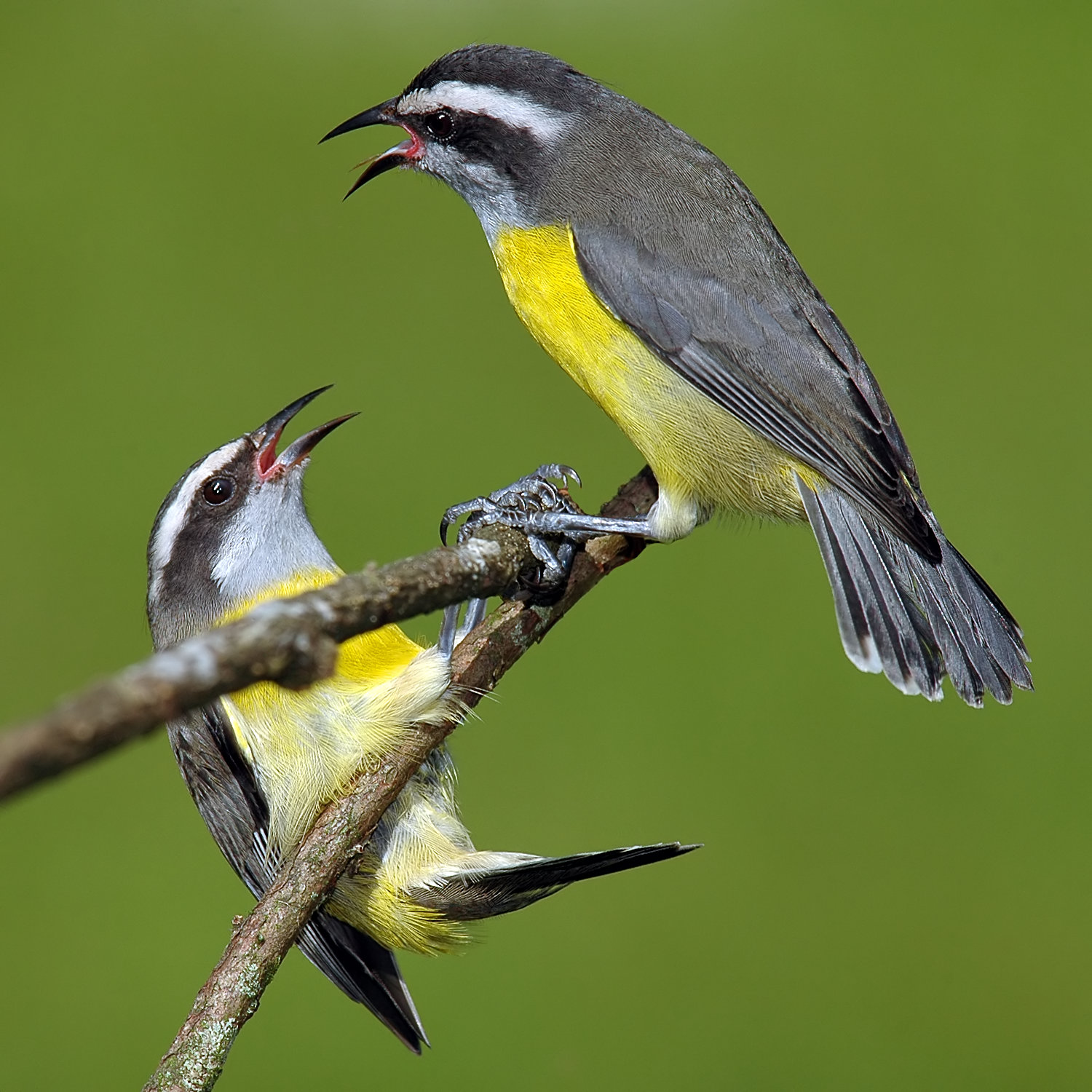
Most subspecies of the bananaquit have dark grey (almost black) upperparts, black crowns and sides of the head, a prominent white eyestripe, grey throat, white vent, and yellow chest, belly, and rump. Coloration is heavily influenced by melanocortin 1 receptor variation.
Hub AI
Bananaquit AI simulator
(@Bananaquit_simulator)
Bananaquit
The bananaquit (Coereba flaveola) is a species of passerine bird in the tanager family Thraupidae. Before the development of molecular genetics in the 21st century, its relationship to other species was uncertain and it was either placed with the buntings and New World sparrows in the family Emberizidae, with New World warblers in the family Parulidae or its own monotypic family Coerebidae. This small, active nectarivore is found in warmer parts of the Americas and is generally common.
Its name is derived from its yellow color and the English word quit, which refers to small passerines of tropical America; cf. grassquit, orangequit.
The bananaquit was formally described by Carl Linnaeus in his landmark 1758 10th edition of Systema Naturae as Certhia flaveola. Linnaeus based his description on the "black and yellow bird" described by John Ray and Hans Sloane, and the "Black and Yellow Creeper" described and illustrated by George Edwards in 1751. The bananaquit was reclassified as the only member of the genus Coereba by Louis Pierre Vieillot in 1809. The genus name is of uncertain origin but may be from a Tupi name Güirá for a small black and yellow bird. The specific epithet flaveolus is a diminutive of the Latin flavus meaning "golden" or "yellow".
Before the development of techniques to sequence DNA, the relationship of the bananaquit to other species was uncertain. It was variously placed with the New World warblers in the family Parulidae, with the buntings and New World sparrows in the family Emberizidae, or in its own monotypic family Coerebidae. Based on the results of molecular phylogenetic studies, the bananaquit is now placed in the tanager family Thraupidae and belongs with Darwin's finches to the subfamily Coerebinae.
It is still unclear if any of the island subspecies should be elevated to species, but phylogenetic studies have revealed three clades: the nominate group from Jamaica, Hispaniola, and the Cayman Islands, the bahamensis group from the Bahamas and Quintana Roo, and the bartholemica group from South and Central America, Mexico (except Quintana Roo), the Lesser Antilles and Puerto Rico. Several taxa were not sampled, but most of these are easily placed in the above groups based on zoogeography alone. Exceptions are oblita (San Andrés Island) and tricolor (Providencia Island), and their placement is therefore uncertain. In February 2010, the International Ornithological Congress listed bahamensis and bartholemica as proposed splits from C. flaveola.
There are 41 currently recognized subspecies:
The bananaquit is a small bird, although there is some degree of size variation across the various subspecies. Length can range from 10 to 13 cm (3.9 to 5.1 in). Weight ranges from 5.5 to 19 g (0.19 to 0.67 oz).
Most subspecies of the bananaquit have dark grey (almost black) upperparts, black crowns and sides of the head, a prominent white eyestripe, grey throat, white vent, and yellow chest, belly, and rump. Coloration is heavily influenced by melanocortin 1 receptor variation.