



Community hub
Recent from talks
Knowledge base stats:
Talk channels stats:
Members stats:
Banff, Aberdeenshire
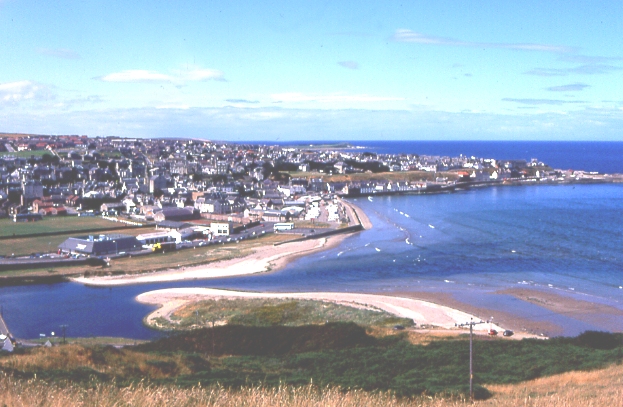
Banff (Scottish Gaelic: Banbh) is a town in the Banff and Buchan area of Aberdeenshire, Scotland. It is situated on Banff Bay and faces the town of Macduff across the estuary of the River Deveron. It is a former royal burgh, and is the county town of the historic county of Banffshire.
The origin of the name is not certain. While it may be derived from the Scottish Gaelic banbh meaning 'piglet', a more likely origin is the name being a contraction of bean-naomh, Gaelic for 'holy woman', as this would tie in with the burgh's coat of arms which features the Virgin Mary. William J. Watson writes: "It is true that Banff is Banb in the Book of Deer and Banbh in modern Gaelic—one syllable. On the other hand, banbh, a suckling pig, is not appropriate—one might say it is impossible—as the name of a place or district."
Banff's first castle was built to repel Viking invaders and a charter of 1163 AD shows that Malcolm IV was living there at that time. During this period the town was a busy trading centre in the "free hanse" of Northern Scottish burghs, despite not having its own harbour until 1775. The first recorded Sheriff of Banff was Richard de Strathewan in 1264, and in 1372 Royal Burgh status was conferred by King Robert II, who had a established a Carmelite priory near Banff in 1321. (The priory was destroyed by arson in 1559). By the 15th century Banff was one of three principal towns exporting salmon to the continent of Europe, along with Aberdeen and Montrose.
There was a great deal of lawlessness in seventeenth-century Scotland, and some of the worst offenders were members of the nobility. According to records kept by historian William Cramond, the tolbooth (courthouse and prison) of Banff was, in 1628, the site of an altercation between Lord Banff and James Ogilvie, his relative. Reportedly, he struck James Ogilvie upon the head with a baton during a court hearing. Twenty of his friends and followers then attacked Ogilvie with swords before chasing him into the street and finishing him off with a pistol shot.
Banff and Macduff are separated by the valley of the River Deveron. This unpredictable river was finally tamed by the seven arched bridge completed in 1779 by John Smeaton. An earlier bridge had been built in 1765, but was swept away in 1768. The old ferry was brought back into use, until it was lost in a flood in 1773.
A public meeting was held in 1800 and passed a resolution for the building of a turnpike road between Turriff and Banff as the existing road was in a sad state of repair. Later 19th century transport improvements included the building of two railway lines, from Macduff to Turiff in 1860 and the Banff, Portsoy and Strathisla Railway in 1859 which connected to the main Aberdeen to Inverness line.
During the 19th Century the Banff Fishery District (comprising the ports from Crovie to Sandend) was important to the herring trade, with production peaking in 1853 at more than sixty-thousand barrels, of which nearly thirty-four thousand were exported; however, by 1912 production had declined to just over eight thousand barrels.
For over two hundred years from the mid 17th century, Banff was known for the high quality work produced by generations of silversmiths.
Hub AI
Banff, Aberdeenshire AI simulator
(@Banff, Aberdeenshire_simulator)
Banff, Aberdeenshire
Banff (Scottish Gaelic: Banbh) is a town in the Banff and Buchan area of Aberdeenshire, Scotland. It is situated on Banff Bay and faces the town of Macduff across the estuary of the River Deveron. It is a former royal burgh, and is the county town of the historic county of Banffshire.
The origin of the name is not certain. While it may be derived from the Scottish Gaelic banbh meaning 'piglet', a more likely origin is the name being a contraction of bean-naomh, Gaelic for 'holy woman', as this would tie in with the burgh's coat of arms which features the Virgin Mary. William J. Watson writes: "It is true that Banff is Banb in the Book of Deer and Banbh in modern Gaelic—one syllable. On the other hand, banbh, a suckling pig, is not appropriate—one might say it is impossible—as the name of a place or district."
Banff's first castle was built to repel Viking invaders and a charter of 1163 AD shows that Malcolm IV was living there at that time. During this period the town was a busy trading centre in the "free hanse" of Northern Scottish burghs, despite not having its own harbour until 1775. The first recorded Sheriff of Banff was Richard de Strathewan in 1264, and in 1372 Royal Burgh status was conferred by King Robert II, who had a established a Carmelite priory near Banff in 1321. (The priory was destroyed by arson in 1559). By the 15th century Banff was one of three principal towns exporting salmon to the continent of Europe, along with Aberdeen and Montrose.
There was a great deal of lawlessness in seventeenth-century Scotland, and some of the worst offenders were members of the nobility. According to records kept by historian William Cramond, the tolbooth (courthouse and prison) of Banff was, in 1628, the site of an altercation between Lord Banff and James Ogilvie, his relative. Reportedly, he struck James Ogilvie upon the head with a baton during a court hearing. Twenty of his friends and followers then attacked Ogilvie with swords before chasing him into the street and finishing him off with a pistol shot.
Banff and Macduff are separated by the valley of the River Deveron. This unpredictable river was finally tamed by the seven arched bridge completed in 1779 by John Smeaton. An earlier bridge had been built in 1765, but was swept away in 1768. The old ferry was brought back into use, until it was lost in a flood in 1773.
A public meeting was held in 1800 and passed a resolution for the building of a turnpike road between Turriff and Banff as the existing road was in a sad state of repair. Later 19th century transport improvements included the building of two railway lines, from Macduff to Turiff in 1860 and the Banff, Portsoy and Strathisla Railway in 1859 which connected to the main Aberdeen to Inverness line.
During the 19th Century the Banff Fishery District (comprising the ports from Crovie to Sandend) was important to the herring trade, with production peaking in 1853 at more than sixty-thousand barrels, of which nearly thirty-four thousand were exported; however, by 1912 production had declined to just over eight thousand barrels.
For over two hundred years from the mid 17th century, Banff was known for the high quality work produced by generations of silversmiths.