Hubbry Logo
Scottish GaelicScottish GaelicMain
Open search
Scottish Gaelic
Community hub
Scottish Gaelic
logo
8 pages, 0 posts
0 subscribers
Be the first to start a discussion here.
Contribute something
Scottish Gaelic
Scottish Gaelic
from Wikipedia

Scottish Gaelic
  • Scots Gaelic
  • Gaelic
Gàidhlig
Pronunciation[ˈkaːlɪkʲ]
Native toUnited Kingdom, Canada
RegionScotland; Cape Breton Island, Nova Scotia
EthnicityScottish Gaels
Speakers70,000 L1 and L2 speakers in Scotland (2022)[1]
130,000 people in Scotland reported having some Gaelic language ability in 2022;[1] 1,300 fluent in Nova Scotia[2]
Early forms
Dialects
Official status
Official language in
Scotland
Recognised minority
language in
Language codes
ISO 639-1gd
ISO 639-2gla
ISO 639-3gla
Glottologscot1245
ELPScottish Gaelic
Linguasphere50-AAA
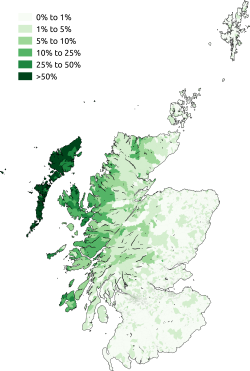
2022 distribution of people with skills in Gaelic in Scotland
Scottish Gaelic is classified as Definitely Endangered by the UNESCO Atlas of the World's Languages in Danger.[3]
This article contains IPA phonetic symbols. Without proper rendering support, you may see question marks, boxes, or other symbols instead of Unicode characters. For an introductory guide on IPA symbols, see Help:IPA.

Scottish Gaelic (/ˈɡælɪk/ GAL-ik; endonym: Gàidhlig [ˈkaːlɪkʲ] ), also known as Scots Gaelic or simply Gaelic, is a Celtic language native to the Gaels of Scotland. As a member of the Goidelic branch of Celtic, Scottish Gaelic, alongside both Irish and Manx, developed out of Old Irish.[4] It became a distinct spoken language sometime in the 13th century in the Middle Irish period, although a common literary language was shared by the Gaels of both Ireland and Scotland until well into the 17th century.[5] Most of modern Scotland was once Gaelic-speaking, as evidenced especially by Gaelic-language place names.[6][7]

In the 2011 census of Scotland, 57,375 people (1.1% of the Scottish population, three years and older) reported being able to speak Gaelic, 1,275 fewer than in 2001. The highest percentages of Gaelic speakers were in the Outer Hebrides. Nevertheless, there is a language revival, and the number of speakers of the language under age 20 did not decrease between the 2001 and 2011 censuses.[8] In the 2022 census of Scotland, it was found that 2.5% of the Scottish population had some skills in Gaelic,[9] or 130,161 persons. Of these, 69,701 people reported speaking the language, with a further 46,404 people reporting that they understood the language, but did not speak, read, or write in it.[10]

Outside of Scotland, a dialect known as Canadian Gaelic has been spoken in Canada since the 18th century. In the 2021 census, 2,170 Canadian residents claimed knowledge of Scottish Gaelic, a decline from 3,980 speakers in the 2016 census.[11][12] There exists a particular concentration of speakers in Nova Scotia, with historic communities in other parts of North America, including North Carolina and Glengarry County, Ontario having largely disappeared.[13]

Scottish Gaelic is classed as an indigenous language under the European Charter for Regional or Minority Languages, which the UK Government has ratified, and the Gaelic Language (Scotland) Act 2005 established a language-development body, Bòrd na Gàidhlig.[14] With the passing of the Scottish Languages Act 2025, Gaelic, alongside Scots, has become an official language of Scotland.[15]

Name

[edit]

Aside from "Scottish Gaelic", the language may also be referred to simply as "Gaelic", pronounced /ˈɡælɪk/ GA-lik in English. However, "Gaelic" /ˈɡlɪk/ GAY-lik also refers to the Irish language (Gaeilge)[16] and the Manx language (Gaelg).

Scottish Gaelic is distinct from Scots, the Middle English-derived language which had come to be spoken in most of the Lowlands of Scotland by the early modern era. Prior to the 15th century, this language was known as Inglis ("English")[17] by its own speakers, with Gaelic being called Scottis ("Scottish"). Beginning in the late 15th century, it became increasingly common for such speakers to refer to Scottish Gaelic as Erse ("Irish") and the Lowland vernacular as Scottis.[18] Today, Scottish Gaelic is recognised as a separate language from Irish, so the word Erse in reference to Scottish Gaelic is no longer used.[19]

History

[edit]

Origins

[edit]
Linguistic division in early 12th century Scotland.
  Gaelic speaking
  Norse-Gaelic zone, use of either or both languages
  English-speaking zone
  Cumbric may have survived in this zone
Place names in Scotland that contain the element bal- from the Scottish Gaelic baile meaning home, farmstead, town or city. These data give some indication of the extent of medieval Gaelic settlement in Scotland.

Based on medieval traditional accounts and the apparent evidence from linguistic geography, Gaelic has been commonly believed to have been brought to Scotland in the 4th and 5th centuries CE by settlers from Ireland who founded the Gaelic kingdom of Dál Riata on Scotland's west coast, in what is present-day Argyll.[20]: 551 [21]: 66  An alternative view has been voiced by archaeologist Ewan Campbell, who has argued that the putative migration or takeover is not reflected in archaeological or placename data (as pointed out earlier by Leslie Alcock). Campbell has also questioned the age and reliability of the medieval historical sources speaking of a conquest. Instead, he has inferred that Argyll formed part of a common Q-Celtic-speaking area with Ireland, connected rather than divided by the sea, since the Iron Age.[22] These arguments have been opposed by some scholars defending the early dating of the traditional accounts and arguing for other interpretations of the archaeological evidence.[23]

Regardless of how it came to be spoken in the region, Gaelic in Scotland was mostly confined to Dál Riata until the eighth century, when it began expanding into Pictish areas north of the Firth of Forth and the Firth of Clyde. During the reign of Caustantín mac Áeda (Constantine II, 900–943), outsiders began to refer to the region as the kingdom of Alba rather than as the kingdom of the Picts. However, though the Pictish language did not disappear suddenly, a process of Gaelicisation (which may have begun generations earlier) was clearly under way during the reigns of Caustantín and his successors. By a certain point, probably during the 11th century, all the inhabitants of Alba had become fully Gaelicised Scots, and Pictish identity was forgotten.[24] Bilingualism in Pictish and Gaelic, prior to the former's extinction, led to the presence of Pictish loanwords in Scottish Gaelic[25] and syntactic influence[26] which could be considered to constitute a Pictish substrate.[27]

In 1018, after the conquest of Lothian (theretofore part of England and inhabited predominantly by speakers of Northumbrian Old English) by the Kingdom of Scotland, Gaelic reached its social, cultural, political, and geographic zenith.[28]: 16–18  Colloquial speech in Scotland had been developing independently of that in Ireland since the eighth century.[29] For the first time, the entire region of modern-day Scotland was called Scotia in Latin, and Gaelic was the lingua Scotica.[30]: 276 [31]: 554  In southern Scotland, Gaelic was strong in Galloway, adjoining areas to the north and west, West Lothian, and parts of western Midlothian. It was spoken to a lesser degree in north Ayrshire, Renfrewshire, the Clyde Valley and eastern Dumfriesshire. In south-eastern Scotland, there is no evidence that Gaelic was ever widely spoken.[32]

Decline

[edit]

Many historians mark the reign of King Malcolm Canmore (Malcolm III) between 1058 and 1093 as the beginning of Gaelic's eclipse in Scotland. His wife Margaret of Wessex spoke no Gaelic, gave her children Anglo-Saxon rather than Gaelic names, and brought many English bishops, priests, and monastics to Scotland.[28]: 19  During the reigns of Malcolm Canmore's sons, Edgar, Alexander I and David I (their successive reigns lasting 1097–1153), Anglo-Norman names and practices spread throughout Scotland south of the Forth–Clyde line and along the northeastern coastal plain as far north as Moray. Norman French completely displaced Gaelic at court. The establishment of royal burghs throughout the same area, particularly under David I, attracted large numbers of foreigners speaking Old English. This was the beginning of Gaelic's status as a predominantly rural language in Scotland.[28]: 19–23 

Clan chiefs in the northern and western parts of Scotland continued to support Gaelic bards who remained a central feature of court life there. The semi-independent Lordship of the Isles in the Hebrides and western coastal mainland remained thoroughly Gaelic since the language's recovery there in the 12th century, providing a political foundation for cultural prestige down to the end of the 15th century.[31]: 553–6 

Linguistic divide in the middle ages. Left: divide in 1400 after Loch, 1932; Right: divide in 1500 after Nicholson, 1974 (both reproduced from Withers, 1984)
  • Note: Caithness Norn as shown in the orange was also spoken in the 1400s in the same region as the 1500s' picture, but its presence, exact timeline, and mixture with Scottish Gaelic is debated*
  Scottish Gaelic
  Scots
  Norn

By the mid-14th century what eventually came to be called Scots (at that time termed Inglis) emerged as the official language of government and law.[33]: 139  Scotland's emergent nationalism in the era following the conclusion of the Wars of Scottish Independence was organized using Scots as well. For example, the nation's great patriotic literature including John Barbour's The Brus (1375) and Blind Harry's The Wallace (before 1488) was written in Scots, not Gaelic. By the end of the 15th century, English/Scots speakers referred to Gaelic instead as 'Yrisch' or 'Erse', i.e. Irish and their own language as 'Scottis'.[28]: 19–23 

Modern era

[edit]

A steady shift away from Scottish Gaelic continued into and through the modern era. Some of this was driven by policy decisions by government or other organisations, while some originated from social changes. In the last quarter of the 20th century, efforts began to encourage use of the language.

The Statutes of Iona, enacted by James VI in 1609, was one piece of legislation that addressed, among other things, the Gaelic language. It required the heirs of clan chiefs to be educated in lowland, Protestant, English-speaking schools. James VI took several such measures to impose his rule on the Highland and Island region. In 1616, the Privy Council proclaimed that schools teaching in English should be established. Gaelic was seen, at this time, as one of the causes of the instability of the region. It was also associated with Catholicism.[34]: 110–113 

The Society in Scotland for the Propagation of Christian Knowledge (SSPCK) was founded in 1709. They met in 1716, immediately after the failed Jacobite rising of 1715, to consider the reform and civilisation of the Highlands, which they sought to achieve by teaching English and the Protestant religion. Initially, their teaching was entirely in English, but soon the impracticality of educating Gaelic-speaking children in this way gave rise to a modest concession: in 1723, teachers were allowed to translate English words in the Bible into Gaelic to aid comprehension, but there was no further permitted use. Other less prominent schools worked in the Highlands at the same time, also teaching in English. This process of anglicisation paused when evangelical preachers arrived in the Highlands, convinced that people should be able to read religious texts in their own language. The first well known translation of the Bible into Scottish Gaelic was made in 1767, when James Stuart of Killin and Dugald Buchanan of Rannoch produced a translation of the New Testament. In 1798, four tracts in Gaelic were published by the Society for Propagating the Gospel at Home, with 5,000 copies of each printed. Other publications followed, with a full Gaelic Bible in 1801. The influential and effective Gaelic Schools Society was founded in 1811. Their purpose was to teach Gaels to read the Bible in their own language. In the first quarter of the 19th century, the SSPCK (despite their anti-Gaelic attitude in prior years) and the British and Foreign Bible Society distributed 60,000 Gaelic Bibles and 80,000 New Testaments.[35]: 98  It is estimated that this overall schooling and publishing effort gave about 300,000 people in the Highlands some basic literacy.[34]: 110–117  Very few European languages have made the transition to a modern literary language without an early modern translation of the Bible; the lack of a well known translation may have contributed to the decline of Scottish Gaelic.[36]: 168–202 

1891 distribution of English (including Scots) and Gaelic in Scotland
  75–80% Gaelic, and English
 25–75% Gaelic, and English; line indicates the 50% isogloss
  5–25% Gaelic, and English
  0–5% Gaelic, and English
  Purely English

Counterintuitively, access to schooling in Gaelic increased knowledge of English. In 1829, the Gaelic Schools Society reported that parents were unconcerned about their children learning Gaelic, but were anxious to have them taught English. The SSPCK also found Highlanders to have significant prejudice against Gaelic. T. M. Devine attributes this to an association between English and the prosperity of employment: the Highland economy relied greatly on seasonal migrant workers travelling outside the Gàidhealtachd. In 1863, an observer sympathetic to Gaelic stated that "knowledge of English is indispensable to any poor islander who wishes to learn a trade or to earn his bread beyond the limits of his native Isle". Generally, rather than Gaelic speakers, it was Celtic societies in the cities and professors of Celtic from universities who sought to preserve the language.[34]: 116–117 

The Education (Scotland) Act 1872 provided universal education in Scotland, but completely ignored Gaelic in its plans. The mechanism for supporting Gaelic through the Education Codes issued by the Scottish Education Department were steadily used to overcome this omission, with many concessions in place by 1918. However, the members of Highland school boards tended to have anti-Gaelic attitudes and served as an obstacle to Gaelic education in the late 19th and early 20th century.[34]: 110–111 

Loss of life due to World War I and the 1919 sinking of the HMY Iolaire, combined with emigration, resulted in the 1910s seeing unprecedented damage to the use of Scottish Gaelic, with a 46% fall in monolingual speakers and a 19% fall in bilingual speakers between the 1911 and 1921 Censuses.[37] Michelle MacLeod of Aberdeen University has said that there was no other period with such a high fall in the number of monolingual Gaelic speakers: "Gaelic speakers became increasingly the exception from that point forward with bilingualism replacing monolingualism as the norm for Gaelic speakers."[37]

The Linguistic Survey of Scotland (1949–1997) surveyed both the dialect of the Scottish Gaelic language, and also mixed use of English and Gaelic across the Highlands and Islands.[38]

Defunct dialects

[edit]

Dialects of Lowland Gaelic have been defunct since the 18th century. Gaelic in the Eastern and Southern Scottish Highlands, although alive until the mid-20th century, is now largely defunct. Although modern Scottish Gaelic is dominated by the dialects of the Outer Hebrides and Isle of Skye, there remain some speakers of the Inner Hebridean dialects of Tiree and Islay, and even a few native speakers from Western Highland areas including Wester Ross, northwest Sutherland, Lochaber and Argyll. Dialects on both sides of the Straits of Moyle (the North Channel) linking Scottish Gaelic with Irish are now extinct, though native speakers were still to be found on the Mull of Kintyre, on Rathlin and in North East Ireland as late as the mid-20th century. Records of their speech show that Irish and Scottish Gaelic existed in a dialect chain with no clear language boundary.[39] Some features of moribund dialects have been preserved in Nova Scotia, including the pronunciation of the broad or velarised l (l̪ˠ) as [w], as in the Lochaber dialect.[40]: 131 

Status

[edit]

The Endangered Languages Project lists Gaelic's status as "threatened", with "20,000 to 30,000 active users".[41][42][better source needed] UNESCO classifies Gaelic as "definitely endangered".[43]

Number of speakers

[edit]
Gaelic speakers in Scotland (1755–2022)
Year Scottish population Monolingual Gaelic speakers Gaelic and English bilinguals Total Gaelic language group
1755 1,265,380 Unknown Unknown 289,798 22.9%
1800 1,608,420 Unknown Unknown 297,823 18.5%
1881 3,735,573 Unknown Unknown 231,594 6.1%
1891 4,025,647 43,738 1.1% 210,677 5.2% 254,415 6.3%
1901 4,472,103 28,106 0.6% 202,700 4.5% 230,806 5.1%
1911 4,760,904 8,400 0.2% 183,998 3.9% 192,398 4.2%
1921 4,573,471 9,829 0.2% 148,950 3.3% 158,779 3.5%
1931 4,588,909 6,716 0.2% 129,419 2.8% 136,135 3.0%
1951 5,096,415 2,178 0.1% 93,269 1.8% 95,447 1.9%
1961 5,179,344 974 <0.1% 80,004 1.5% 80,978 1.5%
1971 5,228,965 477 <0.1% 88,415 1.7% 88,892 1.7%
1981 5,035,315 82,620 1.6% 82,620 1.6%
1991 5,083,000 65,978 1.4% 65,978 1.4%
2001 5,062,011 58,652 1.2% 58,652 1.2%
2011 5,295,403 57,602 1.1% 57,602 1.1%
2022 5,447,700 69,701 1.3% 69,701 1.3%

The 1755–2001 figures are census data quoted by MacAulay.[44]: 141  The 2011 Gaelic speakers figures come from table KS206SC of the 2011 Census. The 2011 total population figure comes from table KS101SC. The numbers of Gaelic speakers relate to the numbers aged 3 and over, and the percentages are calculated using those and the number of the total population aged 3 and over.

Across the whole of Scotland, the 2011 census showed that 25,000 people (0.49% of the population) used Gaelic at home. Of these, 63.3% said that they had a full range of language skills: speaking, understanding, reading and writing Gaelic. 40.2% of Scotland's Gaelic speakers said that they used Gaelic at home. To put this in context, the most common language spoken at home in Scotland after English and Scots is Polish, with about 1.1% of the population, or 54,000 people.[45][46] In 2022, the census showed that 3,551 people recorded Gaelic as their 'main language'.[47] In Stornoway, 195 people out of 6,796 residents aged 3 and over listed Gaelic as their main language, 2.9% of the population. In Na h-Eileanan Siar (the Outer Hebrides) in general, 1,761 out of 25,563 residents indicated it as their main language, or 6.9% of the population. Most (1,011) of these were 65 years and older.[48]

Distribution in Scotland

[edit]
A Scottish Gaelic speaker, recorded in Scotland.

The 2011 UK Census showed a total of 57,375 Gaelic speakers in Scotland (1.1% of population over three years old), of whom only 32,400 could also read and write the language.[49] Compared with the 2001 Census, there has been a diminution of about 1300 people.[50] This is the smallest drop between censuses since the Gaelic-language question was first asked in 1881. The Scottish government's language minister and Bòrd na Gàidhlig took this as evidence that Gaelic's long decline has slowed.[51]

The main stronghold of the language continues to be the Outer Hebrides (Na h-Eileanan Siar), where the overall proportion of speakers is 52.2%. Important pockets of the language also exist in the Highlands (5.4%) and in Argyll and Bute (4.0%) and Inverness (4.9%). The locality with the largest absolute number is Glasgow with 5,878 such persons, who make up over 10% of all of Scotland's Gaelic speakers.

Cumbernauld Gaelic Choir in 2021

Gaelic continues to decline in its traditional heartland. Between 2001 and 2011, the absolute number of Gaelic speakers fell sharply in the Western Isles (−1,745), Argyll & Bute (−694), and Highland (−634). The drop in Stornoway, the largest parish in the Western Isles by population, was especially acute, from 57.5% of the population in 1991 to 43.4% in 2011.[52] The only parish outside the Western Isles over 40% Gaelic-speaking is Kilmuir in Northern Skye at 46%. The islands in the Inner Hebrides with significant percentages of Gaelic speakers are Tiree (38.3%), Raasay (30.4%), Skye (29.4%), Lismore (26.9%), Colonsay (20.2%), and Islay (19.0%).

Today, no civil parish in Scotland has a proportion of Gaelic speakers greater than 65% (the highest value is in Barvas, Lewis, with 64.1%). In addition, no civil parish on mainland Scotland has a proportion of Gaelic speakers greater than 20% (the highest is in Ardnamurchan, Highland, with 19.3%). Out of a total of 871 civil parishes in Scotland, the proportion of Gaelic speakers exceeds 50% in seven parishes, 25% in 14 parishes, and 10% in 35 parishes.

Decline in traditional areas has recently been balanced by growth in the Scottish Lowlands. Between the 2001 and 2011 censuses, the number of Gaelic speakers rose in nineteen of the country's 32 council areas.[53] The largest absolute gains were in Aberdeenshire (+526), North Lanarkshire (+305), the Aberdeen City council area (+216), and East Ayrshire (+208). The largest relative gains were in Aberdeenshire (+0.19%), East Ayrshire (+0.18%), Moray (+0.16%), and Orkney (+0.13%).[citation needed]

In 2018, the census of pupils in Scotland showed 520 students in publicly funded schools had Gaelic as the main language at home, an increase of 5% from 497 in 2014. During the same period, Gaelic medium education in Scotland has grown, with 4,343 pupils (6.3 per 1000) being educated in a Gaelic-immersion environment in 2018, up from 3,583 pupils (5.3 per 1000) in 2014.[54] Data collected in 2007–2008 indicated that even among pupils enrolled in Gaelic medium schools, 81% of primary students and 74% of secondary students report using English more often than Gaelic when speaking with their mothers at home.[55] The effect on this of the significant increase in pupils in Gaelic-medium education since that time is unknown.

Preservation and revitalization

[edit]

Gaelic Medium Education is one of the primary ways that the Scottish Government is addressing Gaelic language shift. Along with the Bòrd na Gàidhlig policies, preschool and daycare environments are also being used to create more opportunities for intergenerational language transmission in the Outer Hebrides.[56]  However, revitalization efforts are not unified within Scotland or Nova Scotia, Canada.[57] One can attend Sabhal Mòr Ostaig, a national centre for Gaelic Language and Culture, based in Sleat, on the Isle of Skye. This institution is the only source for higher education which is conducted entirely in Scottish Gaelic.[58] They offer courses for Gaelic learners from beginners into fluency. They also offer regular bachelors and graduate programmes delivered entirely in Gaelic. Concerns have been raised around the fluency achieved by learners within these language programmes because they are disconnected from vernacular speech communities.[59][60] In regard to language revitalization planning efforts, many feel that the initiatives must come from within Gaelic speaking communities, be led by Gaelic speakers, and be designed to serve and increase fluency within the vernacular communities as the first and most viable resistance to total language shift from Gaelic to English.[57][59] Currently, language policies are focused on creating new language speakers through education, instead of focused on how to strengthen intergenerational transmission within existing Gaelic speaking communities.[57]

Challenges to preservation and revitalization

[edit]

In the Outer Hebrides, accommodation ethics exist amongst native or local Gaelic speakers when engaging with new learners or non-locals.[59] Accommodation ethics, or ethics of accommodation, is a social practice where local or native speakers of Gaelic shift to speaking English when in the presence of non-Gaelic speakers out of a sense of courtesy or politeness. This accommodation ethic persists even in situations where new learners attempt to speak Gaelic with native speakers.[59] This creates a situation where new learners struggle to find opportunities to speak Gaelic with fluent speakers. Affect is the way people feel about something, or the emotional response to a particular situation or experience. For Gaelic speakers, there is a conditioned and socialized negative affect through a long history of negative Scottish media portrayal and public disrespect, state mandated restrictions on Gaelic usage, and highland clearances.[56][61][62] This negative affect towards speaking openly with non-native Gaelic speakers has led to a language ideology at odds with revitalization efforts on behalf of new speakers, state policies (such as the Gaelic Language Act), and family members reclaiming their lost mother tongue. New learners of Gaelic often have a positive affective stance to their language learning, and connect this learning journey towards Gaelic language revitalization.[63] The mismatch of these language ideologies, and differences in affective stance, has led to fewer speaking opportunities for adult language learners and therefore a challenge to revitalization efforts which occur outside the home. Positive engagements between language learners and native speakers of Gaelic through mentorship has proven to be productive in socializing new learners into fluency.[59][62]

Usage

[edit]

Official

[edit]

Scotland

[edit]

In the 2022 census, 3,551 people claimed Gaelic as their 'main language.' Of these, 1,761 (49.6%) were in Na h-Eileanan Siar, 682 (19.2%) were in Highland, 369 were in Glasgow City and 120 were in City of Edinburgh; no other council area had as many as 80 such respondents.[64]

Scottish Parliament
[edit]
Anne Lorne Gillies speaking publicly in the Scottish Gaelic language

Gaelic has long suffered from its lack of use in educational and administrative contexts and was long suppressed.[65]

The UK government has ratified the European Charter for Regional or Minority Languages in respect of Gaelic. Gaelic, along with Irish and Welsh, is designated under Part III of the Charter, which requires the UK Government to take a range of concrete measures in the fields of education, justice, public administration, broadcasting and culture. It has not received the same degree of official recognition from the UK Government as Welsh. With the advent of devolution, however, Scottish matters have begun to receive greater attention, and it achieved a degree of official recognition when the Gaelic Language (Scotland) Act was enacted by the Scottish Parliament on 21 April 2005.

The key provisions of the Act are:[66]

  • Establishing the Gaelic development body, Bòrd na Gàidhlig (BnG), on a statutory basis with a view to securing the status of the Gaelic language as an official language of Scotland commanding equal respect to the English language and to promote the use and understanding of Gaelic.
  • Requiring BnG to prepare a National Gaelic Language Plan every five years for approval by Scottish Ministers.
  • Requiring BnG to produce guidance on Gaelic medium education and Gaelic as a subject for education authorities.
  • Requiring public bodies in Scotland, both Scottish public bodies and cross-border public bodies insofar as they carry out devolved functions, to develop Gaelic language plans in relation to the services they offer, if requested to do so by BnG.

After its creation, Bòrd na Gàidhlig required a Gaelic Language Plan from the Scottish Government. This plan was accepted in 2008,[67] and some of its main commitments were: identity (signs, corporate identity); communications (reception, telephone, mailings, public meetings, complaint procedures); publications (PR and media, websites); staffing (language learning, training, recruitment).[67]

Following a consultation period, in which the government received many submissions, the majority of which asked that the bill be strengthened, a revised bill was published; the main alteration was that the guidance of the Bòrd is now statutory (rather than advisory). In the committee stages in the Scottish Parliament, there was much debate over whether Gaelic should be given 'equal validity' with English. Due to executive concerns about resourcing implications if this wording was used, the Education Committee settled on the concept of 'equal respect'. It is not clear what the legal force of this wording is.[citation needed]

The Act was passed by the Scottish Parliament unanimously, with support from all sectors of the Scottish political spectrum, on 21 April 2005. Under the provisions of the Act, it will ultimately fall to BnG to secure the status of the Gaelic language as an official language of Scotland.[citation needed]

Police Scotland vehicle logo (Bilingual)

Some commentators, such as Éamonn Ó Gribín (2006) argue that the Gaelic Act falls so far short of the status accorded to Welsh that one would be foolish or naïve to believe that any substantial change will occur in the fortunes of the language as a result of Bòrd na Gàidhlig's efforts.[68]

On 10 December 2008, to celebrate the 60th anniversary of the Universal Declaration of Human Rights, the Scottish Human Rights Commission had the UDHR translated into Gaelic for the first time.[69]

However, given there are no longer any monolingual Gaelic speakers,[70] following an appeal in the court case of Taylor v Haughney (1982), involving the status of Gaelic in judicial proceedings, the High Court ruled against a general right to use Gaelic in court proceedings.[71]

While the goal of the Gaelic Language Act was to aid in revitalization efforts through government mandated official language status, the outcome of the act is distanced from the actual minority language communities.[60] It helps to create visibility of the minority language in civil structures, but does not impact or address the lived experiences of the Gaelic speaker communities wherein the revitalization efforts may have a higher return of new Gaelic speakers. Efforts are being made to concentrate resources, language planning, and revitalization efforts towards vernacular communities in the Western Isles.[60]

Qualifications in the language
[edit]

The Scottish Qualifications Authority offer two streams of Gaelic examination across all levels of the syllabus: Gaelic for learners (equivalent to the modern foreign languages syllabus) and Gaelic for native speakers (equivalent to the English syllabus).[72][73]

An Comunn Gàidhealach performs assessment of spoken Gaelic, resulting in the issue of a Bronze Card, Silver Card or Gold Card. Syllabus details are available on An Comunn's website. These are not widely recognised as qualifications, but are required for those taking part in certain competitions at the annual mods.[74]

European Union
[edit]

In October 2009, a new agreement allowed Scottish Gaelic to be formally used between Scottish Government ministers and European Union officials. The deal was signed by Britain's representative to the EU, Sir Kim Darroch, and the Scottish government. This did not give Scottish Gaelic official status in the EU but gave it the right to be a means of formal communications in the EU's institutions. The Scottish government had to pay for the translation from Gaelic to other European languages. The deal was received positively in Scotland; Secretary of State for Scotland Jim Murphy said the move was a strong sign of the UK government's support for Gaelic. He said; "Allowing Gaelic speakers to communicate with European institutions in their mother tongue is a progressive step forward and one which should be welcomed".[75] Culture Minister Mike Russell said; "this is a significant step forward for the recognition of Gaelic both at home and abroad and I look forward to addressing the council in Gaelic very soon. Seeing Gaelic spoken in such a forum raises the profile of the language as we drive forward our commitment to creating a new generation of Gaelic speakers in Scotland."[76]

Signage
[edit]
Bilingual Gaelic–English road sign, at Lochaline in the Scottish Highlands
Monolingual Gaelic direction sign, at Rodel (Roghadal) on Harris in the Outer Hebrides
Bilingual English/Gaelic sign at Queen Street Station in Glasgow

Bilingual road signs, street names, business and advertisement signage (in both Gaelic and English) are gradually being introduced throughout Gaelic-speaking regions in the Highlands and Islands, including Argyll. In many cases, this has simply meant re-adopting the traditional spelling of a name (such as Ràtagan or Loch Ailleart rather than the anglicised forms Ratagan or Lochailort respectively).[77]

Some monolingual Gaelic road signs, particularly direction signs, are used on the Outer Hebrides, where a majority of the population can have a working knowledge of the language. These omit the English translation entirely.

Bilingual railway station signs are now more frequent than they used to be. Practically all the stations in the Highland area use both English and Gaelic, and the use of bilingual station signs has become more frequent in the Lowlands of Scotland, including areas where Gaelic has not been spoken for a long time.[citation needed]

This has been welcomed by many supporters of the language as a means of raising its profile as well as securing its future as a 'living language' (i.e. allowing people to use it to navigate from A to B in place of English) and creating a sense of place. However, in some places, such as Caithness, the Highland Council's intention to introduce bilingual signage has incited controversy.[78]

The Ordnance Survey has acted in recent years to correct many of the mistakes that appear on maps. They announced in 2004 that they intended to correct them and set up a committee to determine the correct forms of Gaelic place names for their maps.[77] Ainmean-Àite na h-Alba ("Place names in Scotland") is the national advisory partnership for Gaelic place names in Scotland.[79]

Canada

[edit]

In the nineteenth century, Canadian Gaelic was the third-most widely spoken European language in British North America[80] and Gaelic-speaking immigrant communities could be found throughout what is modern-day Canada. Gaelic poets in Canada produced a significant literary tradition.[81] The number of Gaelic-speaking individuals and communities declined sharply, however, after the First World War.[82]

Nova Scotia
[edit]
Antigonish, Nova Scotia

At the start of the 21st century, it was estimated that no more than 500 people in Nova Scotia still spoke Scottish Gaelic as a first language. In the 2011 census, 300 people claimed to have Gaelic as their first language (a figure that may include Irish Gaelic).[83] In the same 2011 census, 1,275 people claimed to speak Gaelic, a figure that not only included all Gaelic languages but also those people who are not first language speakers,[84] of whom 300 claim to have Gaelic as their "mother tongue."[85][a]

The Nova Scotia government maintains the Office of Gaelic Affairs (Iomairtean na Gàidhlig), which is dedicated to the development of Scottish Gaelic language, culture and tourism in Nova Scotia, and which estimates about 2,000 total Gaelic speakers to be in the province.[13] As in Scotland, areas of North-Eastern Nova Scotia and Cape Breton have bilingual street signs. Nova Scotia also has Comhairle na Gàidhlig (The Gaelic Council of Nova Scotia), a non-profit society dedicated to the maintenance and promotion of the Gaelic language and culture in Maritime Canada. In 2018, the Nova Scotia government launched a new Gaelic vehicle licence plate to raise awareness of the language and help fund Gaelic language and culture initiatives.[87]

In September 2021, the first Gaelic-medium primary school outside of Scotland, named Taigh Sgoile na Drochaide, opened in Mabou, Nova Scotia.[88]

Outside Nova Scotia
[edit]

Maxville Public School in Maxville, Glengarry, Ontario, offers Scottish Gaelic lessons weekly.[89]

In Prince Edward Island, the Colonel Gray High School now offers both an introductory and an advanced course in Gaelic; both language and history are taught in these classes. This is the first recorded time that Gaelic has ever been taught as an official course on Prince Edward Island.[90]

The province of British Columbia is host to the Comunn Gàidhlig Bhancoubhair (The Gaelic Society of Vancouver), the Vancouver Gaelic Choir, the Victoria Gaelic Choir, as well as the annual Gaelic festival Mòd Vancouver. The city of Vancouver's Scottish Cultural Centre also holds seasonal Scottish Gaelic evening classes.[citation needed]

Media

[edit]

The BBC operates a Gaelic-language radio station Radio nan Gàidheal as well as a television channel, BBC Alba. Launched on 19 September 2008, BBC Alba is widely available in the UK (on Freeview, Freesat, Sky and Virgin Media). It also broadcasts across Europe on the Astra 2 satellites.[91] The channel is being operated in partnership between BBC Scotland and MG Alba – an organisation funded by the Scottish Government, which works to promote the Gaelic language in broadcasting.[92] The ITV franchise in central Scotland, STV Central, has, in the past, produced a number of Scottish Gaelic programmes for both BBC Alba and its own main channel.[92]

Until BBC Alba was broadcast on Freeview, viewers were able to receive the channel TeleG, which broadcast for an hour every evening. Upon BBC Alba's launch on Freeview, it took the channel number that was previously assigned to TeleG.

There are also television programmes in the language on other BBC channels and on the independent commercial channels, usually subtitled in English. The ITV franchise in the north of Scotland, STV North (formerly Grampian Television) produces some non-news programming in Scottish Gaelic.

Education

[edit]

Scotland

[edit]
Sgoil Ghàidhlig Ghlaschu (Glasgow Gaelic School)
Year Number of
students in
Gaelic medium
education
Percentage
of all
students
in Scotland
2005 2,480 0.35%
2006 2,535 0.36%[93]
2007 2,601 0.38%
2008 2,766 0.40%[94]
2009 2,638 0.39%[95]
2010 2,647 0.39%[96]
2011 2,929 0.44%[97]
2012 2,871 0.43%[98]
2013 2,953 0.44%[99]
2014 3,583 0.53%[100]
2015 3,660 0.54%[101]
2016 3,892 0.57%[102]
2017 3,965 0.58%[103]
2018 4,343 0.63%[104]
2019 4,631 0.66%
2020 4,849 0.69%
2021 5,066
2022 5,110
2023 5,461 [105]

The Education (Scotland) Act 1872, which completely ignored Gaelic and led to generations of Gaels being forbidden to speak their native language in the classroom is now recognised as having dealt a major blow to the language. People still living in 2001 could recall being beaten for speaking Gaelic in school.[106] Even later, when these attitudes had changed, little provision was made for Gaelic medium education in Scottish schools. As late as 1958, even in Highland schools, only 20% of primary students were taught Gaelic as a subject, and only 5% were taught other subjects through the Gaelic language.[55]

Gaelic-medium playgroups for young children began to appear in Scotland during the late 1970s and early 1980s. Parent enthusiasm may have been a factor in the "establishment of the first Gaelic medium primary school units in Glasgow and Inverness in 1985".[107]

The first modern solely Gaelic-medium secondary school, Sgoil Ghàidhlig Ghlaschu ("Glasgow Gaelic School"), was opened at Woodside in Glasgow in 2006 (61 partially Gaelic-medium primary schools and approximately a dozen Gaelic-medium secondary schools also exist). According to Bòrd na Gàidhlig, a total of 2,092 primary pupils were enrolled in Gaelic-medium primary education in 2008–09, as opposed to 24 in 1985.[108]

The Columba Initiative, also known as colmcille (formerly Iomairt Cholm Cille), is a body that seeks to promote links between speakers of Scottish Gaelic and Irish.

In November 2019, the language-learning app Duolingo opened a beta course in Gaelic.[109][110][111]

Starting from summer 2020, children starting school in the Western Isles will be enrolled in GME (Gaelic-medium education) unless parents request differently. Children will be taught Scottish Gaelic from P1 to P4 and then English will be introduced to give them a bilingual education.[112]

Canada

[edit]

In May 2004, the Nova Scotia government announced the funding of an initiative to support the language and its culture within the province. Several public schools in Northeastern Nova Scotia and Cape Breton offer Gaelic classes as part of the high-school curriculum.[113]

Maxville Public School in Maxville, Glengarry, Ontario, offers Scottish Gaelic lessons weekly. In Prince Edward Island, the Colonel Gray High School offer an introductory and an advanced course in Scottish Gaelic.[114]

Higher and further education

[edit]

A number of Scottish and some Irish universities offer full-time degrees including a Gaelic language element, usually graduating as Celtic Studies.

In Nova Scotia, Canada, St. Francis Xavier University, the Gaelic College of Celtic Arts and Crafts and Cape Breton University (formerly known as the "University College of Cape Breton") offer Celtic Studies degrees and/or Gaelic language programs. The government's Office of Gaelic Affairs offers lunch-time lessons to public servants in Halifax.

In Russia the Moscow State University offers Gaelic language, history and culture courses.

The University of the Highlands and Islands offers a range of Gaelic language, history and culture courses at the National Certificate, Higher National Diploma, Bachelor of Arts (ordinary), Bachelor of Arts (Honours) and Master of Science levels. It offers opportunities for postgraduate research through the medium of Gaelic. Residential courses at Sabhal Mòr Ostaig on the Isle of Skye offer adults the chance to become fluent in Gaelic in one year. Many continue to complete degrees, or to follow up as distance learners. A number of other colleges offer a one-year certificate course, which is also available online (pending accreditation).

Lews Castle College's Benbecula campus offers an independent 1-year course in Gaelic and Traditional Music (FE, SQF level 5/6).

Church

[edit]
A sign indicating services in Gaelic and English at a Free Church of Scotland congregation in the community of Ness, Isle of Lewis

In the Western Isles, the isles of Lewis, Harris and North Uist have a Presbyterian majority (largely Church of ScotlandEaglais na h-Alba in Gaelic, Free Church of Scotland and Free Presbyterian Church of Scotland). The isles of South Uist and Barra have a Catholic majority. All these churches have Gaelic-speaking congregations throughout the Western Isles. Notable city congregations with regular services in Gaelic are St Columba's Church, Glasgow and Greyfriars Tolbooth & Highland Kirk, Edinburgh. Leabhar Sheirbheisean—a shorter Gaelic version of the English-language Book of Common Order—was published in 1996 by the Church of Scotland.

The widespread use of English in worship has often been suggested as one of the historic reasons for the decline of Gaelic. The Church of Scotland is supportive today,[vague] but has a shortage of Gaelic-speaking ministers. The Free Church also recently announced plans to abolish Gaelic-language communion services, citing both a lack of ministers and a desire to have their congregations united at communion time.[115]

Literature

[edit]

From the sixth century to the present day, Scottish Gaelic has been used as a literary language. Two prominent writers of the twentieth century are Anne Frater and Sorley MacLean.

Names

[edit]

Personal names

[edit]

Gaelic has its own version of European-wide names which also have English forms, for example: Iain (John), Alasdair (Alexander), Uilleam (William), Catrìona (Catherine), Raibeart (Robert), Cairistìona (Christina), Anna (Ann), Màiri (Mary), Seumas (James), Pàdraig (Patrick) and Tòmas (Thomas). Not all traditional Gaelic names have direct equivalents in English: Oighrig, which is normally rendered as Euphemia (Effie) or Henrietta (Etta) (formerly also as Henny or even as Harriet), or, Diorbhal, which is "matched" with Dorothy, simply on the basis of a certain similarity in spelling. Many of these traditional Gaelic-only names are now regarded as old-fashioned, and hence are rarely or never used.

Some names have come into Gaelic from Old Norse; for example, Somhairle ( < Somarliðr), Tormod (< Þórmóðr), Raghnall or Raonull (< Rǫgnvaldr), Torcuil (< Þórkell, Þórketill), Ìomhar (Ívarr). These are conventionally rendered in English as Sorley (or, historically, Somerled), Norman, Ronald or Ranald, Torquil and Iver (or Evander).

Some Scottish names are Anglicized forms of Gaelic names: Aonghas → (Angus), Dòmhnall→ (Donald), for instance. Hamish, and the recently established Mhairi (pronounced [vaːri]) come from the Gaelic for, respectively, James, and Mary, but derive from the form of the names as they appear in the vocative case: Seumas (James) (nom.) → Sheumais (voc.) and Màiri (Mary) (nom.) → Mhàiri (voc.).

Surnames

[edit]

The most common class of Gaelic surnames are those beginning with mac (Gaelic for "son"), such as MacGillEathain / MacIllEathain[116][117] (MacLean). The female form is nic (Gaelic for "daughter"), so Catherine MacPhee is properly called in Gaelic, Catrìona Nic a' Phì[118] (strictly, nic is a contraction of the Gaelic phrase nighean mhic, meaning "daughter of the son", thus NicDhòmhnaill[117] really means "daughter of MacDonald" rather than "daughter of Donald"). The "of" part actually comes from the genitive form of the patronymic that follows the prefix; in the case of MacDhòmhnaill, Dhòmhnaill ("of Donald") is the genitive form of Dòmhnall ("Donald").[119]

Several colours give rise to common Scottish surnames: bàn (Bain – white), ruadh (Roy – red), dubh (Dow, Duff – black), donn (Dunn – brown), buidhe (Bowie – yellow) although in Gaelic these occur as part of a fuller form such as MacGille 'son of the servant of', i.e. MacGilleBhàin, MacGilleRuaidh, MacGilleDhuibh, MacGilleDhuinn, MacGilleBhuidhe.

Phonology

[edit]

Most varieties of Gaelic show either eight or nine vowel qualities (/i e ɛ a ɔ o u ɤ ɯ/) in their inventory of vowel phonemes, which can be either long or short. There are also two reduced vowels ( ɪ]) which occur only in their short versions. Although some vowels are strongly nasal, instances of distinctive nasality are rare. There are about nine diphthongs and a few triphthongs.

Most consonants have both palatal and non-palatal counterparts, including a very rich system of liquids, nasals and trills (i.e. three contrasting "l" sounds, three contrasting "n" sounds and three contrasting "r" sounds). The historically voiced stops [b ɡ] have lost their voicing, so the phonemic contrast today is between unaspirated [p k] and aspirated [pʰ t̪ʰ kʰ]. In many dialects, these stops may however gain voicing through secondary articulation through a preceding nasal, for examples doras [t̪ɔɾəs̪] "door" but an doras "the door" as [ən̪ˠ d̪ɔɾəs̪] or n̪ˠɔɾəs̪].

In some fixed phrases, these changes are shown permanently, as the link with the base words has been lost, as in an-dràsta "now", from an tràth-sa "this time/period".

In medial and final position, the aspirated stops are preaspirated rather than postaspirated.

Orthography

[edit]

Scottish Gaelic orthography is fairly regular; its standard was set by the 1767 New Testament. The 1981 Scottish Examination Board recommendations for Scottish Gaelic, the Gaelic Orthographic Conventions, were adopted by most publishers and agencies, although they remain controversial among some academics, most notably Ronald Black.[120]

The quality of consonants (broad or slender) is indicated by the vowels surrounding them. Slender (palatalised) consonants are surrounded by slender vowels (⟨e, i⟩), while broad (neutral or velarised) consonants are surrounded by broad vowels (⟨a, o, u⟩). The spelling rule known as caol ri caol agus leathann ri leathann ("slender to slender and broad to broad") requires that a word-medial consonant or consonant group followed by ⟨i, e⟩ is preceded by ⟨i, e⟩ and similarly, if followed by ⟨a, o, u⟩ is preceded by ⟨a, o, u⟩.

This rule sometimes leads to the insertion of a silent written vowel. For example, plurals in Gaelic are often formed with the suffix -an [ən], for example, bròg [prɔːk] ("shoe") / brògan [prɔːkən] ("shoes"). But because of the spelling rule, the suffix is spelled -⟨ean⟩ (but pronounced the same, [ən]) after a slender consonant, as in muinntir [mɯi̯ɲtʲɪrʲ] ("[a] people") / muinntirean [mɯi̯ɲtʲɪrʲən] ("peoples") where ⟨e⟩ is purely a graphic vowel inserted to conform with the spelling rule because ⟨i⟩ precedes the ⟨r⟩.

Unstressed vowels omitted in speech can be omitted in informal writing, e.g. Tha mi an dòchas. ("I hope.") > Tha mi 'n dòchas.

Scots English orthographic rules have also been used at various times in Gaelic writing. Notable examples of Gaelic verse composed in this manner are the Book of the Dean of Lismore and the Fernaig manuscript.

Alphabet

[edit]
The Giogha Stone bearing a Goidelic Ogham inscription

Ogham

[edit]

The Ogham writing system was used in Ireland to write Primitive Irish and Old Irish until it was supplanted by the Latin script in the 5th century CE in Ireland.[121] In Scotland, the majority of Ogham inscriptions are in Pictish but a number of Goidelic Ogham inscriptions also exist, such as the Giogha Stone which bears the inscription VICULA MAQ CUGINI 'Viqula, son of Comginus',[122] with Goidelic MAQ (modern mac 'son') rather than Brythonic MAB (cf. modern Welsh mab 'son').

Insular script

[edit]
A' maidin neochiontas na h-óige (Uilleam MacDhunléibhe, 19th century)

The Insular script was used both in Ireland and Scotland but had largely disappeared in Scotland by the 16th century. It consisted of the same 18 letters still in modern use ⟨a, b, c, d, e, f, g, h, i, l, m, n, o, p, r, s, t, u⟩.[123][124] and generally did not contain ⟨j, k, q, v, w, x, y, z⟩.

In addition to the base letters, vowels in the Insular script could be accented with an acute accent (⟨á, é, í, ó, ú⟩ to indicate length. The overdot was used to indicate lenition of ⟨ḟ, ṡ⟩, while the following ⟨h⟩ was used for ⟨ch, ph, th⟩. The lenition of other letters was not generally indicated initially but eventually the two methods were used in parallel to represent the lenition of any consonant and competed with each other until the standard practice became to use the overdot in the Insular Script and the following ⟨h⟩ in Roman type, i.e. ⟨ḃ, ċ, ḋ, ḟ, ġ, ṁ, ṗ, ṡ, ṫ⟩ are equivalent to ⟨bh, ch, dh, fh, gh, mh, ph, sh, th⟩. The use of Gaelic type and the overdot today is restricted to decorative usages.

Plaque commemorating the founders of the Comunn Gàidhealach in Oban in 1891, using the Insular script for decorative purposes

Letters with an overdot have been available since Unicode 5.0 .[125]

Latin script

[edit]

The modern Scottish Gaelic alphabet has 18 letters: ⟨a, b, c, d, e, f, g, h, i, l, m, n, o, p, r, s, t, u⟩. ⟨h⟩ is mostly used to indicate lenition of a consonant. The letters of the alphabet were traditionally named after trees, but this custom has fallen out of use.

Long vowels are marked with a grave accent (⟨à, è, ì, ò, ù⟩), indicated through digraphs (e.g. ⟨ao⟩ for [ɯː]) or conditioned by certain consonant environments (e.g. ⟨u⟩ preceding a non-intervocalic ⟨nn⟩ is [uː]). Traditionally the acute accent was used on ⟨á, é, ó⟩ to represent long close-mid vowels, but the spelling reforms replaced it with the grave accent.[117]

Certain 18th century sources used only an acute accent along the lines of Irish, such as in the writings of Alasdair mac Mhaighstir Alasdair (1741–51) and the earliest editions (1768–90) of Duncan Ban MacIntyre.[126]

Grammar

[edit]

Scottish Gaelic is an Indo-European language with an inflecting morphology, verb–subject–object word order and two grammatical genders.

Noun inflection

[edit]

Gaelic nouns inflect for four cases (nominative/accusative, vocative, genitive and dative) and three numbers (singular, dual and plural).

They are also normally classed as either masculine or feminine. A small number of words that used to belong to the neuter class show some degree of gender confusion. For example, in some dialects am muir "the sea" behaves as a masculine noun in the nominative case, but as a feminine noun in the genitive (na mara).

Nouns are marked for case in a number of ways, most commonly involving various combinations of lenition, palatalisation and suffixation.

Verb inflection

[edit]

There are 12 irregular verbs.[127] Most other verbs follow a fully predictable paradigm, although polysyllabic verbs ending in laterals can deviate from this paradigm as they show syncopation.

There are:

  • Three persons: 1st, 2nd and 3rd
  • Two numbers: singular and plural
  • Two voices: traditionally called active and passive, but actually personal and impersonal
  • Three non-composed combined TAM forms expressing tense, aspect and mood, i.e. non-past (future-habitual), conditional (future of the past), and past (preterite); several composed TAM forms, such as pluperfect, future perfect, present perfect, present continuous, past continuous, conditional perfect, etc. Two verbs, bi, used to attribute a notionally temporary state, action, or quality to the subject, and is (a defective verb that has only two forms), used to show a notional permanent identity or quality, have non-composed present and non-past tense forms: (bi) tha [perfective present], bidh/bithidh [imperfective non-past][117] and all other expected verb forms, though the verb adjective ("past participle") is lacking; (is) is, bu past and conditional.
  • Four moods: independent (used in affirmative main clause verbs), relative (used in verbs in affirmative relative clauses), dependent (used in subordinate clauses, anti-affirmative relative clauses, and anti-affirmative main clauses), and subjunctive.

Word order

[edit]

Word order is strictly verb–subject–object, including questions, negative questions and negatives. Only a restricted set of preverb particles may occur before the verb.

Lexicon

[edit]

The majority of the vocabulary of Scottish Gaelic is of Celtic origin. However, Gaelic contains substantially more words of non-Goidelic extraction than Irish. The main sources of loanwords into Gaelic are the Germanic languages English, Scots and Norse. Other sources include Latin, French and the Brittonic languages.[128]

Many direct Latin loanwords in Scottish Gaelic were adopted during the Old and Middle Irish (600–1200 CE) stages of the language and are often terms related to Christianity. Latin is also the source of the days of the week Diluain ("Monday"), Dimàirt (Tuesday), Disathairne ("Saturday") and Didòmhnaich ("Sunday").[128]

Brittonic

[edit]

The Brittonic languages Cumbric and Pictish were spoken in Scotland during the Early to High Middle Ages, and Scottish Gaelic has many Brittonic influences. Scottish Gaelic contains a number of apparently P-Celtic loanwords, but it is not always possible to disentangle P and Q Celtic words. However, some common words such as dìleab ("legacy"), monadh (mynydd; "mountain") and preas (prys; "bush") are transparently Brittonic in origin.[25]

Scottish Gaelic contains a number of words, principally toponymic elements, that are sometimes more closely aligned in their usage and sense with their Brittonic cognates than with their Irish. This is indicative of the operation of a Brittonic substrate influence. Such items include:[129][130]

Gaelic Meaning Brittonic Meaning Irish Meaning
lios palace (in place-names) llys palace, court les (Old Irish) land between a house and its enclosure
srath river-valley ystrad (Welsh) river-valley srath grassland
tom thicket, knoll, mound tom/tomen (Welsh) dung, mound tom shrub

Neologisms

[edit]

In common with other Indo-European languages, the neologisms coined for modern concepts are typically based on Greek or Latin, although often coming through English; television, for instance, becomes telebhisean and computer becomes coimpiùtar. Some speakers use an English word even if there is a Gaelic equivalent, applying the rules of Gaelic grammar. With verbs, for instance, they will simply add the verbal suffix (-eadh, or, in Lewis, -igeadh, as in, "Tha mi a' watch eadh (Lewis, "watch igeadh") an telly" (I am watching the television), instead of "Tha mi a' coimhead air an telebhisean". This phenomenon was described over 170 years ago, by the minister who compiled the account covering the parish of Stornoway in the New Statistical Account of Scotland, and examples can be found dating to the eighteenth century.[131] However, as Gaelic medium education grows in popularity, a newer generation of literate Gaels has become more familiar with modern Gaelic vocabulary.[citation needed]

Loanwords into other languages

[edit]

Scottish Gaelic has also influenced the Scots language and English, particularly Scottish Standard English. Loanwords include: whisky, slogan, brogue, jilt, clan, galore, trousers, gob, as well as familiar elements of Scottish geography like ben (beinn), glen (gleann) and loch. Irish has also influenced Lowland Scots and English in Scotland, but it is not always easy to distinguish its influence from that of Scottish Gaelic.[128][page needed]

Common words and phrases with Irish and Manx equivalents

[edit]
Scottish Gaelic Irish Manx Gaelic English
sinn [ʃiɲ] (South) sinn [ʃɪn̠ʲ]
(West/North) muid [mˠɪdʲ]
shin [ʃin] we
aon [ɯːn] aon (South) [eːnˠ] (North/West) [iːnˠ] (older North) [ɯːnˠ] nane [neːn]
(un [œn])
one
mòr [moːɾ] mór (North/West) [mˠoːɾˠ] (South) [mˠuəɾˠ] mooar [muːɾ] big
iasg [iəs̪k] iasc [iəsˠk] eeast [jiːs(t)] fish
[kʰuː]
(madadh [mat̪əɣ],
gadhar [gə(ɣ)ər])
madadh (North) [mˠad̪ˠu] (West) [mˠad̪ˠə] (South)madra [mˠad̪ˠɾˠə]
gadhar (South/West) [ɡəiɾˠ] (North) [ɡeːɾˠ]
( [kuː] "hound")
moddey [mɔːðə]
(coo [kʰuː] hound)
dog
grian [kɾʲiən] grian [ɟɾʲiənˠ] grian [ɡriᵈn] sun
craobh [kʰɾɯːv]
(crann [kʰɾaun̪ˠ] mast)
crann (North) [kɾan̪ˠ] (West) [kɾɑːn̪ˠ] (South) [kɾaun̪ˠ]
(craobh "branch" (North/West) [kɾˠiːw, -ɯːw] (South) [kɾˠeːv])
billey [biʎə] tree
cadal [kʰat̪əl̪ˠ] codladh (South) [ˈkɔl̪ˠə] (North) [ˈkɔl̪ˠu](codail "to sleep" [kɔdəlʲ]) cadley [kʲadlə] sleep (verbal noun)
ceann (North) [kʰʲaun̪ˠ] (South) [kʰʲɛun̪ˠ] ceann (North) [can̪ˠ] (West) [cɑːn̪ˠ] (South) [caun̪ˠ] kione (South) [kʲoᵈn̪ˠ] (north) [kʲaun̪] head
cha do dh'òl thu [xa t̪ə ɣɔːl̪ˠ u] níor ól tú [n̠ʲiːɾˠ oːl̪ˠ t̪ˠuː](North) char ól tú [xaɾˠ ɔːl̪ˠ t̪ˠuː] cha diu oo [xa dju u] you did not drink
bha mi a' faicinn [va mi (ə) fɛçkʲɪɲ] bhí mé ag feiceáil [vʲiː mʲeː (ə(ɡ)) fʲɛcaːlʲ]
(Munster) bhí mé/bhíos ag feiscint [vʲiː mʲeː/vʲiːsˠ (ə(ɡ)) fʲɪʃcintʲ]
va mee fakin [væ faːɣin] (Scotland, Man) I saw, I was seeing
(Ireland) I was seeing
slàinte [s̪l̪ˠaːɲtʲə] sláinte [sˠl̪ˠaːn̠ʲtʲə] slaynt [s̪l̪ˠaːɲtʃ] health; cheers! (toast)

Note: Items in brackets denote archaic, dialectal or regional variant forms

Sample text

[edit]

Article 1 of the Universal Declaration of Human Rights in Scottish Gaelic:

Rugadh na h-uile duine saor agus co-ionnan nan urram 's nan còirichean. Tha iad reusanta is cogaiseach, agus bu chòir dhaibh a ghiùlain ris a chèile ann an spiorad bràthaireil.[132]

Article 1 of the Universal Declaration of Human Rights in English:

All human beings are born free and equal in dignity and rights. They are endowed with reason and conscience and should act towards one another in a spirit of brotherhood.[133]

References

[edit]

Further reading

[edit]
[edit]
Revisions and contributorsEdit on WikipediaRead on Wikipedia
from Grokipedia
Scottish Gaelic (Gàidhlig na h-Alba), a member of the Goidelic branch of the Celtic languages within the Indo-European family, is the indigenous tongue of Scotland's Gaels, originating from early medieval migrations of Irish speakers around the 5th century CE and evolving distinctly by the 13th century. Closely related to Irish and Manx but featuring unique phonological traits such as slender and broad consonant distinctions and initial mutations, it employs a standardized orthography based on 18 letters, with pronunciation varying across dialects concentrated in the Highlands, Hebrides, and parts of the northeast. Historically dominant across much of medieval Scotland, Gaelic's influence waned from the early Middle Ages as the Scots language advanced in the southeast lowlands, a process accelerated by the 1707 Act of Union, the Highland Clearances, and prohibitive education policies like the 1872 Education Act that marginalized it in favor of English, leading to a sharp intergenerational decline. Revival efforts intensified in the 20th century through organizations like An Comunn Gàidhealach, the establishment of Gaelic-medium education since the 1980s, and media outlets such as BBC Alba, alongside legislative recognition under the 2005 Gaelic Language (Scotland) Act, which has fostered bilingual signage, broadcasting quotas, and community initiatives. As of Scotland's 2022 Census, approximately 130,000 individuals reported some Gaelic skills, with around 57,600 fluent speakers—roughly 1% of the population—primarily in areas like Na h-Eileanan Siar and Highland, though daily use remains limited to 0.5% of households, underscoring ongoing challenges in transmission despite policy supports. Gaelic's cultural legacy endures in Scotland's placenames (over 6,000 derived from it), a vibrant oral tradition of poetry and song, and modern literature, including works by figures like Sorley MacLean, while diaspora communities in Canada and Australia preserve vestiges amid assimilation pressures.

Name and Etymology

Terminology and Historical Designations

The native self-designation of the language is Gàidhlig, a term derived from Old Irish Goídelc, which denoted the speech of the Gaels and underscores its affiliation with the Goidelic branch of Celtic languages; this etymology is cognate with Irish Gaeilge and Manx Gaelg. Scottish speakers historically employed Gàidhlig to refer to their variety while distinguishing the Irish form as Gàidhlig Èireannach. In English and Scots-language contexts from the late medieval period onward, the language was commonly designated "Irish" or "Erse," reflecting perceptions of its origins among Irish settlers in western Scotland around the 5th century AD; "Erse" itself derives from Scots Ersche, a contraction meaning "Irish," initially applied by Lowland speakers to the Highland Gaelic vernacular. This usage persisted in 16th- and 17th-century documents, such as parliamentary records and administrative texts, where Gaelic texts or speakers were labeled interchangeably with Irish equivalents, as the linguistic divergence from Irish was not yet sharply delineated in external nomenclature. By the 18th century, amid growing cultural documentation efforts like those involving Ossianic collections, distinctions emerged, with "Scottish Gaelic" or simply "Gaelic" gaining traction to differentiate it from Irish, though "Erse" lingered in some usage into the 19th century as an archaic or regional term for Highland speech. These shifts in terminology mirrored broader Lowland-Highland linguistic divides rather than intrinsic changes in the language itself, with empirical records showing "Irish" applied to Scottish Gaelic in contexts like 16th-century legal and ecclesiastical writings until standardization pressures prompted clearer separation.

Relation to Other Gaelic Languages

Scottish Gaelic, Irish, and Manx form the Goidelic subgroup of Celtic languages, all tracing descent from Old Irish, a form spoken approximately 600–900 AD that served as a shared literary standard across Ireland and Scotland until at least the 12th century. The migration of Gaelic-speaking groups from northeastern Ireland to western Scotland around 500 AD initiated the separation, with spoken varieties in Scotland evolving independently due to geographic isolation rather than abrupt political barriers. By the 13th century, Scottish Gaelic had emerged as a distinct spoken form, incorporating influences like Norse loanwords absent or less prevalent in Irish, such as sgeir for "rock" (from Old Norse sker) compared to Irish carraig. These languages exhibit Q-Celtic traits, including the preservation of Proto-Celtic *kw as *k (e.g., Latin quattuor yields Gaelic ceithir "four"), but phonological divergences reduce mutual intelligibility, particularly in spoken form. Scottish Gaelic features broader aspiration of voiceless stops (e.g., /t/ often realized as in certain positions, like taigh "house" pronounced [t̪aɪ]) and variable realization of the slender r, which in many dialects approaches a palatal fricative or approximant [ç] or , contrasting with Irish slender r typically as a palatalized tap [ɾʲ] influenced by regional lenition patterns. Other shifts include Scottish Gaelic's merger of certain vowel qualities and loss of Irish's eclipsis in some grammatical contexts, contributing to lexical overlaps estimated at over 80% in core vocabulary yet practical spoken comprehension often limited to 50-70% without prior exposure, varying by dialect proximity (e.g., higher between Scottish Gaelic and Ulster Irish). Manx, revived in the 20th century after near-extinction, shares this Goidelic kinship but diverged earlier on the Isle of Man, developing unique flattenings in intonation and additional English borrowings, rendering it less intelligible with Scottish Gaelic or Irish than those two are to each other. Core divergences stem from insular isolation post-medieval period, with Manx retaining fewer Old Irish distinctions in consonant mutation compared to the mainland varieties.

Historical Development

Origins and Arrival in Scotland

Scottish Gaelic, a Goidelic Celtic language, originated as a dialect of Old Irish (also known as Primitive Irish or Archaic Irish) spoken in Ireland, with its introduction to Scotland tied to migrations from northeastern Ireland. The primary vector for Gaelic's arrival was the expansion of the Irish kingdom of Dál Riata, whose elites and settlers established footholds along Scotland's western coast in what is now Argyll around 400 AD, with sustained settlement intensifying in the 5th and 6th centuries AD. Archaeological evidence of Irish-style settlements, combined with Ogham inscriptions in Primitive Irish found at sites like Dunadd and Gigha, supports this migration as the mechanism for linguistic transfer, as Ogham was an early Irish script used for commemorative stones dating to the 5th–6th centuries AD. Early textual records, including Irish annals and the foundation of the monastery on Iona by Columba in 563 AD, document the presence of Gaelic-speaking Scots (Scoti) in western Scotland by the mid-6th century, marking the language's initial consolidation in the highlands and islands. Gaelic initially dominated Argyll, the Hebrides, and adjacent mainland areas, where it overlaid or coexisted with pre-existing languages, before expanding eastward into former Pictish territories between the 7th and 10th centuries AD. Pictish, likely a Brythonic (P-Celtic) language related to Welsh rather than Goidelic, was gradually supplanted, as evidenced by the predominance of Gaelic-derived place names (e.g., those incorporating elements like dùn for fort or bàl for homestead) in regions east of the Drumalban fault line by the 10th century, indicating linguistic shift through population movements and elite cultural adoption rather than wholesale population replacement.

Medieval Expansion and Influence

Scottish Gaelic reached its zenith as a prestige language during the medieval period, particularly from the 9th to the 12th centuries, when it served as the tongue of the royal court under the House of Alpin (c. 843–1034). This dynasty, originating from Dál Riata, facilitated the Gaelicisation of the Pictish elite, with kings like Kenneth I mac Alpin (r. 841–858) promoting Gaelic customs and language across Alba following the unification of Picts and Scots. By the 10th century, the ruling class in former Pictland had adopted Gaelic, as reflected in contemporary chronicles like the Chronicle of the Kings of Alba, composed during reigns such as that of Illulb (954–962). The language's expansion accompanied territorial gains, spreading from Argyll into eastern and southeastern Scotland, with key advances including the seizure of Edinburgh in the 960s and the Battle of Carham in 1018, which extended Gaelic influence beyond the Forth. Literary evidence emerges with the Book of Deer, a Latin Gospel manuscript from c. 850–1000 augmented by the earliest known Scottish Gaelic notes in the 1130s, documenting monastic land grants and attesting to Gaelic's role in ecclesiastical and legal contexts. By the 12th century, Gaelic had become entrenched in the southwest via Gall-Ghaidheil settlers and in the Hebrides following Norse retreats post-1266, though it began receding from lowlands under Anglo-French pressures, stabilizing along the Highland line by c. 1400. Gaelic exerted influence on the emerging Scots language through loanwords and bilingualism among lowland elites, particularly in vocabulary related to topography (e.g., ben for mountain, loch for lake) and place-name elements like baile (farmstead). This contact, evident from 13th-century records in the northeast and Fife, included phonological shifts such as the rendering of Gaelic /ɪ/ as Scots /ʌ/ and grammatical features like emphatic adjective repetition. In clan-based societies of the Highlands and Islands, Gaelic underpinned oral traditions and professional bardic poetry, which flourished from the 13th century onward. Hereditary poets, such as the MacMhuirich family (tracing to c. 1215), composed syllabic verse praising chiefs, reinforcing social hierarchies and cultural identity until disruptions in the 16th century. This classical tradition, shared with Ireland but adapted locally, elevated Gaelic's status in lordly circles through panegyrics and elegies.

Factors of Decline: Political, Economic, and Cultural

The decline of Scottish Gaelic involved intertwined political centralization, economic restructuring, and cultural assimilation dynamics, with roots in pre-18th-century shifts rather than isolated events of suppression. By the 15th century, Gaelic had receded in the Lowlands, supplanted by Scots as the vernacular in southern and eastern regions, setting a precedent for language replacement through administrative and social integration. Politically, the 1745 Jacobite defeat intensified anglicization via statutes like the Heritable Jurisdictions Act 1747, which dismantled clan chiefs' inherited legal powers and enforced crown-appointed sheriffs using English procedures, eroding Gaelic-medium governance in the Highlands. This centralization accelerated during the Highland Clearances (circa 1760–1850s), where landlords evicted tenants en masse to convert crofts to sheep pastures, displacing tens of thousands of Gaelic speakers and fracturing communal structures reliant on the language. Economically, 19th-century industrialization prioritized English for trade, manufacturing, and migration to urban centers, marginalizing Gaelic in favor of the dominant commercial tongue. Clearance-induced emigration halved populations in affected Highland parishes—such as Sutherland, where over 15,000 were removed between 1814 and 1820—draining Gaelic heartlands and reducing speakers through overseas outflows to North America and Australia. Culturally, the Protestant Reformation's emphasis on vernacular scripture bypassed Gaelic regions until the New Testament's 1767 translation, leaving Highlanders dependent on Latin or Scots texts and slowing religious adoption in monolingual communities. Parental prioritization of English education for employability, observable in 19th-century census drops—from 231,000 Gaelic speakers in 1881 to under 200,000 by 1891—reflected pragmatic assimilation, as Gaelic conferred limited mobility amid broader economic incentives.

Modern Period and Standardization Efforts

In the 19th century, romantic fascination with Scottish Gaelic emerged prominently through James Macpherson's Ossian poems, first published in Fragments of Ancient Poetry (1760) and expanded in Fingal (1762), which portrayed an idealized ancient Gaelic bardic tradition despite substantial fabrication from oral sources and invention. These works, translated into multiple European languages, elevated perceptions of Highland culture within the Romantic movement, fostering interest in Celtic heritage but exerting negligible impact on actual Gaelic speaker numbers amid ongoing socioeconomic pressures. The 1891 census recorded 254,415 individuals speaking Gaelic, reflecting a population share of 6.3% in Scotland. Literary revival efforts gained traction later in the century with the founding of An Comunn Gàidhealach in 1895, which organized the annual Mòd competitions to promote Gaelic music, poetry, and prose, drawing on romantic collections of folklore to sustain cultural expression. Into the 20th century, modernist Gaelic poets such as Sorley MacLean (1911–1996) advanced the language through innovative verse addressing social and political themes, contributing to a literary renaissance amid persistent decline. Standardization initiatives addressed orthographic inconsistencies arising from dialectal diversity, culminating in the Gaelic Orthographic Conventions (GOC) promulgated in 1981 by the Scottish Certificate of Education Examination Board. These conventions established unified spelling rules for educational assessment, aiming to bridge regional variations such as those in slender vowel representation and apostrophe usage, while serving as a baseline for subsequent publishing and teaching materials. Census figures illustrated the modern trajectory of erosion, with post-World War II data showing a steady reduction to 88,415 Gaelic speakers by 1971, underscoring the challenges preceding formalized orthographic reforms.

Demographics and Distribution

Speaker Numbers and Proficiency Data

The 2022 Census of Scotland recorded 130,161 individuals aged 3 and over with some skills in Scottish Gaelic, equivalent to 2.5% of the population aged 3 and over. Of these, 69,701 reported the ability to speak Gaelic, marking an increase of approximately 12,000 speakers from the 57,375 recorded in the 2011 Census. Proficiency levels varied, with census categories distinguishing between very good, good, fair, and poor speaking ability, alongside understanding, reading, and writing skills; however, only 0.5% of the adult population reported using Gaelic as their main language at home. While overall self-reported skills and speaking ability showed growth from 2011—rising from 1.7% to 2.5% for any skills—trends in core usage areas indicated stagnation or decline in higher proficiency. For instance, in the Western Isles, the proportion of the population able to speak Gaelic dropped from 52% in 2011 to 45% in 2022, reflecting reduced fluency among native communities despite broader gains likely attributable to educational exposure. Bòrd na Gàidhlig has highlighted such disparities, noting that while learner numbers contribute to aggregate increases, daily conversational proficiency in traditional strongholds remains under pressure. Outside Scotland, the 2021 Census of Canada identified 2,170 residents with knowledge of Scottish Gaelic, a decrease from 3,980 in the 2016 census, with the vast majority concentrated among descendants in Nova Scotia. These figures represent self-reported proficiency, encompassing varying degrees from fluency to basic understanding, but underscore a continued erosion in diaspora speaker numbers.

Geographic Concentration and Migration Patterns

Scottish Gaelic maintains its strongest concentrations in the northwestern Highlands and Islands, particularly the Western Isles (Na h-Eilean Siar), where over 40% of the population aged three and over reported some Gaelic language skills in the 2022 census, with speaking proficiency around 30-35% in many communities. Similarly elevated rates persist in parts of Skye and the Highland council area encompassing Wester Ross, where Gaelic remains integral to daily rural life and cultural practices, contrasting sharply with the Scottish Lowlands, where proficiency falls below 0.5% across urban and rural districts alike. These core areas, accounting for roughly half of all Gaelic speakers despite comprising a small fraction of Scotland's landmass, reflect historical settlement patterns rather than recent growth, as rural speaker densities have stabilized or declined amid broader demographic pressures. Internal migration has shifted Gaelic speakers toward urban centers like Glasgow and Edinburgh since the early 20th century, driven by economic opportunities in industry and services following Highland depopulation from agricultural decline and post-World War I restructuring, which reduced rural populations by up to 20-30% in some western counties between 1921 and 1951. This exodus concentrated around 10,000-12,000 speakers in Greater Glasgow by the 2010s, forming urban enclaves but diluting intergenerational transmission, as city environments favor English dominance in education, work, and social integration, with urban-born children showing proficiency rates 50% lower than those from origin communities. Consequently, while urban migration preserved speaker numbers short-term, it fragmented cohesive Gaelic networks, exacerbating decline in source regions through out-migration of young adults. In the diaspora, Scottish Gaelic arrived in Nova Scotia via waves of emigrants from the Highlands and Islands between 1773 and the 1850s, fleeing clearances and famine, establishing communities where the language endured into the early 20th century with up to 10-15% fluency in Cape Breton by 1901. Retention persisted through family and church transmission until mid-19th-century English-only schooling mandates accelerated loss, reducing fluent native speakers to isolated elders by the late 20th century, though recent revitalization has stabilized small learner cohorts without reversing intergenerational attrition. Similar patterns of initial viability followed by assimilation mark other North American outposts, underscoring migration's role in dispersing but not sustaining Gaelic vitality abroad. Scottish Gaelic's trajectory differs markedly from that of Welsh, which has achieved relative stabilization at approximately 17.8% of the Welsh population aged three and over able to speak it, equating to 538,300 individuals in the 2021 census for a population of about 3.1 million. This plateau reflects sustained immersion education and policy support since the mid-20th century, contrasting with Gaelic's steeper post-1900 decline from 6.3% of Scotland's population (254,415 speakers) in 1891 to around 1% (approximately 57,000 fluent speakers) by recent estimates amid a population exceeding 5.4 million. Gaelic's smaller historical base in peripheral regions exacerbated vulnerability to urbanization and emigration, yielding lower retention rates than Welsh's more contiguous heartlands. Comparisons with Irish reveal parallels in revival challenges despite divergent self-reported figures. In the Republic of Ireland's 2022 census, 40% of the population aged three and over (1,873,997 individuals in a populace of roughly 5.1 million) claimed ability to speak Irish, yet only about 1.8% engage in daily use outside education or Gaeltacht areas, with fluent proficiency (speaking "very well" or "well") concentrated among under 42% of claimants. Gaelic mirrors this with Scotland's 2022 census showing 2.5% (around 130,000) with some skills but only 1% fluent speakers, indicating heritage awareness over active transmission in both cases. Similar public funding for revival—such as Ireland's compulsory schooling component versus Scotland's Gaelic-medium education—has yielded comparably modest outcomes in core fluency, attributable to weak intergenerational home use rather than policy insufficiency alone. Scots exhibits passive knowledge dominance akin to Gaelic's "heritage" profile, with 2022 census data reporting 1.5 million able to speak it but over 2.4 million total claimants including understanding-only, versus just 1.1% using it at home. This contrasts with Gaelic's more restricted fluent base (69,701 able to speak in 2022, up slightly from 2011 but still under 1.3% of population), highlighting shared Scottish patterns of cultural identification without robust daily practice. Both languages show inflated claimant numbers relative to proficiency, driven by ethnic affinity surveys rather than functional metrics, unlike Welsh's higher active speaker ratio sustained by denser community networks.
LanguageRegion/Population% Able to Speak (Recent Census)Key Trend (1900s–Present)
Scottish GaelicScotland (~5.5M)~1% fluent (2022)Sharp decline from 6% (1891) due to rural depopulation
WelshWales (~3.1M)17.8% (2021)Stabilization post-1950s via immersion, from ~50% early 1900s
IrishRepublic of Ireland (~5.1M)40% ability, ~1.8% daily fluent (2022)High claims but low usage; Gaeltacht erosion despite mandates
ScotsScotland (~5.5M)~28% speak, higher understanding (2022)Passive dominance; claimant rise without fluency growth

Revitalization Initiatives

Legislative and Policy Frameworks

The Gaelic Language (Scotland) Act 2005 established Bòrd na Gàidhlig as the principal public body responsible for promoting the Gaelic language, advising Scottish Ministers on Gaelic-related matters, and securing its status as an official language of Scotland. The Act mandates the preparation of a National Gaelic Language Plan every five years, outlining strategic priorities for language preservation and development, and requires certain public authorities to formulate their own Gaelic language plans to enhance the language's use in public services. Bòrd na Gàidhlig, operational from February 2006, oversees the implementation of these frameworks by coordinating national efforts, funding initiatives, and ensuring compliance among public bodies with provisions for equal respect toward Gaelic in policy and operations. The most recent National Gaelic Language Plan (2023–2028), approved by Scottish Ministers on December 21, 2023, prioritizes intergenerational transmission through targeted actions in family support, community strengthening, and public sector integration, aiming to increase fluent speakers and daily usage. The Scottish Languages Act 2025, receiving Royal Assent following its passage by the Scottish Parliament on June 17, 2025, grants official status to both Gaelic and Scots languages, imposing duties on Scottish Ministers to promote Gaelic-medium education and empowering local authorities to establish Gaelic schools upon parental requests in areas of demand. This legislation builds on prior frameworks by introducing enforceable standards for Gaelic provision in public services and education planning, while extending protections to Scots. Policy guidelines for bilingual signage emerged in the early 2000s, with Transport Scotland issuing directives in 2002 for Gaelic-English signs on trunk roads traversing Gaelic-speaking communities, prioritizing visibility and equal linguistic respect in designated areas such as the Highlands and Islands. Local authorities, including Highland Council, have since adopted complementary policies mandating bilingual formats for welcome signs, road markings, and public facilities in regions with significant Gaelic heritage, aligning with the 2005 Act's emphasis on official recognition.

Educational Programs and Outcomes

Gaelic-medium education (GME) in Scotland has grown to include provision in 61 primary schools across 16 local authorities during the 2022/23 academic year, with 3,886 pupils enrolled, comprising approximately 1% of all primary pupils. Overall, 5,461 students were primarily taught through the medium of Gaelic as of 2023, including both primary and secondary levels, though secondary GME remains limited to select locations such as Glasgow and Inverness, with around 1,565 secondary pupils. This expansion reflects targeted efforts to immerse students in Gaelic from early years, yet it accounts for only about 2% of total school pupils nationwide when considering both sectors. The 2022 Scotland Census reported that 2.5% of the population aged three and over possessed some Gaelic skills, marking a roughly 50% increase from 2011 levels, primarily driven by gains among children and young people participating in GME. Children aged 3 to 18 constituted 18.5% of those with Gaelic skills in 2022, up from 11.5% in 2011, underscoring GME's role in elevating proficiency among younger cohorts through structured immersion. However, adult speakers in traditional Highland and Island heartlands show limited fluency gains, with overall increases concentrated in urban Lowland areas where GME has proliferated. In Nova Scotia, Canada, Gaelic immersion programs emerged in the 1990s to preserve the language among descendants of Scottish emigrants, evolving into community-based initiatives like those coordinated by the Office of Gaelic Affairs since the early 2000s. These efforts, including intensive immersion classes held in multiple communities, have sustained small pockets of speakers by fostering oral proficiency and cultural transmission, though formal enrollment remains modest and focused on adults and youth rather than widespread schooling. Such programs have helped maintain Gaelic usage in areas like Cape Breton, where historical migration patterns concentrated emigrants, but have not reversed broader intergenerational decline.

Media, Technology, and Cultural Promotion

BBC Alba, a Scottish Gaelic-language television channel jointly operated by the BBC and MG Alba, commenced broadcasting on 19 September 2008, offering up to seven hours of daily programming including news, sports, and cultural content. MG Alba, the Gaelic media service funded by the Scottish Government, received £14.8 million in annual funding for the 2025-26 financial year to support such initiatives, an increase from the prior £12.8 million baseline. Despite these efforts, the channel's reach remains niche, with programming often relying on repeats and limited original productions due to resource constraints. Technological advancements are enhancing Gaelic's digital presence, notably through the ÈIST project led by the University of Edinburgh's Gaelic Algorithmic Research Group, which as of June 2025 achieved nearly 90% accuracy in speech recognition for Gaelic audio from radio and television sources. This initiative addresses challenges like code-switching between Gaelic and English, facilitating tools for transcription, subtitling, and interactive applications to broaden accessibility and support language revitalization in online environments. Complementary digital resources, such as the Speak Gaelic app and LearnGaelic.net platform, provide free audio lessons and courses, contributing to increased online engagement among learners. Cultural events play a pivotal role in promotion, exemplified by the Royal National Mòd, an annual festival established in 1892 by An Comunn Gàidhealach to showcase Gaelic music, poetry, and performance through competitive stages. Attracting thousands of participants and spectators—such as the 2024 event in Oban that culminated in passing the hosting flag to Lochaber for 2025—the Mòd fosters visibility and community participation, with categories spanning traditional song to drama. These gatherings, combined with digital streaming of events, amplify exposure beyond traditional audiences, though metrics indicate sustained but modest growth in broader media consumption.

Achievements in Usage Expansion

The Gaelic Language (Scotland) Act 2005 established Bòrd na Gàidhlig, which requires public authorities to implement Gaelic Language Plans promoting bilingual practices, resulting in expanded signage in Gaelic-speaking regions. These plans have driven the introduction of bilingual road signs, such as those retrofitted along the A9 trunk road north of Perth in 2012 to bolster Gaelic visibility without statutory mandate. Local councils, including East Lothian in 2025, have committed to replacing monolingual welcome signs with bilingual versions as part of broader promotion efforts. Public sector adherence to these plans has fostered Gaelic incorporation in workplace operations, particularly in community-facing roles within education, administration, and services in the Highlands and Islands. Proficiency in Gaelic enhances employability in public services, contributing to linguistic capacity building amid targeted recruitment and training initiatives. Literary output has seen support through grants from the Gaelic Books Council, including the Ùr-sgeul imprint, which facilitated the release of 34 titles by new and established authors in its early phase, alongside ongoing publication funding covering up to 80% of costs for Gaelic-only works. Digital tools have markedly broadened learner engagement, with the Duolingo Scottish Gaelic course, launched in beta on November 30, 2019, drawing over 20,000 sign-ups initially and reaching 1.5 million starters by 2022. Complementary projects like the ÈIST initiative aim to advance Gaelic in AI and technology applications, addressing data sparsity to enhance digital presence.

Challenges and Criticisms of Revival

Persistent Decline in Core Communities

In the Western Isles (Na h-Eileanan Siar), the core stronghold of Scottish Gaelic, the proportion of residents reporting the ability to speak the language fell from 75.1% in the 1981 census to 52.3% in 2011, and further to 44.5% in the 2022 census, marking the first time Gaelic speakers constituted a minority in the region. This decline reflects a consistent erosion in fluency and daily usage within traditional communities, with census self-reporting indicating reduced proficiency among younger cohorts; for instance, only 11% of residents aged 3-17 reported speaking Gaelic as their main language in 2022, down sharply from prior decades. A 2020 sociolinguistic study of Western Isles communities, conducted by researchers at the University of the Highlands and Islands, documented this trajectory and projected a potential collapse of Gaelic as a community language within 10 years absent strengthened intergenerational transmission, based on surveys showing minimal home usage and domain loss to English. The analysis highlighted weakening vernacular networks, where Gaelic's role as a primary medium for social interaction has diminished, with projections estimating speaker proportions dropping below 40% by the mid-2020s if current patterns persist. Intergenerational transmission has faltered markedly, with surveys in core areas revealing parents increasingly prioritizing English to confer economic advantages on children, perceiving Gaelic as insufficient for modern employment opportunities despite its cultural significance. This shift is evidenced by a 41% decline in Gaelic speakers aged 3-17 in the Western Isles from 1981 to 2011, correlating with parental decisions favoring English-dominant upbringing amid broader language shift dynamics. Increasing code-switching and bilingual practices have further eroded Gaelic's purity as a network language in these communities, with empirical observations noting pervasive English insertion in everyday discourse, particularly among youth, which dilutes monolingual fluency and reinforces English as the default for precision and external communication. This phenomenon, documented through qualitative fieldwork, contributes to a feedback loop where reduced Gaelic-only interactions accelerate proficiency loss across generations.

Economic and Practical Barriers

The economic structure of Gaelic-speaking regions in Scotland, primarily the Highlands and Islands, favors English proficiency, limiting incentives for Gaelic maintenance. Employment opportunities in dominant sectors like tourism, which accounts for significant job growth in these areas, predominantly require English to serve international visitors and integrate with national supply chains. While Gaelic skills offer niche advantages in cultural heritage roles, the broader labor market demands bilingualism or English exclusivity, with Gaelic-medium positions concentrated in public sector or specialized services comprising a small fraction of total jobs. Household income data reveal a correlation between Gaelic exposure and lower earnings, as speakers are overrepresented in rural, lower-wage brackets tied to these regions' economies. For instance, individuals from households earning £1,000 or less monthly per adult are most likely to report childhood Gaelic exposure, reflecting structural disadvantages in accessing higher-productivity urban or English-centric markets. This disparity underscores opportunity costs: prioritizing Gaelic acquisition over English fluency restricts mobility into sectors like professional services or technology, where English enables global competition. Youth out-migration from Gaelic heartlands exacerbates practical barriers to intergenerational transmission, as young people relocate to urban centers for education and career prospects unavailable locally. Longstanding patterns of exodus from the Highlands and Islands, driven by sparse high-skill jobs and limited infrastructure, reduce family-based learning environments essential for fluency. Gaelic's primarily regional utility—confined to Scotland's northwest—contrasts sharply with English's international economic leverage, reinforcing individual incentives to assimilate linguistically for advancement, as evidenced by UNESCO's "definitely endangered" status predicated on faltering transmission amid such pressures.

Debates on Effectiveness and Resource Allocation

Public funding for Scottish Gaelic initiatives totaled £117 million from to 2023, averaging £29 million annually across broadcasting, , and programs. This expenditure occurs amid broader fiscal pressures, including shortfalls exceeding £1 billion, raising questions about . Gaelic Medium Education demonstrates proficiency in literacy and subject attainment, often matching or surpassing English-medium outcomes in primary levels for reading, writing, and numeracy. Yet, adult retention remains low, with fragmented secondary provision limiting fluency development and community transmission; many graduates report insufficient opportunities for sustained use, contributing to overall speaking ability stabilizing at around 58,000 individuals in the 2022 census—a marginal decline from 59,000 in 2011—despite gains in basic skills among learners. In core regions like the Western Isles, speaking prevalence fell from 52% to 45% over the same period, underscoring failures in reversing demographic erosion. Proponents emphasize non-monetary returns, such as safeguarding cultural identity and specialized knowledge tied to Gaelic's historical context, arguing these justify investment irrespective of speaker growth. Skeptics counter with causal evidence of natural language shift toward dominant tongues like English, driven by economic incentives and intergenerational transmission breakdowns, and highlight tangible opportunity costs—such as £720,000 for a two-pupil school—diverted from universal education needs. Economic valuations peg Gaelic's direct contribution at £5.6 million yearly, well below funding levels, fueling demands for metrics prioritizing individual choice and viability over mandated preservation.

Potential for Natural Assimilation vs. Artificial Support

Scottish Gaelic's historical trajectory illustrates a pattern of natural linguistic assimilation driven by demographic and economic pressures rather than deliberate eradication alone. The Pictish language, spoken by the pre-Gaelic inhabitants of northern and eastern Scotland until around the 10th-11th century, underwent gradual replacement by Gaelic without sustained revival interventions, as Gaelic-speaking elites and cultural influences from Dál Riata integrated Pictish society through intermarriage, political unification, and the spread of Christianity. Similarly, Gaelic itself receded in the Lowlands by the 17th century amid urbanization and trade integration with English-speaking regions, reflecting speakers' voluntary shifts toward a language offering greater socioeconomic utility in law, commerce, and administration. This mirrors broader causal dynamics where minority languages yield to dominant ones when the latter confer advantages in mobility and opportunity, as seen in Gaelic's post-1745 decline accelerated by Highland Clearances and industrialization, which displaced rural communities into English-dominant urban centers. Empirical data underscores limited potential for Gaelic's organic revival amid persistent preference for English among Scots. The 2022 Scotland Census reported 2.5% of the population aged 3 and over (approximately 130,000 individuals) possessing some Gaelic skills, an increase from 1.7% in 2011, yet fluent daily speakers numbered only about 70,000, or roughly 1.3% of the total population of 5.4 million, concentrated in shrinking heartland areas like Na h-Eileanan Siar where Gaelic is now a minority tongue even locally. Public attitudes surveys indicate broad symbolic support—70% view Gaelic as important to Scottish identity—but reveal practical dominance of English, with only 41% understanding some Gaelic and minimal voluntary adoption outside subsidized contexts. Despite annual public funding exceeding £27 million for promotion, core community transmission continues to erode, suggesting interventions prop up usage artificially without addressing underlying disincentives like English's entrenched role in employment and media. Critics of state-driven efforts argue that coercive or subsidized policies risk backlash and inefficiency, favoring instead organic, community-led preservation over top-down mandates. Instances such as Police Scotland's expansion of bilingual signage and vehicles in 2021 drew thousands of objections, with detractors labeling it "politically driven" and diverting resources from core policing amid perceptions of imposed cultural engineering. Proponents of minimal intervention, including some linguists and local voices, contend that Gaelic's survival hinges on voluntary familial and cultural transmission in viable enclaves rather than broad institutionalization, which may foster resentment and dilute authenticity by prioritizing metrics over genuine demand. This perspective aligns with historical precedents where languages like Pictish assimilated without resistance because alternatives proved adaptive, positing that artificial propping—absent market-driven incentives—merely postpones inevitable decline in a globalized, English-proficient society.

Contemporary Usage

The Gaelic Language (Scotland) Act 2005, receiving royal assent on 1 June 2005, aimed to secure the status of Scottish Gaelic as an official language of Scotland commanding equal respect to English, while establishing Bòrd na Gàidhlig as the principal body for its promotion. This legislation mandates that specified public authorities develop Gaelic language plans to promote the language's use in their operations, particularly in areas with significant Gaelic-speaking populations, though compliance varies and focuses on service provision rather than universal bilingualism. In practice, these plans often include bilingual signage and communications, but enforcement relies on self-assessment by bodies like local councils. On 18 June 2025, the Scottish Parliament unanimously passed the Scottish Languages Act, formally declaring both Gaelic and Scots as official languages of Scotland, thereby extending protections beyond the 2005 framework. However, this declaration imposes no immediate concrete legal obligations for usage in official proceedings, emphasizing aspirational support over mandatory application. Scottish Gaelic's role in legal proceedings remains limited; while interpreters can be provided for witnesses or accused individuals, courts have ruled against a general right to conduct entire trials in Gaelic, prioritizing English as the primary language of justice. In the Scottish Parliament, submissions and correspondence in Gaelic are accepted from the public to MSPs or committees, with translation services available, but plenary debates are conducted predominantly in English. Bilingual Gaelic-English signage is required or encouraged under traffic regulations in Gaelic-dominant localities, particularly within the Highland Council area and other island authorities, with guidance limiting Gaelic text to four lines on signs to maintain clarity. Approximately eight of Scotland's 32 local authorities, including Highland, have committed to expanding such signage, though implementation is uneven and confined to road signs, welcome markers, and public facilities in core communities.

Religious and Community Practices

Scottish Gaelic maintains a prominent role in religious practices among Presbyterian and Free Church congregations in the Western Isles, particularly on Lewis and Harris. Sermons, prayers, and psalm singing are delivered in Gaelic during dedicated services, such as the weekly Sunday morning Gaelic worship at Stornoway Free Church. These practices reflect the language's enduring use in ecclesiastical settings where English alternatives coexist but Gaelic preserves traditional liturgical expression. Bible translations into Scottish Gaelic originated with the New Testament in 1767, enabling direct access to scripture in the vernacular, followed by the complete Bible in 1801. Earlier efforts drew from Irish Gaelic versions due to linguistic similarities, but the 18th-century publications marked the first dedicated Scottish Gaelic editions, supporting worship without reliance on oral interpretation or foreign-language texts. In community life, ceilidhs function as informal social gatherings in Gaelic-speaking island areas, involving conversation, music, and dance conducted primarily in the language. These events, rooted in Highland traditions, foster interpersonal connections and are held for occasions like family milestones, with Gaelic facilitating unscripted participation. Oral storytelling, or sgeulachdan, persists in Hebridean households and communal settings, where elders recount myths, genealogies, and local histories in Gaelic, sustaining narrative heritage through verbal transmission across generations.

Literature, Naming Conventions, and Daily Life

Sorley MacLean (1911–1996), born on the Isle of Raasay, is widely regarded as the foremost Scottish Gaelic poet of the 20th century, with works deeply rooted in Gaelic tradition and addressing themes of landscape, history, and identity. His poetry, often published in bilingual Gaelic-English editions such as White Leaping Flame, exemplifies a modernist revival in Gaelic literature, blending oral heritage with contemporary introspection. Publishers like Acair, established in 1977 and based in Stornoway, have sustained this output by issuing over 400 Gaelic titles, including modern novels, poetry collections, and children's literature that foster new voices in the language. For instance, Acair's catalog features contemporary works by authors such as Niall O'Gallagher, whose poetry collections like Fo Bhlàth explore personal and cultural motifs in Gaelic. Scottish Gaelic naming conventions emphasize patronymic structures, where surnames prefixed with "Mac-"—meaning "son of" in Gaelic—persist as a direct legacy of clan-based lineage, as seen in names like MacDonald (son of Donald). This retention reflects historical Gaelic social organization, with "Mac-" forms comprising a significant portion of Scottish surnames of Highland origin, unaltered despite Anglicization pressures post-18th century. Place names similarly preserve Gaelic roots, often in hybridized forms adapted to English usage; "Ben Nevis," Scotland's highest peak at 1,345 meters, derives from Beinn Nibheis, combining the Gaelic beinn (mountain) with a possible reference to a venomous or heavenly quality, illustrating phonetic simplification in toponymy. In daily life, Scottish Gaelic usage is confined largely to domestic settings within core strongholds like the Outer Hebrides, where it serves as a primary language in family interactions but coexists with English due to economic necessities. Surveys indicate that fluent speakers in these areas, numbering around 57,000 as of the 2011 census, frequently engage in code-mixing, inserting English discourse markers or lexicon into Gaelic sentences to convey nuance or accommodate bilingual fluency. This practice, observed among older bilinguals on islands like Skye and Harris, facilitates seamless communication but signals ongoing language shift, with pure Gaelic discourse rarer outside intimate home environments.

Linguistic Structure

Phonology and Sound System

Scottish Gaelic possesses a consonantal inventory comprising 18 phonemes, consisting of nine broad (velarised) and nine corresponding slender (palatalised) variants that contrast phonemically. These include stops (/pˠ bˠ t̪ d̪ kˠ ɡˠ/, with slender /pʲ tʲ cʲ/), fricatives (/fˠ vˠ sˠ ʃ xˠ ɣˠ/, slender /fʲ sʲ ç ʝ/), nasals (/mˠ n̪ ŋˠ/, slender /mʲ nʲ ɲ/), liquids (/lˠ rˠ/, slender /lʲ rʲ/), and /h/. A hallmark feature is lenition, a phonological process whereby initial stops and fricatives undergo spirantisation (e.g., /pˠ/ → /fˠ/, /t̪/ → /h/, /kˠ/ → /xˠ/), often triggered grammatically and altering word form without changing meaning. Palatalisation further distinguishes consonants based on adjacent vowels, with slender variants involving fronting or affrication (e.g., /tʲ/ as [cʲ] or [t͡ʃʲ]). The vowel system features nine monophthongs, realised in both short and long forms, including /i e ɛ a ɔ o u ʉ ɯ/ (with length marked as /iː/ etc.), alongside ten diphthongs such as /ai ei ia/. Vowel quality varies by environment, with nasalisation possible after nasals, though less distinct in modern speech. Prosodically, Scottish Gaelic exhibits fixed stress on the initial syllable of content words, resulting in reduction of unstressed vowels to schwa (/ə/) or elision, which contrasts with less pervasive reduction in related varieties. Some dialects, notably Lewis, employ tonal accents—rising on monosyllables and falling on polysyllables—alongside pre-aspiration of stops (/pʰ t̪ʰ kʰ/). Dialectal variations affect realisations, such as in the Outer Hebrides: Harris preserves more conservative vowels (e.g., /ui/ in some forms), while Lewis shows shifts like /au/ for /av/ and enhanced lenition or aspiration (/x/-like vs. /h/). These differences, rooted in historical divergence, influence consonant friction and vowel rounding but maintain core systemic contrasts across varieties.

Orthography and Writing Systems

The earliest known writing system associated with the Goidelic languages, including the ancestor of Scottish Gaelic, was the Ogham script, consisting of incisions along a central line primarily used for Primitive Irish inscriptions from the 4th to 9th centuries CE. Ogham inscriptions appear in Scotland, such as on Gigha, reflecting early Gaelic linguistic presence, though the script was largely supplanted by the Latin alphabet introduced through Christian missionary activity around the 5th-6th centuries. With the adoption of the Latin script, Scottish Gaelic was initially recorded in the Insular hand, a distinctive angular script derived from half-uncial, used in medieval manuscripts until the late Middle Ages. By the 16th century, printed Gaelic texts, such as the 1567 translation of the Book of Common Order, employed the Roman alphabet, marking the shift to a more standardized typographic form influenced by continental printing conventions. This evolution prioritized etymological consistency over phonetic representation, resulting in a shallow orthography where digraphs and trigraphs systematically denote sounds, such as "mh" for /v/ and "bh" for /v/ or /jʲ/. Modern Scottish Gaelic orthography was formalized through the Gaelic Orthographic Conventions (GOC) issued in 1981 by the Scottish Certificate of Education Examination Board, codifying rules for spelling, including the representation of palatalized consonants via adjacent "i" (e.g., "t" vs. "ti" for /tʲ/) and accommodating dialectal phonemic differences without regional variants in standard writing. These conventions, revised in 2005 and 2009, promote uniformity across northern (e.g., Hebrides) and southern (e.g., Argyll) dialects by standardizing forms that reflect a classical base, though pronunciation varies; for instance, southern dialects may broaden certain vowels not distinguished orthographically from northern realizations. This system uses 18 letters of the Latin alphabet, excluding j, k, q, v, w, x, y, z, with traditional tree names for letters persisting in nomenclature.

Grammar: Morphology and Syntax

Scottish Gaelic nouns are inflected for two grammatical genders—masculine and feminine—and two numbers, singular and plural, with case distinctions primarily realized through morphological changes, preposition selection, and initial mutations rather than extensive suffixation. The historical five-case system (nominative, accusative, genitive, dative, vocative) has simplified in the modern language, where nominative and accusative often merge, genitive marks possession or prepositional objects, dative appears with certain prepositions, and vocative triggers specific mutations for direct address. The definite article an (masculine singular nominative) or na (plural or feminine contexts) inflects for gender, number, and case, inducing lenition (e.g., an cat "the cat" becomes na cait in plural) or nasalization in specific environments. Indefinite nouns lack articles, while possessives use genitive forms without articles in simple constructions. Verbs exhibit synthetic inflection for tense, mood, person, and number in limited paradigms, particularly for past tense via lenition of the initial consonant (e.g., briseadh "was broken" from bris), but rely heavily on periphrastic constructions involving the substantive verb bi ("to be") plus a verbal noun for present, future, and aspectual nuances. Synthetic future forms exist for some verbs (e.g., ceannachaidh "will buy"), though periphrastic alternatives with a + verbal noun predominate for clarity and dialectal variation. Verbs distinguish independent (initial position) and dependent (after particles) forms, with the latter often showing vowel alternations or suppletion, as in tha (independent present) versus bheil (dependent). Syntactically, Scottish Gaelic employs a verb-subject-object (VSO) word order in main clauses, with the tensed verb or copula preceding the subject, as in Tha an duine a' ruith ("The man is running"), where periphrastic tha ... a' encodes progressive aspect. Prepositions fuse with pronouns to form inflected prepositional pronouns, such as agam ("at/by me" from ag + first-person singular) or dhuit ("to you" from do + second-person singular), which decline for person and number without separate dative marking. Relative clauses modify nouns post-nominally and are introduced by the particle a, which lenites the following verb or uses special relative forms (e.g., an duine a bha a' ruith "the man who was running"), maintaining VSO internally while linking via predicate abstraction. Subordinate clauses may invert to SVO under certain particles, but VSO prevails in embedded contexts without complementizers.

Lexicon: Influences and Evolution

Scottish Gaelic's lexicon reflects layers of historical contact, with significant Old Norse borrowings arising from Viking settlements in the Northern and Western Isles between the 8th and 13th centuries. Norse speakers eventually shifted to Gaelic, imposing vocabulary related to seafaring, landscape, and daily life; examples include cleit ("rocky eminence," from Old Norse klettr), sgeir ("sea rock," from sker), and geodha ("cleft or gully," from gjá). After the Norse era, influences from Latin via Christianization and Norman French through feudal structures added ecclesiastical and administrative terms, though these were less pervasive than later sources. From the 18th century onward, following the 1707 Acts of Union and expanding English dominance in governance, trade, and education, English emerged as the primary lexical donor, introducing direct loans (e.g., pàipear for "paper") and especially calques—semantic translations of English phrases using Gaelic equivalents. This shift accelerated Gaelic's adaptation to modern domains while preserving core Celtic roots. Contemporary evolution involves systematic neologism creation by bodies like An Seòtal (the Gaelic Terminology Committee) and initiatives such as Faclan Ùra Gàidhlig, which coin compounds for technological and scientific concepts lacking native precedents. For instance, telebhisean ("television") combines the Greek-derived prefix tele- with bhisean (from "vision"), illustrating hybrid formation to denote remote visual transmission. Conversely, Scottish Gaelic's lexical exports to English remain sparse, primarily confined to cultural specifics like whisky, a shortening of uisge beatha ("water of life"), which entered English via distillation practices in the 18th century.

Sample Texts and Phrases

Common greetings in Scottish Gaelic include halò for "hello," madainn mhath for "good morning," feasgar math for "good afternoon," and oidhche mhath for "good night." Responses to inquiries like "how are you?" (ciamar a tha thu?) often use tha mi gu math meaning "I am well." Basic expressions of gratitude feature tapadh leat for "thank you" (singular) and tapadh leibh for plural or formal contexts. Numbers from one to ten are: aon (1), (2), trì (3), ceithir (4), còig (5), sia (6), seachd (7), ochd (8), naoi (9), deich (10). These cardinal forms adjust for grammatical context, with triggering singular agreement unlike higher numbers. Simple sentences demonstrate verb-subject structure, as in tha mi a' bruidhinn Gàidhlig ("I speak Gaelic") or dè an t-ainm a tha ort? ("What is your name?"). A traditional sample text is the Lord's Prayer (Ùrnaigh an Tighearna), used in both Protestant and Catholic liturgies: Ar n-Athair, a tha 'n nèamh,
Gu naomh a thèid d' ainm.
Thig do rìoghachd,
Dèanar do thoil, mar a thèid i 'n nèamh, mar sin air thalamh.
Tabhair dhuinn an diugh ar n-aran làitheil.
Agus math thu dhuinn ar fiachan, mar a mhaitheas sinn dhoibh-s' a tha 'n ar dleasbaidh.
Agus na leig leinn a-steach do bhrògan; ach saor sinn o olc:
Oir is leatsa an rìoghachd, agus a' chumhachd, agus a' ghloir, gu sìorraidh. Amàn. This version reflects post-Reformation standardization, with minor denominational variations in wording such as thoir versus tabhair for "give."

References

  1. https://en.wikisource.org/wiki/An_Etymological_Dictionary_of_the_Gaelic_Language/Outlines_of_Gaelic_Etymology
Add your contribution
Related Hubs
Contribute something
User Avatar
No comments yet.