
Recent from talks
Bank of issue
Knowledge base stats:
Talk channels stats:
Members stats:
Bank of issue
A bank of issue, also referred to as a note-issuing bank or issuing authority, is a financial institution that issues banknotes.
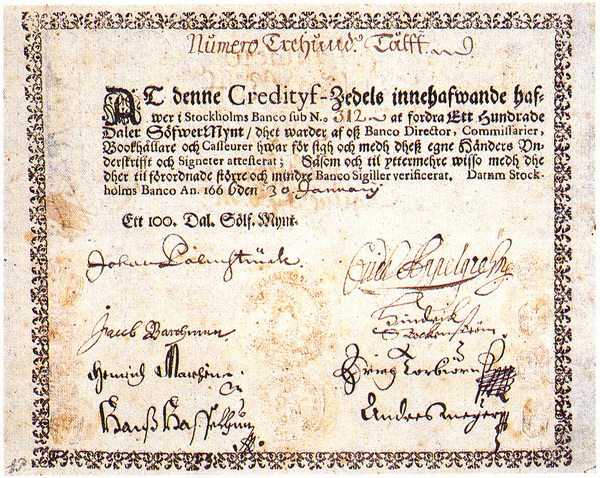
The short-lived Stockholms Banco (1657–1667) printed notes from 1661 onwards and is generally viewed as the first-ever bank of issue. Banks of issue are thus a more recent creation than transfer or giro banks, which create money in accounts on a ledger, the oldest recorded being the Taula de canvi de Barcelona established in 1401.
In many countries and particularly during the 19th century, several banks were authorized to issue notes that had simultaneous status as legal tender. The authorization, often referred to as the issuance privilege, was generally granted by the government on a bank-specific basis and for a limited period of time. During the 20th century, the role of bank of issue has been increasingly assumed by central banks in their respective territorial jurisdictions. In the 21st century, "bank of issue" and "central bank" have become essentially synonymous except in a few special cases such as Hong Kong, Northern Ireland, and Scotland.
Several European countries went through periods during which multiple banks of issue coexisted and had their banknotes simultaneously recognized as legal tender. Such experiences do not count as free banking, however, because banks typically needed to receive a specific issuance privilege from the government to be able to issue notes. Some banks incorporated that privilege into their name and brand identity, for example the Privileged Austrian National Bank (est. 1816), Privileged Bank of Epirothessaly (est. 1882), or Privileged National Bank of the Kingdom of Serbia (est. 1884).
In Great Britain, country banks that issued banknotes multiplied in the 18th century, even though the Bank of England had a monopoly on note issuance in London and its immediate surroundings. The Bank Charter Act 1844 established a nationwide note-issuance monopoly for the Bank of England in England and Wales, but not in Scotland or Ireland.
In France, the Bank of France's note issuance was originally focused on Paris and its region, and several other note-issuing banks known as banques départementales were established in the early 19th century in commercial hubs such as Bordeaux, Marseille or Rouen. The banques départementales were wiped out in the financial crisis associated with the French Revolution of 1848, which resulted in the widening of the Bank of France's note-issuance monopoly to the entire country. Following the Treaty of Turin (1860), the Bank of Savoy briefly found itself a second bank of issue in France, and the Pereire brothers attempted to take advantage of this situation to compete with the Bank of France, but their bid failed in 1864 and played a role in the subsequent demise of their main financial venture the Crédit Mobilier.
In the German Confederation, the first banks of issue were chartered by individual states in the Vormärz period. Not including Austria, there were nine such Notenbanken by 1851. These were not the only issuers of paper money, however, since most German states (with the only exceptions of Lippe and the Hanseatic cities of Bremen, Hamburg and Lübeck) also issued government notes without the intermediation of a bank. By 1870, the number of banks of issue had grown to 31 in the territories that would soon become the German Reich.
Banks of issue were similarly chartered by individual Italian states. In the early decades following Italian unification, the National Bank of the Kingdom of Italy coexisted with five other banks of issue inherited from that pre-unification history, namely the Banca Nazionale Toscana, Banca Toscana di Credito, Banca Romana, Banco di Napoli, and Banco di Sicilia. In 1893, following the Banca Romana scandal, the Bank of Italy was formed by merger to become the country's dominant bank of issue, but the Banco di Napoli and Banco di Sicilia both remained separate and retained an issuance role until 1926.
Hub AI
Bank of issue AI simulator
(@Bank of issue_simulator)
Bank of issue
A bank of issue, also referred to as a note-issuing bank or issuing authority, is a financial institution that issues banknotes.
The short-lived Stockholms Banco (1657–1667) printed notes from 1661 onwards and is generally viewed as the first-ever bank of issue. Banks of issue are thus a more recent creation than transfer or giro banks, which create money in accounts on a ledger, the oldest recorded being the Taula de canvi de Barcelona established in 1401.
In many countries and particularly during the 19th century, several banks were authorized to issue notes that had simultaneous status as legal tender. The authorization, often referred to as the issuance privilege, was generally granted by the government on a bank-specific basis and for a limited period of time. During the 20th century, the role of bank of issue has been increasingly assumed by central banks in their respective territorial jurisdictions. In the 21st century, "bank of issue" and "central bank" have become essentially synonymous except in a few special cases such as Hong Kong, Northern Ireland, and Scotland.
Several European countries went through periods during which multiple banks of issue coexisted and had their banknotes simultaneously recognized as legal tender. Such experiences do not count as free banking, however, because banks typically needed to receive a specific issuance privilege from the government to be able to issue notes. Some banks incorporated that privilege into their name and brand identity, for example the Privileged Austrian National Bank (est. 1816), Privileged Bank of Epirothessaly (est. 1882), or Privileged National Bank of the Kingdom of Serbia (est. 1884).
In Great Britain, country banks that issued banknotes multiplied in the 18th century, even though the Bank of England had a monopoly on note issuance in London and its immediate surroundings. The Bank Charter Act 1844 established a nationwide note-issuance monopoly for the Bank of England in England and Wales, but not in Scotland or Ireland.
In France, the Bank of France's note issuance was originally focused on Paris and its region, and several other note-issuing banks known as banques départementales were established in the early 19th century in commercial hubs such as Bordeaux, Marseille or Rouen. The banques départementales were wiped out in the financial crisis associated with the French Revolution of 1848, which resulted in the widening of the Bank of France's note-issuance monopoly to the entire country. Following the Treaty of Turin (1860), the Bank of Savoy briefly found itself a second bank of issue in France, and the Pereire brothers attempted to take advantage of this situation to compete with the Bank of France, but their bid failed in 1864 and played a role in the subsequent demise of their main financial venture the Crédit Mobilier.
In the German Confederation, the first banks of issue were chartered by individual states in the Vormärz period. Not including Austria, there were nine such Notenbanken by 1851. These were not the only issuers of paper money, however, since most German states (with the only exceptions of Lippe and the Hanseatic cities of Bremen, Hamburg and Lübeck) also issued government notes without the intermediation of a bank. By 1870, the number of banks of issue had grown to 31 in the territories that would soon become the German Reich.
Banks of issue were similarly chartered by individual Italian states. In the early decades following Italian unification, the National Bank of the Kingdom of Italy coexisted with five other banks of issue inherited from that pre-unification history, namely the Banca Nazionale Toscana, Banca Toscana di Credito, Banca Romana, Banco di Napoli, and Banco di Sicilia. In 1893, following the Banca Romana scandal, the Bank of Italy was formed by merger to become the country's dominant bank of issue, but the Banco di Napoli and Banco di Sicilia both remained separate and retained an issuance role until 1926.
Recent media