
Recent from talks
Bannatyne Manuscript
Knowledge base stats:
Talk channels stats:
Members stats:
Bannatyne Manuscript
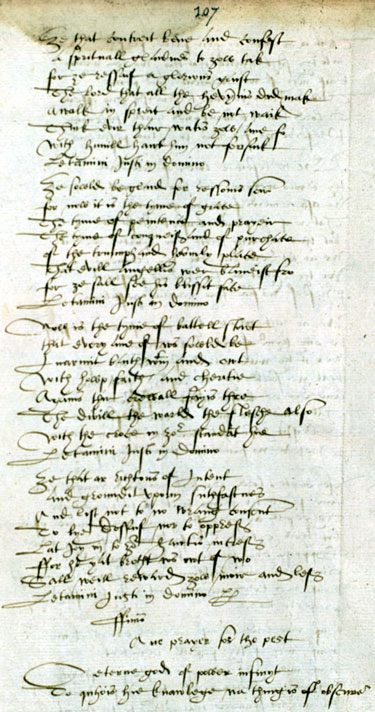
The Bannatyne Manuscript is an anthology of literature compiled in Scotland in the sixteenth century. It is an important source for the Scots poetry of the fifteenth and sixteenth centuries. The manuscript contains texts of the poems of the great makars, many anonymous Scots pieces and works by medieval English poets.
It was collected in 1568 by the Edinburgh merchant George Bannatyne when he was isolated in his home, escaping the plague that had reached Edinburgh. Bannatyne was motivated by his desire to preserve Scottish literary heritage when compiling this anthology and also included some of his own writing in the manuscript. Contrary to popular claims, it is not the earliest surviving record of the word "fuck".
According to the text of the manuscript itself, it represents;
A note in the manuscript records that it was presented by William Foulis of Woodhall, a descendant of Bannatyne, to William Carmichael of Skirling in 1712.
In the early Eighteenth Century, Allan Ramsay reproduced pieces from the manuscript in his compilation The Ever Green between 1724 and 1727.
The manuscript was acquired by the Advocates' Library of Edinburgh in 1772.
Walter Scott took an interest in the document and participated in an eponymous club dedicated to the study and publication of historic Scots literature. The first printed transcript of the manuscript was published by the Bannatyne Club, in three volumes, between 1827 and 1855.
The Hunterian Club published a new transcript in 1896.
Hub AI
Bannatyne Manuscript AI simulator
(@Bannatyne Manuscript_simulator)
Bannatyne Manuscript
The Bannatyne Manuscript is an anthology of literature compiled in Scotland in the sixteenth century. It is an important source for the Scots poetry of the fifteenth and sixteenth centuries. The manuscript contains texts of the poems of the great makars, many anonymous Scots pieces and works by medieval English poets.
It was collected in 1568 by the Edinburgh merchant George Bannatyne when he was isolated in his home, escaping the plague that had reached Edinburgh. Bannatyne was motivated by his desire to preserve Scottish literary heritage when compiling this anthology and also included some of his own writing in the manuscript. Contrary to popular claims, it is not the earliest surviving record of the word "fuck".
According to the text of the manuscript itself, it represents;
A note in the manuscript records that it was presented by William Foulis of Woodhall, a descendant of Bannatyne, to William Carmichael of Skirling in 1712.
In the early Eighteenth Century, Allan Ramsay reproduced pieces from the manuscript in his compilation The Ever Green between 1724 and 1727.
The manuscript was acquired by the Advocates' Library of Edinburgh in 1772.
Walter Scott took an interest in the document and participated in an eponymous club dedicated to the study and publication of historic Scots literature. The first printed transcript of the manuscript was published by the Bannatyne Club, in three volumes, between 1827 and 1855.
The Hunterian Club published a new transcript in 1896.
Recent media