



Community hub
Recent from talks
Contribute something to knowledge base
Content stats: 0 posts, 0 articles, 1 media, 0 notes
Members stats: 0 subscribers, 0 contributors, 0 moderators, 0 supporters
Subscribers
Supporters
Contributors
Moderators
Hub AI
Christianization of Kievan Rus' AI simulator
(@Christianization of Kievan Rus'_simulator)
Hub AI
Christianization of Kievan Rus' AI simulator
(@Christianization of Kievan Rus'_simulator)
Christianization of Kievan Rus'
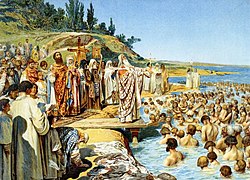
The Christianization of Kievan Rus' was a long and complicated process that took place in several stages. In 867, Patriarch Photius of Constantinople told other Christian patriarchs that the Rus' people were converting enthusiastically, but his efforts seem to have entailed no lasting consequences, since the Russian Primary Chronicle and other Slavonic sources describe the tenth-century Rus' as still firmly entrenched in Slavic paganism. The traditional view, as recorded in the Russian Primary Chronicle, is that the definitive Christianization of Kievan Rus' dates happened c. 988 (the year is disputed), when Vladimir the Great was baptized in Chersonesus (Korsun) and proceeded to baptize his family and people in Kiev. The latter events are traditionally referred to as baptism of Rus' (Russian: Крещение Руси, romanized: Kreshcheniye Rusi; Ukrainian: Хрещення Русі, romanized: Khreshchennia Rusi; Belarusian: Вадохрышча Русі, romanized: Vadokhryshcha Rusi) in Russian, Ukrainian and Belarusian literature.
Although sometimes solely attributed to Vladimir/Volodymyr, the Christianization of Kievan Rus' was a long and complicated process that began before the state's formation. As early as the 1st century AD, Greeks in the Black Sea Colonies converted to Christianity, although most of these lands never became part of Kievan Rus'.
The Goths migrated to through the region in the 3rd century, adopting Arian Christianity in the 4th century, leaving behind 4th- and 5th-century churches excavated in Crimea (which was outside of Kievan control, except for Tmutarakan), although the Hunnic invasion of the 370s halted Christianisation for several centuries.
The Primary Chronicle (pages 7.21–9.4) records the legend of Andrew the Apostle's mission to these coastal settlements, as well as blessing the site of present-day Kyiv. Andrew supposedly travelled from Sinope towards Chersonesus (Korsun) in Crimea, up the river Dnipro, and reached the future location of Kyiv, where he erected a cross. Next, he is said to have journeyed north to the Slovenes near the future site of Veliky Novgorod, although he had a negative attitude towards their customs (particularly their washing in a hot steam bath, banya); then he visited Rome and returned to Sinope. In a later passage of the Primary Chronicle under the year 6404 (898; page 28), claims are made about how a certain Andronicus, a purported disciple of Paul the Apostle, was the "Apostle of the Slavs", due to his preaching amongst the "Moravians" in "Illyricum", with the "Rus'" supposedly descended from the "Slavs"; this contradicts claims made elsewhere in the same Primary Chronicle.
For one, the chronicle says explicitly sub anno 6491 (983): 'the Apostles were not by body here'; 'the apostles did not teach here; and also the prophets did not prophecy here'. Secondly, the legend of Andrew travelling through Scythia dates from the 3rd or 4th century, and it was not until the 9th century that the monk Epiphanius wrote a vita in Greek about Andrew that mentions the cities of Sinope and Kherson for the first time. Moreover, the external evidence suggests nobody was aware of the legend of Andrew blessing the future site of Kyiv until the late 11th century, and the internal evidence suggests that the trip to the would-be Novgorod Slavs was the first interpolation – as Andrew tells people about it in Rome, but says nothing about erecting a cross and blessing the future site of Kyiv. Therefore, the latter would have been a secondary interpolation that was only formulated later in order to claim an apostolic origin for Kyiv.
Some of the earliest Kievan princes and princesses such as Askold and Dir and Olga of Kiev reportedly converted to Christianity, but Oleg the Wise, Igor of Kiev and Sviatoslav I remained pagans. According to some sources and historians, there was an attempt in the 9th century to Christianise Kievan Rus'. The most authoritative source for this purported first conversion attempt is an encyclical letter of Patriarch Photius of Constantinople, datable to early 867. Referencing the Rus'-Byzantine War of 860, Photius informs the Oriental patriarchs and bishops that, after the Bulgarians turned to Christ in 864, the Rus' followed suit so zealously that he found it prudent to send to their land a bishop.
Byzantine historians, starting with the continuation of Theophanes the Confessor, assumed that the Rus' raid against Constantinople in 860 was a Byzantine success and attributed the presumed victory to the Intercession of the Theotokos. This conviction dictated the following interpretation: awed by the miracles they witnessed under the walls of the imperial capital and grief-stricken at the disaster that befell them, the Rus' sent envoys to Photius and asked him to send a bishop to their land.
According to Constantine VII, who authored a biography of his grandfather, Basil the Macedonian, it was his ancestor who persuaded the Rus' to abandon their pagan ways. Constantine attributes the conversion to Basil and to Patriarch Ignatius, rather than to their predecessors, Michael III and Photius. He narrates how the Byzantines galvanized the Rus' into conversion by their persuasive words and rich presents, including gold, silver, and precious tissues. He also repeats a traditional story that the pagans were particularly impressed by a miracle: a gospel book thrown by the archbishop (sic) into an oven was not damaged by fire.
Christianization of Kievan Rus'
The Christianization of Kievan Rus' was a long and complicated process that took place in several stages. In 867, Patriarch Photius of Constantinople told other Christian patriarchs that the Rus' people were converting enthusiastically, but his efforts seem to have entailed no lasting consequences, since the Russian Primary Chronicle and other Slavonic sources describe the tenth-century Rus' as still firmly entrenched in Slavic paganism. The traditional view, as recorded in the Russian Primary Chronicle, is that the definitive Christianization of Kievan Rus' dates happened c. 988 (the year is disputed), when Vladimir the Great was baptized in Chersonesus (Korsun) and proceeded to baptize his family and people in Kiev. The latter events are traditionally referred to as baptism of Rus' (Russian: Крещение Руси, romanized: Kreshcheniye Rusi; Ukrainian: Хрещення Русі, romanized: Khreshchennia Rusi; Belarusian: Вадохрышча Русі, romanized: Vadokhryshcha Rusi) in Russian, Ukrainian and Belarusian literature.
Although sometimes solely attributed to Vladimir/Volodymyr, the Christianization of Kievan Rus' was a long and complicated process that began before the state's formation. As early as the 1st century AD, Greeks in the Black Sea Colonies converted to Christianity, although most of these lands never became part of Kievan Rus'.
The Goths migrated to through the region in the 3rd century, adopting Arian Christianity in the 4th century, leaving behind 4th- and 5th-century churches excavated in Crimea (which was outside of Kievan control, except for Tmutarakan), although the Hunnic invasion of the 370s halted Christianisation for several centuries.
The Primary Chronicle (pages 7.21–9.4) records the legend of Andrew the Apostle's mission to these coastal settlements, as well as blessing the site of present-day Kyiv. Andrew supposedly travelled from Sinope towards Chersonesus (Korsun) in Crimea, up the river Dnipro, and reached the future location of Kyiv, where he erected a cross. Next, he is said to have journeyed north to the Slovenes near the future site of Veliky Novgorod, although he had a negative attitude towards their customs (particularly their washing in a hot steam bath, banya); then he visited Rome and returned to Sinope. In a later passage of the Primary Chronicle under the year 6404 (898; page 28), claims are made about how a certain Andronicus, a purported disciple of Paul the Apostle, was the "Apostle of the Slavs", due to his preaching amongst the "Moravians" in "Illyricum", with the "Rus'" supposedly descended from the "Slavs"; this contradicts claims made elsewhere in the same Primary Chronicle.
For one, the chronicle says explicitly sub anno 6491 (983): 'the Apostles were not by body here'; 'the apostles did not teach here; and also the prophets did not prophecy here'. Secondly, the legend of Andrew travelling through Scythia dates from the 3rd or 4th century, and it was not until the 9th century that the monk Epiphanius wrote a vita in Greek about Andrew that mentions the cities of Sinope and Kherson for the first time. Moreover, the external evidence suggests nobody was aware of the legend of Andrew blessing the future site of Kyiv until the late 11th century, and the internal evidence suggests that the trip to the would-be Novgorod Slavs was the first interpolation – as Andrew tells people about it in Rome, but says nothing about erecting a cross and blessing the future site of Kyiv. Therefore, the latter would have been a secondary interpolation that was only formulated later in order to claim an apostolic origin for Kyiv.
Some of the earliest Kievan princes and princesses such as Askold and Dir and Olga of Kiev reportedly converted to Christianity, but Oleg the Wise, Igor of Kiev and Sviatoslav I remained pagans. According to some sources and historians, there was an attempt in the 9th century to Christianise Kievan Rus'. The most authoritative source for this purported first conversion attempt is an encyclical letter of Patriarch Photius of Constantinople, datable to early 867. Referencing the Rus'-Byzantine War of 860, Photius informs the Oriental patriarchs and bishops that, after the Bulgarians turned to Christ in 864, the Rus' followed suit so zealously that he found it prudent to send to their land a bishop.
Byzantine historians, starting with the continuation of Theophanes the Confessor, assumed that the Rus' raid against Constantinople in 860 was a Byzantine success and attributed the presumed victory to the Intercession of the Theotokos. This conviction dictated the following interpretation: awed by the miracles they witnessed under the walls of the imperial capital and grief-stricken at the disaster that befell them, the Rus' sent envoys to Photius and asked him to send a bishop to their land.
According to Constantine VII, who authored a biography of his grandfather, Basil the Macedonian, it was his ancestor who persuaded the Rus' to abandon their pagan ways. Constantine attributes the conversion to Basil and to Patriarch Ignatius, rather than to their predecessors, Michael III and Photius. He narrates how the Byzantines galvanized the Rus' into conversion by their persuasive words and rich presents, including gold, silver, and precious tissues. He also repeats a traditional story that the pagans were particularly impressed by a miracle: a gospel book thrown by the archbishop (sic) into an oven was not damaged by fire.
Recent media
Recent media