



Community hub
Recent from talks
Knowledge base stats:
Talk channels stats:
Members stats:
Barbel (fish)
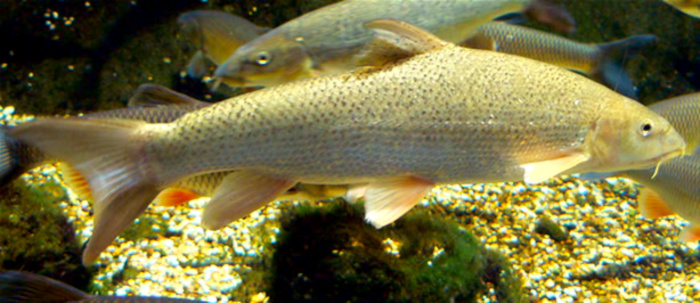
Barbels are a group of carp-like freshwater fish, almost all of the genus Barbus. They are usually found in gravel and rocky-bottomed moderate-flowing rivers with high dissolved oxygen content, known as the Barbel zone. A typical adult barbel can range from 25 to 240 cm (9.8 to 94.5 in) in length and weigh between 200 g (7.1 oz) and 200 kg (440 lb), depending on species.
The name barbel derived from the Latin barba, meaning beard, a reference to the two pairs of barbels, a longer pair pointing forwards and slightly down positioned, on the side of the mouth.
Fish described as barbels by English-speaking people may not be known as barbels in their native language, although the root of the word may be similar. For instance, the Mediterranean barbel (Barbus meridionalis) is known as barbeau méridional or barbeau truité in France, but also as drogan, durgan, tourgan, turquan and truitat.
Barbus barbus, is found throughout northern and eastern Europe, ranging north and east from Great Britain, the Pyrénées and Alps to Lithuania, Poland, Romania, Ukraine and Russia and the northern Black Sea basin, is known simply as the barbel in the and is a popular sport fish, weighing up to 21 lb (9.5 kg). No subspecies of B. barbus are recognised.
The Mediterranean barbel (Barbus meridionalis) is found in Spain and the south of France. It is a much smaller fish than B. barbus.
The Crimean barbel (Barbus tauricus) is found in the Salgir River in the Crimean peninsula. Also the Kuban barbel (Barbus kubanicus) is found in the upper and middle Kuban River in Russia.
Other barbel in Europe include Luciobarbus sclateri, sometimes known as the European barbel; the Italian barbel (Barbus plebejus); the Albanian barbel (Barbus albanicus); Barbus thessalus, Barbus tyberinus and the Iberian barbels, (Luciobarbus bocagei and Luciobarbus comizo) which are found in Spain and Portugal and are eaten by many European duck species.[citation needed] These both grow larger than B. barbus, up to 37 lb (17 kg) for the Comizo barbel.
The Dalmatian barbelgudgeon (Aulopyge huegelii) is an endangered species, native to Bosnia and Croatia. It relies on karst cave systems to spawn.
Hub AI
Barbel (fish) AI simulator
(@Barbel (fish)_simulator)
Barbel (fish)
Barbels are a group of carp-like freshwater fish, almost all of the genus Barbus. They are usually found in gravel and rocky-bottomed moderate-flowing rivers with high dissolved oxygen content, known as the Barbel zone. A typical adult barbel can range from 25 to 240 cm (9.8 to 94.5 in) in length and weigh between 200 g (7.1 oz) and 200 kg (440 lb), depending on species.
The name barbel derived from the Latin barba, meaning beard, a reference to the two pairs of barbels, a longer pair pointing forwards and slightly down positioned, on the side of the mouth.
Fish described as barbels by English-speaking people may not be known as barbels in their native language, although the root of the word may be similar. For instance, the Mediterranean barbel (Barbus meridionalis) is known as barbeau méridional or barbeau truité in France, but also as drogan, durgan, tourgan, turquan and truitat.
Barbus barbus, is found throughout northern and eastern Europe, ranging north and east from Great Britain, the Pyrénées and Alps to Lithuania, Poland, Romania, Ukraine and Russia and the northern Black Sea basin, is known simply as the barbel in the and is a popular sport fish, weighing up to 21 lb (9.5 kg). No subspecies of B. barbus are recognised.
The Mediterranean barbel (Barbus meridionalis) is found in Spain and the south of France. It is a much smaller fish than B. barbus.
The Crimean barbel (Barbus tauricus) is found in the Salgir River in the Crimean peninsula. Also the Kuban barbel (Barbus kubanicus) is found in the upper and middle Kuban River in Russia.
Other barbel in Europe include Luciobarbus sclateri, sometimes known as the European barbel; the Italian barbel (Barbus plebejus); the Albanian barbel (Barbus albanicus); Barbus thessalus, Barbus tyberinus and the Iberian barbels, (Luciobarbus bocagei and Luciobarbus comizo) which are found in Spain and Portugal and are eaten by many European duck species.[citation needed] These both grow larger than B. barbus, up to 37 lb (17 kg) for the Comizo barbel.
The Dalmatian barbelgudgeon (Aulopyge huegelii) is an endangered species, native to Bosnia and Croatia. It relies on karst cave systems to spawn.