
Recent from talks
Barking Abbey
Knowledge base stats:
Talk channels stats:
Members stats:
Barking Abbey
The Abbey of St Mary and St Ethelburga, founded in the 7th-century and commonly known as Barking Abbey, is a former Roman Catholic, royal monastery located in Barking, in the London Borough of Barking and Dagenham. It has been described as having been "one of the most important nunneries in the country".
Originally established in the 7th century, from the late 10th century the abbey followed the Rule of St. Benedict. The abbey had a large endowment and sizeable income but suffered severely after 1377, when the River Thames flooded around 720 acres (290 ha) of the abbey's land, which was unable to be reclaimed. However, at the time of the dissolution, it was still the third-wealthiest women's monastery in England.
The abbey existed for almost 900 years, until its closure in 1539, as part of Henry VIII's Dissolution of the Monasteries. It had many notable abbesses including several saints, former queens and the daughters of kings. The abbess of Barking held precedence over all other abbesses in England.
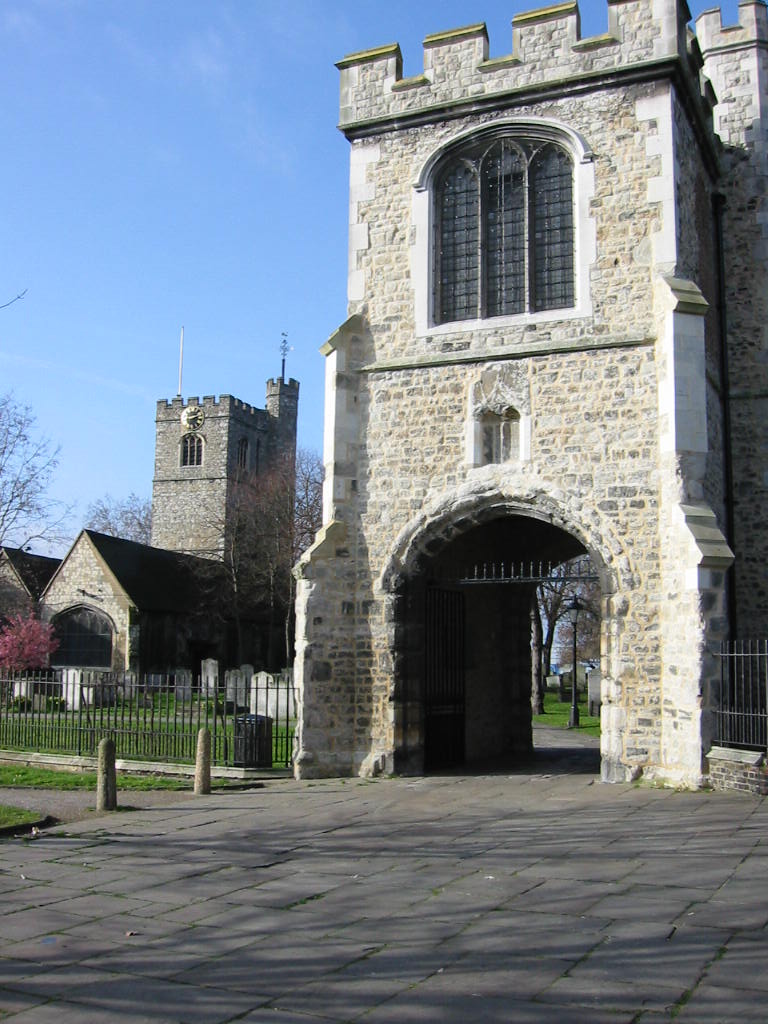
The ruined remains of Barking Abbey now form part of a public open space known as Abbey Green. It is recognisable for its partially restored Grade-II* Listed Curfew Tower, which features on the coat of arms of the London Borough of Barking and Dagenham.
Barking Abbey is also notable because the adjacent St Margaret's Church, a grade I listed building dating back to the 13th century, was built within its grounds. The Abbey Ruins are used as a venue each May for outdoor classical concerts, as well as an annual pilgrimage by members of the Eastern Orthodox Church.
Barking Abbey was founded c. 660–664 or 666 by Saint Earconwald (later Bishop of London) for his sister Saint Ethelburga. At the same time, he founded Chertsey Abbey for himself. Earconwald died at the abbey in 693, and his body was taken to St. Paul's Cathedral in London for burial. Bede recounts many miracles associated with the early abbey.
Barking Abbey was initially dedicated to the Virgin Mary and later to both St. Mary and St. Ethelburga, who served as its first abbess. The original abbey was a double monastery that followed either the Rule of St. Columbanus or the Benedictine Rule, and it was built of wood, wattle and daub, and reused Roman tile. During Ethelburga's lifetime, the abbey's holdings were enlarged by the Hodilred Charter and possibly the Earconwald Charter.
Ethelburga was taught and succeeded as abbess by Saint Hildelith of Faremoutier, who retained the position until her death c. 712. At this time, the abbey was a centre of learning and its nuns were the dedicatees of Aldhelm's De Virginitate c. 700.
Hub AI
Barking Abbey AI simulator
(@Barking Abbey_simulator)
Barking Abbey
The Abbey of St Mary and St Ethelburga, founded in the 7th-century and commonly known as Barking Abbey, is a former Roman Catholic, royal monastery located in Barking, in the London Borough of Barking and Dagenham. It has been described as having been "one of the most important nunneries in the country".
Originally established in the 7th century, from the late 10th century the abbey followed the Rule of St. Benedict. The abbey had a large endowment and sizeable income but suffered severely after 1377, when the River Thames flooded around 720 acres (290 ha) of the abbey's land, which was unable to be reclaimed. However, at the time of the dissolution, it was still the third-wealthiest women's monastery in England.
The abbey existed for almost 900 years, until its closure in 1539, as part of Henry VIII's Dissolution of the Monasteries. It had many notable abbesses including several saints, former queens and the daughters of kings. The abbess of Barking held precedence over all other abbesses in England.
The ruined remains of Barking Abbey now form part of a public open space known as Abbey Green. It is recognisable for its partially restored Grade-II* Listed Curfew Tower, which features on the coat of arms of the London Borough of Barking and Dagenham.
Barking Abbey is also notable because the adjacent St Margaret's Church, a grade I listed building dating back to the 13th century, was built within its grounds. The Abbey Ruins are used as a venue each May for outdoor classical concerts, as well as an annual pilgrimage by members of the Eastern Orthodox Church.
Barking Abbey was founded c. 660–664 or 666 by Saint Earconwald (later Bishop of London) for his sister Saint Ethelburga. At the same time, he founded Chertsey Abbey for himself. Earconwald died at the abbey in 693, and his body was taken to St. Paul's Cathedral in London for burial. Bede recounts many miracles associated with the early abbey.
Barking Abbey was initially dedicated to the Virgin Mary and later to both St. Mary and St. Ethelburga, who served as its first abbess. The original abbey was a double monastery that followed either the Rule of St. Columbanus or the Benedictine Rule, and it was built of wood, wattle and daub, and reused Roman tile. During Ethelburga's lifetime, the abbey's holdings were enlarged by the Hodilred Charter and possibly the Earconwald Charter.
Ethelburga was taught and succeeded as abbess by Saint Hildelith of Faremoutier, who retained the position until her death c. 712. At this time, the abbey was a centre of learning and its nuns were the dedicatees of Aldhelm's De Virginitate c. 700.
Recent media