
Recent from talks
Bar chord
Knowledge base stats:
Talk channels stats:
Members stats:
Bar chord
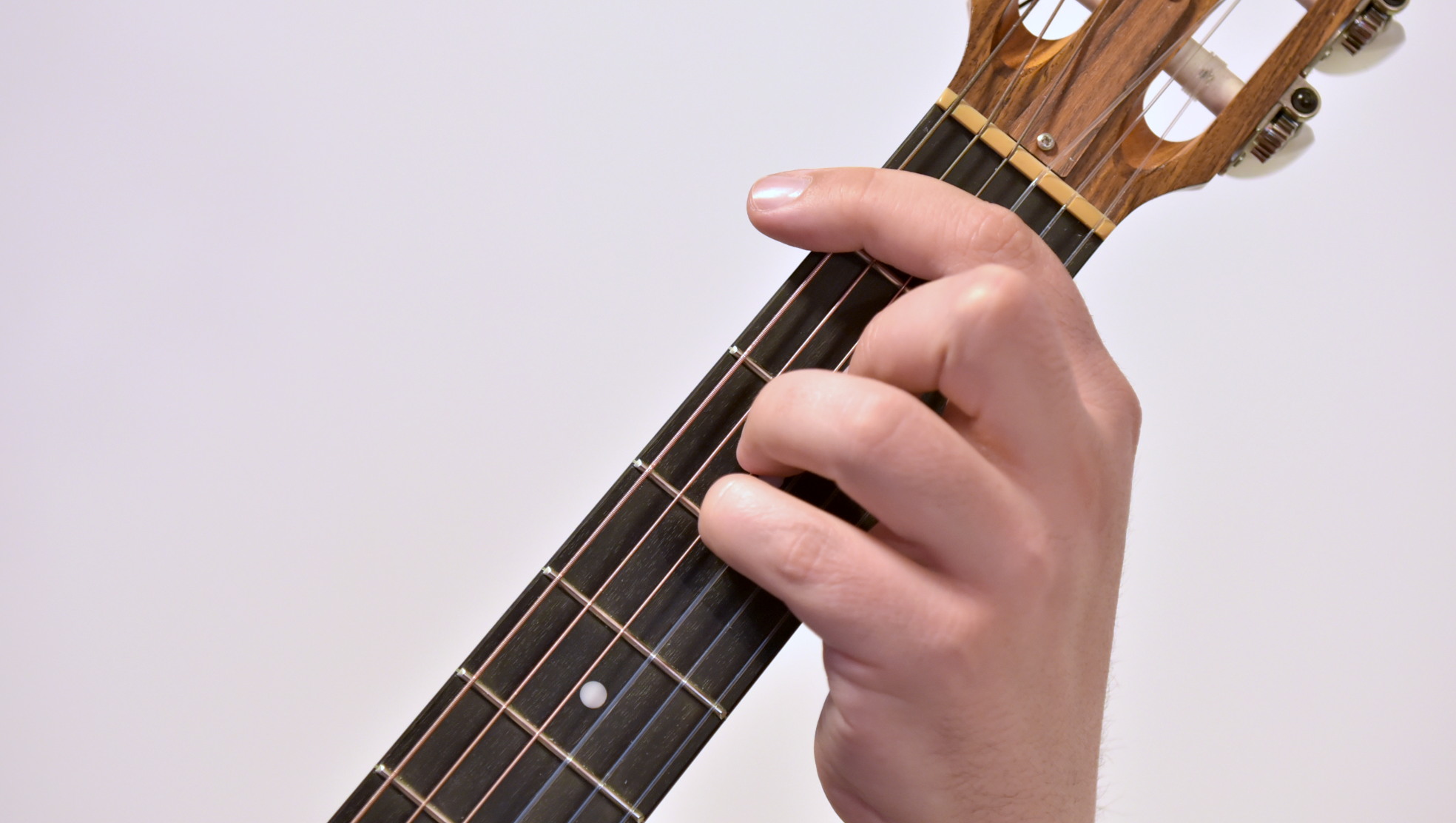
In music, a Bar chord (also spelled barre chord) is a type of chord on a guitar or other stringed instrument played by using one finger to press down multiple strings across a single fret of the fingerboard (like a bar pressing down the strings).
Players often use this chording technique to play a chord that is not restricted by the tones of the guitar's open strings. For instance, if a guitar is tuned to regular concert pitch, with the open strings being E, A, D, G, B, E (from low to high), open chords must be based on one or more of these notes. To play an F♯ chord the guitarist may barre strings so that the chord root is F♯.
Most bar chords are "moveable" chords, as the player can move the whole chord shape up and down the neck. Commonly used in both popular and classical music, bar chords are frequently used in combination with "open" chords, where the guitar's open (unfretted) strings construct the chord. Playing a chord with the bar technique slightly affects tone quality. A closed, or fretted, note sounds slightly different from an open, unfretted, string. Bar chords are a distinctive part of the sound of pop music and rock music.
Using the bar technique, the guitarist can fret a familiar open chord shape, and then transpose, or raise, the chord a number of half-steps higher, similar to the use of a capo. For example, when the current chord is an E major and the next is an F♯ major, the guitarist bars the open E major up two frets (two semitones) from the open position to produce the barred F♯ major chord. Such chords are hard to play for beginners due to the pressing of multiple strings with a single finger. Mastering the bar chord technique can be one of the most difficult challenges that a beginner guitarist faces.
Guitarists typically use bar chords to voice chords in higher positions. Keys that don't have many open notes in standard tuning (hence few or no open chord fingerings) require many bar chords. The two most commonly barred notes are variations on the fingering shapes of A and E in first (open) position. The E-type bar chord is an E chord shape (022100) barred up and down the frets, transposing the chord. For example, the E chord barred one fret up becomes an F chord (133211). The next fret up is F♯, followed by G, A♭, A, B♭, B, C, C♯, D, E♭, and then back to E (1 octave up) at fret twelve.
The "A" type bar chord, occasionally called the double bar, is the A chord shape (X02220) moved up and down the frets. To bar the A chord shape, the guitarist puts the index finger across the top five strings, usually touching the 6th string (E) to mute it. They then bar either the ring or little finger across the 2nd (B), 3rd (G), and 4th (D) strings two frets down, or one finger frets each string. For instance, barred at the second fret, the A chord becomes B (X24442). From fret one to twelve, the barred A becomes B♭, B, C, C♯, D, E♭, E, F, F♯, G, A♭, and at the twelfth fret (that is, one octave up), it is A again.
Sometimes the guitarist leaves out the highest note in a double bar chord. Most variations of these two chords can be barred: dominant 7ths, minors, minor 7ths, etc.
Minor bar chords include a minor third in the chord rather than the major third (in "E" and "A" shaped bar chords, this note happens to be the highest 'non-barred' note). Example:
Hub AI
Bar chord AI simulator
(@Bar chord_simulator)
Bar chord
In music, a Bar chord (also spelled barre chord) is a type of chord on a guitar or other stringed instrument played by using one finger to press down multiple strings across a single fret of the fingerboard (like a bar pressing down the strings).
Players often use this chording technique to play a chord that is not restricted by the tones of the guitar's open strings. For instance, if a guitar is tuned to regular concert pitch, with the open strings being E, A, D, G, B, E (from low to high), open chords must be based on one or more of these notes. To play an F♯ chord the guitarist may barre strings so that the chord root is F♯.
Most bar chords are "moveable" chords, as the player can move the whole chord shape up and down the neck. Commonly used in both popular and classical music, bar chords are frequently used in combination with "open" chords, where the guitar's open (unfretted) strings construct the chord. Playing a chord with the bar technique slightly affects tone quality. A closed, or fretted, note sounds slightly different from an open, unfretted, string. Bar chords are a distinctive part of the sound of pop music and rock music.
Using the bar technique, the guitarist can fret a familiar open chord shape, and then transpose, or raise, the chord a number of half-steps higher, similar to the use of a capo. For example, when the current chord is an E major and the next is an F♯ major, the guitarist bars the open E major up two frets (two semitones) from the open position to produce the barred F♯ major chord. Such chords are hard to play for beginners due to the pressing of multiple strings with a single finger. Mastering the bar chord technique can be one of the most difficult challenges that a beginner guitarist faces.
Guitarists typically use bar chords to voice chords in higher positions. Keys that don't have many open notes in standard tuning (hence few or no open chord fingerings) require many bar chords. The two most commonly barred notes are variations on the fingering shapes of A and E in first (open) position. The E-type bar chord is an E chord shape (022100) barred up and down the frets, transposing the chord. For example, the E chord barred one fret up becomes an F chord (133211). The next fret up is F♯, followed by G, A♭, A, B♭, B, C, C♯, D, E♭, and then back to E (1 octave up) at fret twelve.
The "A" type bar chord, occasionally called the double bar, is the A chord shape (X02220) moved up and down the frets. To bar the A chord shape, the guitarist puts the index finger across the top five strings, usually touching the 6th string (E) to mute it. They then bar either the ring or little finger across the 2nd (B), 3rd (G), and 4th (D) strings two frets down, or one finger frets each string. For instance, barred at the second fret, the A chord becomes B (X24442). From fret one to twelve, the barred A becomes B♭, B, C, C♯, D, E♭, E, F, F♯, G, A♭, and at the twelfth fret (that is, one octave up), it is A again.
Sometimes the guitarist leaves out the highest note in a double bar chord. Most variations of these two chords can be barred: dominant 7ths, minors, minor 7ths, etc.
Minor bar chords include a minor third in the chord rather than the major third (in "E" and "A" shaped bar chords, this note happens to be the highest 'non-barred' note). Example:
Recent media