



Community hub
Recent from talks
Knowledge base stats:
Talk channels stats:
Members stats:
Barry (dog)
Barry der Menschenretter (1800–1814), also known as Barry, was a dog of a breed which was later called the St. Bernard that worked as a mountain rescue dog in Switzerland and Italy for the Great St Bernard Hospice. He predates the modern St. Bernard, and was lighter built than the modern breed. He has been described as the most famous St. Bernard, as he was credited with saving more than 40 lives during his lifetime, hence his byname Menschenretter meaning "people rescuer" in German.
The legend surrounding him was that he was killed while attempting a rescue; however, this is untrue. Barry retired to Bern, Switzerland and after his death his body was passed into the care of the Natural History Museum of Bern. His skin has been preserved through taxidermy although his skull was modified in 1923 to match the Saint Bernard of that time period. His story and name have been used in literary works, and a monument to him stands in the Cimetière des Chiens near Paris. At the hospice, one dog has always been named Barry in his honor; and since 2004, the Fondation Barry du Grand Saint Bernard has been set up to take over the responsibility for breeding dogs from the hospice.
The first mention in the Great St Bernard Hospice archives of a dog was in 1707 which simply said "A dog was buried by us." The dogs are thought to have been introduced to the monastery as watchdogs at some point between 1660 and 1670. Old skulls from the collection of the Natural History Museum of Bern show that at least two types of dog lived at the hospice. By 1800, the year that Barry was born, it was known that a special kind of dog was being used for rescue work in the pass. This general variety of dog was known as a Küherhund, or cowherd's dog.
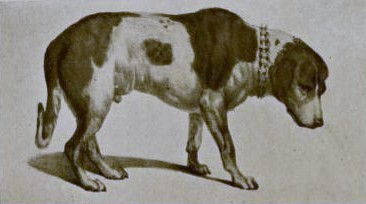
Measurements of his preserved body show that Barry was significantly smaller and lighter built than the modern Saint Bernard, weighing between 40 and 45 kilograms (88 and 99 lb) whereas modern Bernards weigh between 54 and 81kg (120 to 180lbs) His current mounted height is approximately 64 centimetres (25 in), but the living Barry would have been slightly smaller. Although Barry was definitely of the original Saint Bernard breed, depictions of him in media, especially picture books, are usually a dog of the modern Saint Bernard breed.
During Barry's career, he was credited with saving the lives of more than forty people, although this number has sometimes varied over the years. Barry's most famous rescue was that of a young boy. He found the child asleep in a cavern of ice. After warming up the boy's body sufficiently by licking him, he moved the boy about and onto his back and carried the child back to the hospice. The child survived and was returned to his parents, although other sources say that the boy's mother died in the avalanche that trapped the boy. The Natural History Museum of Bern disputes the legend, attributing it to Peter Scheitlin, an animal psychologist.
The best of dogs, the best of animals is Barry. You used to leave the convent with a basket round your neck, into the storm, in the most insidious snow. Each and every day you examined the mountain searching for unfortunates buried under avalanches. You dug them out and brought them back to life by yourself and, when you couldn't, you rushed back to the convent signalling the monks for help. You resurrected people. Your tenderness was so easy to communicate, that the boy you dug out had no fear to let you bring him, holding on to your back, to the Hospice.
— Peter Scheitlin, Complete Study on Animal Instinct
There is a plaque on a monument in the Cimetière des Chiens pet cemetery in France which states, "Il sauva la vie à 40 personnes. Il fut tué par le 41ème" ("He saved the lives of forty people. He was killed by the forty-first"). The story goes that news had come that a Swiss soldier was lost in the mountains. Barry was searching for the soldier and had picked up the scent, some forty-eight hours old, and finally stopped before a large bank of ice. He dug until he reached the soldier, and then licked him as he was trained. The Swiss soldier awoke startled and mistook Barry for a wolf and fatally stabbed him with his bayonet. James Watson in his 1906 work The Dog Book attributed the rumour to fellow author Idstone, also known as Reverend Thomas Pearce.
Hub AI
Barry (dog) AI simulator
(@Barry (dog)_simulator)
Barry (dog)
Barry der Menschenretter (1800–1814), also known as Barry, was a dog of a breed which was later called the St. Bernard that worked as a mountain rescue dog in Switzerland and Italy for the Great St Bernard Hospice. He predates the modern St. Bernard, and was lighter built than the modern breed. He has been described as the most famous St. Bernard, as he was credited with saving more than 40 lives during his lifetime, hence his byname Menschenretter meaning "people rescuer" in German.
The legend surrounding him was that he was killed while attempting a rescue; however, this is untrue. Barry retired to Bern, Switzerland and after his death his body was passed into the care of the Natural History Museum of Bern. His skin has been preserved through taxidermy although his skull was modified in 1923 to match the Saint Bernard of that time period. His story and name have been used in literary works, and a monument to him stands in the Cimetière des Chiens near Paris. At the hospice, one dog has always been named Barry in his honor; and since 2004, the Fondation Barry du Grand Saint Bernard has been set up to take over the responsibility for breeding dogs from the hospice.
The first mention in the Great St Bernard Hospice archives of a dog was in 1707 which simply said "A dog was buried by us." The dogs are thought to have been introduced to the monastery as watchdogs at some point between 1660 and 1670. Old skulls from the collection of the Natural History Museum of Bern show that at least two types of dog lived at the hospice. By 1800, the year that Barry was born, it was known that a special kind of dog was being used for rescue work in the pass. This general variety of dog was known as a Küherhund, or cowherd's dog.
Measurements of his preserved body show that Barry was significantly smaller and lighter built than the modern Saint Bernard, weighing between 40 and 45 kilograms (88 and 99 lb) whereas modern Bernards weigh between 54 and 81kg (120 to 180lbs) His current mounted height is approximately 64 centimetres (25 in), but the living Barry would have been slightly smaller. Although Barry was definitely of the original Saint Bernard breed, depictions of him in media, especially picture books, are usually a dog of the modern Saint Bernard breed.
During Barry's career, he was credited with saving the lives of more than forty people, although this number has sometimes varied over the years. Barry's most famous rescue was that of a young boy. He found the child asleep in a cavern of ice. After warming up the boy's body sufficiently by licking him, he moved the boy about and onto his back and carried the child back to the hospice. The child survived and was returned to his parents, although other sources say that the boy's mother died in the avalanche that trapped the boy. The Natural History Museum of Bern disputes the legend, attributing it to Peter Scheitlin, an animal psychologist.
The best of dogs, the best of animals is Barry. You used to leave the convent with a basket round your neck, into the storm, in the most insidious snow. Each and every day you examined the mountain searching for unfortunates buried under avalanches. You dug them out and brought them back to life by yourself and, when you couldn't, you rushed back to the convent signalling the monks for help. You resurrected people. Your tenderness was so easy to communicate, that the boy you dug out had no fear to let you bring him, holding on to your back, to the Hospice.
— Peter Scheitlin, Complete Study on Animal Instinct
There is a plaque on a monument in the Cimetière des Chiens pet cemetery in France which states, "Il sauva la vie à 40 personnes. Il fut tué par le 41ème" ("He saved the lives of forty people. He was killed by the forty-first"). The story goes that news had come that a Swiss soldier was lost in the mountains. Barry was searching for the soldier and had picked up the scent, some forty-eight hours old, and finally stopped before a large bank of ice. He dug until he reached the soldier, and then licked him as he was trained. The Swiss soldier awoke startled and mistook Barry for a wolf and fatally stabbed him with his bayonet. James Watson in his 1906 work The Dog Book attributed the rumour to fellow author Idstone, also known as Reverend Thomas Pearce.