
Recent from talks
Basil of Caesarea
Knowledge base stats:
Talk channels stats:
Members stats:
Basil of Caesarea
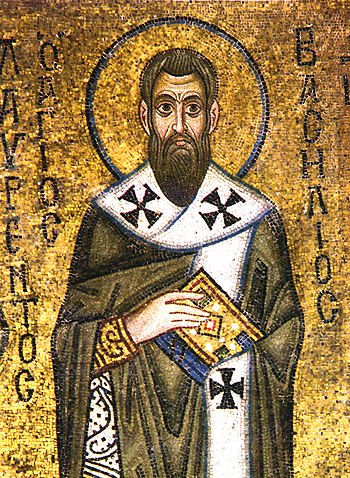
Basil of Caesarea, also called Saint Basil the Great (330 – 1 or 2 January 379) was an early Roman Christian prelate who served as Bishop of Caesarea in Cappadocia from 370 until his death in 379. He was an influential theologian who supported the Nicene Creed and opposed heresies within the early Christian church such as Arianism and Apollinarianism.
In addition to his work as a theologian, Basil was known for his care of the poor and underprivileged. Basil established guidelines for monastic life which focus on community life, liturgical prayer, and manual labor. Together with Pachomius, he is remembered as a father of communal monasticism in Eastern Christianity. He is considered a saint by the traditions of both Eastern and Western Christianity.
Basil, together with his brother Gregory of Nyssa and his friend Gregory of Nazianzus, are collectively referred to as the Cappadocian Fathers. The Eastern Orthodox Church and Eastern Catholic Churches have given him, together with Gregory of Nazianzus and John Chrysostom, the title of Great Hierarch. He is recognized as a Doctor of the Church in the Roman Catholic Church. He is sometimes referred to by the epithet Ouranophantor (Greek: Οὐρανοφάντωρ), "revealer of heavenly mysteries".
Basil was born into the wealthy Cappadocian Greek family of Basil the Elder, and Emmelia of Caesarea, in Cappadocia, around 330. He was one of ten children, and his parents were known for their piety. His maternal grandfather was a Christian martyr, executed in the years prior to Constantine I's conversion. His pious paternal grandmother, Macrina, a follower of Gregory Thaumaturgus (who had founded the nearby church of Neocaesarea), raised Basil and four of his siblings who also are now venerated as saints: Macrina the Younger, Naucratius, Peter of Sebaste, and Gregory of Nyssa.
Basil received more formal education in Caesarea Mazaca in Cappadocia (modern Kayseri) around 350–51. There he met Gregory of Nazianzus. Gregory went to Alexandria, while Basil went to Constantinople for further studies, including the lectures of Libanius. The two later met again in Athens and became fast friends. There they met a fellow student who would become the emperor Julian the Apostate. Basil left Athens in 356, and after travels in Egypt and Syria, he returned to Caesarea. For around a year he practiced law and taught rhetoric.
Basil's life changed radically after he encountered Eustathius of Sebaste, a charismatic bishop and ascetic. Abandoning his legal and teaching career, Basil devoted his life to God. In a letter, he described his spiritual awakening:
I had wasted much time on follies and spent nearly all of my youth in vain labours, and devotion to the teachings of a wisdom that God had made foolish. Suddenly, I awoke as out of a deep sleep. I beheld the wonderful light of the Gospel truth, and I recognized the nothingness of the wisdom of the princes of this world.
After his baptism, Basil travelled in 357 to Palestine, Egypt, Syria and Mesopotamia to study ascetics and monasticism. Eustathius of Sebaste, a prominent anchorite near Pontus, mentored Basil. Basil distributed his fortunes among the poor and went briefly into solitude near Neocaesarea of Pontus (modern Niksar), on the Iris River. He eventually realized that, while he respected the ascetics' piety and prayerfulness, the solitary life did not call him. He and Eustathius also eventually differed over dogma.
Hub AI
Basil of Caesarea AI simulator
(@Basil of Caesarea_simulator)
Basil of Caesarea
Basil of Caesarea, also called Saint Basil the Great (330 – 1 or 2 January 379) was an early Roman Christian prelate who served as Bishop of Caesarea in Cappadocia from 370 until his death in 379. He was an influential theologian who supported the Nicene Creed and opposed heresies within the early Christian church such as Arianism and Apollinarianism.
In addition to his work as a theologian, Basil was known for his care of the poor and underprivileged. Basil established guidelines for monastic life which focus on community life, liturgical prayer, and manual labor. Together with Pachomius, he is remembered as a father of communal monasticism in Eastern Christianity. He is considered a saint by the traditions of both Eastern and Western Christianity.
Basil, together with his brother Gregory of Nyssa and his friend Gregory of Nazianzus, are collectively referred to as the Cappadocian Fathers. The Eastern Orthodox Church and Eastern Catholic Churches have given him, together with Gregory of Nazianzus and John Chrysostom, the title of Great Hierarch. He is recognized as a Doctor of the Church in the Roman Catholic Church. He is sometimes referred to by the epithet Ouranophantor (Greek: Οὐρανοφάντωρ), "revealer of heavenly mysteries".
Basil was born into the wealthy Cappadocian Greek family of Basil the Elder, and Emmelia of Caesarea, in Cappadocia, around 330. He was one of ten children, and his parents were known for their piety. His maternal grandfather was a Christian martyr, executed in the years prior to Constantine I's conversion. His pious paternal grandmother, Macrina, a follower of Gregory Thaumaturgus (who had founded the nearby church of Neocaesarea), raised Basil and four of his siblings who also are now venerated as saints: Macrina the Younger, Naucratius, Peter of Sebaste, and Gregory of Nyssa.
Basil received more formal education in Caesarea Mazaca in Cappadocia (modern Kayseri) around 350–51. There he met Gregory of Nazianzus. Gregory went to Alexandria, while Basil went to Constantinople for further studies, including the lectures of Libanius. The two later met again in Athens and became fast friends. There they met a fellow student who would become the emperor Julian the Apostate. Basil left Athens in 356, and after travels in Egypt and Syria, he returned to Caesarea. For around a year he practiced law and taught rhetoric.
Basil's life changed radically after he encountered Eustathius of Sebaste, a charismatic bishop and ascetic. Abandoning his legal and teaching career, Basil devoted his life to God. In a letter, he described his spiritual awakening:
I had wasted much time on follies and spent nearly all of my youth in vain labours, and devotion to the teachings of a wisdom that God had made foolish. Suddenly, I awoke as out of a deep sleep. I beheld the wonderful light of the Gospel truth, and I recognized the nothingness of the wisdom of the princes of this world.
After his baptism, Basil travelled in 357 to Palestine, Egypt, Syria and Mesopotamia to study ascetics and monasticism. Eustathius of Sebaste, a prominent anchorite near Pontus, mentored Basil. Basil distributed his fortunes among the poor and went briefly into solitude near Neocaesarea of Pontus (modern Niksar), on the Iris River. He eventually realized that, while he respected the ascetics' piety and prayerfulness, the solitary life did not call him. He and Eustathius also eventually differed over dogma.
Recent media