



Community hub
Recent from talks
Knowledge base stats:
Talk channels stats:
Members stats:
Bath School disaster
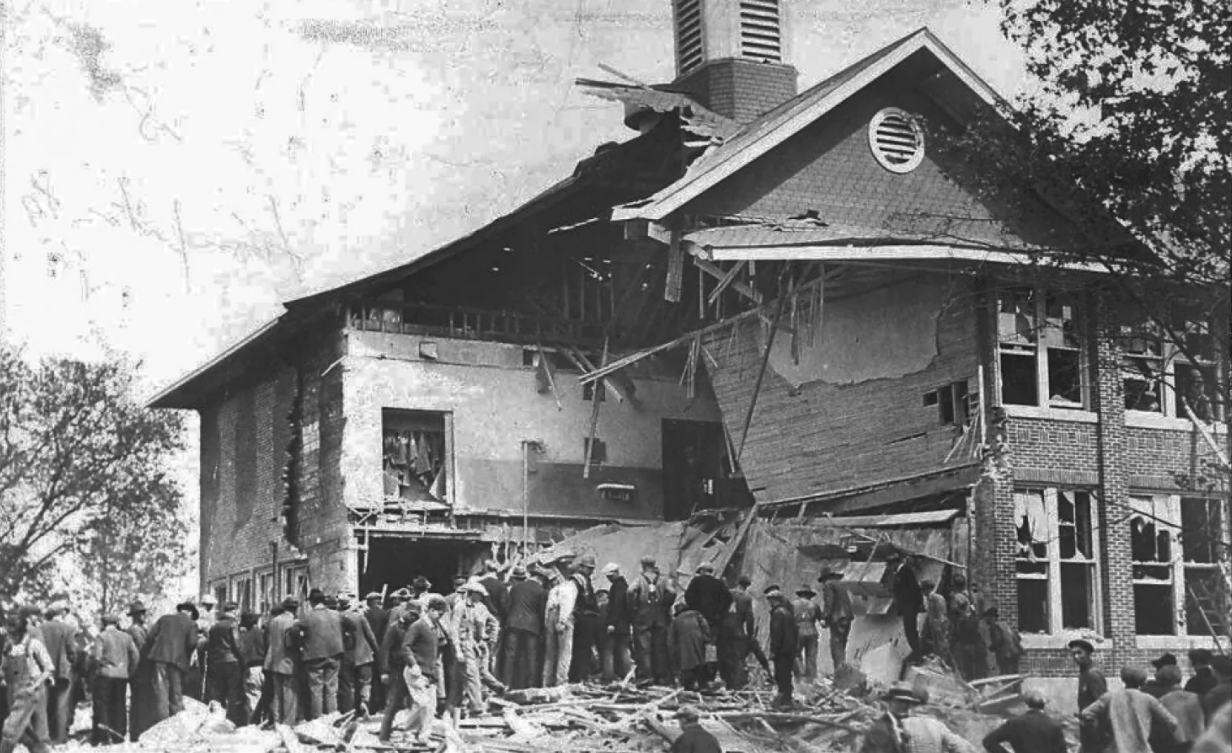
The Bath School disaster was a series of violent attacks perpetrated by Andrew Kehoe upon the Bath Consolidated School in Bath Township, Michigan, United States, on May 18, 1927. That morning, Kehoe, the school treasurer of Bath Township, detonated explosives he had previously planted underneath the school building, killing 38 people. As rescue efforts began, Kehoe drove to the school in a truck filled with explosives and shrapnel, where he detonated it, killing himself and four others. Earlier the same day, he had also destroyed his farmstead with explosives after having murdered his wife, Nellie Price Kehoe.
Kehoe, who was Bath's school board treasurer, was angered by increased taxes and being defeated in the April 5, 1926 election for Bath township clerk. It was thought by locals that he had planned revenge following his defeat. Kehoe had a reputation as a difficult man, both on the school board and in his personal life. In addition, he was notified in June 1926 that his mortgage was soon to be foreclosed. For much of the next year, Kehoe purchased explosives and secretly hid them on his property and under the school.
During the rescue and recovery efforts, searchers discovered a further 500 pounds (230 kg) of explosives under the south wing of the school that had been set to detonate simultaneously with the initial explosion. With this discovery, it was determined that Kehoe's intention was to destroy the entire school and everyone in it.
At the time of the bombing, Bath Township was a civil township of 300 adult residents located 10 miles (16 km) northeast of the city of Lansing in the U.S. state of Michigan. The present-day municipality of Bath Charter Township covers 31 square miles (80 km2) and the small unincorporated village of Bath is within its borders. The township itself lies within Clinton County, Michigan, an area of about 566 square miles (1,470 km2).
In the early 1920s, the area was primarily agricultural. After years of debate, Bath Township voters approved the creation of a consolidated school district in 1922, along with an increase in township property taxes to fund a new school. When the school opened, 236 students were enrolled from grade 1 to grade 12. The school's creation was controversial, but in Bath resident Monty Ellsworth's opinion consolidated schools had great advantages over the smaller rural schools they replaced. All landowners within the township area were required to pay higher ad valorem property taxes.
Andrew Philip Kehoe was born in Tecumseh, Michigan on February 1, 1872 into a family of 13 children and attended the local high school. After graduating, he studied electrical engineering at Michigan State College in East Lansing and moved to St. Louis, Missouri, where he worked as an electrician for several years. At some point during this period, Kehoe suffered a head injury in a fall and was semiconscious or in a coma for a period of several weeks. He later returned to Michigan and his father's farm.
After his mother's death, Kehoe's father married a much younger widow, Frances Wilder, and a daughter was born. On September 17, 1911, as his stepmother attempted to light the family's oil stove, it exploded and set her on fire. Kehoe threw a bucket of water on her, but as the fire was oil-based, the water spread the flames more rapidly and her body was engulfed with fire. The injuries were fatal and she died the next day. Some of Kehoe's later neighbors in Bath Township believed that he had caused the stove explosion.
Kehoe married Ellen "Nellie" Price in 1912 at the age of 40. Seven years later, they moved to a farm outside Bath Township. Kehoe was said to be dependable, doing favors and volunteer work for his neighbors. He was also described as notoriously impatient. For example, he had shot and killed a neighbor's dog that had come on his property and annoyed him by barking. He had also beaten one of his horses to death when it did not perform to his expectations.
Hub AI
Bath School disaster AI simulator
(@Bath School disaster_simulator)
Bath School disaster
The Bath School disaster was a series of violent attacks perpetrated by Andrew Kehoe upon the Bath Consolidated School in Bath Township, Michigan, United States, on May 18, 1927. That morning, Kehoe, the school treasurer of Bath Township, detonated explosives he had previously planted underneath the school building, killing 38 people. As rescue efforts began, Kehoe drove to the school in a truck filled with explosives and shrapnel, where he detonated it, killing himself and four others. Earlier the same day, he had also destroyed his farmstead with explosives after having murdered his wife, Nellie Price Kehoe.
Kehoe, who was Bath's school board treasurer, was angered by increased taxes and being defeated in the April 5, 1926 election for Bath township clerk. It was thought by locals that he had planned revenge following his defeat. Kehoe had a reputation as a difficult man, both on the school board and in his personal life. In addition, he was notified in June 1926 that his mortgage was soon to be foreclosed. For much of the next year, Kehoe purchased explosives and secretly hid them on his property and under the school.
During the rescue and recovery efforts, searchers discovered a further 500 pounds (230 kg) of explosives under the south wing of the school that had been set to detonate simultaneously with the initial explosion. With this discovery, it was determined that Kehoe's intention was to destroy the entire school and everyone in it.
At the time of the bombing, Bath Township was a civil township of 300 adult residents located 10 miles (16 km) northeast of the city of Lansing in the U.S. state of Michigan. The present-day municipality of Bath Charter Township covers 31 square miles (80 km2) and the small unincorporated village of Bath is within its borders. The township itself lies within Clinton County, Michigan, an area of about 566 square miles (1,470 km2).
In the early 1920s, the area was primarily agricultural. After years of debate, Bath Township voters approved the creation of a consolidated school district in 1922, along with an increase in township property taxes to fund a new school. When the school opened, 236 students were enrolled from grade 1 to grade 12. The school's creation was controversial, but in Bath resident Monty Ellsworth's opinion consolidated schools had great advantages over the smaller rural schools they replaced. All landowners within the township area were required to pay higher ad valorem property taxes.
Andrew Philip Kehoe was born in Tecumseh, Michigan on February 1, 1872 into a family of 13 children and attended the local high school. After graduating, he studied electrical engineering at Michigan State College in East Lansing and moved to St. Louis, Missouri, where he worked as an electrician for several years. At some point during this period, Kehoe suffered a head injury in a fall and was semiconscious or in a coma for a period of several weeks. He later returned to Michigan and his father's farm.
After his mother's death, Kehoe's father married a much younger widow, Frances Wilder, and a daughter was born. On September 17, 1911, as his stepmother attempted to light the family's oil stove, it exploded and set her on fire. Kehoe threw a bucket of water on her, but as the fire was oil-based, the water spread the flames more rapidly and her body was engulfed with fire. The injuries were fatal and she died the next day. Some of Kehoe's later neighbors in Bath Township believed that he had caused the stove explosion.
Kehoe married Ellen "Nellie" Price in 1912 at the age of 40. Seven years later, they moved to a farm outside Bath Township. Kehoe was said to be dependable, doing favors and volunteer work for his neighbors. He was also described as notoriously impatient. For example, he had shot and killed a neighbor's dog that had come on his property and annoyed him by barking. He had also beaten one of his horses to death when it did not perform to his expectations.