



Community hub
Recent from talks
Knowledge base stats:
Talk channels stats:
Members stats:
Battle of Apple River Fort
The Battle of Apple River Fort, occurred on the late afternoon of June 24, 1832 at the Apple River Fort, near present-day Elizabeth, Illinois, when Black Hawk and 200 of his "British Band" of Sauk and Meskwaki were surprised by a group of four messengers en route from Galena, Illinois. One of the couriers was wounded in the thigh as the riders quickly made for the protection of the nearby stockade. Courier Fred Dixon lagged behind and provided cover for his comrades. The other couriers rode ahead to warn some 70 settlers of the approaching Sauk and Meskwaki, thus saving their lives. The small company of militia at the fort, about 28-30 men and boys led by Captain Clack Stone, fought off Black Hawk's 150-man war party in an action that lasted about an hour. The withering pace of the gunfire eventually convinced Black Hawk that the fort was too heavily defended to lead a direct attack. He considered burning the fort, then switched to raiding cabins of foodstuffs, clothing and cooking utensils. In the gathering darkness, Black Hawk and his war party retreated.
After the battle, some of the fort defenders won praise for their efforts to repel the Indian attack. Among them were: Elizabeth Winters, Rebecca Hitt, Sarah Vanvoltinburg, and Elizabeth Armstrong. Mrs. Armstrong rallied the 40 or so women and children who had taken shelter inside the fort. The women and children were divided into two groups: one to mold rifle balls and another to roll paper cartridges and fill them with a measure of gunpowder into paper cartridges. Some of the married women reload weapons so that the militia could increase the pace of their fire. Courier George Harkleroad was struck in the neck and mortally wounded: the fort's only fatality. Native casualties remain unknown, although some defenders later reported blood on the ground and inside a nearby building.
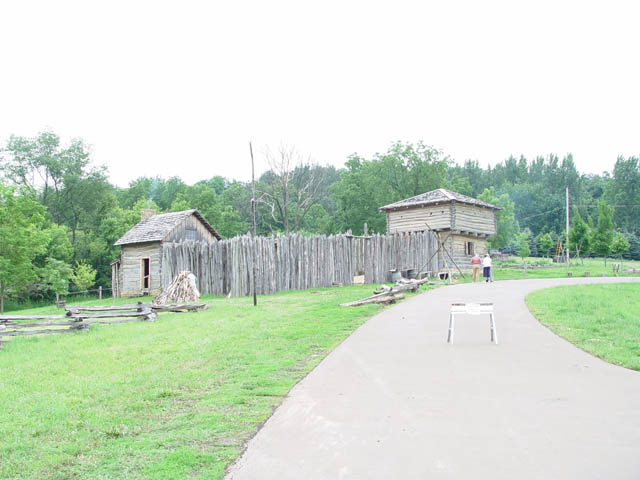
For some time afterward, the old fort was used by local squatters. The former battlefield and the fort remains were sold in 1847. The new owner re-purposed many of the timbers from the fort to build a livestock barn. What remained was burned. Today, a replica fort was built near the original site in the late 1990s and still stands in the modern Village of Elizabeth, IL. The site is managed by the Illinois Department of Natural Resources as "Apple River Fort State Historic Site."
As a consequence of the 1804 Treaty of St. Louis between William H. Harrison the Governor of Indiana Territory and a group of Sauk and Meskwaki leaders regarding land settlement, the Sauk and Meskwaki tribes vacated their lands in Illinois and moved west of the Mississippi in 1828. However, the Sac's principle warrior Black Hawk and others disputed the treaty, claiming that the full tribal councils had not been consulted, nor did those representing the tribes have authorization to cede lands. Angered by the loss of his birthplace, between 1830–31 Black Hawk led a number of incursions across the Mississippi River, but was persuaded to return west each time without bloodshed. In April 1832, encouraged by promises of alliance with other Great Lakes tribes and supplies from the British in Canada, he again moved his so-called "British Band" of around 500 warriors and a like number of families and non-combatants into Illinois. Finding no allies among the local Ho Chunk, he attempted to return to Iowa, but was temporarily stopped by the presence of several companies of militia. As night fell, the undisciplined Illinois militia fled before Black Hawk's warriors in a skirmish known today as Battle of Stillman's Run. A number of other engagements followed, and the militias of Michigan Territory and Illinois were mobilized to hunt down Black Hawk's Band. The conflict became known as the Black Hawk War.
The period between Stillman's Run and the Battle of Apple River Fort was filled with war-related activity and events. A series of attacks at Buffalo Grove, the Plum River settlement, Fort Blue Mounds and one of the conflict's most infamous incidents: the Indian Creek massacre, all took place between mid-May and late June 1832. The week preceding the Battle of Apple River Fort was an important turning point for the militia: between June 16–18 two small but important fights occurred. One was known as "Stephenson's Fight'" today incorrectly called Waddams Grove and the other at Horseshoe Bendin present-day Wisconsin, played a key role in changing public perception about the militia after its defeat at Stillman's Run.
Following the militia's disastrous defeat at Stillman's Run on May 14, settlers in the lead-mining region around Galena panicked; many left the area altogether. The exaggerated claim that 2,000 "bloodthirsty warriors were sweeping all Northern Illinois with the bosom of destruction" sent terror through the region. At the Apple River Settlement, the situation prompted residents to form a 46-man militia tentatively under Captain Vance L. Davidson. By late May, Davidson was at the Plum River settlement (present-day Savanna, Illinois) and Captain Clack Stone had been elected to command the militia company. The single blockhouse at Apple River Fort was completed around May 22; the stockade was completed sometime later. In the days immediately preceding June 18, 1832, Apple River Fort's horses were raided and stolen during the night. This incident was one of several around that time that led Illinois militia officer James W. Stephenson to clash with a handful of warriors at "Stephenson's Fight" (later erroneously named Waddams Grove on June 18.
On June 24, 1832, a supply wagon loaded with meat and lead bars from Galena arrived at Apple River Fort around noon. Around this time, Black Hawk and his 200-man war party also en route to the fort, had gathered at a gap in Terrapin Ridge. Black Hawk's forces were able to elude detection until the time they opened fire. At around 4 p.m. four couriers from Galena bound for the army camp at Dixon's Ferry arrived at the fort. The fort's occupants were eager to hear their news from Galena and of the conflict with Black Hawk.
There were 28-30 armed militia inside Apple River Fort at the time of the attack. Another 40 women, children and other settlers were resident in the Apple River Settlement. Captain Clack Stone and his officers commanded the fort's defenders. Most of the defenders were members of Stone's militia company augmented by a few civilians. A few of the militia company were away from the stockade and were not present for the battle.
Hub AI
Battle of Apple River Fort AI simulator
(@Battle of Apple River Fort_simulator)
Battle of Apple River Fort
The Battle of Apple River Fort, occurred on the late afternoon of June 24, 1832 at the Apple River Fort, near present-day Elizabeth, Illinois, when Black Hawk and 200 of his "British Band" of Sauk and Meskwaki were surprised by a group of four messengers en route from Galena, Illinois. One of the couriers was wounded in the thigh as the riders quickly made for the protection of the nearby stockade. Courier Fred Dixon lagged behind and provided cover for his comrades. The other couriers rode ahead to warn some 70 settlers of the approaching Sauk and Meskwaki, thus saving their lives. The small company of militia at the fort, about 28-30 men and boys led by Captain Clack Stone, fought off Black Hawk's 150-man war party in an action that lasted about an hour. The withering pace of the gunfire eventually convinced Black Hawk that the fort was too heavily defended to lead a direct attack. He considered burning the fort, then switched to raiding cabins of foodstuffs, clothing and cooking utensils. In the gathering darkness, Black Hawk and his war party retreated.
After the battle, some of the fort defenders won praise for their efforts to repel the Indian attack. Among them were: Elizabeth Winters, Rebecca Hitt, Sarah Vanvoltinburg, and Elizabeth Armstrong. Mrs. Armstrong rallied the 40 or so women and children who had taken shelter inside the fort. The women and children were divided into two groups: one to mold rifle balls and another to roll paper cartridges and fill them with a measure of gunpowder into paper cartridges. Some of the married women reload weapons so that the militia could increase the pace of their fire. Courier George Harkleroad was struck in the neck and mortally wounded: the fort's only fatality. Native casualties remain unknown, although some defenders later reported blood on the ground and inside a nearby building.
For some time afterward, the old fort was used by local squatters. The former battlefield and the fort remains were sold in 1847. The new owner re-purposed many of the timbers from the fort to build a livestock barn. What remained was burned. Today, a replica fort was built near the original site in the late 1990s and still stands in the modern Village of Elizabeth, IL. The site is managed by the Illinois Department of Natural Resources as "Apple River Fort State Historic Site."
As a consequence of the 1804 Treaty of St. Louis between William H. Harrison the Governor of Indiana Territory and a group of Sauk and Meskwaki leaders regarding land settlement, the Sauk and Meskwaki tribes vacated their lands in Illinois and moved west of the Mississippi in 1828. However, the Sac's principle warrior Black Hawk and others disputed the treaty, claiming that the full tribal councils had not been consulted, nor did those representing the tribes have authorization to cede lands. Angered by the loss of his birthplace, between 1830–31 Black Hawk led a number of incursions across the Mississippi River, but was persuaded to return west each time without bloodshed. In April 1832, encouraged by promises of alliance with other Great Lakes tribes and supplies from the British in Canada, he again moved his so-called "British Band" of around 500 warriors and a like number of families and non-combatants into Illinois. Finding no allies among the local Ho Chunk, he attempted to return to Iowa, but was temporarily stopped by the presence of several companies of militia. As night fell, the undisciplined Illinois militia fled before Black Hawk's warriors in a skirmish known today as Battle of Stillman's Run. A number of other engagements followed, and the militias of Michigan Territory and Illinois were mobilized to hunt down Black Hawk's Band. The conflict became known as the Black Hawk War.
The period between Stillman's Run and the Battle of Apple River Fort was filled with war-related activity and events. A series of attacks at Buffalo Grove, the Plum River settlement, Fort Blue Mounds and one of the conflict's most infamous incidents: the Indian Creek massacre, all took place between mid-May and late June 1832. The week preceding the Battle of Apple River Fort was an important turning point for the militia: between June 16–18 two small but important fights occurred. One was known as "Stephenson's Fight'" today incorrectly called Waddams Grove and the other at Horseshoe Bendin present-day Wisconsin, played a key role in changing public perception about the militia after its defeat at Stillman's Run.
Following the militia's disastrous defeat at Stillman's Run on May 14, settlers in the lead-mining region around Galena panicked; many left the area altogether. The exaggerated claim that 2,000 "bloodthirsty warriors were sweeping all Northern Illinois with the bosom of destruction" sent terror through the region. At the Apple River Settlement, the situation prompted residents to form a 46-man militia tentatively under Captain Vance L. Davidson. By late May, Davidson was at the Plum River settlement (present-day Savanna, Illinois) and Captain Clack Stone had been elected to command the militia company. The single blockhouse at Apple River Fort was completed around May 22; the stockade was completed sometime later. In the days immediately preceding June 18, 1832, Apple River Fort's horses were raided and stolen during the night. This incident was one of several around that time that led Illinois militia officer James W. Stephenson to clash with a handful of warriors at "Stephenson's Fight" (later erroneously named Waddams Grove on June 18.
On June 24, 1832, a supply wagon loaded with meat and lead bars from Galena arrived at Apple River Fort around noon. Around this time, Black Hawk and his 200-man war party also en route to the fort, had gathered at a gap in Terrapin Ridge. Black Hawk's forces were able to elude detection until the time they opened fire. At around 4 p.m. four couriers from Galena bound for the army camp at Dixon's Ferry arrived at the fort. The fort's occupants were eager to hear their news from Galena and of the conflict with Black Hawk.
There were 28-30 armed militia inside Apple River Fort at the time of the attack. Another 40 women, children and other settlers were resident in the Apple River Settlement. Captain Clack Stone and his officers commanded the fort's defenders. Most of the defenders were members of Stone's militia company augmented by a few civilians. A few of the militia company were away from the stockade and were not present for the battle.