
Recent from talks
Battle of Baxter Springs
Knowledge base stats:
Talk channels stats:
Members stats:
Battle of Baxter Springs
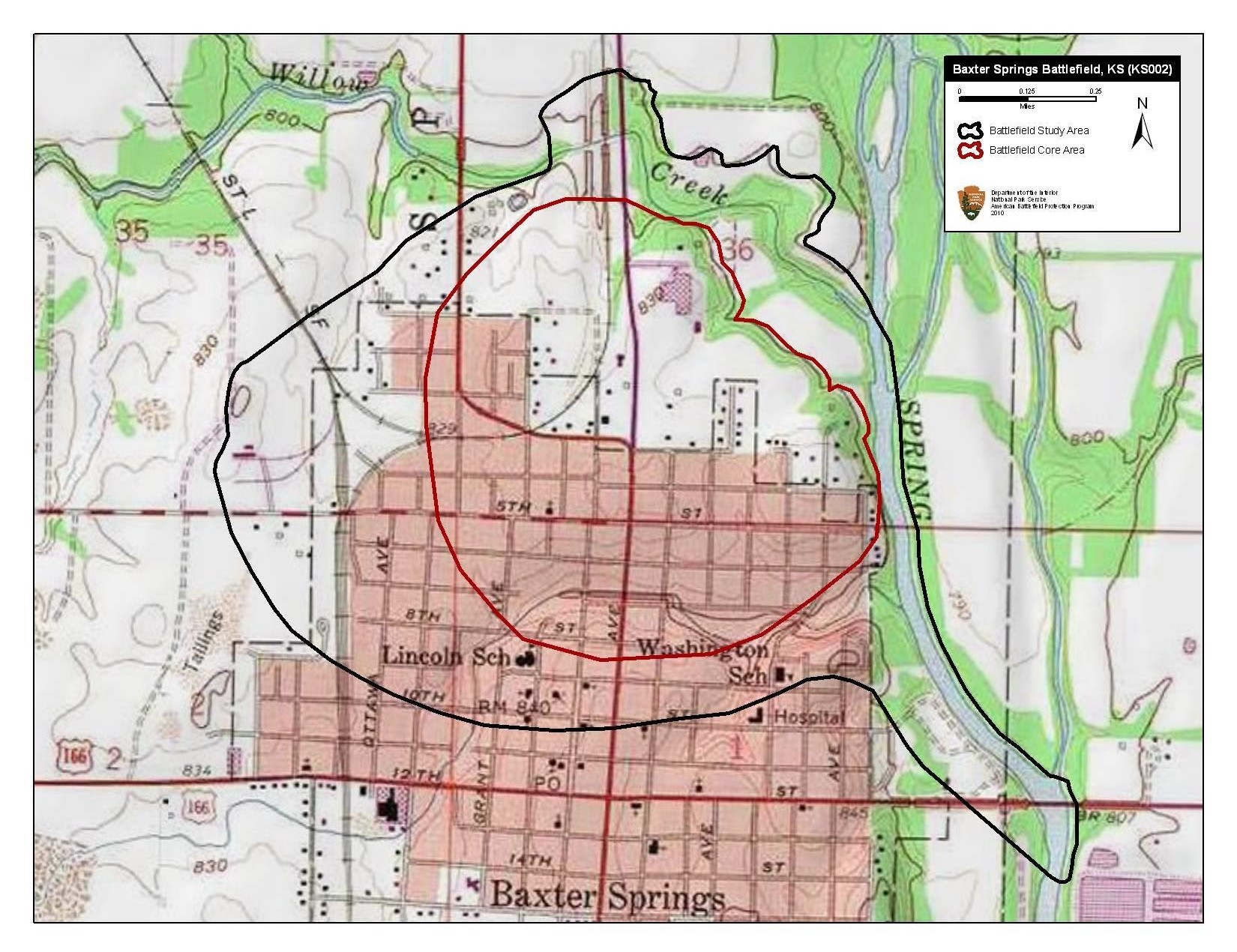
The Battle of Baxter Springs, more commonly known as the Baxter Springs Massacre, was a minor battle of the American Civil War fought on October 6, 1863, near the present-day town of Baxter Springs, Kansas.
In late 1863, Quantrill's Raiders, a large band of pro-Confederate bushwhackers led by William Quantrill, was traveling south through Kansas along the Texas Road to winter in Texas. Numbering about 400, this group captured and killed two Union teamsters who had come from a small Federal Army post called Fort Baxter (frequently referred to as Fort Blair). The bushwhackers assaulted the fort but were repulsed, eventually retreating to the prairie, where they attacked a separate Union column, leaving only a few survivors.
Quantrill decided to attack Fort Baxter and divided his force into two columns, one under him and the other commanded by a subordinate, David Poole. Poole and his men proceeded down the Texas Road, where they encountered Union soldiers, most of whom were African Americans. They chased and attacked the Union troops, killing some before the soldiers reached the earth-and-log Fort Baxter. The garrison there consisted of about 25 cavalry and 65–70 infantry of the United States Colored Troops.
Poole's column attacked the fort, but the garrison fought them off. First Lieutenant James Burton Pond received the Medal of Honor for leading the defense of the fort. The citation for his Medal of Honor reads:
The American flag remained standing over the fort thanks to the bravery of the 2nd Kansas Colored Infantry, who helped rally the federal soldiers.
Moving out onto the prairie, Quantrill's column encountered a Union detachment escorting Maj. Gen. James G. Blunt, who was moving his command headquarters south from Fort Scott, Kansas to Fort Smith, Arkansas. Quantrill's men greatly outnumbered the Union forces.
Wearing Federal uniforms and thereby taking the Federals by surprise, Quantrill's column killed most of the detachment, including many who attempted to surrender. Among the dead was a military band, Maj. Henry Z. Curtis (son of Maj. Gen. Samuel R. Curtis), and Johnny Fry (first official westbound rider of the Pony Express), a total of 103 men. Also killed was James R. O'Neill, an artist-correspondent for Leslie's Weekly. When a few men escaped to Fort Baxter, soldiers went out to search for survivors; there were few, but Blunt was among them.
After the massacre of Blunt's troops, Quantrill sent a demand ordering Pond to surrender the fort. Pond refused the surrender. Quantrill's subordinate, William T. Anderson, known as "Bloody Bill," wanted to attack the fort again, but Quantrill refused, and the guerrillas left for Texas.
Hub AI
Battle of Baxter Springs AI simulator
(@Battle of Baxter Springs_simulator)
Battle of Baxter Springs
The Battle of Baxter Springs, more commonly known as the Baxter Springs Massacre, was a minor battle of the American Civil War fought on October 6, 1863, near the present-day town of Baxter Springs, Kansas.
In late 1863, Quantrill's Raiders, a large band of pro-Confederate bushwhackers led by William Quantrill, was traveling south through Kansas along the Texas Road to winter in Texas. Numbering about 400, this group captured and killed two Union teamsters who had come from a small Federal Army post called Fort Baxter (frequently referred to as Fort Blair). The bushwhackers assaulted the fort but were repulsed, eventually retreating to the prairie, where they attacked a separate Union column, leaving only a few survivors.
Quantrill decided to attack Fort Baxter and divided his force into two columns, one under him and the other commanded by a subordinate, David Poole. Poole and his men proceeded down the Texas Road, where they encountered Union soldiers, most of whom were African Americans. They chased and attacked the Union troops, killing some before the soldiers reached the earth-and-log Fort Baxter. The garrison there consisted of about 25 cavalry and 65–70 infantry of the United States Colored Troops.
Poole's column attacked the fort, but the garrison fought them off. First Lieutenant James Burton Pond received the Medal of Honor for leading the defense of the fort. The citation for his Medal of Honor reads:
The American flag remained standing over the fort thanks to the bravery of the 2nd Kansas Colored Infantry, who helped rally the federal soldiers.
Moving out onto the prairie, Quantrill's column encountered a Union detachment escorting Maj. Gen. James G. Blunt, who was moving his command headquarters south from Fort Scott, Kansas to Fort Smith, Arkansas. Quantrill's men greatly outnumbered the Union forces.
Wearing Federal uniforms and thereby taking the Federals by surprise, Quantrill's column killed most of the detachment, including many who attempted to surrender. Among the dead was a military band, Maj. Henry Z. Curtis (son of Maj. Gen. Samuel R. Curtis), and Johnny Fry (first official westbound rider of the Pony Express), a total of 103 men. Also killed was James R. O'Neill, an artist-correspondent for Leslie's Weekly. When a few men escaped to Fort Baxter, soldiers went out to search for survivors; there were few, but Blunt was among them.
After the massacre of Blunt's troops, Quantrill sent a demand ordering Pond to surrender the fort. Pond refused the surrender. Quantrill's subordinate, William T. Anderson, known as "Bloody Bill," wanted to attack the fort again, but Quantrill refused, and the guerrillas left for Texas.
Recent media